
Frost and Frozen Pergola Louvres: When Not to Operate the Roof
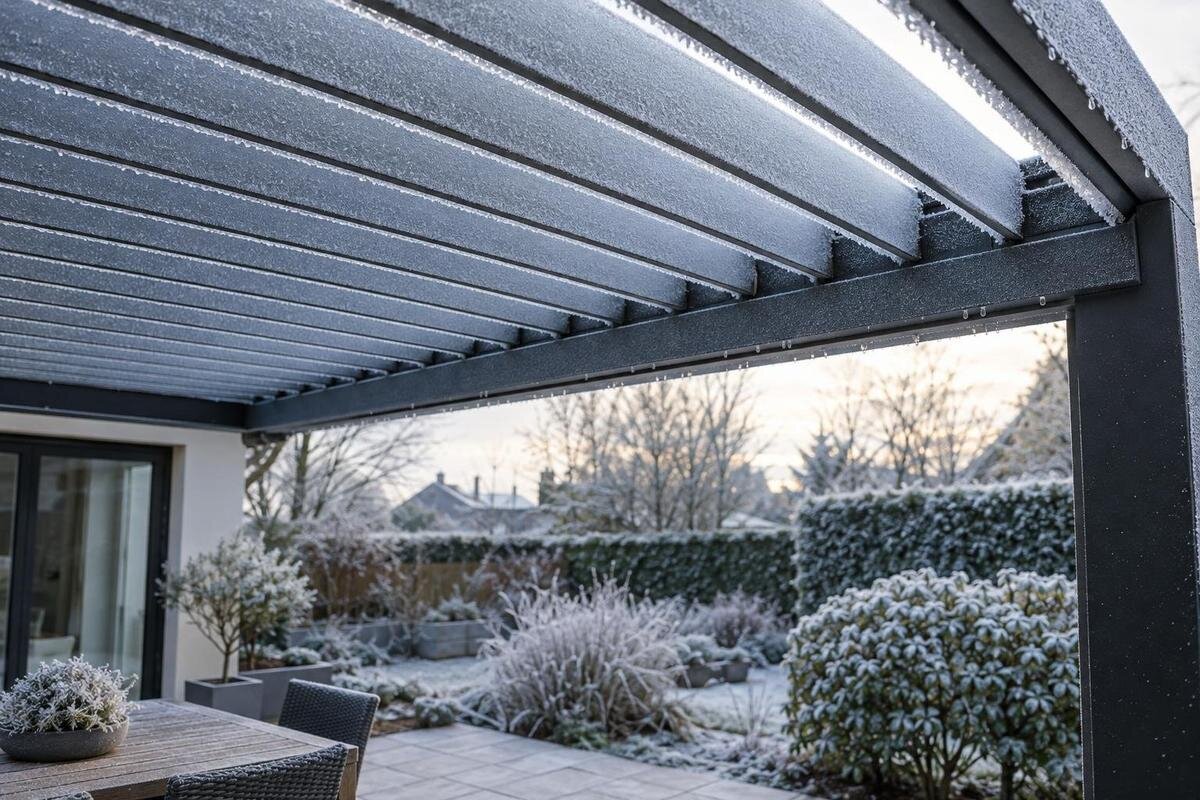
Pergola winter care
Frost can turn an ordinary roof-control question into a stop signal. Water may freeze where louvres overlap or around moving parts, sometimes before the ice is obvious from below. A motor that hesitates, stops or sounds different should not be challenged with extra button presses or a hand-operated workaround. This guide explains what freezing can do, when to leave the roof alone, what not to try and how to find the approved response for the pergola model you actually have.

01
How frost can lock a louvred roof
Frost can interfere with a louvred pergola even when the roof does not look fully iced. Rain, freezing rain, wet snow, condensation or thaw water can remain in the narrow clearances between moving parts after the visible surface has dried. When that moisture freezes, neighbouring louvres may bond along an edge, or ice may grip a pivot, connecting part or another point in the drive path. The vulnerable locations depend on the model. A light coating on an exposed face is not proof that the joints below it are clear; a small frozen patch can be enough to hold part of the mechanism in place.
Freeze-thaw weather can make the roof's condition change several times in a day. A sunny interval might loosen surface frost while water stays sheltered at an overlap or pivot; a later drop in temperature can lock that area again. Conditions shown by a nearby weather station do not reveal the temperature at every part of the roof. Shaded edges, exposed louvres and protected moving components can warm at different rates. There is no single outdoor temperature or quick visual check that confirms a mechanism is free. Treat ice near a moving joint as a stop condition unless the instructions for that model provide a specific inspection and recovery method.
Signs to stop operating the louvres
Leave the controls alone if you see ice bridging louvre edges, glaze around a moving joint, frozen slush in a gap or ice on a visible channel. Snow or ice resting on the roof is also a reason not to use movement to test or shift it unless the model's instructions explicitly permit that action. A command that produces no travel, partial travel, an abrupt stop, uneven movement or a new scraping or clicking sound is another stop signal. A motor that sounds strained or continues running without normal movement also needs attention. Do not make repeated attempts to see whether another press will free the roof.
Do not assume the mechanism is clear because it moved earlier in the day, one louvre looks loose or the motor makes a sound. A freeze can develop between operating periods, and an obstruction at one point may affect other moving parts. If travel begins and then stalls, use the normal stop control only as described in the instructions; do not hold a button or issue the opposite command as an experiment. Keep people clear of the moving area and of any place where ice could fall. When the symptom is unfamiliar, leave the roof in place and check the approved response.
02
Why forcing the mechanism is risky
Ice adds resistance that the drive may not encounter during ordinary movement. Applying more force can strain gears, shafts, connecting parts, mounts or louvre edges; the result depends on the design and how the parts are linked. A motor may stop, strain or continue trying, and none of those outcomes shows that the ice has cleared. Forcing a frozen roof could turn a temporary blockage into a damaged or misaligned part. Do not pull a louvre by hand, lever an edge with a tool, push up from below or repeatedly press the control. If you are considering the Bloomcabin Bioclimatic Pergola, ask how its instructions address a seized mechanism before buying.
A manual crank or emergency mode is not automatically an ice-release device. It may be intended for a particular service situation or power failure, and using it against a frozen roof could strain the mechanism just as a powered attempt can. Use an override only if the exact instructions explicitly authorize it for the condition at hand and describe the steps. Avoid removing covers, disconnecting an actuator, recalibrating travel or applying lubricant to free a seized part. These actions can conceal the original problem or make diagnosis harder. If the manual does not explain what to do, stop and seek model-specific guidance rather than trying a workaround.
Use the instructions for the exact model
Winter operating limits are model-specific. Look for the operating and maintenance instructions and check whether they address frost, freezing rain, ice on the louvres and operation at low temperatures. The guidance may set different conditions for the roof mechanism, motor, controller or sensors; do not assume a limit for one component applies to the whole system. Check whether the manufacturer gives a position for periods of freezing weather, instructions for a snow-covered roof or a restriction on operation until ice has cleared. If a numerical limit is given, use it with the conditions and qualifications stated in the document, not as a general rule for other pergolas.
Match the instructions to the exact model and installed control configuration, including any options that affect operation. A product-family name or a manual for a similar-looking roof may not describe the same drive or control logic. When reviewing the Bloomcabin Wall-Mounted Pergola, request the operating and winter-care instructions for the configuration you intend to buy. Ask the manufacturer or installer to point to the written procedure if the documents do not explain an ice lock, snow-covered roof or stalled actuator. A cold-weather limit is not, by itself, a snow-load rating or a guarantee of performance in every storm.

03
Snow load, ice binding and drainage are different issues
Snow on a roof and ice in a moving joint are related winter hazards, but they are not the same problem. Snow can create a structural load; a thin ice bridge can stop the louvres from moving, and both conditions can occur at once. Do not assume that opening or closing the roof will shed snow, reduce the load or put the structure in a safer position. Moving louvres under an accumulation could cause a jam, and the safe response depends on the model's instructions. Appearance alone cannot establish a safe snow load or a universal clearing threshold. Do not climb onto the pergola, scrape snow from above or use the actuator to dislodge it.
During a thaw, water follows the drainage route intended for that particular design and may then refreeze at an outlet or in a channel. A clear-looking roof does not prove that the drainage path or moving joints are clear. Check the diagram and winter instructions for the exact configuration rather than assuming all pergolas drain alike. When comparing the Bloomcabin Pergola with other options, request its drainage information separately from its snow specifications: those documents answer different questions. Treat blocked or icing drainage as separate from louvre movement, and do not run the roof to clear an outlet.
What to do while the roof is frozen
Once a stop sign appears, do not test the mechanism with more commands. If the manufacturer's directions call for waiting for a natural thaw, leave the roof untouched until the stated conditions are met; do not decide it is clear just because the exposed surface looks dry. Avoid hot water, heat guns, open flames, portable heaters, de-icing salt, solvents or sharp scrapers unless the model's written instructions specifically approve a method. Improvised treatment can send water into a joint, create a refreeze or damage a surface, and it cannot confirm that the drive path is unobstructed. Never stand on the pergola or reach into gaps to break ice.
From a safe position on the ground, note what is visible without operating or dismantling anything: where ice has formed, whether snow is resting on the roof, whether a drain looks obstructed and what happened before you stopped using the controls. A photo from a safe location may help a service provider, but do not climb a ladder or stand under icicles or an edge that could shed ice for a closer view. Include the product name in your service request; the Bioclimatic Pergola listing can help you identify it. If the structure or control seems damaged, keep people clear and request the approved inspection procedure.
04
Check drainage before freeze-up
Before cold weather, review the drainage route as a whole rather than looking only at the outlet. The manufacturer's diagram should show where water is intended to go for the relevant configuration and which areas are meant to be inspected or cleaned. If the maintenance instructions allow it, clear loose leaves or debris from accessible areas while everything is ice-free. Do not dismantle a cover or insert a rod to clear a frozen channel. A blocked path may leave meltwater to pool or refreeze, but clearing an outlet does not confirm that a louvre pivot or actuator area is free.
Check whether the winter maintenance guidance distinguishes routine debris removal from ice removal. A drainage drawing may show the water route without explaining whether the roof can be operated in frost or how to clear ice. Keep the documents for the installed configuration rather than relying on a general illustration. For a model such as the Wall-Mounted Pergola, ask which drainage information applies to the actual roof and outlet arrangement, and which areas are accessible for routine maintenance. If water is visibly backed up, leave the mechanism alone and ask the recommended service contact to assess it.
When a control problem could be mistaken for ice
No movement does not diagnose frost. A frozen linkage can resist a motor, while a control, power supply, sensor or other fault can produce a similar symptom. A humming sound or illuminated display does not show that it is safe to keep trying. Follow only the troubleshooting checks written for the exact control system, and stop if a check calls for disassembly, electrical testing or bypassing a safety device. Do not remove motor covers, alter wiring, defeat sensors or repeatedly reset a fault to force movement. Electrical diagnosis and work on components should be left to an appropriately qualified service provider.
Before requesting help, make a brief service note: the product and control model if known, approximate time and weather, what the roof was doing, whether the command produced movement, and any display or sound you observed. Record an error message exactly; do not interpret it as an ice code unless the manual does. If you are choosing a wall-mounted pergola from Bloomcabin, ask which controller comes with the proposed configuration and how its instructions address a stalled roof. If an installed roof has stopped partway or remains in a position that worries you, use only a published emergency procedure. Do not assume that a reset or manual mode is safe against ice.

05
What to ask before choosing a pergola
If you plan to use a pergola through winter, ask for its operating documents before comparing appearance or accessories. Find out whether the exact roof is permitted to move at stated low temperatures, what counts as frozen or obstructed, what the instructions say about snow and ice, and how to respond if the drive stalls. Ask for separate information about structural snow capacity, roof operation and drainage; one statement about weather resistance does not answer all three questions. Confirm that any specified control or sensor matches the proposed configuration, and keep the model-specific instructions with the purchase and installation records.
Consider enclosure choices separately from roof operation. Side screens, panels or glazing may change exposure and airflow, but they do not make a frozen roof operable or establish its snow rating. If you plan to add an enclosure, confirm that it is approved for the particular model, whether it changes inspection or service access, and whether winter guidance is different. When reviewing Bloomcabin Pergola product information, clarify which accessories are included and request written confirmation of compatibility for the proposed setup. An example image does not establish that an enclosure is included or approved, so compare the confirmed configuration rather than appearance alone.
When operation can resume
Resume operation only when the manufacturer's instructions for the exact model allow it and any required thawing, snow removal or inspection has been completed using the approved method. If ice was visible around the louvres, a dry upper surface cannot confirm that hidden joints have cleared. When the instructions call for a service inspection, wait for that assessment rather than using partial movement as a test. Match any restart procedure to the correct model and controller. If you are considering Bloomcabin's bioclimatic pergola, ask whether its winter instructions explain when operation may resume after an ice-related stoppage.
At the first permitted operation, remain in a safe position with a clear view, use the normal control as the manual specifies and stop if travel is uneven, unusually slow, noisy or incomplete. Do not cycle the roof several times to prove it works, or switch directions to shake off residue. Record a recurrence, stop using the mechanism and report it; binding could involve ice, debris, alignment or a control fault that needs a model-specific assessment. A smooth movement is not a substitute for any inspection the manufacturer requires after a freeze.
Frequently asked questions
Can I operate the louvres if there is only light frost?
Only if the instructions for your exact model allow operation in those conditions and there is no sign of ice at moving joints or resistance. Frost on an exposed surface does not show whether hidden parts are clear. If movement is uneven, stalls or sounds different, stop rather than trying again.
Can I pour warm water over frozen louvres?
Do not use warm water, de-icing products or tools unless the manufacturer specifically approves that method for your model. Water can run into a joint and refreeze, while chemicals or scraping may damage surfaces. An improvised thaw also cannot confirm that the whole drive path is clear.
Should I open the roof to get snow off?
Do not use the controls to shift or shed snow unless the model-specific instructions explicitly allow it under those conditions. Snow load and ice binding are separate concerns, and there is no universal louvre position or snow-clearing rule for every pergola. Never climb onto the roof to clear it.
Does a humming motor mean the louvres are frozen?
Not necessarily. Ice, a control or power issue, or another fault can produce similar symptoms. Stop operating the roof, note any error message and check only the troubleshooting steps written for your exact control system. If the instructions do not resolve the issue, contact the manufacturer or a qualified service provider.
Should the louvres stay open or closed all winter?
There is no universal winter position. Follow the instructions for the exact model, including any guidance for snowfall, freezing weather and periods when the roof will not be used. Do not change the position if the louvres are frozen or the roof is snow-loaded unless the manufacturer specifically permits that movement.
A frozen louvred roof cannot be judged by the season, one temperature reading or a glance at its top surface. Ice can remain hidden where the mechanism moves, and snow, drainage and control faults raise different questions. The safest decision is to stop at the first sign of binding and use instructions that match the exact model. If those instructions do not cover the condition, leave the roof untouched until the manufacturer or a qualified service provider confirms the appropriate response.
