
Greenhouse Heat & Humidity Management | Canada
Bloomcabin Journal • A Canadian approach to greenhouse climate
Balancing heat and moisture in a home greenhouse
Read the signals from crops, weather and sensors, then use ventilation, shade and watering to manage VPD, condensation and changing seasonal conditions.
Why conditions change under glazing
A greenhouse creates its own shifting environment rather than simply adding warmth to the garden.
Sunlight can heat the enclosed air quickly. At the same time, transpiring plants release water vapour. Later, the glazing, aluminum frame and foliage lose heat; relative humidity climbs, and colder surfaces may reach dew point. Canadian sites experience very different combinations of spring cold, summer heat and exposure, so management must respond to the location rather than a national average.
Each part of the system affects another. Heat changes photosynthesis, respiration, bloom and fruit development. Moisture in the air influences transpiration, nutrient transport, pollination, condensation and disease pressure. Airflow alters the thin layer of air beside a leaf, while irrigation and shade change both leaf and air conditions.
The useful objective for a home grower is a microclimate that remains steady enough for the chosen plants but can be adjusted when weather changes. Seedlings and lettuce do not ask for the same conditions as cucumbers, tomatoes or peppers. A sheltered city yard can also behave quite differently from an exposed garden or a region with another seasonal pattern.
When the structure itself is still being chosen, plan for climate adjustment from the outset. While browsing the Canadian Bloomcabin greenhouse range , assess working vents, interior height, enclosed air volume and glazing—not appearance alone.
01 • Choosing a temperature range
Which greenhouse temperature should you aim for?
No setting works for every planting. A mixed home greenhouse is easier to manage when cool-growing plants are distinguished from warmth-loving ones. Spinach, lettuce and many young plants thrive at lower temperatures than eggplants, tomatoes, cucumbers, basil, peppers or chilies. Available light and the crop’s stage of development also shift what is appropriate.
As an initial daytime band, about 20–27 °C suits many warm-season vegetables, with a modest drop after dark. Treat that as guidance rather than a thermostat command. Persistent heat can interfere with tomato fruit set, unsuitable daytime or overnight conditions can make peppers lose flowers, and excessive warmth encourages lettuce to bolt.
Let the planting plan determine how the house is run. Leaf crops can occupy a cooler area, whereas tomatoes, basil and peppers generally need more warmth. Where crops share one structure, create zones, allow room between plants and provide dependable ventilation.
Ask this instead
“Which range supports this plant’s growth without exposing it to heat, cold or moisture strain?”
02 • Conditions after sunrise and sunset
Why daytime and overnight readings tell different stories
In daylight, photosynthesis is active and solar energy may make a leaf hotter than the surrounding air. Darkness stops photosynthesis, although respiration carries on. Some difference between day and night is expected. Problems arise when overnight cold suppresses plant activity or continued warmth leaves no cooler recovery period.
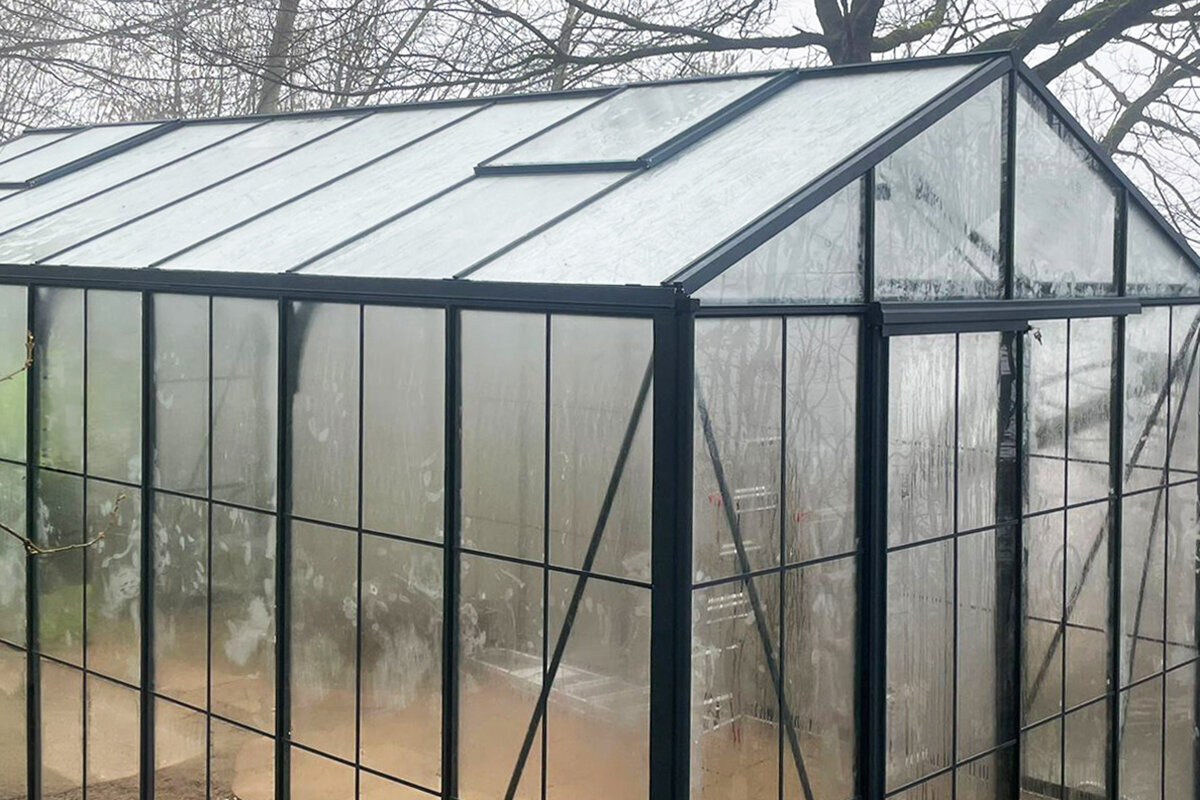
Radiative cooling on a clear night can leave foliage and glazing colder than the thermometer’s air reading. Condensation follows the surface temperature, so a leaf may reach dew point while a nearby sensor reports air that is several degrees warmer.
Where nights are cool, a greenhouse can soften the temperature drop. During warm summer weather, however, it also needs to shed stored heat after sunset. A greater volume of enclosed air responds more gradually, which means a model such as the Bloomcabin Classic will not change at the same pace as a tiny sealed enclosure.
Use a thermometer with minimum and maximum memory, or install a logger. A midday check alone can conceal the readings that best explain plant behaviour: the previous day’s peak and the lowest overnight value.
03 • Moisture in the air
How humid should a greenhouse be?
A universal humidity target is misleading because relative humidity (RH) changes with temperature. Air has a higher moisture capacity when warm. If its water content remains unchanged while it cools, the RH increases, so ordinary afternoon conditions can approach saturation only a few hours later.
The dampest pocket is often deep among the leaves rather than beside the entrance. Transpiration supplies moisture, while thick foliage slows its removal. Consequently, a door-mounted hygrometer may appear reassuring even though humidity is much higher among the tomato plants.
A workable middle ground is more useful for mixed crops than one supposedly ideal percentage. Excessively dry air places greater evaporative demand on plants and can contribute to wilting. Excess moisture delays drying, may hinder pollination in some crops, and makes fungal problems and condensation more likely.
Above all, avoid keeping the structure close to saturation for extended periods, particularly through the night. Moving air and foliage that dries promptly usually offer better disease protection than trying to hold RH to an exact hourly figure.
04 • Reading VPD
What VPD reveals about the plant’s environment
Vapour pressure deficit (VPD) is the gap between the water-vapour pressure possible at a given temperature and the pressure actually present. Because it brings temperature and moisture together, it gives a more plant-centred picture of evaporative demand than RH by itself.
When VPD is very low, moisture is abundant relative to the air’s capacity; transpiration eases and leaves take longer to dry. At the other extreme, strong evaporative demand removes water quickly, requiring the root system to keep pace. Neither condition is universally best, and the suitable interval varies by plant and development stage.
Specialized commercial controls are unnecessary for observing the pattern at home. A device that measures temperature and RH and derives VPD or dew point is enough to show useful relationships. For instance, a reading of 70 % RH at 12 °C does not affect a plant in the same way as 70 % RH at 30 °C.
In plain language
RH reports the air’s relative moisture. VPD indicates the strength of the atmosphere’s pull on water in a plant.
That distinction is why no single reading can describe the whole greenhouse climate.
05 • Cooling to dew point
How nighttime cooling turns an apparently dry house damp
Dew point is reached when cooling leaves the air unable to retain all its moisture as vapour. Any glass, metal, pipe or leaf surface that falls below that temperature begins collecting condensation. Water appears first on the coldest materials and may later form on the crop as cooling continues.
The result is not merely an untidy pane. Falling droplets can scatter soil or plant debris, and prolonged leaf moisture favours Botrytis and other disease organisms. Closing every opening tightly each evening in an effort to conserve heat can therefore worsen the moisture problem.
Keeping every vent open overnight is not the alternative. Use an appropriate combination of heat, short controlled air changes, circulation, early watering, clean surfaces and adequate spacing between plants.
One myth worth reconsidering
“Rain outside means opening a vent cannot help the inside dry.”
It still may help. Even when cool outdoor air is saturated, it can carry less water in absolute terms than warmer greenhouse air. Bringing it inside and warming it lowers its relative humidity, leaving capacity to collect additional moisture.
06 • Starting points by plant
Crop-specific guidance for a home greenhouse
Use these figures as initial references, not as fixed professional production settings. Variety, development, light, root-zone warmth and local weather all affect the best result. For that reason, the moisture column gives a management approach instead of an artificial exact percentage.
| Crop | Suggested daytime conditions | Approach after dark | Moisture approach |
|---|---|---|---|
| Tomatoes | A practical interval for strong growth is about 18–27 °C; if heat remains above roughly 32 °C, pollination and fruit formation may suffer. | Allow some cooling from the daytime level, but avoid consistently cold or excessively warm nights while plants are flowering. | Keep conditions moderate and prevent both overnight saturation and leaves remaining wet for long periods. |
| Cucumbers | Many home-grown cucumber crops respond well to warmth around 21–29 °C. | Do not let overnight temperatures fall far enough to check growth. | Cucumbers accept a damper atmosphere than many other crops, although air still needs to circulate. |
| Sweet peppers & chilies | About 21–27 °C provides a sound working interval; conditions at either extreme can impair fruit formation. | Maintain warmth, but avoid repeated hot nights during the flowering period. | Aim for moderate moisture, limiting very humid flowering conditions and condensation after dark. |
| Basil | Active basil growth is supported by warmth of about 21–29 °C. | Shield it from chilly nights because basil is vulnerable to low-temperature injury. | Use a moderate moisture level with airflow, as persistently damp foliage encourages disease. |
| Lettuce | Many lettuces prefer cooler conditions around 15–20 °C rather than the heat of midsummer. | Cooler nights are generally beneficial provided temperatures do not cause injury. | Prevent lingering moisture on leaves and pockets of still, damp air. |
| Strawberries | Keep temperatures moderate, recognizing that the suitable span changes with cultivar and development. | A cooler night is generally suitable, but blossoms need protection from frost. | Reduce moisture on blossoms and berries as much as practical, and maintain airflow. |
| Seedlings | Requirements vary by crop; once germination is complete, steady moderate warmth is usually preferable to continuous heat. | Protect roots from cold while also avoiding warm nights when light is inadequate. | Extra moisture can support germination, but scale it back once seedlings emerge. |
Refine these starting points by consulting horticultural guidance for your area and observing how the particular plants respond.
07 • Managing the seasonal shift
A Canadian greenhouse through spring, summer, fall and winter
Spring
One mild afternoon is not proof that stable growing weather has arrived. Monitor the coldest overnight reading and the root zone. On bright days, begin venting before heat accumulates, even if the outdoor air still feels cool. The timing and severity of spring cold differ widely across Canadian regions.
Summer
Heat buildup becomes the leading concern. Start exchanging air early, open the available vents fully when needed, maintain circulation, and introduce shade during a prolonged hot spell. Dry areas call for close attention to excessive VPD; humid areas require care when moisture and heat occur together.
Fall
Moisture deserves increasing attention as daylight wanes. A warm day can add considerable vapour to the air, followed by a rapid evening rise in RH as the structure cools. Reduce irrigation with declining light and continue airing the house during mild weather.
Winter
Cold is only one part of winter management. Weak light slows both growth and transpiration, while tightly shut glazing holds moisture indoors. Decide whether the structure will merely exclude frost, support cool-weather crops or maintain genuinely warm conditions; the energy and ventilation requirements are quite different.
08 • Replacing indoor air
Ventilation does much of the everyday climate work
Exchanging air carries away water vapour and excess heat, replenishes CO₂ and evens out local temperature differences. With passive ventilation, buoyant warm air escapes high in the structure as cooler air enters through a door or lower inlet. Fans may assist either the exchange or circulation within the house.
A combination of roof openings, lower inlets or doors, and movement among the plants is generally more effective than relying on one small window. Automatic openers are particularly helpful when a bright morning begins before anyone is available to adjust the vents.
For easier day-to-day adjustment, favour generous enclosed volume and openings that are practical to operate; options include the Prestige series along with Bloomcabin’s lean-to greenhouse .
Which opening does what?
Openings in the roof: let buoyant hot air escape from the highest part of the structure.
Doors and low inlets: replace outgoing air and support cross-flow through the growing space.
Fans for circulation: cannot substitute for fresh-air exchange, but they help break up localized warm, chilly or damp pockets.
High tunnels: usually rely substantially on passive flow, making ample end or side openings important. Consider the Bloomcabin high tunnel greenhouse.
09 • Responding to excess heat
A sensible cooling sequence for a hot greenhouse
Begin by exchanging air. Shade limits the solar energy arriving inside but does not carry away heat already accumulated, so it works best alongside ventilation. During a lengthy hot period, shade cloth or heat-reducing glazing can protect seedlings, lettuce and fruit susceptible to sunscald.
Pay attention below the foliage as well. Dark pots standing on dark paving can run considerably hotter than the measured air. More soil volume, mulch, pale surfaces and regular watering can reduce root stress. Avoid removing a large amount of foliage immediately before a heat wave.
A compact enclosure responds quickly to weather, so enclosed volume deserves as much attention as the model. For a roomier workspace with slower swings, consider the Bloomcabin Orangery .
Work through these steps
1. Open doors and high vents before the structure becomes hot.
2. Improve circulation around and through the foliage.
3. Introduce shade if incoming sunlight is still adding too much heat.
4. Prevent sharp changes in root-zone temperature and moisture.
5. Relocate plants when one position overheats repeatedly.
10 • Reducing excess moisture
Lower humidity without creating another source of plant stress
Irrigate earlier in the day. This gives foliage, paths and other surfaces more time to dry.
Eliminate pooled water. A puddle continues supplying vapour until it has dried.
Give foliage breathing room. Closely packed plants trap damp air exactly where infections can take hold.
Maintain circulation. Gentle, even movement limits local temperature differences and helps moisture evaporate.
Exchange damp air during cool weather too. A brief opening can remove warm, moisture-laden indoor air and replace it with outdoor air containing less absolute moisture.
Limit surfaces that cool below dew point. Warm roots, insulation and mixed indoor air can reduce the number of cold surfaces.
Avoid unnecessary irrigation late in the day. Foliage should be dry before the coldest overnight period begins.
Thin material that no longer serves the crop. Weeds, old foliage and congested growth add transpiration while obstructing air movement.
11 • Placing and using sensors
Where will a climate sensor give a representative reading?
Position the principal device at roughly the height of the crop canopy, where the foliage encounters the surrounding air. Shield it from direct sunlight unless the unit already has suitable radiation protection. Avoid placing it immediately beside a heater, doorway, fan discharge or roof opening.
A single instrument may be sufficient in a tiny structure. More spacious greenhouses often contain separate sunny, shaded, central, edge and dense-canopy environments. When plants struggle only in one corner, put another logger there rather than assuming the whole house shares the same conditions.
Inside a larger structure such as the Bloomcabin Orangery , readings from several positions can show contrasts between sunny and shaded areas, the central path and the foliage itself.
A useful setup displays present temperature and RH, retains the daily low and high, and preferably derives dew point or VPD. Logging over time is valuable because it reveals the speed of change after dawn, irrigation or the opening of a vent.
12 • Habits that distort climate management
Seven avoidable errors that can undermine a greenhouse crop
1. Taking the only reading at middayPredawn may bring the greatest humidity, the lowest temperature occurs overnight, and damaging leaf conditions can develop before a slow sensor makes the problem obvious.
2. Sealing all openings as soon as the sun setsMoisture accumulated during the day can then remain trapped. In a heated structure, a brief and deliberate air change may be preferable to holding nearly saturated air indoors.
3. Using RH as an unchanging setpointBecause RH moves with temperature, interpret it alongside VPD or dew point.
4. Assuming wilt always means dry soilSevere heat can make a plant droop even when the growing medium is wet. Examine the root zone before irrigating again.
5. Filling every available spaceAn overcrowded canopy can remain damp even while conditions in the aisle seem comfortable.
6. Letting sunlight strike the instrumentDirect solar heating can make the device report the temperature of a warmed object rather than that of the surrounding air.
7. Preparing only for typical conditionsPlan for abrupt bright mornings, unusually cold nights and hot afternoons during a heat wave, not merely the monthly average.
13 • FAQ
Questions about greenhouse heat and moisture
At what point is a greenhouse too hot?
The answer depends on what is growing. For mixed vegetables, heat strain becomes much more likely when conditions hold in the 30–35 °C range or climb beyond it. Flowers and developing fruit often show harm before mature foliage does.
Can airing the greenhouse help during rain?
Often it can, especially when a heated structure contains trapped moisture. Cool outdoor air at saturation may still contain less water overall than the warmer indoor atmosphere. Its RH drops after it enters and warms, allowing it to collect moisture.
When does humidity become excessive?
Do not rely on the percentage alone. Risk increases as temperature approaches dew point and leaf surfaces remain damp. A short-lived rise is generally less concerning than spending an entire night close to saturation.
Is mechanical air circulation necessary?
A small structure with an open canopy may not need it, but circulation becomes more useful as foliage fills the space. A fan can disrupt stagnant pockets; it cannot perform the fresh-air role of doors or vents.
Does extra greenhouse volume make control easier?
More enclosed air generally produces slower temperature swings than a miniature structure. Even so, the available vent area, glazing, wind exposure, orientation and planting density remain important. Poor openings can allow a large greenhouse to overheat too.
A quick routine for each week
Set aside five minutes to spot small climate warnings before they develop into persistent crop trouble
1. Write down the previous night’s low and the preceding day’s high.
2. With two instruments, compare readings from the aisle and within the foliage.
3. Inspect leaves and glazing for condensation early in the day.
4. Verify that automatic openers moved at times that were useful.
5. Examine moisture around the roots before altering the irrigation schedule.
6. Note what the crop is showing, including dropped flowers, soft growth, curling leaves, wilting, spots or unexpectedly slow ripening.
For structure and ventilation planning, consult Bloomcabin’s local pages for the greenhouse range and Classic model.
Putting the observations together
A reliable greenhouse climate comes from a managed daily pattern, not one target value
Compared with open-ground growing, a greenhouse gives you more influence over heat, incoming light, moisture and airflow. The frame and glazing cannot manage those factors alone. Results depend on how ventilation, doors, shade, irrigation, plant spacing, circulation and observations are combined.
Consider the daily high and low, the direction of the humidity trend, dew point and visible plant response as one set of evidence. This approach allows you to intervene before leaves wilt or water begins dripping from the glazing.
Browse Bloomcabin greenhouse designsReferences and additional reading
- LWG Bavaria — Small greenhouses
- LWG Bavaria — Mini greenhouse and ventilation
- LWG Bavaria — Vegetable damage symptoms in greenhouses
- LWG Bavaria — High humidity in small greenhouses
- Wageningen UR — Climate in greenhouse horticulture
This material is intended for Canadian home greenhouse growers. The temperature intervals are practical first steps rather than fixed production specifications. Adjust them for the variety, stage of growth, local conditions, greenhouse construction, root environment and the response you observe.
