
Is a Ceiling Fan Compatible with Your Pergola?
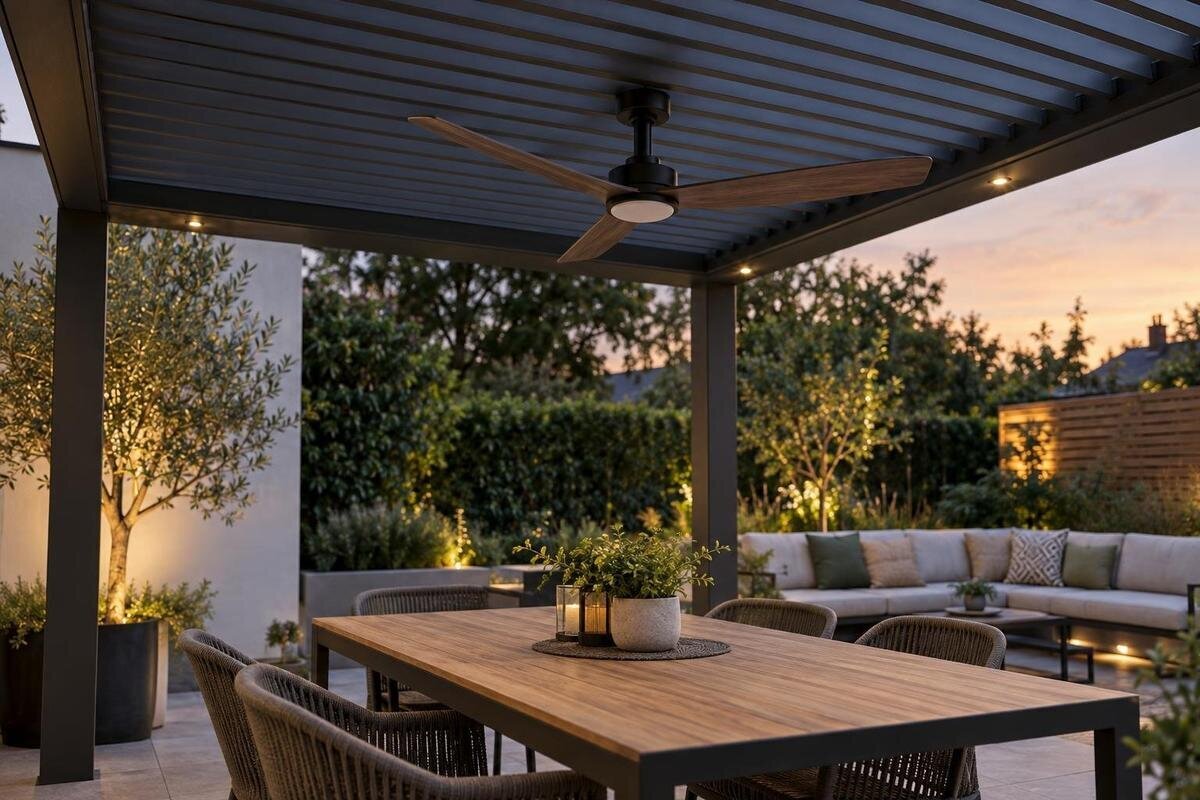
Pergola planning
A ceiling fan can sometimes work under a pergola, but open space overhead does not make the frame a ceiling-fan support. Compatibility depends on the exact mounting point, the fan’s dynamic load, roof and blade clearances, outdoor exposure, and an electrical plan reviewed for the site. Check these together before buying a fan or altering the structure.

01
Four checks for pergola fan compatibility
A ceiling fan may be compatible with a pergola, but there is no reliable yes-or-no answer based on appearance alone. A fan’s weight is only part of the load: when it runs, vibration and changing forces act at the bracket. Those forces must pass from an approved mounting point into the pergola’s supporting structure. A beam that feels rigid by hand, or a spot that looks centred over a table, does not prove that the frame is designed for a rotating fixture. The visible beam also doesn’t reveal how forces transfer through its joints and supports.
Treat compatibility as four separate checks: the pergola can support the exact fan at the proposed point; the blades and housing have the required clearance; the fan is approved for the site’s outdoor exposure; and a qualified electrician can provide a suitable power and control plan. One approval does not cover the others. An existing light, nearby outlet or open roof bay cannot answer all four questions. Check the final installed arrangement rather than relying on a product photo or a bare frame. If any relevant manual or supplier document is silent, the installation is unconfirmed—not automatically acceptable.
Confirm the mounting point and dynamic load
The fan’s weight acts continuously, while its motor and rotating blades can introduce vibration and changing forces. The bracket must connect to a support the pergola manufacturer has approved for that purpose, or that a qualified structural professional has assessed for the exact installation. Don’t assume a roof slat, louvre, shade panel, trim piece or accessory rail can take the load. An existing light attachment point isn’t automatically suitable either; its approval may cover a different fixture, force pattern or fastening method. Avoid drilling or adding a clamp until the proposed method has been confirmed, since a convenient attachment can alter a member or interfere with another component.
Ask for documentation that names or clearly covers your pergola model, proposed support location and exact fan arrangement. Useful details include the permitted attachment method, fan and bracket weight, any downrod or adapter, approval for dynamic loads and conditions tied to the installed structure. A general capacity figure for a frame or roof, including one stated for another purpose, doesn’t automatically approve a fan. The Bloomcabin Pergola listing can help identify the product when you contact the supplier, but the listing itself is not evidence of an approved fan mount. Ask whether the approval accounts for other equipment attached to the frame, and have an unconfirmed attachment assessed before anyone drills or hangs equipment.
02
Moving roofs need clearance in every position
A bioclimatic pergola needs an extra check if its roof includes moving components. A ceiling fan fixed below that roof must not interfere with the full movement of louvres or other parts, and it must not be attached to a moving element unless the product instructions explicitly permit that use. A partly open position can change the overhead space, so a check made with the roof in only one position is incomplete. Even if the fan is fixed to a stationary support, the surrounding clearance may change as roof parts move. The Bloomcabin Bioclimatic Pergola page identifies a product; only model-specific technical information can confirm a fan mounting method.
Ask the supplier or installer to review the proposed location with the roof in each permitted position, including the space required for opening, closing and service. Compare the blade sweep, motor housing and any downrod with the roof’s path, rather than judging whether the fan seems to fit when everything is still. Preserve any required access to drainage, controls and moving components. If an answer depends on leaving the roof in a certain position, get that restriction in writing and decide whether it suits how you intend to use the pergola. The fan should not prevent the roof from operating as specified.
Measure the full blade sweep and headroom
Use the fan manual—not a rule of thumb—to establish the required clearance above and below the blades, between their tips and nearby obstructions, and around the motor. Measure the full swept circle, fixture height and any downrod. Check beams, posts, walls, screens and pergola edges, then confirm the required vertical distance from the finished floor to the lowest part of the fan. There is no single number that can be safely applied to every blade diameter, mounting height and layout. Keep the exact fan model in the measurement plan, since a change in blade size or downrod length can change the result.
Measure the occupied area as well as the empty frame. Include tall furniture, people standing or reaching, doors and windows that swing into the space, and any neighbouring structure that reduces blade-to-wall distance. A wall-mounted layout makes the adjacent wall an important measurement, but the wall-mounted pergola listing cannot show the clearance at your site. Compare actual dimensions with the exact fan installation instructions and ask the installer to confirm them before fixing the mount. If a downrod is proposed, include its full length in the lowest-point measurement. Also account for any movable screen or accessory that could enter the blade area.

03
Match the fan’s outdoor rating to the exposure
An outdoor-rated ceiling fan is not automatically suitable for every open-air pergola. Read the fan maker’s instructions for the exposure it permits and the environmental conditions it can tolerate. Some products distinguish between dry, damp and wet locations; use the maker’s definitions rather than assuming that a roof makes the area dry. Wind-driven rain, condensation and temperature changes can reach an open-sided structure, while an adjustable roof may leave the fan more exposed in some positions. The fan must be approved for the actual location, not merely described as outdoor in a headline or listing.
Check the manual for any limits on water exposure, direct weather, operating temperature or maintenance, and ask the retailer or electrician to clarify terms you can’t match to the site. Don’t infer suitability from a finish, product photo or the word ‘covered’. Conversely, an outdoor-use designation applies to the fan; it says nothing about the pergola’s mounting capacity or the site’s electrical design. A fan intended for a sheltered location may not suit a spot reached by wind-driven rain, while an outdoor rating still leaves the other checks unresolved. Use instructions for the exact model rather than assuming another fan in the same range has identical approval.
Have an electrician review the supply and controls
Base the electrical plan on the selected fan’s exact manual and have it reviewed by a qualified electrician familiar with outdoor installations. Ask them to check the fan’s supply and control requirements against what is available, then determine a suitable way to route and protect wiring in this particular space. Outdoor routing depends on exposure, the pergola arrangement and applicable requirements, so this article is not a wiring plan. A nearby outlet, loose cord or existing light circuit doesn’t prove that a fan can be connected there. The electrician should confirm that the intended controls suit the fan; a connector that fits is not proof of compatibility.
Share the pergola model and installation drawings, fan model, proposed mount and any roof movement with the electrician before work begins. If a roof motor, lighting or other controls are planned, ask how the fan’s switching and cable route will avoid moving parts and remain accessible for service. A page such as the Bloomcabin Pergola product page may identify the structure, but don’t infer that it includes a fan supply, wiring route or compatible controls unless the documentation says so. Confirm the complete arrangement with the electrician and installer before work begins; resolving a route on site can require a change to the planned layout.
04
Coordinate the fan with other fixtures and roof parts
Plan the fan with every other overhead item, not as an isolated accessory. Its blade disk and motor need clear space; lights, heaters, retractable screens and roof controls may also occupy space or need access. Put all proposed fixtures and moving components on one measured overhead plan, then check for overlaps and service access. A light body within the fan’s specified clearance can make a workable mount unusable, and a fan bracket must not block roof travel. If several powered items are proposed, have the electrician review their requirements together instead of assuming the existing supply will serve later additions.
Record which items have documented mounting points and which still need confirmation; don’t assume a generic accessory point can support a rotating fan. When discussing a bioclimatic pergola model with the supplier, include both the proposed fan location and any documented roof movement in the same plan. Check the overhead layout from places where people sit and walk, too: an approved mounting point may still be poorly located for the intended use. Keep access to controls and service areas in the drawing so furniture or a later-added fixture won’t block them after installation.
What mounting approval should cover
Ask for an answer tied to this combination: pergola make and model, configuration, exact supporting member or mounting point, fan model, bracket and any rod, plus the way the structure is assembled and supported. The confirmation should say whether the proposed attachment is permitted and state any limits or installation conditions, rather than offering a broad assurance that the frame is ‘strong enough’. A product family can include different configurations, and a statement about a similar-looking unit or another span may not apply to yours. Save the relevant manual, supplier correspondence and installer confirmation with your project records so later work can be checked against the same plan.
Check the conditions attached to the approval as carefully as the approval itself. It should be clear which fan, bracket, downrod and supporting member the answer covers, and whether it depends on a particular roof configuration or installation condition. Compare these details with the installer’s plan rather than treating a general assurance as a final answer. If the supplier’s response leaves the attachment or load path unresolved, ask a qualified structural professional to assess that part; electrical decisions belong with the electrician. For Bloomcabin Wall-Mounted Pergola, keep the product details with the project records so the reviewed configuration remains identifiable.

05
Plan fan compatibility before choosing the structure
If a ceiling fan is important to the project, raise it before finalizing the pergola purchase or installation. Ask the supplier which mounting positions, if any, are documented for a fan and whether the proposed model affects roof movement, accessories or assembly. Don’t assume a later retrofit will be simple: there may be no approved mounting point where you need it, and adding an electrical route can require a separate design review. Compare specific products only after identifying the fan, its instructions and intended location; a general request for ‘fan-ready’ needs a clear definition.
If the support, clearance, outdoor suitability or electrical route can’t be verified, don’t add a reinforcing plate or hang a fan from the nearest beam without approval. Consider leaving the overhead frame untouched, choosing a structure with a documented fan-mounting option, or assessing an independently supported fan intended for that environment. Use the bioclimatic model listing to identify a product under consideration, not as proof that it accepts a fan. For an open pergola, compare the fan maker’s stated coverage with the area you want to serve. An independently supported option also needs to suit its location and be used as its own instructions specify.
Bring the checks together before installation
Before committing, assemble the exact fan manual and pergola documentation, then mark the proposed fan centre and blade radius on a measured plan. Note roof positions, surrounding beams, walls, screens, furniture and the route people take through the space. Ask the supplier or structural professional to confirm the mounting point and load approval; have the installer verify assembly conditions; and ask the electrician to assess the supply, controls and outdoor wiring. If you’re comparing a regular pergola model, give the reviewer its exact configuration, not just a picture or broad product category. Make sure everyone reviews the same plan.
Proceed only when the answers align: documented support for the fan’s dynamic load, clearances that hold through any roof movement, an outdoor rating that matches the real exposure, and an electrical plan reviewed by a qualified electrician. Keep any conditions—such as a specified mounting point, fan configuration or restriction on roof operation—with the project documents. If one answer is missing or conflicts with another, resolve it or choose a different arrangement before installation. Recheck the plan if the fan, rod, roof configuration or fixture positions change; approval for one set of components should not be carried over by assumption.
Frequently asked questions
Can I attach a ceiling fan to a pergola beam?
Only if the pergola documentation or an appropriate structural assessment approves that exact member, fastening method and fan configuration. A beam’s size or apparent stiffness is not proof that it can support a rotating fan. Don’t drill, clamp or suspend a fan from it on that basis alone.
Is an outdoor-rated ceiling fan suitable for any pergola?
No. The rating addresses the fan’s permitted exposure; it does not confirm that the pergola can support it, that the blades have enough clearance or that the electrical supply is suitable. Check the exact fan instructions against the conditions at the installation site.
Can a fan go under a bioclimatic pergola roof?
Possibly, but only if the proposed mounting point is approved and the fan clears the roof through its full range of movement. The fan must not be attached to a moving part unless the product instructions explicitly allow it. Ask the supplier to confirm any operating restrictions in writing.
How much clearance does a pergola ceiling fan need?
There is no single clearance figure for every fan and pergola. Follow the exact fan manual and check the blade sweep, motor height, any downrod, nearby walls and beams, and the space above people and furniture. For a moving roof, repeat the check in every permitted position.
Who can confirm whether my pergola can take a ceiling fan?
Ask the pergola supplier about documented mounting points, and consult a qualified structural professional if the proposed attachment is not covered. The installer can confirm assembly conditions, while a qualified electrician reviews the supply, controls and wiring route. Each review covers a different part of compatibility.
Compatibility means more than having enough room for a fan. The exact fan and pergola must work together: the mounting must be suitable, the required clearances must be maintained, the fan must suit the outdoor exposure, and the electrical arrangement must be appropriate. If those conditions can’t be confirmed, don’t proceed at the proposed location. Plan the fan with the structure rather than treating it as a last-minute ceiling accessory.
