
Is a Louvered Pergola Watertight in Heavy Rain?
PERGOLA RAIN PERFORMANCE
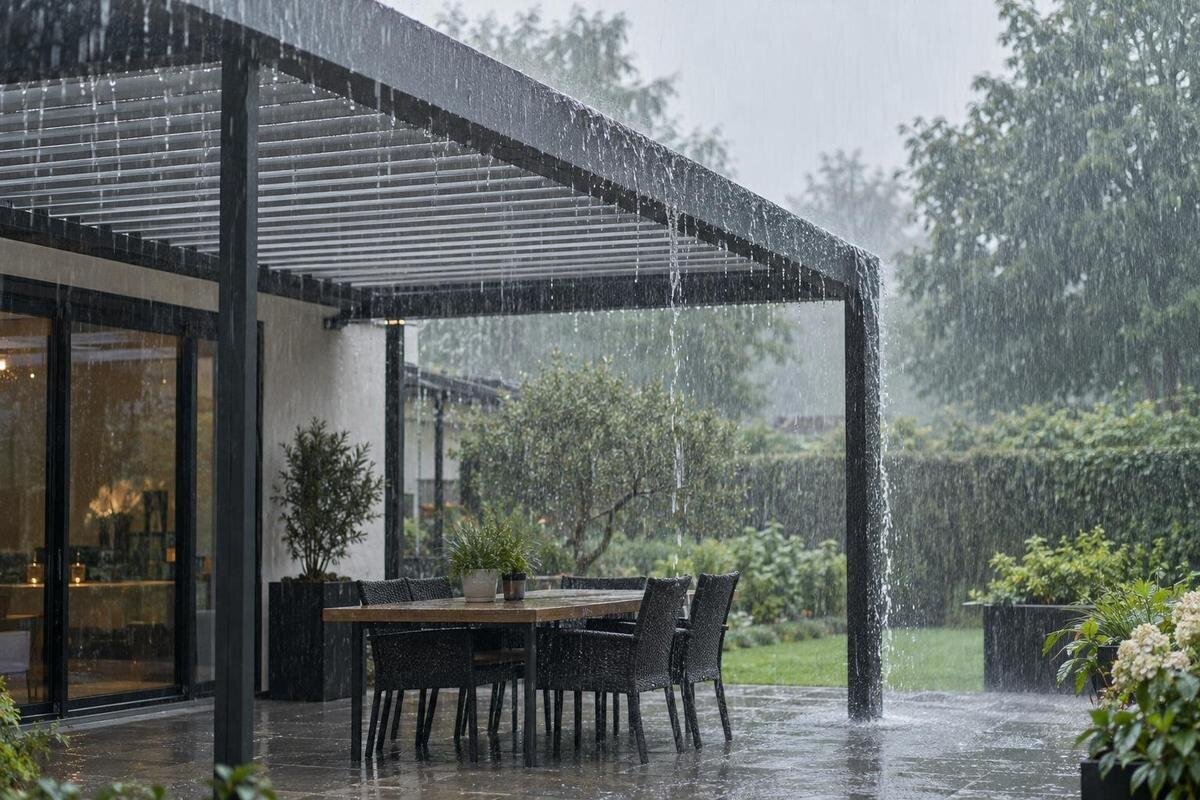
A closed louvred roof may collect and channel rainfall, but that alone does not show how it will perform in a severe downpour. The model’s blade joints and drainage route matter, as do rainfall intensity, wind direction and whether the sides are open. The useful question is not simply whether the louvres close, but what conditions the exact model and enclosure have been shown to handle.

What “watertight” means for a louvred pergola
A louvred pergola can shed rainfall when its roof is set to the position intended for rain and its channels can carry water away. That does not guarantee that the entire area below will stay dry in every heavy storm. Moving blades have joints, and many pergolas remain open around the perimeter; water can enter from those sides even if runoff is leaving the roof as intended. A short demonstration in calm, vertical rain also says little about a long downpour or wind-driven rain. “Watertight” might mean no water passed through the roof joints during one test, or it might suggest that furniture and flooring stay dry. Those are different claims.
Before relying on that word, ask what was tested: the exact model and roof size, louvre position, rainfall rate in millimetres per hour, test duration, wind speed and direction, and whether sides or doors were fitted. Find out whether the observation covered the roof alone or the usable space below, and what counted as water entry. The Bloomcabin Wall-Mounted Pergola listing can help identify a model, but a product name or image is not evidence of a heavy-rain limit. A useful claim describes a defined setup and its observed result, as well as conditions outside the test. Without those boundaries, “waterproof” or “all-weather” language is too broad to guide a purchase.
How closed louvres direct rain
On many adjustable roofs, louvres turn to a specified closed or rain-shedding position; their meeting or overlapping edges guide water towards a collection channel. How that junction works, and where the flow travels, varies by model. An angle used for ventilation may leave intentional gaps, so “mostly closed” is not necessarily rain-ready. From below, it can be hard to see whether the blades align correctly or whether a channel runs behind a beam. Product photos rarely show this hidden route. Ask for a drawing that identifies the rain position, blade direction, joints and parts that collect runoff.
A drainage diagram should trace water from the louvre surface through corners and roof intersections to its discharge point, rather than stopping at a gutter. When considering the Bloomcabin Pergola, request a diagram for the exact roof size and configuration you want; another layout may have different channel lengths or outlets. Read it alongside the operating instructions so you can connect the specified rain position with the route water follows. Do not assume water exits through a post, or that every pergola uses the same concealed route. A visible trough shows that a collection feature exists; it does not establish how much water it can handle or how it behaves if a joint or outlet is obstructed.
Why heavy rain can challenge drainage
Rain falling across the whole roof becomes runoff that the drainage route must collect and discharge. A higher rainfall rate sends water to the channels faster; sustained rain adds to the total volume over time. The roof may therefore appear to work during a short shower but behave differently during a prolonged downpour. A restricted outlet, debris or a flow path that cannot discharge water quickly enough can contribute to spillover. That is not the same problem as rain passing directly through a blade joint, so it is useful to distinguish the two when evaluating a report or investigating a leak.
For the Bloomcabin Bioclimatic Pergola, ask what weather limits apply to the roof configuration you are considering and whether the documentation explains the rainfall conditions behind them. The model name alone does not establish a tested rainfall limit. Check whether any observed result applies to the roof size you want, and whether it covers the collection route as well as the louvres themselves. No generic description can give you a reliable threshold for every design. If a report describes water escaping, distinguish between water passing through a joint, spilling over an edge and leaving a drainage outlet. Those observations concern different parts of the system and should not be treated as interchangeable evidence of a roof leak.
Joints, wall connections and exposed roof edges
The main roof surface is only one possible route for water. Look at the ends of the blades, perimeter seals, corners, and the places where louvres meet the surrounding frame. Water may also escape where collection channels join or where a roof edge meets a wall. Wind can press rain against a joint from a direction that a roof-only observation did not cover. If water appears near a wall-mounted pergola, the connection to the building is a separate detail to assess; the pergola product name alone cannot explain how it meets your wall.
If you are considering the wall-mounted pergola, ask for the model-specific wall-connection detail and have a qualified installer assess whether it suits the existing wall and installation. Avoid assuming that a general sealing method will suit every roof or building. For an existing installation, record where water first appears, whether the louvres were fully in their rain position, and what the wind was doing. These details help distinguish the wall junction from nearby roof edges and channels. A drip at an outer edge is not automatically evidence of a blade-joint leak, just as water near a wall does not by itself identify the source. Assess the connection separately from the main roof surface.

How wind-driven rain reaches open sides
Rain does not always fall straight down. In gusty conditions, drops can travel sideways under a roof edge or around a corner, and the direction can change during a storm. The side facing the wind, nearby shelter and the position of the pergola all affect how exposed the area beneath it is. A roof can shed water from above while rain still reaches seating through an open side. That is a different expectation from asking whether the roof itself sheds rainfall, and it is one reason a roof-only claim cannot promise a dry outdoor room.
Screens or other side panels may reduce direct exposure, but do not assume they make the space watertight. Their edges, tracks, corners and meeting points can leave openings, and adding an enclosure changes the configuration being assessed. When considering side protection for the bioclimatic pergola, confirm which enclosure options are compatible. Then ask whether any rain observation includes that particular side treatment in the position you plan to use, along with the roof and its drainage. Pay attention to which sides were enclosed and which remained open during the observation. A claim for a pergola without side panels does not automatically describe performance with them fitted, nor does a sheltered demonstration establish protection from rain approaching an exposed side.
Trace the full drainage route
Follow the water from the roof surface to wherever it leaves the pergola. Depending on the design, it may pass through a collection channel, travel along a frame member and discharge at a particular edge or outlet. The route is not always visible from below, and it should not be assumed to run through the posts. A drainage diagram can show where water is collected and released, including outlets at corners or transitions between roof sections. Ask what happens if water cannot leave through the usual route, if the manufacturer documents an overflow path.
The discharge point matters at the site as well as on the product drawing. When reviewing the regular pergola’s drainage layout, check where water would land in relation to doors, paths, walls and areas where it could collect. Also check whether the relevant openings remain accessible for inspection and cleaning in your proposed location. Leaves and other debris can obstruct a route, so ask what the manufacturer recommends for inspection and maintenance. Do not assume an integrated outlet connects to your property’s drainage system. If the site needs changes to manage the water, have a qualified professional assess them. The important connection is between the product’s discharge point and the place that water will actually reach on your property.
What a useful rain-performance claim includes
To interpret a rain-performance claim, separate the conditions of the observation from its reported result. The conditions include rainfall rate and duration, wind speed and direction, louvre setting, roof dimensions and any installed side panels. The result should explain whether water entered, where it appeared and whether the observation concerned the roof or the area beneath it. Vertical rain, wind-driven spray and other setups are not interchangeable descriptions. Compare the stated conditions with the exposure that matters at your site before treating the result as relevant to your purchase. A broad phrase such as “weather-resistant” gives you no basis for that comparison unless the accompanying information explains what was observed.
When reviewing a claim associated with the Wall-Mounted Pergola product page, check that the supporting information covers the configuration being offered, not just a similar-looking model, another roof size or a roof without your planned enclosure. Ask what the observer counted as water entry and whether runoff reached the intended outlet. This distinction matters when comparing a roof-only result with a claim about keeping the space below dry. A brief showroom demonstration may show how the blades move, but it cannot establish performance in a storm unless its conditions are defined and relevant. Keep the report or written response with the proposed configuration so you can compare claims on the same basis.
Operating the roof as weather changes
The louvre position affects how much rain can pass through the roof. If the blades are open for ventilation, water can fall through the openings; for rain, the manufacturer may specify a different position. Confirm which setting is intended for rainfall rather than assuming that a particular angle or partial closure is enough. Also ask what the operating instructions say about moving the roof in rain or wind. The permitted conditions depend on the model, so do not assume that it can always be closed once a storm is underway or that it should be moved in every kind of weather.
Before choosing the Bloomcabin Pergola model, find out how its roof is operated, how long it takes to reach its rain position and what the instructions say when conditions change. If a control or automatic feature is included in the configuration, check its documented behaviour rather than assuming it will close the roof at the right time. Distinguish an included feature from an option when reviewing the proposed setup, and make sure the operating guidance covers that setup. Do not force blades that do not move as expected; follow the model’s instructions. If the roof has been wet, follow the manufacturer’s directions before changing its position, as water may remain on parts of the system.

Side enclosures change rain protection
A roof and a side enclosure work as a combined setup, but screens, panels and glazing are not interchangeable. Each type has its own edges, tracks, corners and openings, and wind-driven rain can enter at those points. A partial screen may reduce rain from one direction while leaving other sides exposed. An enclosure can also redirect water towards a different part of the roof frame or threshold. Do not infer how well any of these options protects the space from its name or appearance; confirm the exact configuration and the conditions it is intended to handle.
Ask whether the roof and the specific enclosure have been assessed together, with the panels in the position you expect to use. Check what the documentation says about doors, corners, joints and water reaching the inside of the enclosure, not just the roof’s drainage. A side treatment that reduces spray is not automatically a watertight wall. If your priority is keeping stored items reliably dry, look for an enclosed structure with evidence that matches that use and the weather conditions you need to manage. A pergola claim for the roof alone is not enough to establish how a fully enclosed configuration will perform.
Match the evidence to how you will use the space
Decide what “dry enough” means for your plans. Occasional rain reaching open-sided seating may be acceptable; keeping cushions, electronics or other water-sensitive belongings dry is a different requirement. Note which sides are exposed to prevailing storm winds, whether you plan to add an enclosure, and where roof runoff will be discharged. Think about the weather conditions that matter at your site, rather than treating a single demonstration as a promise for every storm. The more specific your intended use, the easier it is to judge whether a product’s stated limits and test setup are relevant.
Compare model-specific drawings, drainage routes, operating instructions and any controlled rain observations as one package. Confirm that each document applies to the same roof size and side configuration, and ask what conditions fall outside its stated limits. If you cannot establish how runoff leaves the roof or how the wall connection should be handled, have a qualified installer assess the site before relying on the arrangement. Where dependable dryness is essential, a louvred pergola with open sides may not meet the need; consider an enclosed system whose documented performance matches the conditions you expect.
Frequently asked questions
Can closed louvres stop all rain?
Not necessarily. A closed roof may direct rain into its drainage system, but water can still enter at joints or exposed sides, particularly when wind drives it beneath the roof. Check the limits for the exact model and configuration.
What does “heavy rain” mean in a product claim?
The phrase is useful only when the test conditions are clear. Ask for the rainfall rate and duration, wind conditions, louvre position and side configuration used in the observation.
Do gutters make a louvred pergola watertight?
Gutters or channels collect and direct water, but their presence alone does not establish how much they can handle or whether joints and outlets stay dry. Ask for the full drainage route and its documented limits.
Will side screens keep rain out?
They may reduce direct exposure, but gaps at edges, tracks and corners can still admit wind-driven rain. Look for evidence covering the exact roof and side enclosure together.
What should I request before buying?
Ask for model-specific drawings, a drainage diagram, operating instructions and any controlled rain observations or stated weather limits. Confirm the documents match the roof size and enclosure configuration you are considering.
Closed louvres can be part of an effective rain-shedding roof, but “closed” and “watertight” are not interchangeable. Confidence in heavy-rain performance comes from evidence for the exact roof, drainage route, side configuration and stated test conditions—and from knowing where discharged water goes. If the space must stay reliably dry through wind-driven storms, choose an enclosure whose documented limits match that need rather than relying on a generic pergola description.
