
Manual or Motorized Pergola Louvres: Which Fits Your Routine?
Pergola buying guide
Manual and motorized pergola louvres can serve the same broad purpose, but they ask different things of the person using them. A roof adjusted once before a meal creates a different routine from one changed several times as the sun moves or your preference for shade and airflow shifts. Reach matters too: a control may be easy for one person to use and inconvenient for another. The product category alone cannot tell you whether the louvres are hand-operated, powered, sensor-controlled or connected to an app. Match the actual mechanism and controls to how often you expect to use them, then confirm those details for the exact model.

How manual and motorized louvres are operated
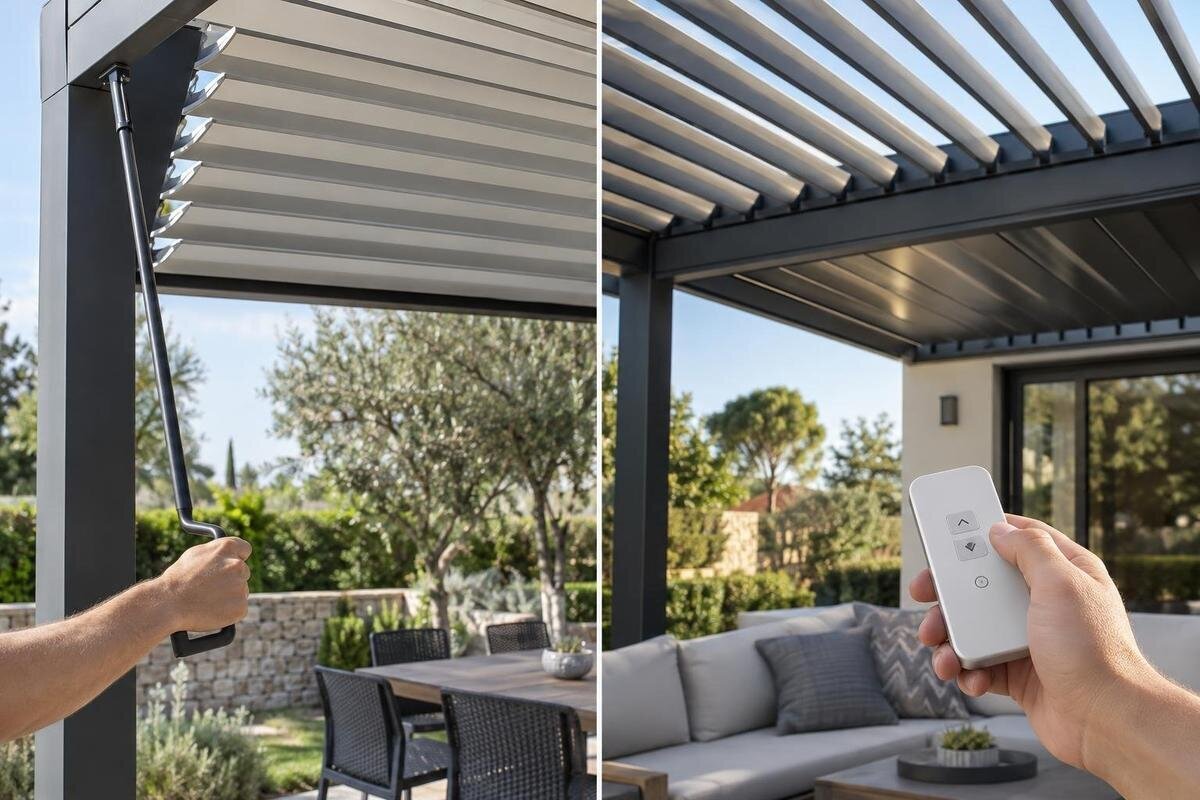
Manual and motorized describe how movement is powered, not what the roof does. With manual operation, a person operates the mechanism; depending on the design, this could mean turning a crank, moving a lever or using another hand control. Motorized operation uses a motor to move the louvres in response to a control, whose form is model-specific. Neither label tells you the louvres’ range of movement, how many move together or how much effort the system requires. Ask about operating speed and whether you can pause movement partway if those details matter to you.
Keep roof type and operation separate when comparing products. A louvred roof may use a manual or powered mechanism; a motor does not by itself mean the roof retracts, senses weather or closes automatically. Use the Bloomcabin Pergola listing to identify a candidate, then distinguish two questions: what movement does the roof make, and how does the user control it? Ask for the mechanism diagram or operating instructions to understand both. This distinction helps you compare the roof function you want without confusing it with the convenience of a particular control. A product photo is not a substitute for those details.
How often will you adjust the roof?
Think about actual habits rather than how often you imagine using the controls. On a typical day outdoors, would you make one adjustment before sitting down, or several as the sun moves, a meal shifts outside or your preference for airflow changes? Note who would make each change and whether they would need to leave their seat or cross the patio. A brief record over a representative week can show whether adjustments are occasional or frequent. Focus on changes household members would realistically make, rather than every possible change in the weather.
Frequency matters more than a broad label such as “large pergola.” The regular pergola product page lists an area range from 9 to 24 m², but area alone does not specify operating force, travel or control type. Compare the effort and time involved in each adjustment with the number of changes you expect to make. If changes are infrequent and you are comfortable operating the mechanism by hand, manual control may be enough. If people often interrupt what they are doing to adjust the roof, a motor may reduce the effort involved. The useful comparison is the operating routine for the offered configuration, rather than its footprint alone.
Can every user reach the control?
Consider where the operator will stand or sit, not just the roof. A manual handle or crank needs to be reachable where it is installed, with enough room to use it; a chair, railing, planter or stored item could make access awkward. Ask for the proposed control position and consider whether each regular user can reach it comfortably. If you expect to adjust the louvres while seated, check access from that position rather than assuming the control will be convenient from the patio edge. A final furniture layout is more useful for this check than an empty patio plan.
A motor reduces the need for manual effort, but its control still needs to be accessible. A wall control may require you to get up, while a remote can be misplaced or kept by one user. When considering the Bloomcabin Bioclimatic Pergola listing, compare the proposed interface with the positions from which you expect to operate it. Can you identify the controls easily and use them comfortably? Consider access both when the patio is quiet and when chairs are occupied or pulled out from the table. This makes the reach check more realistic than simply measuring the distance between a control and a seat.
Effort and steps involved in manual operation
A manual mechanism does not use a motor to move the roof, but it still asks for time, reach and physical input each time you make an adjustment. If possible, see the operation for the model you are considering. Note where you stand, what hand action is required, how the louvres begin and finish moving, and whether you can stop at an intermediate position. Ask whether the control has to be brought out and put away each time, and whether the instructions differ when the roof is partly open. These are practical details to confirm, not something to infer from a photo or the word “manual.”
Distinguish a manual configuration from a powered one that might have a hand-operated override. An override is useful only if the exact model includes it and the operating instructions explain when it can be used; do not assume it is standard. If independence from electrical power matters, ask how the chosen roof moves and what happens during an outage. When using Bloomcabin’s regular pergola page to identify a candidate, compare its normal operating procedure with any backup procedure. A hand control intended for everyday adjustments and an override intended for particular circumstances should not be treated as interchangeable when assessing your routine.

What motorization changes in daily use
Powered movement may appeal if you adjust the roof often, share operation among several people or find a manual control inconvenient from your usual position. Its practical advantage is less physical input for each adjustment; it does not decide when the roof should move, so someone still needs to use the control unless automatic functions are specifically included. Consider whether you would prefer a fixed control, a remote you keep nearby or another interface. Ask whether you need to press and hold a control, whether movement can be paused and what happens when the control is released. Those details shape the day-to-day experience.
Do not read “motorized” as “automatic.” A motor may respond to a person using a control without any weather sensor, timer, smart-home connection or app. When comparing options on the bioclimatic pergola page, separate powered movement from any functions that decide when movement occurs. Ask which controls are included and whether additional functions require separate equipment or setup. Then consider whether those functions would serve a habit you actually have, such as wanting to make an adjustment without retrieving another device. Keep the basic operating method clear before weighing optional controls or connections that may add steps to everyday use.
Power and support for motorized louvres
Before selecting powered operation, find out how the motor is supplied and who is responsible for planning that connection. Ask the seller or installer to state the requirements for the exact configuration, where a power source would be needed and whether electrical work is included in the project or arranged separately. Supply methods vary across products, so do not plan around an assumed plug, battery or wiring route. A qualified electrician familiar with local requirements should assess electrical work; this guide does not provide wiring or installation instructions. Confirm the plan early enough to coordinate it with the patio layout and other work.
Support arrangements also affect the usefulness of powered operation. Ask who handles service for the motor and controls, where to get troubleshooting instructions and whom to contact if the system stops responding. Find out what happens if a remote is lost or a control battery is flat, and whether an app or internet connection is required for normal use. For a candidate from Bloomcabin’s bioclimatic model listing, keep these answers with the configuration details so they are easy to find later. Distinguish routine tasks the owner is expected to handle from problems that require a service provider, rather than assuming every control issue has the same solution.
Weather limits are separate from operation
Control type is not a weather rating. A motor does not prove that a roof is watertight, suitable for a particular snow or wind condition, or safe to move in every kind of weather; manual operation does not settle those questions either. Ask for the manufacturer’s instructions covering permitted roof positions, drainage and operating limits, including what to do in rain, wind, snow or freezing conditions relevant to your site. Do not guess a safe position from the appearance of the louvres or a video. The guidance needs to apply to the exact model and configuration.
Weather sensors, timers and remote monitoring are separate questions from whether a motor is present. If an automatic response matters, ask which function or sensor is included, what it responds to and whether someone still needs to supervise or prepare the roof in changing conditions. When considering the Bloomcabin Wall-Mounted Pergola page, describe the weather-related task you want the system to handle rather than asking only whether it is automatic. Compare the answer with the model’s operating limits and your household’s responsibilities. Keep those instructions available to everyone who uses the pergola, including anyone looking after the property while you are away.
Plan for everyone who uses the pergola
Shared use can affect the choice. Think about who will adjust the roof: one owner, other household members, guests or someone caring for the property while you are away. A hand control may be straightforward for some households, while a remote or app may suit others; neither is automatically more intuitive. Ask how the controls work, whether more than one person can use them and whether access can be restricted if that matters. Make sure regular users know the normal procedure and where to find the model-specific instructions, rather than relying on one person to operate the roof.
Include small habits in the comparison: where a remote will be kept, who replaces its batteries if it uses them, whether an app needs an account or internet access, and what happens if the phone is unavailable. These are questions to verify, not features to presume. If the wall-mounted pergola listing is on your shortlist, discuss how household members would share access to the offered controls. Agree on a storage place for any portable control and make sure operating information is available to more than one person. A control that is convenient for its usual owner may be less useful to someone who cannot find it or does not know how to use it.
Compare the exact configuration, not just the model name
Compare like with like before deciding. For each candidate, record the full model and configuration, whether operation is manual or motorized, what movement the roof makes, where the control is, what is included and what power or setup is required. Ask for current operating instructions and a mechanism diagram, not just a general brochure. If a product family has multiple variants, make sure the answer applies to the version and size being offered. Keep separate notes about optional sensors, app functions, manual overrides and service contacts so that a possible feature is not confused with equipment included in the configuration.
The supplied Bloomcabin facts identify a regular pergola, a bioclimatic pergola and a wall-mounted pergola; each listing gives an area range from 9 to 24 m². Those facts establish model identity and area range, not manual or motorized operation, control placement, power supply, sensors, retractability or a manual override. A term such as “bioclimatic” does not establish the specific operating configuration. Treat each model name as a way to identify what you are comparing, then request model-specific documentation. Do not infer the included controls or mechanism from the name alone.
Choose by frequency, access and power
Manual operation can suit a routine with infrequent adjustments, a comfortably reachable control and a household that is content to supply the effort each time. Motorized operation is worth considering when adjustments are frequent, repeated handling is inconvenient or the control needs to be used from a different position—but only if the power plan, controller and support arrangements work for you. If your main reason is weather response, verify the roof’s limits and any sensor separately; a motor alone does not provide automatic protection. Decide which of these needs matters most before comparing options.
For a close call, ask three questions: how often will the roof actually be adjusted; can every regular user reach and understand the proposed control; and are you comfortable with the confirmed power and service arrangements? If one answer rules out a configuration, the choice may become simple. If both remain viable, compare the operation of the exact models and note the effort, steps and controls involved. Include how you expect to use the pergola through the seasons, but rely on the manufacturer’s instructions for any weather-related operating limits.
Frequently asked questions
What does “motorized” mean for pergola louvres?
A motor supplies the movement, but the term does not identify the control, power source or available features. It does not automatically mean the louvres are sensor-controlled or connected to an app. Check the exact model configuration and its operating instructions.
Are motorized louvres automatic?
Not necessarily. A motorized system may move when someone uses a switch or another control. Timers, weather sensors and app-based functions are separate features; confirm whether they are included in the configuration you are considering.
Will manual louvres work during a power outage?
A genuinely manual mechanism moves the roof without a motor supplying the movement. A powered model’s manual override, however, is not something to assume. If operation during an outage matters, ask whether the exact configuration has an override and how it works.
Does a larger pergola need a motor?
Area alone does not determine the operating effort or whether a motor is needed. The mechanism, control position and how often you adjust the louvres all matter. The supplied Bloomcabin listings give area ranges, but not operating-force or control details.
Can a motor or weather sensor be added later?
Only the manufacturer or a qualified supplier can confirm compatibility for the exact model and configuration. Ask whether a motor, controls or sensor can be added, what the work involves and what documentation applies. Do not assume an upgrade is available.
The right pergola louvre control is the one your household will use without friction. If occasional hand adjustments fit your habits, a manual mechanism may keep the routine simple. If frequent changes make physical operation inconvenient, a motor may be worthwhile once its controls, power and support are confirmed. In either case, judge the product by its documented mechanism and operating limits, not by assumptions attached to “manual,” “motorized” or “bioclimatic.”
