
Older Pergola Repair or Replacement: A Decision Checklist
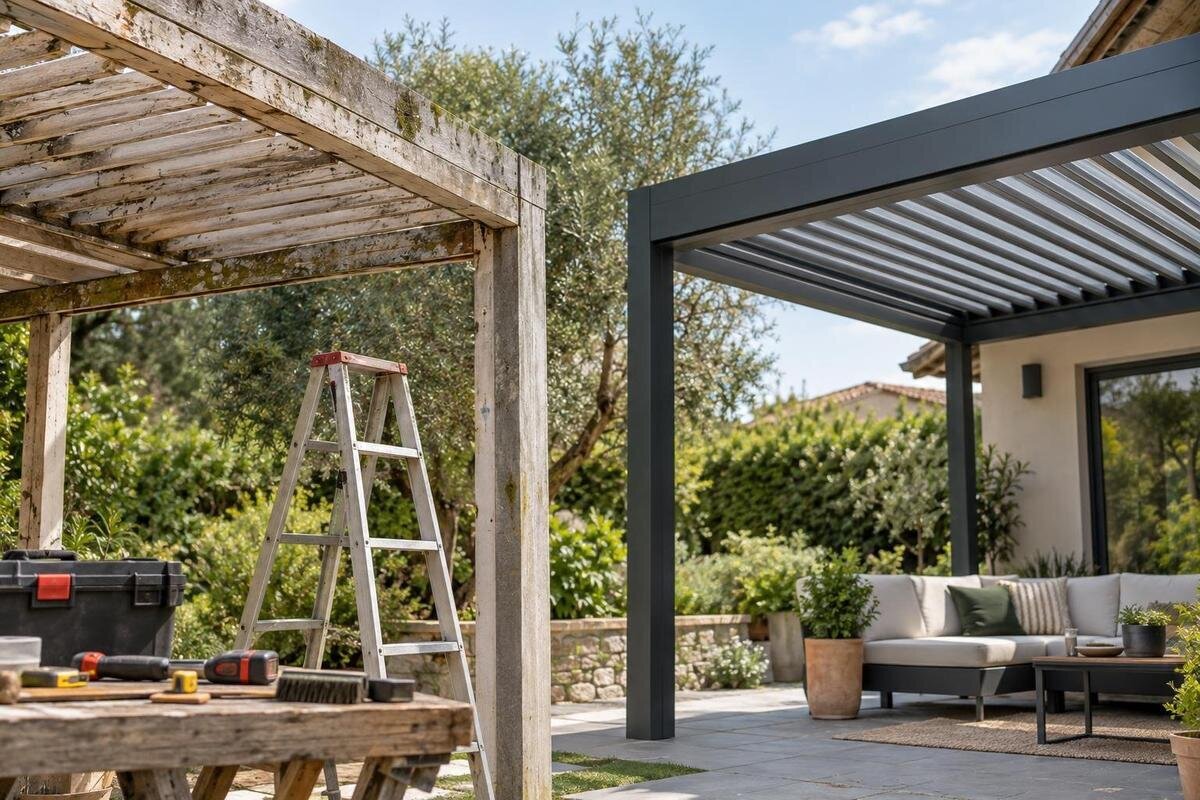
Pergola repair and replacement
An older pergola does not need replacing simply because it has been in place for years, and a small repair is not automatically good value. The useful question is whether the problem is understood, the rest of the structure and its attachment remain suitable, compatible parts and qualified service can be confirmed, and the full repair scope compares sensibly with a replacement. Use this checklist to separate safety concerns, isolated faults, recurring problems and wider deterioration before requesting a quote.

Check safety before pricing repairs
Before comparing quotes, decide whether it is safe to keep using the pergola. A post that has shifted, a visibly separated connection, a newly sagging or distorted member, cracking, or movement that was not present before calls for caution. Keep people clear and arrange an in-person assessment rather than trying to make the structure usable with a prop, a quick tightening or repeated operation. A loose or fallen component above a place people use should also be treated as more than a cosmetic issue. If the pergola includes a moving or powered system and it behaves unpredictably, stop operating it and have a qualified service professional assess it. A photograph can help explain what you see, but it cannot establish structural safety.
Even when nothing looks urgent, visible appearance alone does not show whether concealed attachments, bases or adjoining parts are sound. Ask a qualified pergola or building professional to examine the affected area and, where relevant, its connections to a wall or supporting surface. Before deciding on repair, request a clear explanation of what was inspected, what was found, what remains uncertain, and whether the pergola can continue to be used while work is pending. If the issue involves powered components, ask that this part of the assessment be handled by someone qualified for that work. Do not climb onto the structure, remove covers or dismantle components to improve the inspection; provide observations from a safe position and leave hands-on diagnosis to the appropriate professional.
Record symptoms rather than diagnoses
Write down what the pergola does, not what you think is broken. Record the location of the symptom, what happens, how often it occurs, when you first noticed it and whether it has changed. Note whether the issue appears during normal operation, after a period of non-use or following a particular weather event; that timing is useful context, not proof of a cause. If it comes and goes, say so rather than reporting only its best or worst moment. Describe the result in plain terms, such as a connection that looks newly loose or a control that does not respond, rather than naming a part you have not confirmed. A short, dated log can help a service person distinguish a one-off event from an ongoing pattern without asking you to reproduce a potentially unsafe fault.
Take an overall photo that shows where the affected area sits, then close views that show the visible detail. A short video can help with a sound or movement only if recording it is safe and the pergola can be operated normally; do not trigger a fault, reach into moving parts or climb for a better angle. Include a photo of the product identification label if it is accessible without removing anything. Keep the original purchase record, manual, drawings and previous repair invoices together, and note which documents are missing. Avoid filters or markup that obscure the original image; if you add arrows or notes, keep an untouched copy as well. Clear, dated evidence is more useful than a large set of images with no location or context.
Look for a recurring pattern
A single symptom can point to a repairable component, but it does not prove the fault is isolated. Compare the affected area with the rest of the pergola: are there other new changes, or does the rest look and operate as it did before? Record separate symptoms instead of grouping them under a broad label such as “the system is failing.” A technician can use that detail to decide what needs inspection and whether several observations may be related. Avoid deciding from a single visible mark or a brief period when the mechanism seems to work; intermittent movement and hidden connections may need a closer assessment. One apparent fault can also be a consequence of a different issue, so ask for the reasoning behind a proposed part replacement.
Recurrence deserves particular attention. If the same problem returned after a repair, ask what the earlier work addressed and whether anyone has identified an underlying cause, rather than ordering the same-looking part again. Multiple symptoms, repeated adjustments or new issues appearing in different areas make it harder to treat each call-out as an isolated fix. Gather the previous invoices or service notes and ask for one assessment of the whole affected system before adding another repair. If that assessment leads you to compare whole-unit replacement, include the Bloomcabin Pergola catalogue listing among the options you want priced. Keep the proposed replacement separate from the diagnosis of the existing unit.
Confirm replacement-part availability
Part support begins with exact identification. Gather the product name, model or serial information, purchase record, manual and any service history you have. Labels may be difficult to read or missing on older installations; state that clearly rather than guessing. An order number or approximate purchase date may help trace records if the label is unavailable. Send overall and close-up photographs and describe where the part sits and what it does, but do not remove it just to find a code. A part that looks similar, fits at first glance or carries a familiar product name is not necessarily an approved match. Ask the seller or service provider to confirm the precise part reference and the model range it belongs to before treating availability as established.
Ask whether the relevant manual or technical drawing matches your exact model, and whether a compatible replacement component is actually available. If a part is discontinued or cannot be identified, find out whether an approved substitute exists, what related work it would require and whether the original problem needs a broader diagnosis. Keep parts enquiries separate from replacement shopping: the Bloomcabin Bioclimatic Pergola product page identifies a current catalogue model, not a source for older components or proof of compatibility. Record any uncertainty about parts or service in your comparison. An unanswered enquiry leaves a question open; it does not establish that a substitute will work.

Compare the full repair and replacement scope
A repair quote should cover more than the price of a visible component. Ask whether it includes diagnosis, the correct part, labour, access to the affected area, removal and refitting, adjustments, and any related components the technician expects to address. Clarify whether diagnosis is included in the quote or charged separately, which findings are confirmed, and which could change the scope once work begins. If the recommendation is to replace several parts, ask why each item is needed and how it relates to the fault. Include previous call-outs and repeat service in your comparison; a small invoice can still be poor value if it leaves the cause unresolved.
Request a replacement estimate on an equivalent basis: removal and disposal of the old unit, site preparation, installation, any changes to the footprint or attachment, and any separately scoped electrical or building work. Ask what is included, what is excluded and what would trigger a revised quote. The Bloomcabin Pergola product page lists an area range from 9 to 24 m², which gives you an initial reference for a replacement enquiry. Confirm the dimensions and installation scope for the model being quoted rather than treating that range as a site fit check. Compare like with like, including work by other trades where needed, rather than weighing one component price against an entire installation estimate.
Check whether a replacement fits the site
Check whether the existing layout still works before comparing a replacement. Note the pergola’s overall footprint, the position of posts or a wall connection, clear walking routes, doors and windows, nearby drains, and any furniture or equipment that must remain accessible. Use actual site measurements where you can take them safely, and distinguish measured dimensions from estimates. Think about daily use too: where people enter, whether seating still fits, whether a door can be used as intended, and whether the present arrangement creates maintenance-access problems. A replacement that changes footprint or placement may solve one frustration while creating another; sketch the layout so everyone assessing it is working from the same information.
An older unit is not always a simple template for a new one. A wall-mounted design and a freestanding design interact with a site differently, and a change in size or attachment may call for a different professional assessment. If you are considering the Bloomcabin Wall-Mounted Pergola, ask the provider to compare the proposed model with your actual measurements, access needs and site conditions. Include doors, windows and the wall connection in that discussion so the estimate reflects the layout you need. Treat it as a like-for-like replacement only after the relevant differences have been assessed, rather than assuming the old footprint settles the question.
Assess the supports and connections
Treat the supports and joints as a separate part of the assessment, not as background to a broken component. From a safe position, note visible movement at a base, a gap at a connection, cracking, corrosion, distortion or recurring staining. Describe where the mark appears and whether it has changed; a surface sign alone cannot tell you how far damage extends or whether a connection is sound. Do not tighten, pry or probe a suspect joint to see if it moves. Those actions can hide evidence or alter a condition that a professional needs to assess. A photo that includes nearby posts or surfaces can show how the sign relates to the wider structure.
Ask the qualified person to look beyond the immediately failed item at the relevant posts, beams, joints, bases and, where applicable, wall or supporting surface. The purpose is to find out whether the repair can be limited to one element or whether the support it depends on also needs work. Mention any prior movement, water entry, impact, modifications or repairs, even if they seem unrelated. For a replacement such as the wall-mounted Bloomcabin Pergola model, have the assessment address the proposed wall attachment as well as the existing condition. The replacement quote should make clear what support work is included and what remains to be assessed.
Treat powered components as a separate service issue
If the pergola has a motor, controller, remote, sensor or other powered component, record the exact behaviour without opening an enclosure or changing the wiring. Note whether a command is missed, movement stops partway or a control works inconsistently, but do not bypass a safety device or keep cycling a system that behaves abnormally. These symptoms can have different causes, so a visible control fault is not enough to identify a replacement part. Leave diagnosis and electrical work to a qualified service professional, and ask whether the structural mechanism and control system need to be assessed together. If the system is unpredictable, describe the issue rather than demonstrating it.
Have the repair scope name the component being diagnosed, the exact compatible part if identified, any related parts or adjustments, and the checks the service provider will perform after the work. Ask whether the proposed repair restores the function you rely on, rather than assuming that a new control will fix every movement problem. If replacement is on your shortlist, use the Bloomcabin Bioclimatic Pergola model details to identify features you want the provider to confirm. Compare documented functions with those you currently use, and list any unanswered questions about operation or controls. Do not make an unconfirmed feature a deciding reason to replace the existing pergola.

When repair is worth pursuing
Use a short written test instead of letting age decide. Repair looks more promising when an assessment identifies one manageable fault, an exact compatible part is available and confirmed, the rest of the pergola and its attachment are suitable, and the quote covers the work with clear assumptions. Replacement deserves closer consideration when a safety concern remains unresolved, essential parts or service cannot be confirmed, the same problem keeps returning, or a repair estimate leaves major scope open. These are prompts to gather better evidence, not a score that can replace a qualified inspection. A cosmetic issue alone should not be confused with a structural concern, and a functioning system alone does not confirm that hidden connections are sound.
Set out the options side by side: repair now, obtain a more complete assessment, or request a replacement scope. Compare total quoted cost, the work each option includes, expected disruption, unresolved questions about parts or site conditions, and how well the result fits your intended use. If the Bioclimatic Pergola listing is on your replacement shortlist, apply the same comparison to that model rather than relying on its name or appearance. Consider what you want the pergola to do over the coming years, without assuming that age predicts future repair needs. Where price or scope remains uncertain, identify the missing information before calling either option cheaper.
Prepare a focused service enquiry
A focused enquiry makes it easier to get a useful response. Include the model and serial details you can read, the approximate purchase date if known, a short symptom log, dated overview and close-up photos, copies of manuals or drawings, and a concise list of earlier repairs. State what you want assessed: identification of a part, diagnosis of a recurring fault, a repair estimate, or a replacement proposal. For a replacement comparison, add the available footprint and attachment information, intended use and any access limitations. Mark estimates as estimates; an unverified measurement should not be presented as a confirmed specification. Send only details that are safe to gather, and explain when an item is unknown rather than filling the gap with a guess.
Ask the provider to separate confirmed findings from assumptions and to explain whether the exact part is supported, what labour or related work is included, and what may change the quote. For a replacement enquiry, name the model you want considered—for example, Bloomcabin Wall-Mounted Pergola—and ask what site information is still needed to assess fit and installation scope. Keep the reply with your photos and records so another provider can assess the same information rather than starting with a vague description of an old pergola. Before comparing estimates, check that both address the same requested work and clearly identify any exclusions.
Frequently asked questions
Does a pergola’s age alone mean it should be replaced?
No. Age is useful background, but it does not confirm the structure’s condition, parts support or repair scope. Base the decision on an assessment of the affected components and supports, any recurring problems, confirmed part compatibility, and a fair comparison of repair and replacement estimates.
Can I use a replacement part that looks identical?
Not without confirming that it is compatible with the exact pergola model. Similar appearance or dimensions do not establish that a part is approved for your system. Ask the seller or service provider to confirm the part reference and model range before ordering or arranging installation.
What signs mean I should stop using the pergola?
New movement, a shifted post, a separated connection, cracking, or a visibly sagging or distorted member calls for caution and an in-person assessment. Keep people clear of anything that may move or fall. If a powered or moving component behaves unpredictably, do not keep operating it; ask a qualified service professional to assess it.
What if the same fault returns after a repair?
Ask what the earlier repair addressed and whether the cause was identified. A recurring symptom may need a broader assessment before another part is ordered. Compare previous service records and ask for a quote that explains the proposed diagnosis, the work included and any remaining uncertainty.
What should I include in a repair or replacement enquiry?
Send the model or serial details you can find, a short symptom log, dated overall and close-up photos, available manuals or drawings, and a list of earlier repairs. For a replacement estimate, add the available footprint, attachment details, intended use and any access limitations. Clearly label estimates and unknowns.
Age is useful background, not a verdict. Repair is a reasonable option when the fault and compatible part are identified, the supporting structure has been assessed, and the quoted work addresses the cause with clearly stated uncertainties. If safety, compatibility or recurring faults remain unresolved, obtain the missing assessment before paying for another repair. Once those questions are answered, compare the full cost and scope of each option with how you want to use the pergola—not just with the price of one component.
