
LED Strips or Spotlights Under a Pergola?
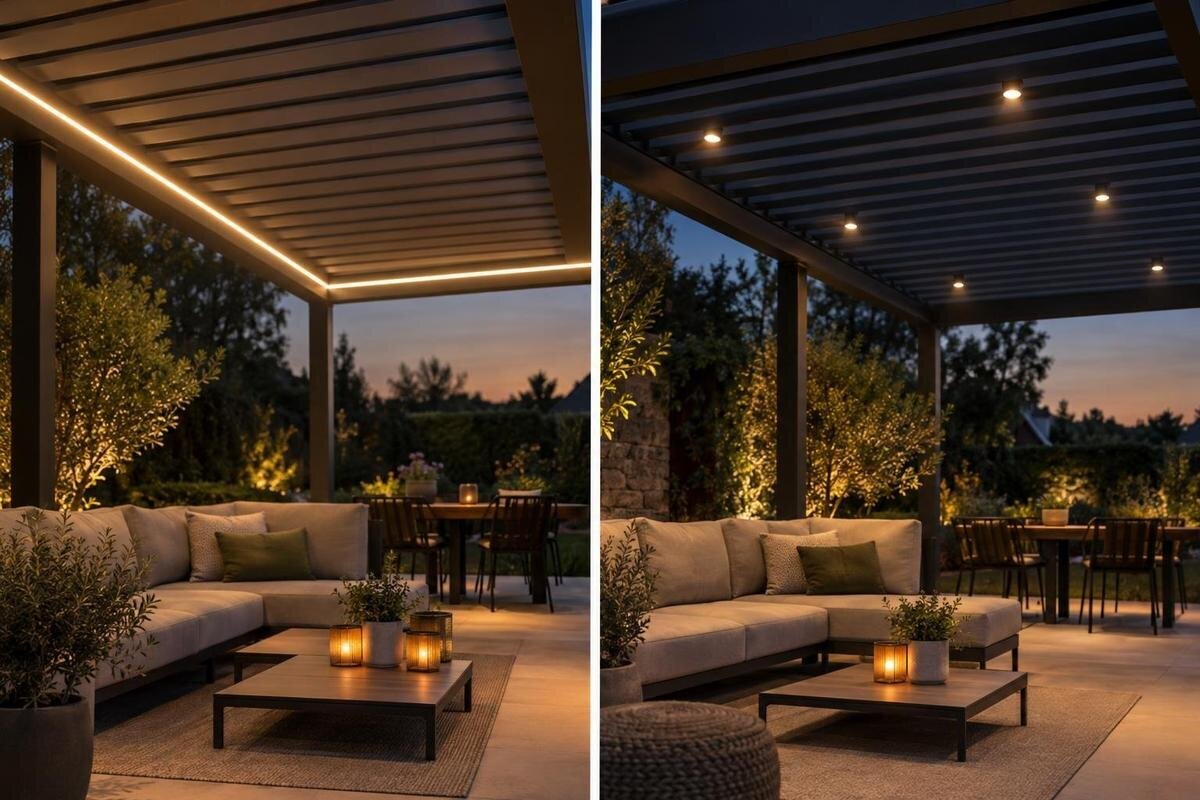
Pergola lighting
LED strips and spotlights can both make a pergola usable after sunset, but they distribute light differently. A strip traces a line along its approved mounting position; spotlights create separate pools whose reach depends on the exact beam and spacing. Neither option is automatically more even, lower-glare or easier to maintain. The useful comparison begins with the positions the pergola manufacturer actually permits, then considers the light pattern, what people see from their seats and how each fitting will be serviced. Check the exact fixture instructions and outdoor suitability before treating any location as a viable option.

What to verify before choosing 1
LED strips and spotlights create different light patterns
An LED strip creates a line of light along its installed length. With the right diffuser or profile, it can look more continuous than a row of separate points, but that appearance depends on the particular strip, cover and viewing angle. It is still a linear light source: illumination across a table or the floor varies with distance from the strip, the direction of its light, its beam pattern and nearby obstructions. A beam or edge that hides the strip from view can also block some of its light. An unbroken run may avoid visible gaps along that line without guaranteeing uniform illumination elsewhere. Compare the effect on the occupied area, not just the line visible from below.
Spotlights send light into distinct beams or pools. They can direct attention to a selected area when their approved location, beam spread and aim line up with it, yet gaps may remain between pools. A wider beam or closer spacing can change how those pools meet, while a narrow beam may leave a smaller bright area with darker surroundings. The number of spots alone tells little about coverage. For a fair comparison, use the beam angle and light-output information for each exact fitting and draw where the light falls at the intended mounting height. Also check whether each spotlight is fixed or adjustable; a plan must not assume it can be tilted towards a target. Compare the edge of each lit area as well as its brightest point, because smoothness and usable light are not the same thing.
Supported mounting positions set the real choice
Begin with the exact pergola drawing and instructions, not a product photograph or an assumed mounting surface. Identify the positions approved for lighting, any permitted orientation, the usable run length and the routes reserved for wiring. These mounting options can determine whether a long strip run is possible or whether spots can be spaced and aimed where needed. For a Bloomcabin Pergola configuration, ask for the drawing for the chosen size and layout. Separate the pergola’s overall dimensions from the space available for fixtures: a frame member that looks convenient is not automatically an approved mounting location. Record these restrictions before comparing the two light patterns.
No generic rule says that every beam, perimeter edge or underside can carry a fixture. A strip needs a suitable, approved continuous mounting path and a clear answer about corners, end connections and any maximum run; spotlights need approved points with enough room for the fitting and its required clearance. If a roof element or other component moves, verify that the fitting and cable remain clear throughout the permitted movement. If the supported positions do not deliver the desired pattern, choose another documented arrangement rather than adding holes or attaching a light to an unapproved part. Treat any proposed mount outside the supplied drawing as a question for the manufacturer, not an installer guess.
What to verify before choosing 2
Light coverage depends on the beam layout
Draw the pergola plan and mark the approved fixture locations before judging coverage. Add the table, chairs, circulation route and the places where people actually sit or stand; then sketch a strip as a line and spotlights as separate beam areas using the fixture’s published distribution information. A simple plan makes omissions visible: a row may miss the ends of a table, while a line along one edge may leave the opposite side in shadow. A side view helps show whether beams or trim interrupt the light path. Keep the drawing tied to the actual model and configuration, rather than generic diagrams. Do not assume that a centreline gives equal coverage on both sides.
Surroundings affect the result too. A nearby wall, fence or pale surface may reflect light back into the pergola, whereas an obstruction can cast a shadow; neither effect is captured by counting fittings on a plan. Compare vertical surfaces as well as the tabletop or floor. On the configuration drawing for a Bloomcabin Bioclimatic Pergola, mark where the proposed light paths pass structural edges or screens. A strip may cast a continuous shadow along an obstruction, while a spotlight’s beam may be partly blocked. If a structural component moves during use, include its permitted positions in the comparison rather than judging coverage from a single view.
Glare changes with the viewing angle
Glare is about what the eye sees, not simply whether a fixture points downward. A strip can appear as a long bright line when it sits directly in a seated person’s sightline; a cover may make the points less distinct but cannot make an overly bright source disappear. A spotlight presents a smaller source, which can still look intense when viewed directly. Its beam might also strike a light-coloured table, glazing or a wall and create a bright patch. Fixture brightness, shielding, angle and surface finish all matter, so neither format is automatically gentler on the eyes. People who use the space from different seats may see the same fitting differently.
Mark eye positions at the main chairs and standing routes on the drawing, then draw a sightline to each proposed fitting. Repeat from the entrance and nearby windows if they are part of the view; a source that is comfortable from the table may be conspicuous on approach. For a Bloomcabin Wall-Mounted Pergola, compare views towards the wall with views towards the open sides, using the approved fixture positions on the exact layout. If samples are available, view the actual fitting and diffuser at the intended angle. Note whether the light itself or its reflection catches the eye, and which seats are affected. This gives each option a more useful glare assessment than its appearance in a product photo.

What to verify before choosing 3
Continuous strip runs and spotlight spacing
With a strip, check whether the approved run can stay continuous where the design needs a continuous line. Corners, interruptions at posts, joins and end caps can create visible breaks, and some systems specify where a run may be cut or reconnected. Do not assume a strip can be trimmed to any length or bent around an angle; the exact manual should state what is allowed. Decide whether a straight section is enough or whether each turn needs a documented connector or different fitting. The final run should be based on available, approved mounting length rather than the perimeter you would ideally like to illuminate. Consider how a break will read from the patio as well as beneath the frame.
Spotlight spacing should follow the fitting’s beam information at its intended mounting height, not a standard distance copied from another pergola. If adjacent light pools overlap, coverage may look smoother; if they remain separate, dark bands can appear between them. A narrower beam can make each pool more distinct, while a broader one may cover more area but still be interrupted by structural members or furniture. When comparing layouts for the regular Bloomcabin Pergola model, show the full pattern before changing the fixture count. Check where adjacent beams meet across the table and walking routes, rather than judging spacing only along the frame. Additional fittings are useful only if their permitted positions address the gaps.
Replacement access matters over time
Maintenance depends on the whole strip assembly, not just the LED tape. Check whether the selected system uses a replaceable section, a continuous assembly, a separate diffuser or a driver or control component, and which parts the manufacturer identifies as serviceable. Some products permit only specified cut points or connectors; others must be replaced as a larger unit. Ask how to identify the correct replacement component and whether access to end connections is required. Do not assume an LED tape can be peeled off and swapped without checking its installation method or instructions. Include the access needed to remove a cover, if the system has one.
Spotlights are not automatically easier to service: some use a replaceable lamp, while others have an integrated light source or require replacement of the complete fitting. Confirm the exact model, service steps and whether a driver is separate, then consider how a technician can reach it without removing structural parts. For a Bioclimatic Pergola model, assess access to the proposed lights, connections and fasteners on its configuration drawing. Keep the pergola and fixture details together so a future repair does not depend on guessing which component was installed. Record whether a failure means changing one fitting, one strip section or an entire run; that distinction is more useful than assuming either format is simpler to maintain.
What to verify before choosing 4
Match the pattern to the main use
Choose by the effect you need at the main occupied area. If you want a continuous visual line and broad light along a length, an approved strip run may be the more relevant option to compare; if you want defined pools over selected places, spotlights may suit that aim when their beam and mounting points support it. Those are tendencies, not guarantees: a strip can leave a table dim, and a spot can spread widely. Check the actual distribution and whether the fitting can be directed; not every spotlight is aimable. If reading or serving is a priority, confirm the light reaches that surface without putting the bright source in the normal view.
Do not treat the choice as a contest between more fittings and fewer. A combination can be useful where a continuous line and targeted pools address different parts of the space, provided both fixture types and their electrical arrangement are supported. For the wall-mounted model, compare coverage near the wall with coverage in the more open area. Keep the comparison centred on your main priority: does the strip illuminate the surface you use, or would a spotlight at a permitted position reach it more effectively? If one type meets the need, adding a second system creates more components to control and service without necessarily improving the result.
Controls must suit the exact fixtures
Check control compatibility against the exact fixture, not only against the words LED strip or spotlight. Dimming is not universal: the light source, driver or power supply, controller and dimmer must be specified to work together. A strip system may use a separate driver, while spotlight arrangements vary by product; do not assume that a control shown with one model applies to another. If dimming is important, request the permitted control method and any limits from the fixture documentation before settling on a layout. A compatible fitting still needs a suitable installation plan; compatibility is not evidence of an approved mount. Check whether the control is included or merely shown in an illustration.
Decide whether all lights should switch together or whether separate areas need independent control, then record that alongside each proposed mounting point. More groups can change cabling and control requirements, so have the electrical professional review the actual plan rather than adding controls later. For a bioclimatic pergola configuration, list the selected fixtures and their compatible controls in one schedule. Distinguish what is included from what must be selected separately, and identify which lights each control operates. The electrician can then review power and connection details using the relevant manuals. This is a planning schedule, not a wiring diagram or permission to route cables through the structure.

What to verify before choosing 5
Outdoor suitability and mounting approval
An open-sided pergola can leave fittings exposed to conditions that an indoor fixture was never designed for. Check the exact product documentation for outdoor suitability at the exposure of the proposed position, including likely water contact, moisture and temperature conditions; a broad outdoor label may not answer every location-specific question. The same caution applies to the power supply, connectors and controls, not only the visible lamp. Compare complete system information for each option. A strip sold for outdoor use is not automatically suitable along every beam, and an attractive spotlight housing does not establish a rating. Ask a qualified professional to interpret suitability where exposure is uncertain.
Electrical suitability and pergola mounting approval are separate checks. Confirm that the manufacturer permits the specific fitting, orientation, fastening method and cable route on the chosen structure, then have a qualified electrical professional review the fixture instructions and connections. Do not drill a convenient-looking beam or assume the pergola is a sealed or weatherproof enclosure. When reviewing Bloomcabin’s regular pergola, distinguish documented lighting options from accessories that merely appear compatible. Keep the approved positions on the final plan so the structural and electrical reviews refer to the same arrangement. Neither an outdoor rating alone nor an available mounting point answers both questions.
Compare the options on one plan
A side-by-side plan can make the decision clearer than comparing pictures of one strip and one spotlight. Draw each option only at documented mounting points, using the fitting’s distribution data; mark the table, chairs, entrances, beam obstructions and seated sightlines. Then compare three outcomes separately: whether the occupied area is covered, whether the source is visible from normal viewpoints, and whether a failed component can be reached and replaced as specified. This keeps a smooth-looking perimeter line from being mistaken for useful task coverage, and it prevents attractive isolated pools from hiding gaps. Record what remains unknown as an approval or specification question, not an assumption. If useful, label each uncertainty by who can answer it.
Summarize the comparison with the exact fixture models, their proposed positions, controls and replacement arrangements. Keep unanswered questions specific: whether a strip can span an interruption, whether a spotlight can aim at the table, or whether a connection remains accessible. Resolve those details with the supplier, manufacturer or electrical professional responsible for them. If no supported position produces the pattern you want, reconsider the fixture type or layout rather than adapting the structure yourself. There does not have to be a universal winner. One arrangement may provide smoother coverage, while another offers more focused light or simpler replacement; choose according to the priorities that matter in your pergola.
Frequently asked questions
Which gives more even light under a pergola: LED strips or spotlights?
Neither does so automatically. A strip creates a linear source, while spotlights create separate beams. Even coverage depends on the specific fixture, its approved position, mounting height and how the light patterns meet. Compare the manufacturers’ distribution information on a drawing of your pergola rather than assuming a strip is uniform or spotlights will leave gaps.
Are LED strips less likely to cause glare than spotlights?
Not necessarily. A strip may appear as a bright line from a seat, while a spotlight can be an intense point in direct view. The result depends on the actual fitting, its position, shielding, brightness and surrounding surfaces. Check sightlines from the places where people will sit and stand.
Can I cut an LED strip to fit a pergola beam?
Only if the instructions for that exact system permit it and specify how the cut end or connection must be handled. Check the permitted cut points, connectors and maximum run before planning the layout. Have a qualified electrical professional review any proposed outdoor installation.
Are LED strips easier to replace than spotlights?
Not by default. A strip may be serviceable in sections or only as a larger assembly; a spotlight may have a replaceable lamp or an integrated light source. Check the exact product instructions, service access and the parts identified for replacement before comparing upkeep.
Can I use both strips and spotlights?
Potentially, if both fixture types have documented, approved positions on the specific pergola and the electrical and control arrangements support them. A combination is not automatically better: compare its coverage, glare and replacement access with a simpler layout, and have a qualified electrical professional review the plan.
LED strips suit a continuous visual line when a permitted run delivers the coverage you need. Spotlights offer distinct pools when their supported positions and beam patterns align with the places you use. Compare both from the same seats and on the same plan, including access for replacement. The stronger choice is the one that provides useful light with acceptable glare and a manageable service arrangement—not simply the one that looks more attractive in a catalogue.
