
Why Do Pergola Louvers Drip When Opened After Rain?
Pergola rainwater and operation
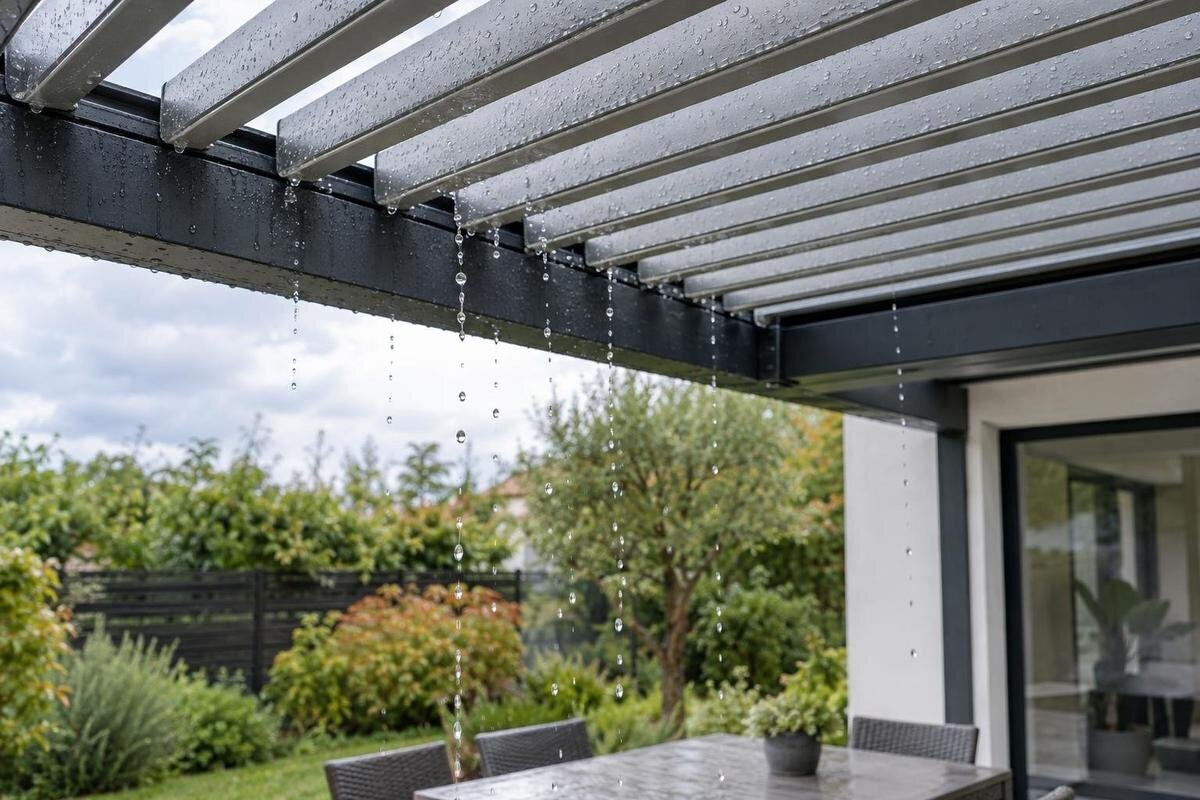
Seeing drops fall as a louvred pergola opens after rain does not, on its own, prove that the roof is leaking. Water may remain on a blade, around an end detail or in part of the roof’s collection route, then move when the louvres turn. The exact source and intended operating practice depend on the roof design and configuration. This guide explains what the timing and location can tell you, what to inspect safely and why the drainage diagram for the precise model matters.

Questions for buyers 1
Why movement releases water after the rain
When rain falls on a louvred roof, it does not necessarily leave every blade at once. Depending on the blade profile and its angle, a thin film or separate beads can remain on the upper face, near a lip or around an overlap. Surface tension may hold a bead in place after the main flow has passed. How much remains also depends on the roof’s position during and after rainfall. A roof that looks as though it has drained from below may still have small amounts of water on surfaces that are difficult to see from the patio.
When the blades rotate, their low edges change position and the surfaces holding water tilt. A bead can move to a new low point and fall; movement may also expose an edge or channel that was covered at the previous angle. That can explain a brief release on the first movement, even after the rain has stopped. It does not prove that every drop is harmless, or that the roof is leaking. Whether a particular amount or location is expected depends on the exact design and its operating instructions, not on a universal rule for louvred roofs.
Where water may remain in a louvred roof
Water can fall from a different point than the one where it collected. A drop may run along a blade edge, pass around an end detail or track beneath a surface before detaching. Some roof designs direct water towards a perimeter channel; others use a different collection route. Wind can shift a falling drop as well, so the spot where it lands on the deck is only one clue. Note the blade row, edge or frame section above the drip, and whether the same point appears again. For an existing Bloomcabin Bioclimatic Pergola, confirm the name and selected configuration before seeking its drainage information.
Pay attention to what happens as movement begins, not just where the blades end up. If the model’s diagram shows water travelling from the blades into a gutter or channel, a drop may emerge at a joint or outlet farther along that route. The diagram can help establish whether that is an intended discharge point. Without it, do not assume that every frame edge is a gutter or every post is a downpipe. Water visible underneath may have travelled from above; a drop by itself does not prove that water passed through a failed seal.
Questions for buyers 2
Timing and drip location are useful clues
Note whether the first drop appears as a blade starts to turn, only at a particular angle, or after movement has stopped. Also record whether the drops stop shortly afterwards or continue at a steady pace. These details are more useful than saying simply that the pergola drips after rain. They can help distinguish water released by movement from water arriving while the roof remains in one position, but timing alone cannot identify the cause: a drop may travel along a surface before appearing below.
Compare the pattern over more than one naturally occurring rain event if it is safe and practical; do not repeatedly cycle the mechanism just to reproduce the symptom. A shifting fall point may fit water being redirected as the blades move, while a drip that repeatedly appears at the same joint merits comparison with the drainage diagram. Wind can move the drop, and different rainfall can change the amount of water involved. If your unit is a Bloomcabin Wall-Mounted Pergola, include that exact model name in your notes; a general description such as louvred roof does not identify its drainage layout.
Follow the drainage route for the exact roof
Use a drainage diagram for the precise roof rather than a generic illustration of a louvred pergola. Follow the route from where rain lands, through the collection point and along any channel or gutter shown, to the designated discharge. Designs differ: a diagram may show a perimeter route, collection within part of the frame or another arrangement. Treat these as possibilities to verify, not features to assume. The operating instructions matter too, because a drawing of the stationary roof may not explain what happens while the blades are moving.
Ask for documents that match the named model and configuration, and clarify any stated limits or operating conditions. The Bioclimatic Pergola product page lists sizes from 9 to 24 m²; that range identifies available sizes but does not show where a selected roof sends rainwater. When reading a diagram, identify which side of the roof it shows and how that view relates to the place where you observed the drip. Keep the blade edges, collection channels and discharge points separate in your notes rather than treating them as one continuous visible surface. If a drawing shows only the closed position, ask which parts of the water path remain relevant when the blades turn. A product photo can help identify appearance, but it is not a map of hidden gutters, outlets or internal water paths.

Questions for buyers 3
Operate the louvres by the model’s instructions
Do not assume that all louvres should be opened immediately after rain, held at one particular angle or left closed for a fixed period. There is no universal waiting time that can replace the instructions: the mechanism, blade profile and drainage design vary. Follow the operating guidance for your exact model, including any restrictions on when movement is permitted. If the manual does not explain post-rain operation, ask the supplier or installer instead of borrowing a sequence from another pergola.
When movement is permitted, allow for the possibility that residual drops will fall as the blades change angle. Let people using the area know, and move cushions or other items that could be damaged before operating the roof. A brief release can still be inconvenient even when its source is understood, so distinguish the question of where the water comes from from the practical question of what is underneath it. Use the controls as directed; do not force a blade that hesitates, bypass a stop or keep cycling it in an attempt to drain it. If you are considering the Bloomcabin wall-mounted pergola, ask how its operating guidance addresses reopening after rain so you can plan everyday use of the covered area.
Visible checks that do not require dismantling
From a safe viewing position, look for obvious debris near a collection point or outlet shown in the model’s guide. Leaves or other visible material may help explain a change in flow, but their presence does not confirm that a channel is blocked. Look for water tracks, staining or a consistently wet area as well as the drip itself. Record what is visible and where; avoid reaching up or climbing onto the roof just to trace a suspected route.
Only clear material that the manufacturer’s instructions describe as safely accessible. Do not poke into outlets, remove covers, dismantle parts or use a cleaning method that the manual does not recommend. Keep a visible observation separate from a diagnosis: a leaf beside an outlet is something you can report, whereas a blockage inside that outlet may not be visible. Likewise, a water track shows where water has travelled, not necessarily where it first collected. If the route cannot be inspected safely from the ground, leave it to a qualified installer. Use the Bloomcabin Pergola listing to help identify the model when requesting cleaning guidance, and specify which collection point or outlet you can actually see.
Questions for buyers 4
When repeated dripping needs a closer inspection
A release that happens only as the blades move is different from water that repeatedly escapes from one place while the roof is stationary. A continuing drip, a new stream at a joint, or water emerging somewhere not shown as a discharge point calls for a closer look. These observations do not prove a particular fault: an obstruction, a damaged or displaced component, a seal issue or an installation concern are among the possibilities an installer may need to assess. Compare what you see with the drainage diagram before drawing a conclusion.
A change from the roof’s usual pattern is worth describing clearly. Separate a single release during opening from a drip that resumes after movement has stopped, and distinguish scattered drops from water repeatedly emerging at one joint. These are observations, not diagnoses; calling every instance a leak can obscure the difference between retained water and an unexplained escape along the drainage route. An installer can use that distinction when deciding what needs inspection. If your roof is the Bloomcabin Wall-Mounted Pergola model, identify it by name and configuration when arranging an assessment. Explain whether the pattern is new or has occurred since installation, without assuming that either history establishes the cause.
How rain, wind and freezing conditions affect the pattern
Rainfall and wind can change how much water reaches a collection route and where drops land. Wind may carry rain towards exposed edges or push a falling drop away from its source. A drip observed during one shower therefore cannot establish how the roof will behave in every weather condition. Use the model’s stated weather limits and test conditions when assessing performance; do not interpret a brief release during movement as a guarantee of performance in heavy or wind-driven rain.
In freezing weather, water left on the roof can freeze, and ice may prevent normal movement. Do not force the louvres if ice is present; follow the model’s instructions or ask a qualified installer how to proceed. Keep the conditions in your notes: an observation made when ice is visible should not be treated as equivalent to one made after rain without freezing conditions. If you are assessing the bioclimatic pergola model for your site, ask how its weather guidance addresses both drainage and permitted operation. The useful question is whether the documented conditions match the use you have in mind, rather than whether the product name suggests an unrestricted storm, rain or snow guarantee.

Questions for buyers 5
Questions to ask before choosing a louvred pergola
Before buying, ask how rainwater is collected and where it is discharged for the exact roof configuration. Request the drainage diagram and the instructions for operating the blades after rain. Check whether the documents describe any operating conditions, weather limits or maintenance access that matter for your intended use. Ask specifically whether they explain water released during opening, rather than accepting an answer that covers only the stationary, closed roof. These are different parts of the same buying question: how the roof handles rain and what to expect when using it afterwards. If you are planning an enclosure, ask which enclosure configuration is suitable for that model and whether it affects access to the drainage route. Have the supplier distinguish features included in your selected configuration from options shown elsewhere.
Consider where the documented discharge points would fall in relation to your planned seating, doors and walking routes. Mark those locations on your proposed layout, along with the places where cushions or other moisture-sensitive items would normally sit. This does not guarantee that every drop will land in one place, but it makes the intended water path easier to discuss before installation. Ask separately about discharge from the drainage system and residual drops during blade movement; an answer about one may not explain the other. The Bloomcabin Pergola product page can identify the model you are considering. Pair that reference with the drainage information for your selected option so the discussion concerns the roof you would actually buy.
How to describe the drip to an installer
Keep a short record the next time rain is followed by permitted louvre movement. Note the date, general weather, roof position during the rain, when movement began, the first place you saw a drop and whether it stopped or continued. If the drip appears at a particular angle, include that detail. Use a consistent description of location, such as the blade row nearest a particular side, rather than switching between the point overhead and the spot where water lands. If you take a photo or short video from a safe position, explain which part of the roof it shows. Do not create extra operating cycles to gather more data; an observation during normal, instructed use is safer and more useful than repeatedly trying to reproduce a symptom.
Present what you observed separately from what you think caused it. For example, say that drops appeared from one blade edge during opening and stopped afterwards, rather than labelling the event a failed seal without an assessment. Compare your record with the drainage diagram and operating instructions, and identify the point you cannot explain. If the diagram is unclear, ask the installer to relate that specific point to the intended water path. A brief release may be consistent with retained water, while a persistent or repeatedly misplaced drip still needs explanation. This gives the assessment a clear question to resolve: whether the observed timing and location fit the exact roof’s design, and what requires attention if they do not.
Frequently asked questions
Do a few drops mean the pergola is leaking?
Not necessarily. Drops released as the louvres turn may be water left on a blade or in part of the drainage route. Repeated dripping from the same unexpected joint, or water that continues to escape while the roof is stationary, should be compared with the model’s drainage diagram and assessed if the cause is unclear.
How long should I wait after rain before opening the louvres?
There is no universal waiting time. Follow the operating instructions for the exact roof. If they do not explain post-rain operation, ask the supplier or installer rather than borrowing a timing rule from another pergola.
Why do the drops fall at one particular louvre angle?
As a blade turns, its edges and low points change position. A bead of water may travel until it reaches an edge or opening, then fall. Note the angle and location, but use the model’s drainage information to judge whether that release is expected.
Should I open and close the roof repeatedly to drain it?
No. Repeated movement may release more water without identifying its source. Operate the louvres only as the exact model’s instructions allow, and do not force a blade or mechanism that hesitates.
Can I clear a pergola drainage channel myself?
Only do cleaning that the model’s instructions describe as safe and accessible. Do not climb onto the roof, remove covers or poke into an outlet to investigate. If the route is not safely visible or the drip keeps returning, have a qualified installer assess it.
A drip as the louvres begin to move can come from water retained on a blade or along the roof’s drainage route, released as the surfaces change angle. That is a possible explanation, not proof that every drip is expected. The timing, repeated location and behaviour after movement stops are useful clues. Compare them with the model-specific drainage diagram and operating instructions; if water keeps appearing at an unexpected point, a qualified installer can assess the exact roof.
