
Should Pergola Louvres Be Open or Closed in Strong Wind?
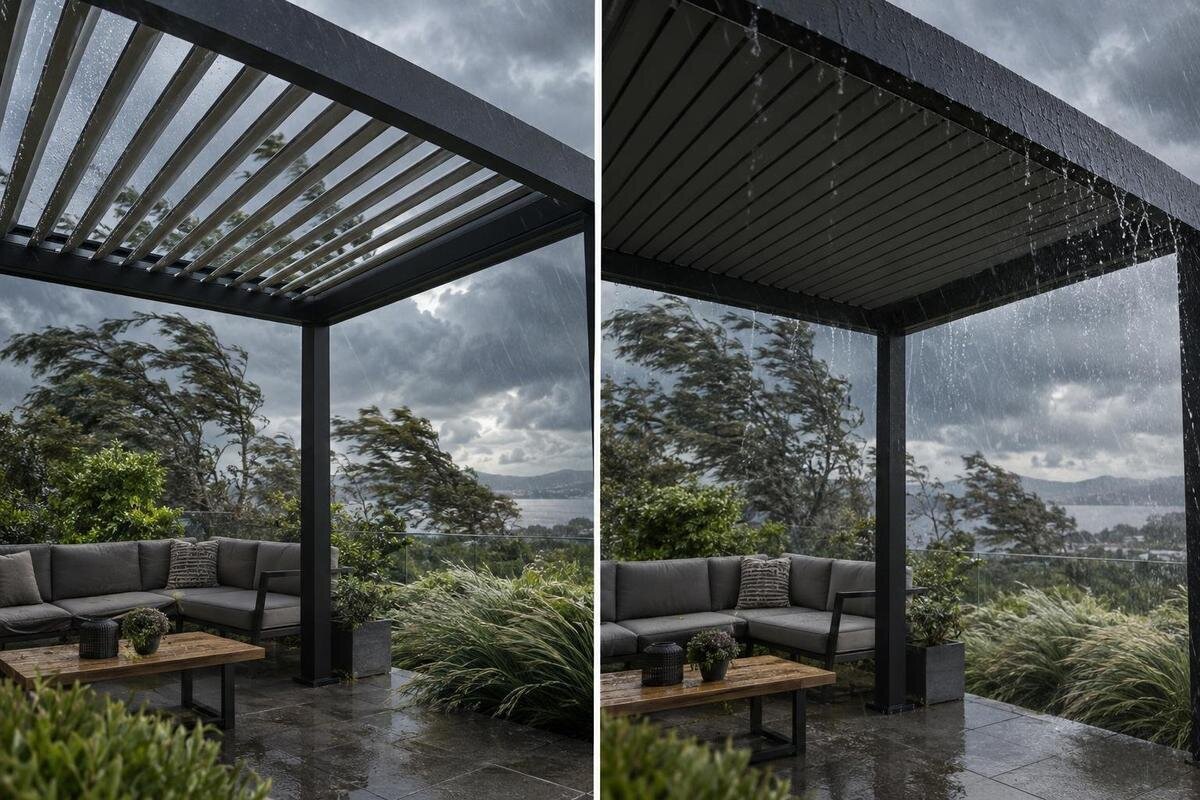
Pergola wind operation
If you’re asking whether to open or close pergola louvres before strong wind, there is no safe universal setting. The correct position—and whether the roof should be moved at all—depends on the current operating instructions for the exact model and installed configuration. Open blades leave gaps through the roof; closed blades form a more continuous surface, but neither observation identifies the lower-risk position. Find the relevant manual and wind documents before conditions deteriorate. Don’t borrow a rule from another pergola or treat a product image as operating guidance.

What to check before buying 1
Why there is no universal louvre position
A louvred roof changes shape as its blades rotate. With the blades open, air can pass through more readily than when they are closed; closed blades form a more continuous plane. Both arrangements are exposed to wind, but in different ways. Those broad observations explain why position matters; they do not tell you which position the manufacturer permits. Blade design, pivots, supports, operating mechanism and the assembly described in the documents are product-specific. Wind direction and changing gusts also affect conditions around a pergola, so a visual guess cannot replace the operating procedure.
Two familiar rules—open the roof so wind passes through, or close it so the blades cannot move—sound decisive but leave out details that matter. Wind can shift direction and behave unevenly around buildings, fences and other obstacles; conditions at your pergola may not match a general forecast point. A setting used on one model, or shown in one demonstration, is not automatically suitable for another. Instructions may distinguish ordinary use from a designated weather or resting position, too. Treat “strong wind” as a prompt to consult the exact manual, not as a direction to choose either state.
Identify the exact pergola and configuration
Begin with the paperwork for the unit in front of you, not a photo or generic product description. Record the exact product family and model code, any size or configuration shown on the order, and the revision or date printed on the manual. Note whether the pergola is freestanding or wall-mounted, and list any screens, glazing or other components included in the installation. The Bloomcabin Pergola product listing can confirm the catalogue family name and lists areas from 9 to 24 m²; that range identifies available sizes, not a wind limit or operating instruction.
Keep purchase and installation records with the manual, and check that they refer to the same product and revision. If the order uses a shortened name, ask the seller to confirm the full identifier in writing. Copy any identification label or serial number exactly rather than relying on the family name alone. Don’t select a manual because the roof looks similar, the louvres have the same colour or a page photograph resembles yours; appearance may not distinguish the model or its controls. For a second-hand unit, ask which documents came with it and whether anything was added later.
What to check before buying 2
Find the model-specific wind instructions
Look beyond an assembly booklet or short product summary for current owner instructions covering use, roof operation and weather. Check sections on wind, storms, louvre operation, shutdown or safe use, including warnings in footnotes and diagrams. Find out whether the document tells you what position to use before wind, what to do once it is present, and when operation must stop. Record the exact words for any required position rather than paraphrasing them as simply “open” or “closed.” If no instruction addresses wind or blade movement, the absence of a statement is not permission to improvise; ask which separate document applies.
Read each limit with its definition. If a document gives a wind speed, note its units and whether it means sustained wind, a gust or another measure. Check whether it applies while operating the roof, leaving it in a position or to the installed assembly, and ask how the wind was measured. Find out whether the guidance assumes a certain louvre angle or side configuration. Don’t turn an undefined phrase such as “wind-resistant” into a personal threshold, or substitute a weather-app reading for a missing definition. The Bloomcabin Bioclimatic Pergola listing helps confirm the catalogue family name; the operating instructions still need to match the product on your order.
Separate operating limits from test results
Weather information can describe different things: an operating limit, an observation under controlled conditions or a result from a specified test. Those statements are not interchangeable. An operating limit tells you what the manufacturer allows during use or adjustment; an observation records what happened in the conditions observed; a test result applies to its stated method and setup. None, by itself, answers whether to open or close the louvres in every strong wind. A number on a page should not be read as a promise that every installation will behave identically.
Ask what the reported condition included: the exact roof model and position, wind direction, assembled configuration, side panels and what was being assessed. A controlled observation at one blade angle cannot automatically establish behaviour at every angle. Check whether a stated figure applies while the roof is moving or only while stationary. When considering the Bloomcabin Wall-Mounted Pergola, ask whether the reported result covers the mounting arrangement being quoted, rather than treating the model name as a description of your wall connection. If the paperwork uses “rating,” “resistance” or “limit” without defining the expected user action, request an explanation in plain language.

What to check before buying 3
Check the exact louvre position the manual names
Don’t assume “open” and “closed” are precise enough for a decision. The instructions may refer to fully open, fully closed, a specified angle or a designated resting position; use the wording and diagram for your model. A drawing may show a position for ventilation or rain rather than one for wind. Check the caption or legend: is it a required setting, an example or simply an illustration of the movement range? If a partial opening appears without a named position or angle, ask what the manufacturer means instead of estimating by eye. Treat a named resting or storm position as distinct unless the instructions say otherwise.
Follow only the documented control method and any stated conditions for moving the roof. A position does not automatically mean the blades are locked, the mechanism is protected or the roof can be left unattended in every type of weather. Don’t push, tie, brace or bypass components to force a position unless the manufacturer explicitly describes that method. If a control stops or the blades do not respond normally, don’t keep trying commands; use the manual’s troubleshooting instructions. Before choosing the regular Bloomcabin Pergola, ask how the instructions identify the required position and how the user can recognize it with the supplied controls.
Confirm when roof movement is permitted
Find out whether the manufacturer permits moving the louvres once wind is already gusting. A procedure might require action before a defined condition, specify a position during certain weather or prohibit adjustment while wind is in progress; none should be assumed. If the manual gives a trigger, confirm how it is described and whether it refers to forecast or observed wind, and what measure it uses. Don’t wait until the roof is exposed to a gust to test whether a control still responds. If the instructions do not say what to do once wind begins, request a model-specific answer before trying to move the roof then.
Make the plan practical before a windy forecast: keep the instructions accessible, identify the approved control, and make sure everyone likely to use it understands the same named position and any limit on movement. Don’t experiment with repeated adjustments to see which state “feels” steadier, or invent a forecast threshold from experience with another structure. If you’re comparing the bioclimatic pergola option, include permitted roof movement in your questions about day-to-day use: who will operate it, and which instructions will they need to follow? Keep any separate procedures for ordinary use and storm preparation clearly identified so household members do not confuse them.
What to check before buying 4
Match the guidance to mounting and enclosure
Side enclosures can change how air reaches and moves around a roof, so a wind instruction for an open-sided pergola may not automatically cover one fitted with screens, sliding panels or glazing. The effect cannot be inferred from material or appearance alone; check the configuration described in the manufacturer’s documents. See whether they cover the roof by itself, the complete assembly or optional enclosure components in a specified position. If panels can be open, closed or retracted, note which arrangement the guidance addresses. A closed panel changes the setup, but that fact alone does not say whether louvres should be open or closed.
Confirm the mounting type and additions before comparing instructions. Freestanding and wall-mounted pergolas are not interchangeable terms in the paperwork; neither category by itself proves an installation is more or less suitable for wind. For a quote involving the wall-mounted pergola model, make sure the order describes the mounting arrangement and any selected enclosure components. If your setup differs from the one shown in the documents, give the supplier or qualified installer the exact model and a clear description of the installed components, then ask whether the guidance covers it. Include the position of any panels, not just whether they are fitted.
Keep drainage information separate from wind guidance
Drainage diagrams and wind instructions answer different questions. A drainage drawing may show the intended route for rainwater through roof channels and outlets; it does not, by itself, tell you how to position louvres in strong wind. A position drawn for rain management is not automatically a wind setting. If rain and wind are expected together, consult the separate instructions for each condition rather than assuming that a drainage diagram proves the roof is watertight or suitable for every storm. Read each illustration for the purpose stated in its title or notes.
Check the title, model identifier, revision and notes on every drawing. A brochure for a similar-looking roof or a diagram without a matching model reference cannot settle a model-specific operating question. When reviewing documents for the Bloomcabin Pergola range, keep drainage drawings and roof-operation instructions separately labelled so their purposes remain clear. If a drainage diagram and wind sheet seem to show different roof positions, ask which instruction applies when wind and precipitation occur together. Keep the answer with both documents, including the relevant diagram reference, so nobody later mistakes an illustration of a water route for a louvre operating rule.

What to check before buying 5
Documents to request before buying
Ask to see the current operating instructions and any model-specific weather-performance sheet for the exact item being quoted. Record the model and document revision, mounting type and chosen enclosure; the permitted louvre state during strong wind; any defined wind limit and what it means; whether you can move the roof once gusts begin; and whether the documents cover your selected configuration. If an observation or rating is cited, ask which setup and louvre position it describes. These details are more useful than a bare claim that a pergola is “wind rated.”
Ask the seller to answer unresolved points in writing and attach the response to the quote or order record. Request the user action, not only a performance number: what should you do, and when does that instruction stop applying? If the Bloomcabin Bioclimatic Pergola is on your shortlist, use these questions when reviewing its quote rather than judging wind operation from the catalogue description alone. Keep unanswered questions visible in your comparison notes. If the manual will be supplied only after purchase, ask about model-specific wind guidance before committing rather than discovering the gap as a storm approaches.
When instructions are missing or conflict
If a manual is missing, unclear or inconsistent with a sales page, don’t settle the question by choosing whichever answer sounds more plausible. Contact the manufacturer or supplier with the exact product identifier, manual revision, mounting type and enclosure details. Point to the sentence or diagram causing uncertainty, then ask for a written answer: which louvre position is permitted, under what wind condition, and whether adjustment is allowed once wind has started. General reassurance that a pergola is made for outdoor use does not answer those operating questions.
When two documents differ, note their dates and ask which version applies to your model and configuration; don’t assume that a later general brochure replaces a model-specific instruction. Keep the reply with the manual so other household members do not have to interpret the same ambiguity. If the roof moves abnormally or appears damaged, don’t try to correct it with an improvised position or repair; stop using it and seek guidance from the manufacturer or a qualified professional. The aim is to have a clear procedure before the next windy period.
Frequently asked questions
Should pergola louvres be open or closed in a windstorm?
Neither position is universally safest. Follow the current instructions for your exact model and installed configuration. They should identify any permitted position or wind-related limit. If they do not say what to do, ask the manufacturer or supplier for model-specific guidance rather than relying on a general rule.
Can I adjust the roof after strong gusts have started?
Only if the instructions for your model allow operation in those conditions. Guidance for preparing the roof before wind may differ from instructions for wind already underway. Don’t test the controls in a gust or force the blades; ask the manufacturer if the manual does not explain when adjustment is allowed.
Does a wind rating tell me which louvre setting to use?
Not necessarily. A stated figure could describe an operating limit, a controlled observation or a result under specified test conditions. Check what it applies to, which roof position and configuration it covers, and what action it calls for. Ask for clarification if the document does not make those points clear.
Do side screens or glazing change the wind instructions?
They can change the installed configuration, so check whether the manufacturer’s guidance covers your exact arrangement. Don’t assume that instructions for an open-sided pergola apply when panels or screens are fitted. Include their positions and the mounting type when asking for advice.
Can a drainage diagram or product photo settle the question?
No. A drainage diagram addresses water routing, and a photo illustrates a product; neither establishes the permitted louvre position in strong wind. Match the model identifiers on your documents, then use the operating instructions or ask for a model-specific answer.
The answer is not determined by whether the blades look as though they let wind pass through or form a cover. It comes from current instructions matched to the model and its actual configuration. Before a windy forecast, know the permitted position, any stated limit and whether movement is allowed once gusts begin. If the documents leave those points unanswered, request written clarification specific to your pergola. That keeps a design guess, catalogue image or result from another setup from becoming a rule for yours.
