
Pergola Privacy at Night: How Lighting Changes Views
Pergola planning guide
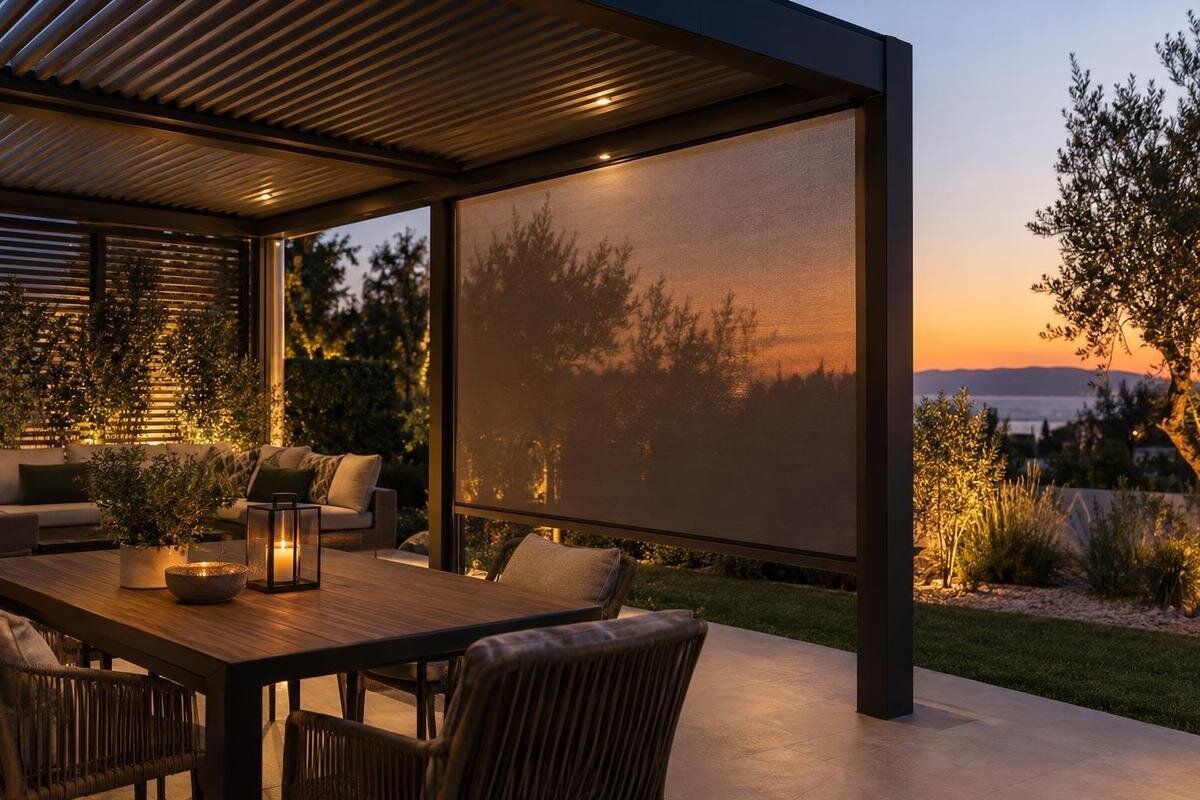
Privacy under a pergola can feel different after sunset because lighting changes how clearly people can be seen through a screen or pane. A fabric that seems concealing in daylight may reveal silhouettes when the seating area is lit, while clear glazing preserves sightlines. The reliable way to choose is to test the actual viewing angles with the lights, furnishings and routines you expect to use.

Why a pergola can feel less private after dark
A screen does not have one fixed privacy level in every lighting condition. What matters is the view through it, the contrast between a person and the background, and the brightness on each side. In daylight, the open yard may be much brighter than a shaded seating area, so an observer may notice the screen more than the people behind it. After dark, a pergola light or light spilling through a door can make occupants stand out against a darker yard. The material has not changed; the balance of light has. Twilight, full darkness and the moment a lamp switches on are separate conditions worth checking, and nearby house lights can shift the balance again.
That change is why a daytime glance or a fabric label is not enough. Open weave and clear panes leave direct sightlines; translucent material may soften details without hiding movement or an outline. A screen that looks solid in daylight may prove translucent when backlit; a genuinely opaque surface blocks direct transmission, though gaps and edges can still leave a view. Your eyes also adjust to bright and dark areas differently, so a view from a lit kitchen may not match one from a dark path. Judge from the observer's side, at more than one angle and distance. Movement and body outline may be noticeable even when facial detail is not.
Map the sightlines before choosing a screen
Make a simple overhead sketch of the pergola, house, lot boundaries and nearby vantage points before deciding what to cover. Mark where people sit, where they stand to serve food or move through the space, and likely observer positions: a neighbour's patio, a sidewalk, a gate, a bedroom window or an upper deck. For each observer, draw a line to the part of the seating area you want to conceal. Repeat from seated and standing eye levels inside; a panel that blocks one line may leave another open above or around it. Also mark the approach to the area, where someone may pause before sitting. Give each point a label so you can compare the same views during an evening trial.
Draw the sketch to the exact proposed footprint and orientation, not an idealised rectangle. The Bloomcabin Pergola product page can identify the model you are considering, but use confirmed dimensions for the selected configuration rather than treating a gallery image or model name as a scale drawing. Mark posts, doors, steps and any wall or fence that already interrupts a view. This helps distinguish one exposed viewing corridor from a request for privacy on every side, and shows whether the target edge is beside a window, a neighbour's yard or the seating end. Check seated and standing sightlines from both sides, not only on the plan.
What fabric screens conceal—and what they can reveal
Fabric privacy depends on construction and position, not just the words used to describe it. A closely woven, opaque material can stop a direct view through its covered area, whereas open mesh leaves sightlines that may reveal movement, especially when the person behind it is lit. A sheer or translucent panel can blur detail in daylight yet show silhouettes at night. Colour, texture, distance from viewer to fabric and contrast behind it all affect what an observer can make out. A small handheld swatch can look more concealing than a large panel because it gives no sense of the complete view. Note what lies behind the panel too; a high-contrast background can make outlines easier to see. With open weave, check oblique approach angles as well as a straight-on view.
If you are assessing fabric alongside a specific product, such as the Bloomcabin Bioclimatic Pergola page, ask which side treatments are approved for that exact model and whether they are included or separate. Do not assume that a third-party screen, catalogue photo or accessory shown with another setup comes with the pergola or fits it. Test a sample at the proposed position with a person and ordinary furniture behind it. Check both sides while the seating area is unlit, softly lit and at its normal evening brightness; note facial detail, movement and outlines, not simply whether the screen looks dark. Let the observer's eyes adjust before asking what they can recognize.
How glazing affects privacy at night
Clear glazing leaves a direct sightline: unless a covering or reflection obscures it, someone outside can see the seating area. Reflective glass can look mirror-like from one side when that side is brighter, but the effect changes with viewing angle and relative brightness. When the pergola is lit at night and the viewer is outside in darkness, the glass may reveal more of the interior rather than act as a mirror. At dusk, reflections can be strong on the brighter side; after dark, the brighter side may shift indoors. The same pane may reflect the garden at one hour and reveal the seating area later. Do not treat tint or a daytime reflection as guaranteed night privacy.
Frosted or otherwise diffusing glazing can reduce detail while still showing movement, shadows or a bright interior glow; it is not the same as an opaque wall. If the plan uses the Bloomcabin Wall-Mounted Pergola, confirm which glazing or side-panel combinations, if any, are approved for the precise configuration rather than assuming from the model name. Test the actual glass or film type from both directions, including a view through a house window and one from the yard. A sample seen at arm's length does not reproduce a full pane: reflections change across the surface, and a small sample cannot reveal what happens at its edges. Ask for the specified glass or film before arranging the trial.

Place pergola lighting with sightlines in mind
List every light source that may be on during an ordinary evening: pergola or wall fixtures, kitchen and living-room lights, task lamps, path lighting and a neighbour's porch light. Mark which fall behind people, which illuminate the screen itself and which are visible from outside. If a light is behind a person relative to a translucent screen, it can turn them into a strong outline. Light aimed through clear glazing can make the interior conspicuous; glare from a fixture can also make it harder to judge what an observer sees. Repeat with nearby outdoor lights on, because an illuminated doorway or yard changes the background.
If you are considering the regular pergola model, mark the seats, likely lights and observer positions separately on your plan; do not assume the product page establishes a lighting package or privacy feature. Where practical, arrange lighting in controllable zones so you can use only the light needed for an activity, and direct task light onto its work surface rather than across a key sightline. Lowering interior brightness can reduce contrast that makes occupants stand out, but it cannot turn open mesh or clear glazing into an opaque barrier. A table lamp may create a different view from overhead lighting. Test the brighter setting you will actually use, switching one lighting group at a time rather than checking only all-on and all-off.
Check views from indoors and neighbouring properties
Include views from inside the house as well as from the yard. A neighbour looking from an upstairs window or balcony has a downward angle that a fence-height screen may not cover, while someone at ground level can look through an opening at the end of the pergola. A lit kitchen behind the seating area may silhouette people against a translucent screen; an unlit room with a bright pergola can produce a different impression through a window. Notice whether curtains or blinds are normally open in those rooms, rather than relying on an arrangement you will seldom use. Include diagonal windows too, since they may see around a panel that blocks a direct view. A lamp near an interior door can also backlight the seating area when the main room lights are low.
Repeat the sightline check at each window, deck or path that matters, and include the observer's position, not just the boundary between properties. A candidate such as the bioclimatic model listing still needs assessment in its proposed location; the product identity cannot show whether a particular neighbour's upper window overlooks the seats. If you cannot check a neighbouring viewpoint directly, use the height and direction shown on a site sketch and treat it as an exposed line until tested. Avoid promising privacy from a single fence or screen when someone may look over, around or through it. Check the house-light settings you will actually use, including open curtains.
Confirm side treatments for the exact pergola model
Before ordering fabric or glazing, ask about compatibility by exact model and configuration. Clarify which sides can accept an approved accessory, whether it is fixed or movable, what portion of the side it covers, and whether it leaves gaps at posts, corners, the top or bottom. Ask who supplies it and whether it is part of the quoted configuration or separate. A screen that fits one model or arrangement may not fit another, and a product photo does not establish what is included. Ask whether coverage or gaps change when a movable panel is open, closed or retracted. These questions establish the extent of the screening, which a fabric sample alone cannot show.
When discussing the Bloomcabin Pergola configuration with the product team, provide your sketch, chosen side and desired viewing direction, then ask which approved options fit that exact setup. Describe the problem in observable terms: whether you need to conceal a seated person from someone on a ground-level patio, someone standing near a gate or someone at an upper-floor window. Ask whether the side is open, glazed or screened in the configuration being discussed rather than assuming. Request confirmation for the precise model and configuration, preferably in writing. If compatibility is not confirmed, do not use an unrelated screen mock-up as proof that the final installation will have the same coverage.
Run a realistic evening privacy trial
A realistic evening trial should reproduce the full viewing surface, furniture arrangement and brightest lighting you expect to use. If possible, use a safe, temporary full-height mock-up of the proposed material at the intended location; a small sample held in one hand will not reveal edge gaps or how a person moves behind it. Ask another person to stand at the mapped observer points while you sit and stand in the pergola, then switch through lighting combinations expected on a normal night. Repeat from inside looking out if keeping the garden view matters. Test once at dusk and again after full dark; the brightness balance changes. Allow the observer's eyes to adjust after switching the lights.
If you are considering the wall-mounted pergola model, include the house wall, doors and windows in the trial rather than testing the panel in isolation. Keep a brief record for each test: observer position, lights on, screen or pane used, and whether faces, outlines or movement were visible. A phone photo can help you remember a setup, but automatic exposure may brighten dark areas or dim bright ones, so do not use the image alone as proof of privacy. The observer's view under actual conditions is more useful. Record which lighting group changes the view most, so you can distinguish the effect of house lighting from the pergola's own lights.

Balance night privacy with daytime views
Privacy after dark is only one part of the choice. In daylight, check whether the same panel blocks a garden view from the seat, makes a room beyond the pergola feel darker, or leaves a route exposed. Decide which exact view matters most: a screen across a neighbour-facing opening may be enough, while wrapping every side can close off views you want to keep. Translucent material can admit daylight yet show outlines once the area behind it is lit, so judge daytime and evening results separately. Decide which views must remain open and at what time of day.
If the Bloomcabin Bioclimatic Pergola is on your list, compare its proposed side treatments using the same criteria: daytime view outward, daytime view inward, visibility with intended lights on and what remains visible from elevated positions. Confirm that the treatments being compared are approved for the selected configuration. This keeps the decision tied to a real sightline instead of broad claims such as privacy fabric or reflective glass. If no option meets both the evening privacy goal and daytime view, consider changing the seating or light position, or add a separately sourced privacy layer only after confirming it is suitable and compatible. Compare movable treatments in the open or closed position you expect to use most often.
Set practical expectations for privacy
Define your privacy goal by the viewpoints and lighting conditions that matter, rather than expecting concealment from every direction. A continuous opaque surface can block a direct view across its covered area, but someone may still be seen at an end, through an open entry or through a gap; a translucent screen may show shadows. Set a realistic target, such as concealing body detail from one specific viewpoint, rather than assuming no one can see in. Keeping a lighting control within reach can help you choose a less exposing setting, but it does not replace the physical coverage needed for the view you want to block.
Use your evening notes to describe the privacy you expect from the final side configuration: specify observer positions, lights normally on, where people sit or stand, and whether a view outward matters. Recheck after moving the table, adding a task lamp or changing house lighting; each can alter the sightline or contrast. Changes to panel, door or window positions can also affect the result. If the arrangement cannot be tested until installed, avoid relying on a temporary reflection or untested mesh as the only privacy measure. The aim is to limit what others can see during ordinary use, not to promise the same degree of privacy from every viewpoint.
Frequently asked questions
Can a privacy screen work at night?
It can, if the covered area is genuinely opaque and blocks the relevant sightline. Open mesh and translucent fabric may reveal movement or silhouettes when the pergola is brighter than the yard. Test a full-size sample from each important viewpoint with your usual lights on; a daytime look alone cannot establish evening privacy.
Are one-way screens or reflective glazing private after dark?
Not reliably. Reflective surfaces depend on viewing angle and which side is brighter. At night, light inside the pergola can make the interior easier to see from outside. Treat one-way claims as conditional and test the precise glazing or fabric in both lighting directions.
Is clear glazing enough to hide people in a pergola?
No. Clear glazing preserves a direct view unless a curtain or another suitable privacy layer is in place. Reflections may obscure the view temporarily, but they can change as interior and exterior lighting changes. If concealment is essential, assess an opaque covering for the specific sightline. A diffusing treatment may obscure detail while still revealing silhouettes.
What should an evening privacy test include?
Map seated, standing and elevated observer positions, recreate the seating and lighting, and ask another person to check from outside after dusk and in full dark. Test the proposed panel at full height if possible, from both sides. Note faces, outlines, movement, gaps and what remains visible at the edges.
Will turning off pergola lights protect privacy?
Not necessarily. Kitchen lights, windows, path lights and neighbouring fixtures may still illuminate the seating area, and ambient light can change what is visible through glass or mesh. Check the whole lighting arrangement, including the normal positions of curtains and lamps; switching off one fixture is not a privacy guarantee.
Good after-dark privacy is a result to verify, not a property you can assume from a fabric name or a daytime reflection. Map the views that matter, recreate the lighting and positions you actually use, and judge each screen or pane from both sides. Then confirm the selected side treatment against the exact pergola configuration. That gives you a realistic trade-off between evening concealment and the daylight view you want to keep.
