
Reducing Pergola Splashback Around Seating
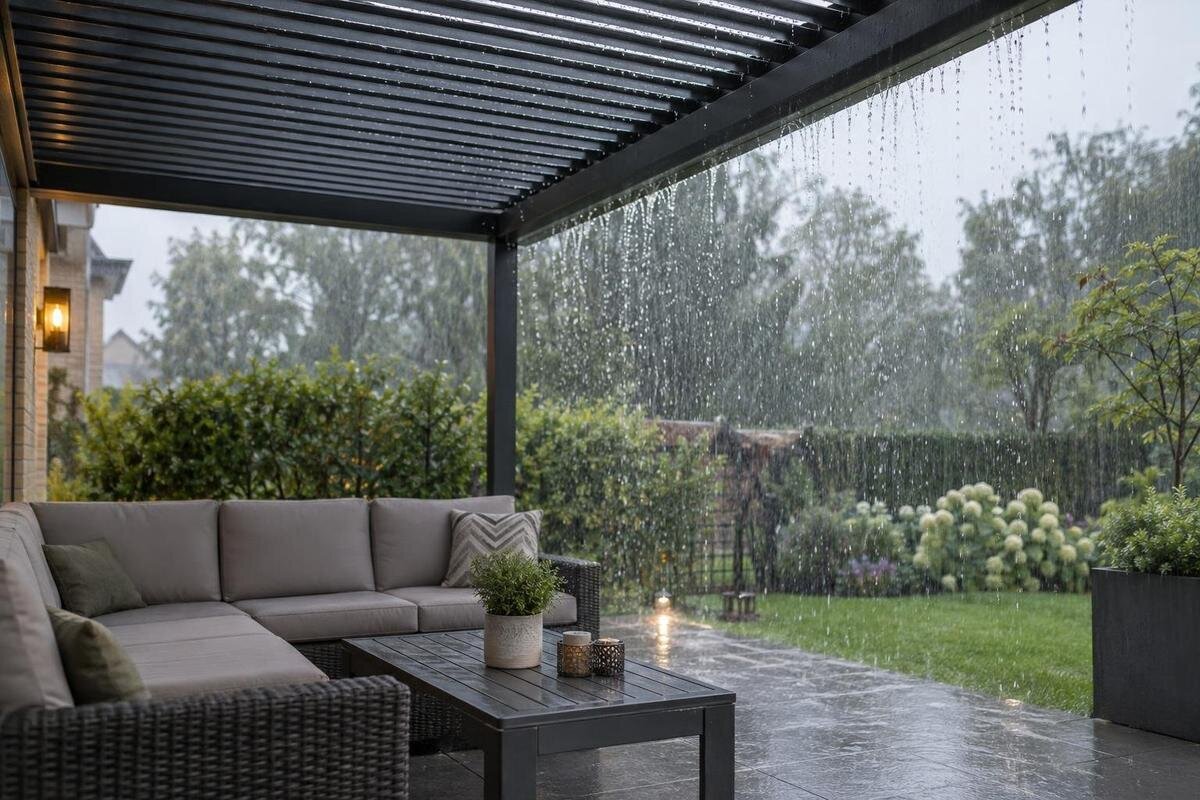
Pergola weather planning
Rain can reach pergola seating from the ground as well as from above. Drops striking exposed paving can rebound onto chair legs and low surfaces, even when the roof limits direct rainfall. That wet patch may look like a leak, but a stream, a puddle and wind-driven rain need different responses. This guide focuses on floor-level splash: how to read the wet pattern, map hard and soft surfaces around the seating, adjust furniture placement, and decide when a surface or enclosure change warrants professional or model-specific advice. No paving choice or seating gap can guarantee a dry area in every rain.

What pergola splashback looks like
Floor-level splashback is water that hits a nearby surface and rebounds into the seating area. Hard patio paving can send some drops outward instead of absorbing them; these droplets may reach chair feet, table bases, shoes or a cushion set close to the ground. A pergola roof may reduce direct rain from above, but it does not stop droplets created on uncovered paving beyond its edge. The distance and direction depend on the impact point, surface shape and wind. Rebound is often easiest to spot near where rain hits, though gusts or uneven paving can spread wetting farther. Treat it as a ground-level water path, not proof on its own that the roof is leaking.
Look at the wet pattern across both the ground and furniture. Small scattered marks on paving near an exposed edge, together with speckling on lower chair parts, can be consistent with rebound. A broad wet patch on the side facing the wind may point to rain blowing through an opening; a narrow trail or drip line may point to water arriving from above. Pooled water can wet feet by direct contact. Check table legs, chair frames and nearby planters rather than judging from a cushion alone. These clues can overlap, so one damp seat is not a reliable diagnosis. Note the lowest wet points before choosing a fix.
Tracing the water source before making changes
Try to observe during ordinary rainfall only when it is safe; do not go onto a wet patio in severe weather to investigate. Note the wind direction, whether rain is steady or gusty, and where wetting first appears. A concentrated flow entering from a roof edge or outlet is different from a field of small droplets beside paving. After the rain, inspect the same area: a splash pattern may fade quickly, while a low spot can stay wet. If you can observe from a sheltered doorway or window, compare what happens during the rain with what remains afterwards. Repeat on another occasion if the pattern is unclear; one shower may not show the usual route.
Sketch the roof perimeter, posts, chairs, nearby door, paved sections, planted edges and any place water collects. Add arrows for flow paths and mark where droplets land on the lowest furniture parts. Include the paved area outside the seating, since water can start beyond the roof before reaching the chairs. If you are planning a pergola, the Bloomcabin Pergola listing gives a size range of 9 to 24 m²; use the exact chosen configuration's dimensions, where available, to draw its edge on the site plan. That range is not a footprint drawing and says nothing about how far ground splash may travel. A dated photo and brief weather note are more useful than relying on memory.
Paving and landscape at the seating edge
Compare the paving immediately beside the seating with the ground farther out. Concrete, stone, tile and interlocking pavers are hard surfaces, but they do not all shed or scatter water in the same way. Texture, uneven joints, small depressions, dirt and the depth of a puddle can affect where drops go. A smooth finish is not automatically splash-free, and a textured finish is not automatically a solution: neither description tells you whether rain will rebound into a chair. The useful evidence is the wet zone after rain, not a material label in isolation. Look at the side of the patio where drops land, not just the spot where furniture is usually stored.
Map the transition to lawn, planting, gravel or a drainage strip as well. Water may run from a larger paved area towards the pergola before it splashes, so a wet seat beside a garden border is not necessarily caused by the border itself. When comparing the Bloomcabin Bioclimatic Pergola listing with your site plan, use the exact planned footprint to locate the roof edge relative to the surrounding patio. Include the adjoining uncovered paving and planted edges, not just the area beneath the roof. This keeps the ground surface in the assessment even when you are choosing a roof style.
Where water collects and flows
After rain, look for standing water or a damp track that leads towards the chairs. A shallow low area can wet furniture directly as water spreads across the floor; if drops hit that water or a nearby edge, rebound may add to it. Follow water from its first visible path to where it rests rather than treating every wet patch as splashback. Leaves or grit left in a narrow band can hint at where water travelled, although cleaning and foot traffic may erase those clues. Check more than one point around the pergola, including paved space beyond the seating footprint; the visible pool may be downstream from where rain first lands.
The aim is a surface-water route that does not collect beside seats, a doorway or the building, but there is no one slope or drain detail that fits every patio. Raising an edge or redirecting flow without understanding the levels can move the problem to a threshold or another part of the yard. If paving needs to be reset, a channel added or an outlet changed, ask a qualified landscape or drainage professional to assess the site and where water can go. A Bloomcabin Wall-Mounted Pergola listing names a product, not the grading at your wall-to-patio junction; assess that junction separately.

Seating position and the recurring wet zone
Use the damp-area map to test a seating layout before buying new furniture or reworking the patio. Move a chair temporarily farther from the exposed edge or low spot, then check whether its legs, seat and the path to it stay drier after similar rain. If only the chair feet are wet, moving the chair may solve the practical problem without changing the whole surface. If water still spreads across the walking route, the underlying flow needs attention. Check the furniture in its normal position, with chairs pulled out for use, rather than judging only by how neatly everything fits when pushed in.
Do not treat the roof outline as the exact boundary of a dry zone. Wind can carry rain through open sides, and splashes can reach inward from paving beyond the covered area. For the Bloomcabin Pergola configurations, compare the dimensions supplied for the exact model with the space needed for seats in use; a stated floor area alone does not show where a chair sits relative to an exposed edge. Keep cushions easy to remove if you want to bring them in after wet weather, but treat that as a convenience rather than a fix for pooling. Leave room to move around the table without stepping into the wettest strip.
Surface changes and drainage
Where paving meets planting, a change in surface may reduce direct impact along one strip, but it is not a guaranteed splash barrier. A planted area can become saturated or compacted; loose gravel can shift and may not suit a walkway or furniture feet. If you are considering permeable paving, check the full system and site conditions with its supplier or installer rather than assuming the top layer will take all the rain. Material, joints and the route water takes all matter. The goal is not simply to replace a hard surface: water still needs a suitable path away from the seating and building.
Plan any proposed border, planting bed or paving revision on the same sketch as the pergola and seating. If the Bloomcabin Bioclimatic Pergola is on your shortlist, keep the roof selection and patio treatment as separate decisions. Mark where the proposed surface change would meet the existing paving and where the observed water path crosses that boundary. Ask a landscape professional whether the change will interrupt the splash path without trapping water or sending it elsewhere. Avoid adding a raised strip or edging just to deflect droplets until its effect on the overall flow is understood.
Side protection for wind-driven rain
If wetting mainly reaches the seating from an exposed side during windy rain, a compatible side screen or enclosure may be worth considering. It addresses rain blown through an opening, not water rebounding from paving under or beyond the pergola. Side elements can have different coverage and operating limits, and an opening near the floor may remain; do not assume a panel creates a fully enclosed or watertight room. Use only options approved for the exact pergola model and follow its product information. Consider how the chosen arrangement affects entry and everyday movement as well as how it changes exposure to rain.
Before purchase, ask for the suitable enclosure configuration for the chosen model and for weather limits supported by product-specific information. Check what conditions are covered by any controlled observations or drainage diagrams rather than reading a broad claim into a product photograph. For a chosen bioclimatic setup, confirm whether a side element is available and compatible with that exact model. A roof type alone does not tell you whether a seat will stay dry. Even a suitable side element will not correct a puddle or a patio that directs water towards the chairs.
Paving beside a wall-mounted pergola
At a wall-mounted installation, inspect the paving where it meets the wall and near the door threshold. Rain can rebound from that strip onto the lower wall or seating, while water collecting there can wet chair feet without bouncing. A wall or roof attachment should not be treated as a substitute for checking the ground. Note whether the damp pattern starts at the wall, on the open side, or at the junction between paving and planting. Keep the diagnosis focused on what water does on the surface; moisture on a wall may have a different route and deserves its own assessment.
If you are comparing the wall-mounted Bloomcabin model, review the exact planned footprint and wall connection with a qualified installer, and assess the paving separately. The product category does not establish that a given wall, threshold or patio detail is suitable for your site, nor that attachment alone prevents wind-driven rain. When water repeatedly gathers beside a building or enters at a doorway, have a qualified professional assess the junction rather than covering the spot with a mat or changing levels by guesswork. Explain where water first appears and whether it remains after the surrounding paving has dried.

Checking a seating change after rain
A repeatable check can help separate practical symptoms without altering the surface. After rain, photograph the same view of the ground and furniture, note the wind direction and mark the wet area's limits on a sketch. Then move one chair to a visibly drier position for a later ordinary rain and compare the result. Change one thing at a time: moving several chairs, adding a rug and shifting a planter together makes it harder to tell which change mattered. If possible, compare more than one rain event, since the direction and intensity can vary. Do not stage a test in severe weather or block an opening to force water into a particular path.
If the wet zone follows hard paving and changes when the seat moves, a layout adjustment may be enough for day-to-day comfort. If water flows or pools regardless of chair position, prioritize a surface-drainage assessment. If the source still seems to come from the pergola, ask the supplier for product-specific information for the exact model and configuration. Use the Bloomcabin Pergola product page to identify the model you are discussing, and describe the wet pattern separately. Bring the wet-area sketch and your comparison notes to a qualified installer or drainage professional if the cause remains unclear.
Temporary fixes that can create new problems
Avoid quick fixes that hold water in place or redirect it without a plan. An outdoor mat might hide a puddle, but it may stay damp, shift underfoot or conceal the condition of the paving. A low barrier can divert runoff towards a doorway or a neighbour's yard. If you try a temporary layout change, move furniture rather than placing objects across a drain or flow route. In colder weather, standing water on paving can freeze, making a concealed puddle a further concern. A fix that masks wetness is not the same as resolving its source.
After a change to the layout, planting or paving, check the next ordinary rain and see whether the walking route and seat area remain clear of pooled water. Keep the goal modest: reduce the identifiable splash path and place furniture in a less exposed zone, rather than expecting an open pergola to stay completely dry in every condition. If water keeps collecting at a building edge, crossing a path or proving hard to trace, have a qualified drainage or landscape professional inspect the site before making further changes.
Frequently asked questions
Does wet furniture mean the pergola roof is leaking?
Not necessarily. Splashback tends to leave scattered, low-level marks beside hard paving; a drip may leave a line or concentrated spot, while wind-driven rain often wets the exposed side. Look at where water first lands and how the ground looks. If water still seems to come from above, ask a qualified installer to assess it.
Can different paving stop splashback?
No surface label guarantees that. Texture, joints, slope, puddles and runoff all affect what reaches the chairs; gravel or planting may still collect or move water. Choose a finish as part of a site drainage plan, rather than treating it as a stand-alone splash barrier.
Will a side screen keep the seating dry?
A compatible screen may reduce rain blown through an open side, but it will not stop drops rebounding from paving under or beyond the pergola. Confirm availability and documented limits for the exact model and configuration; do not assume a panel makes the seating area watertight.
How far should chairs sit from the paving edge?
There is no universal gap. Use the wet-area map, the structure's exact footprint and the chair's normal pulled-out position; test a different spot after ordinary rain. Distance helps only if the observed splash path stops short, and seating should not obstruct circulation or drainage.
What should I ask before changing the surface or enclosure?
Ask for model-specific weather limits, relevant controlled observations, drainage diagrams and details of a suitable enclosure configuration, if one is being considered. For persistent pooling or water at a wall or threshold, ask a qualified landscape or drainage professional to assess the site rather than relying on a product label.
A pergola seating area is most comfortable when its roof, surrounding patio and furniture positions are considered together. Follow the wet pattern through ordinary rain, then change the part that is actually causing it. A new enclosure cannot undo water pooling on the floor, and a furniture layout cannot correct persistent runoff. Matching the response to the ground-level path is the practical way to reduce splashback without shifting the problem to a new spot.
