
Rain or Condensation Under a Pergola: How to Tell
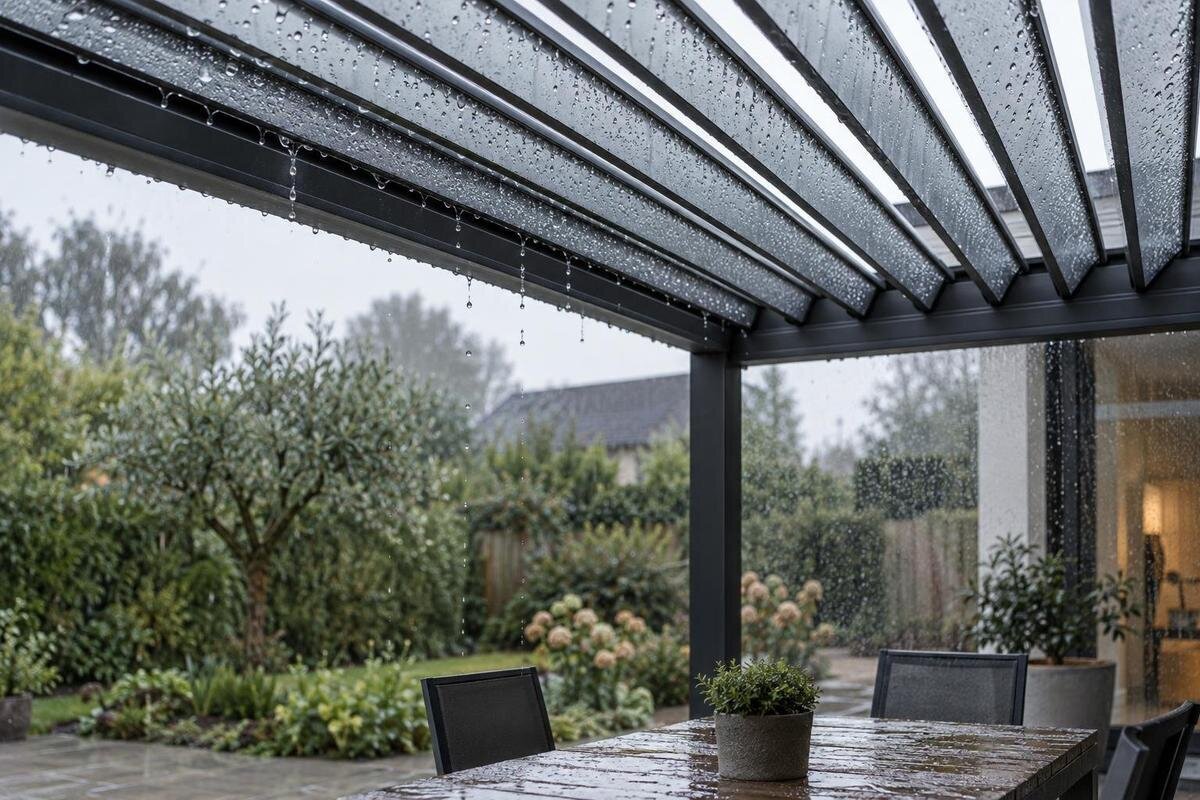
PERGOLA WEATHER GUIDE
Water beneath a pergola can come from rain entering through or around the roof, or from condensation forming on a cool surface. A wet chair, paving stone or beam does not identify the source on its own. The most useful clues are when droplets appear, what the weather was doing and whether moisture is spread across surfaces or follows a particular edge or joint. Compare those observations before treating a damp spot as a leak. Pergola roof designs and documented weather limits vary, so the same pattern can have different explanations on different models.

01
The quickest clues: timing, weather and pattern
Begin with three observations: whether rain was falling recently, whether wind was pushing it towards the pergola, and where the first visible drops appeared. Then note the roof’s position and which sides, if any, were open. Widespread fine beads on cool surfaces during rain-free, humid weather lean towards condensation. A narrow, repeatable track that appears during wind-driven rain leans towards rain entry or water travelling along the roof. These are clues, not a pass-or-fail test: both processes can occur during the same spell, and a few isolated drops cannot identify the source. The distinction depends on the sequence, not simply how wet the area looks afterwards.
Keep the question focused on moisture at or above seating height. Water on paving may have arrived by another route, while a damp cushion may simply have caught droplets from overhead. First decide whether water seems to form on a surface or arrive from somewhere else. You do not need to take the roof apart or test it to make that distinction. Make an initial note, then compare the same location after a rainy period and after a damp period with no rain. Repeated observations are more useful than one memorable storm, especially if wind direction or roof position differed. Use the same viewing angle each time so you can compare the pattern.
When did the droplets first appear?
Write down when the area was last dry, when precipitation began and ended, and when you first noticed droplets. Include whether the pergola had been in use and, if applicable, whether the roof’s position had changed. Rain-related moisture often starts during a shower or follows it after a delay; water can travel along a surface before falling. Condensation may appear later as surfaces cool, often overnight or in the morning. Neither the clock time nor the delay proves the cause, but a timeline can reveal a repeated link that memory tends to blur. Note separately when the last shower ended and when visible water stopped.
Compare more than one event if practical. If the same line gets wet during several rain events but remains dry on rain-free, damp mornings, rain is the stronger explanation. If beads recur on cool surfaces after rain-free nights, condensation becomes more plausible. A local weather record helps, but it is not a perfect account of conditions at the pergola: a brief shower may pass over one property, and a sheltered corner may differ from a nearby weather station. Record what happened at the structure, not only what an app forecast. Also note any interval between rain ending and the first drop; delay alone cannot separate the two causes.
02
Match the wet area to rain and wind
Rain and wind are most informative together. A drip that starts during rain blowing towards an exposed side, then appears beneath that side, is more consistent with wind-driven entry than with condensation; a track may also begin at a roof edge or connection. Record wind direction as observed and which sides were open, not just that it was windy. Airflow around a house, fence or trees can differ from the reading at a nearby weather station. Rain falling with little wind may still reach an opening, depending on the roof design, so calm conditions do not rule it out. Compare repeated events with different wind directions if you can.
For an attached layout, note whether the wet area lies near the wall, below a roof connection or at an exposed edge. These are distinct locations to show an installer, not proof of a defect. If you are identifying your unit using the Bloomcabin Wall-Mounted Pergola page, also describe the connection at your home. Compare your installed arrangement with the assembly and weather-performance documents for the exact model. A wall may shelter one section while leaving another exposed, so an attached layout alone does not explain the water’s source. A photograph that includes both the wall and roof edge can make the location clearer.
What the droplet pattern can tell you
Condensation often shows first as many small beads or a thin film on cool parts of the underside, frame or other exposed surfaces. It may be spread across an area rather than forming a single stream, though shade, temperature and airflow can make it patchy. Look for moisture appearing directly on a surface rather than arriving from a point above it. If several different cool surfaces in the same sheltered area are damp at once, that supports condensation, but it is not conclusive: rain can enter broadly through an open roof or be blown under a cover. A diffuse pattern is a clue, not a unique signature.
Rain-related water more often leaves a repeatable trail: one seam, edge, opening or connection becomes wet first, followed by a drip line or a mark below. Look for the first wet point, not just the largest puddle or darkest stain. A dried mark can remain after its source has stopped, so distinguish fresh moisture from an older stain in your photos. If the Bloomcabin Pergola product page identifies your model, include that name when sharing the images, along with the location of the trail. A recognizable model and a clear moisture pattern provide different information; neither replaces the weather and timing details needed to interpret what happened.

03
Trace where the water first forms
From a spot where the underside is visible, trace the apparent route with your eyes: does a bead form on a surface, does water run along the frame, or does a drop arrive from above? Photograph the first wet point and the point where it falls, using the same viewpoint each time. A drop can land well away from its entry point after following a frame or another surface, so the wet seat or floor spot is not necessarily directly beneath the source. Note whether furniture intercepted it, since that can obscure the first location. Do not climb onto the roof or remove parts to follow a path; a ground-level view and clear notes are enough for an initial comparison.
Where the first wet point seems near a house connection, capture the roof edge and adjacent wall in the same set of images. For a unit identified through the Bloomcabin Wall-Mounted Pergola listing, ask about the installation details for that specific model and wall interface. The useful distinction is whether water appears to travel from the junction or form directly on the underside. If droplets visibly begin on the underside itself, record whether nearby surfaces are also beading. That contrast can help separate condensation forming in place from rainwater travelling along the structure. Avoid diagnosing a hidden connection from a single photo.
Roof type and position change the evidence
The word pergola covers different roof arrangements, and they do not provide the same coverage. An open-slat roof leaves openings; adjustable louvres or a retractable cover can expose different areas according to position; a fixed cover has its own joints and may have stated weather limits. Note whether the roof was open, partly open or closed when moisture appeared. Rain passing through an intentional opening is different from water crossing a closed roof assembly, although the product instructions determine what is expected. Do not assume that a roof is watertight simply because it looks closed, or that a few drops prove a failure.
If your unit has adjustable louvres, record their position without moving them just to reproduce a drip. When identifying a unit through the Bloomcabin Bioclimatic Pergola listing, confirm its exact configuration rather than inferring the louvre arrangement, drainage route or weather limits from the model name. Check its operating guidance as well. Add-on screens or walls also belong in the record: they can change where wind-driven rain reaches and how air moves. The enclosure documentation should identify which combinations are intended. Be precise about what was closed when moisture appeared, since a closed roof and closed sides describe different parts of the setup.
04
Why condensation can form on a dry day
Condensation does not require rain or a roof defect. Air carries invisible water vapour; when moist air meets a surface cooler than its dew point, some vapour turns into liquid. Outdoors, a roof surface can cool as the air cools after sunset while damp air remains around the structure. That is why beads may appear overnight or early in the day even when no rain fell. Cloud, humidity and temperature changes influence the likelihood, but a forecast cannot tell you the temperature of the actual underside. You do not need to calculate a dew point to use this clue: check whether droplets form during a rain-free cooling period.
Shade, shelter and airflow can make one part damp while a nearby part stays dry; patchiness therefore does not automatically mean a leak. Nearby moisture sources and reduced air movement may also affect conditions, particularly where sides are enclosed, but those details are not a diagnosis by themselves. For an enquiry about the Bloomcabin Pergola listing, describe the conditions at your site: recent rain, time of day, which surfaces bead, and any enclosure configuration. Those details are more useful than looking for one universal weather threshold. If another cool outdoor surface nearby shows similar beads, include it in your comparison, while noting any differences in exposure.
Keep a short observation log
A short log turns clues into a comparison. For each observation, note the date and time, recent rain, wind direction, roof position, open sides or enclosure, and which surface became wet first. Add one photo of the whole pergola and close views of the same spots, captioned with what changed. Include a rain-free observation as well as a rainy one, and say whether the area was dry beforehand. If you do not know the exact roof position or model, record that uncertainty rather than guess. Consistent notes help an installer assess a pattern more clearly than a report that it drips sometimes.
A garden-hose test is not a useful first check: an uncontrolled spray does not reproduce local wind or rainfall and may create a different path from the one you are trying to diagnose. Do not climb, dismantle roof parts or apply sealant before the source is understood. If the Bloomcabin Bioclimatic Pergola product page matches your unit, use that model name when requesting operating instructions for its exact configuration. Record the adjustable roof’s actual position rather than changing it for an improvised test. If the manufacturer or a qualified installer recommends a controlled check, follow the procedure they provide.

05
When to ask for a model-specific inspection
A professional review is sensible when the same point repeatedly becomes wet during rain, when a visible track follows a closed roof joint, or when moisture does not match the model’s documented use. Those clues suggest a rain-path or installation-detail question, not a confirmed defect: wind, roof position and intended drainage still matter. Ask for the model-specific weather-performance documents and drainage diagram, then compare them with the observed configuration and enclosure. Avoid relying on a blanket promise such as waterproof in every storm; the relevant limits need to be stated for that design. A useful record can narrow the question without deciding it for you.
Give the installer the exact model name, the roof position at the time, the weather, the first visible wet point and whether the same pattern has repeated. If you use the regular Bloomcabin Pergola model page to identify the product, include the installed configuration as well so the enquiry concerns your actual setup. Ask whether the observed route agrees with its documented drainage layout and weather limits. This keeps the discussion focused on where the water travels rather than on a general complaint about dripping. If moisture reaches lights, wiring or powered equipment, keep clear and have a qualified professional assess it; do not touch wet electrical components.
What to confirm before choosing a pergola
If you are choosing a pergola, decide what weather exposure and level of coverage you expect, then request information for the exact roof configuration. Ask how the roof is meant to behave in rain, what openings remain in each position, where water is directed, and which enclosure configurations are suitable. Compare those details with the site and intended use rather than relying on a category name or product photo. When considering the Bloomcabin wall-mounted pergola product page, make the house connection a separate part of that discussion. Ask how the proposed installation addresses the connection and exposure to wind-driven rain at your seating area.
Compare the answers against how you plan to use the seating area. A roof’s coverage, its stated weather limits and its enclosure configuration are separate parts of that comparison; labels such as wall-mounted, regular or bioclimatic do not settle them. If an answer depends on a particular installation or roof position, have that condition clarified for the proposed arrangement. Keep condensation in the discussion too: moisture forming on a cool underside is a different question from rain passing through or around the roof. Understanding that distinction helps you set expectations without treating every future droplet as evidence that the pergola has failed.
Frequently asked questions
Can condensation form under a pergola when it has not rained?
Yes. Condensation forms when moist air meets a surface cool enough for water vapour to turn into droplets. It can appear overnight or in the morning after a dry spell. Beads across cool surfaces make condensation more plausible, but do check local rain history: a brief shower or water travelling along the roof can be easy to miss.
Does dripping while it rains mean the pergola has a leak?
Not necessarily. Wind can carry rain through an opening or under an exposed edge, and the roof’s position may affect where rain enters. Compare the first wet point with the model’s weather-performance information. If water repeatedly tracks across a closed joint, ask a qualified installer to assess it; the pattern alone does not confirm a defect.
Can I tell the source by the size of the droplets?
Droplet size is not a reliable test. It can depend on how water formed, collected or travelled along a surface. Give more weight to when the drops appear, where moisture first forms, whether the pattern repeats, and what the rain, wind and roof position were like.
Why does water sometimes drip after the rain stops?
Water can continue along a surface and drip later, while condensation can form as surfaces cool after rainfall. Note the delay, roof position and first wet point. A delay by itself does not distinguish the two; compare the same spots during a rain-free period as well.
Should I spray the pergola with a garden hose to check for a leak?
Not as a first check. An uncontrolled spray does not reproduce local rain and wind, and it may create a different water path. Start with observations and the documents for the exact model. If a test is needed, follow a procedure provided by the manufacturer or a qualified installer.
Treat a damp spot as a clue, not a diagnosis. Rain is more plausible when moisture tracks a shower or wind direction and returns at the same edge or joint; condensation is more plausible when beads form directly on cool surfaces during a damp, rain-free spell. Confirm those clues with a short log and the roof’s actual position, then compare them with documentation for the exact model. If the evidence repeatedly points to one rain path—or moisture is near electrical equipment—bring the record to a qualified professional rather than altering the roof or sealing it by guesswork.
