
Replacing Pergola Seals: Identifying the Correct Profile
Pergola repairs and spare parts
A seal that looks close to the original can still be the wrong replacement if its retaining edge, cross-section or contact face differs from the pergola’s channel. Identify the exact location and product model before measuring, then compare the seal with the matching manual or parts drawing. Clear photos and a part number are more reliable than colour or length alone. This guide shows what to record and what to ask before ordering a matched component.

Why an exact seal profile matters
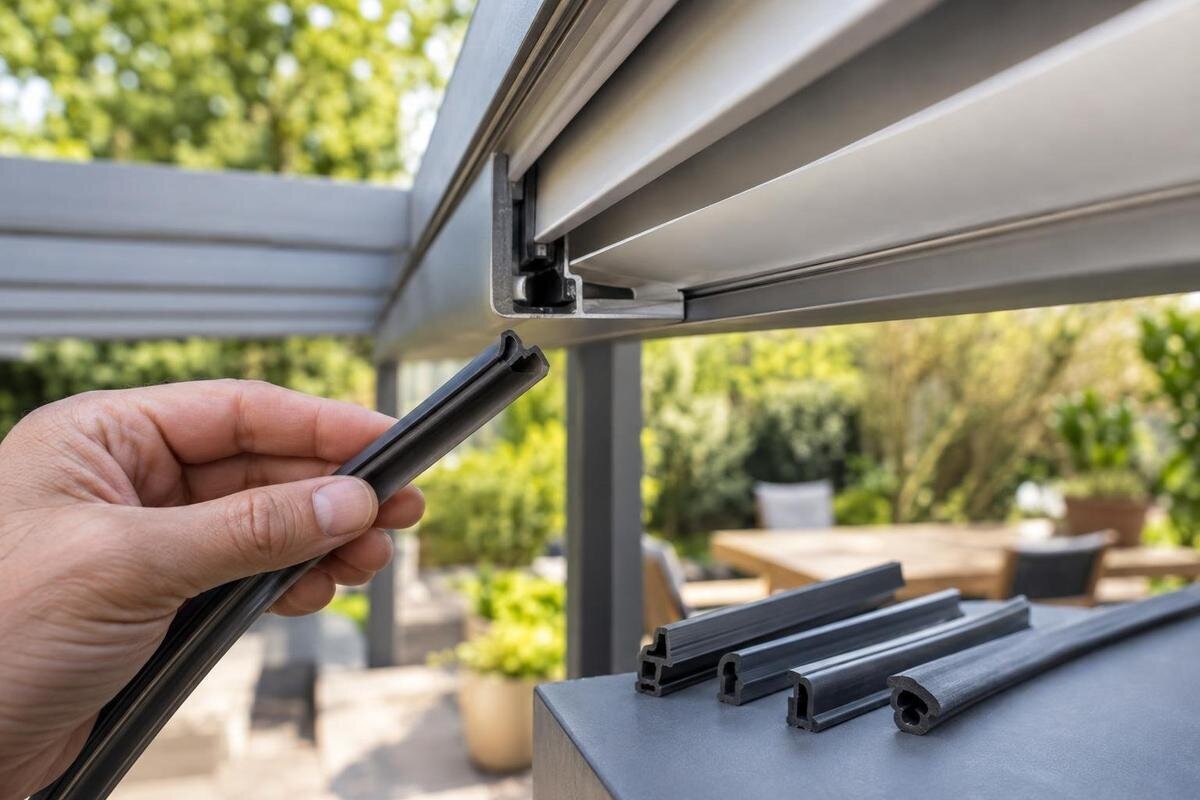
A pergola seal is matched by its profile and by the place it occupies, not just by its length or colour. Depending on the design and location, it may press against a neighbouring part, sit in a shaped channel, cover an edge or cushion contact between components. The end-on cross-section shows details that matter: a flat or stepped base, a retaining foot, a lip, a hollow section or one or more fins. These are possible shapes, not a description of your pergola. Two strips can look similar from the side and still attach differently. Use the terms in the product drawing where possible instead of guessing a technical name from appearance.
A mismatch may loosen or work its way out, protrude too far, or fail to meet the adjacent surface as intended; where a component moves, it may also interfere with normal movement. A seal intended for one location may be unsuitable elsewhere, even if the cross-section seems close. Some open joints or channels may be deliberate clearances or water paths, so do not assume every visible gap needs filling. The useful ordering question is which specified part belongs at this exact interface on this exact model. Treat an unlabelled strip as unverified until the supplier confirms its profile and intended position.
Locate the seal before measuring
First map where the seal begins and ends and what it touches. Use permanent reference points, such as a named corner, beam, side, panel or support, and note whether the seal runs along an edge or between two components. If the adjoining piece is stationary or moves during normal use, record that only if you can observe it safely; do not operate a roof to find out. Where several seals look alike, assign a separate letter to each location rather than assuming that identical-looking runs use the same part. A service team can then connect the part you mean to a position on its drawing.
State the viewing direction in your notes. Left and right can be ambiguous, so say whether you are facing the pergola from outside or standing beneath it, and identify the side by a stable feature as well. Avoid relying on broad descriptions such as roof seal or side seal; these can refer to several interfaces. Note whether the seal appears continuous, interrupted, missing, loose or distorted, without trying to diagnose why. If the position is overhead or cannot be seen from a stable, accessible place, do not reach over a roof or moving assembly to trace it. Tell the parts team what is hidden instead.
Confirm the pergola’s model and history
Find the exact product name and, if available, model code, serial number, order number and approximate purchase date in the invoice, order confirmation, owner’s manual or product label. Copy the wording as printed, including distinguishing terms such as wall-mounted or bioclimatic, rather than replacing a specific name with a general description. One catalogue example is the Bloomcabin Wall-Mounted Pergola listing. Its name can help you recognize the wording used for a product family, but the listing does not establish which seal is installed on your individual unit.
Add anything known about the installation’s history: a previous seal replacement, a repair, an added accessory or a component with its own label. A similar-looking pergola may have different product documentation, so note any date or code printed on your records rather than estimating from the finish. If you bought the structure second-hand, ask for the original order email or manual and photograph any product label clearly. Do not fill in an uncertain character from memory; mark it as unreadable and send the photo. If no code can be found, say so and provide the model name and position information you do have.
Compare the seal’s cross-section with its channel
A profile is the shape and dimensions of the seal’s cross-section, viewed from the end; its run length is a separate measurement. Compare the retaining base with the channel and the lip or contact section with the adjoining surface. Examples of retaining shapes include a tongue or foot, but the part drawing should determine the correct description. A square-on end view shows these features more clearly than a long side view. Distinguish the part held in the groove from the part that meets the neighbouring component, and note which way each faces. If either feature is hidden, identify that limitation in your request rather than guessing its shape. Ask the supplier which profile details they need to identify the part.
An old seal may have flattened, stretched, torn or shrunk, so its current shape is not automatically the original specification. If a short, loose piece is already available, keep it uncut and label its position; do not pry out an installed section solely to obtain a sample unless the model instructions permit it and you can do so safely. A catalogue page such as the Bloomcabin Pergola product page can confirm product wording, but it provides no cross-section, channel dimensions or interchangeability information. Send a sample or measurements alongside the model details and ask the parts team to compare them with the correct drawing rather than matching by eye. Keep samples from different locations separate.

Use the correct manual or parts drawing
The manual, exploded view or parts list for the exact model can help you find the part code. Check that the document applies to your model and, if a date or revision is shown, that it matches the information on your unit. A drawing may identify both the seal’s position and how its profile faces the adjacent component; compare those details and the part number instead of relying on a small illustration. Search using the manufacturer’s own terminology, which may include words such as seal, gasket or weatherstrip. Treat terms such as glazing seal as relevant only if they appear in documentation for your model. Keep the page number and drawing label with your notes so a support representative can check the same reference.
If your paperwork identifies a Bloomcabin Bioclimatic Pergola, include that exact model wording when requesting the matching manual or parts drawing. The catalogue name helps identify a product family; it does not confirm a seal profile, revision or suitable substitute. If you cannot find the diagram, ask the seller or manufacturer for the applicable parts list and provide the model code, serial number if available, and seal location. Ask whether the listed part number applies to your unit and whether a replacement or superseding component has been confirmed. Do not use a drawing for a similar-looking pergola as evidence that its parts are interchangeable.
Inspect the receiving channel without dismantling
Before examining a channel more closely, check whether it is visible from a stable position without a ladder, removing panels or placing a hand near moving parts. Photograph the seal seated in place and the receiving groove if it is already exposed. Describe what you can see: whether the groove looks continuous, whether part of it is hidden, and whether there is a visible obstruction, deformation or residue. These observations help locate the issue but do not prove its cause. Do not force a panel, operate a mechanism just to expose the edge or dismantle an assembly to reach the seal. If it is overhead, powered or difficult to secure, leave close inspection to the manufacturer’s service team or a qualified professional.
Where both the channel and seal are visible, note how the retaining part appears to enter the groove and which surface the contact edge faces. Do not scrape, pry, drill, add adhesive or use a solvent or lubricant to make an old strip easier to remove; the appropriate method depends on the model. If the seal has pulled out more than once or the channel looks damaged, report that detail instead of ordering a thicker strip to compensate. When your record names the Bloomcabin Wall-Mounted Pergola, use that exact name and describe the inspected edge from a stated viewpoint.
Record dimensions without treating them as a match
Keep profile, channel and run length as three separate details. A correct cross-section may still be needed in a specified length, but an accurate length cannot make the wrong retaining base or contact shape fit. If the channel is safely exposed, record where each measurement was taken and use millimetres; do not assume the channel’s opening width equals the seal’s base width. Say whether a figure came from an intact sample, the visible opening or a drawing, and mark estimates as approximate. The parts supplier can tell you which measurement is useful and whether a part code is still required. Avoid turning a rough measurement into a guessed standard size.
If a seal has a retaining foot, tongue or angled lip, use an arrow or simple sketch to show its orientation. Do not compress a hollow section or stretch soft material to match a ruler, and do not round a figure to fit a guessed catalogue size. If your invoice uses the name Bloomcabin Pergola, copy it exactly; the Bloomcabin Pergola catalogue page can serve as a name reference, not a dimensional specification. Place the scale in the same plane as the part so perspective does not make it appear wider or taller, and say which side of the pergola was measured. These details help prevent a useful but limited measurement from being mistaken for a complete fit check.
Take photos that show position and profile
Build a photo set in which each image answers a different question. Start with a wide view showing where the seal sits on the pergola, add a medium view with nearby corners or components, then take a close-up of the channel and contact edge. If a loose sample is already available, photograph its short end square-on beside a ruler without squeezing it. Use even light and focus on the profile; take a second angle if a shadow or reflection hides a retaining feature. Keep the original, uncropped files as well as a marked-up copy, since labels and arrows can help but should not cover the detail being checked.
Label each photo with the position code from your map and a viewing direction, such as a view from outside the pergola. If your order record identifies a Bloomcabin Bioclimatic Pergola, use that model name in your request; the bioclimatic pergola catalogue listing can help you check the product wording. Keep a serial label in a separate frame if it is elsewhere and make its characters legible. Before sharing, crop out unrelated personal information where practical. A short video may show a movement issue only if the mechanism is already safe to operate; do not run a powered roof solely to capture a clip. If the issue is static, clear stills are usually easier for a parts team to review.

Make a complete replacement-parts request
Make the replacement request easy to verify. Include the full product name, model code and serial number if present, order number or purchase date, seal position code, and whether the seal is missing, loose, split or visibly distorted. Attach the wide, medium and close-up photographs, plus any safely obtained loose sample or measurements clearly marked as approximate or confirmed. For an order identified as a Bloomcabin Wall-Mounted Pergola, use that full name; the wall-mounted pergola catalogue entry can help you check the wording. Mention previous repairs or changes that may matter. This gives the support team context to compare your request with the relevant parts drawing.
Ask for an explicit match: the part number or profile reference, the position it belongs to, and confirmation that it applies to your exact model and revision. Also ask whether the part replaces an older code, what length is required and whether there are model-specific instructions or accompanying components. Do not assume that one seal is supplied by the metre or that two similar positions use the same profile; let the supplier define the ordered unit and quantity. If they cannot identify it from your first message, ask which further image or measurement would resolve the question before placing an order. Save the reply with the manual and invoice for future reference.
Confirm compatibility before ordering
Before paying for a generic strip or an online listing that looks similar, compare more than colour and stated length. The description should identify the profile or retaining method, the intended location and the model or models for which compatibility is confirmed. Ask what supports the match when a listing uses only broad wording such as pergola weather seal. A seller’s photograph cannot establish the hidden cross-section or fit in your specific channel. The Bloomcabin Pergola product listing is a catalogue reference for a product name, not evidence that an unlabelled seal offered elsewhere matches that model. Similar appearance is a reason to ask a question, not a basis for ordering.
If no exact part is identified, do not cut a random strip, bond pieces together or reshape the channel to make a near-match work. Alterations can change how the seal sits or contacts a neighbouring component and may make later service harder. Ask the manufacturer or seller whether an approved replacement exists for your precise model and revision; do not assume one is available. If access requires dismantling or working around powered, overhead or moving components, arrange qualified service instead of improvising. Once a part is confirmed, follow the model-specific instructions or have a professional handle removal and refitting if the procedure is unclear. The aim is a traceable, matched component, not an apparently neat fill.
Frequently asked questions
Is measuring the seal’s length enough to identify a replacement?
No. Length describes the run, but the cross-section, retaining feature, orientation, channel and exact position also matter. Treat a length measurement as supporting information and ask for confirmation of the part number for your model.
Can I use a generic pergola weatherstrip if it looks close?
Only if the manufacturer or seller confirms that its profile and intended position match your exact model. Similar colour, length or appearance is not proof of fit. Do not cut or force an unverified strip into the channel.
Should I remove a piece of seal to send as a sample?
A short piece that is already loose may be useful. Remove an installed section only if the model’s instructions permit it and it is safely accessible. Do not dismantle an overhead, moving or powered assembly to obtain a sample; ask a qualified service professional for help.
Which photos should I include in a parts request?
Send a wide view showing the seal’s location, a closer view of the surrounding components, and a clear view of the seal and channel. If a loose sample is available, photograph its end beside a ruler without compressing it. Label each image with its position and viewing direction.
What if the old seal is too damaged to measure?
Do not rely on the damaged shape alone. Provide the model and serial details, the seal’s position, any manual or drawing reference, and clear photos. If you include measurements of the visible opening, label them approximate and ask the supplier to confirm a matched part or approved replacement.
Finding a replacement seal is an identification task before it is a shopping task. Record the exact pergola model, map the seal to its position, compare its profile with the correct drawing and send clear images with any measurements labelled as approximate or confirmed. Get a part number and confirmation that it matches the specific model and interface. If access requires dismantling or working around moving or powered assemblies, leave inspection and repair to a qualified professional. This avoids treating length, colour or a similar photo as proof of fit and creates a useful record of the replacement for future repairs.
