
Can a Restaurant Pergola Cover Its Costs?
Restaurant patio investment guide
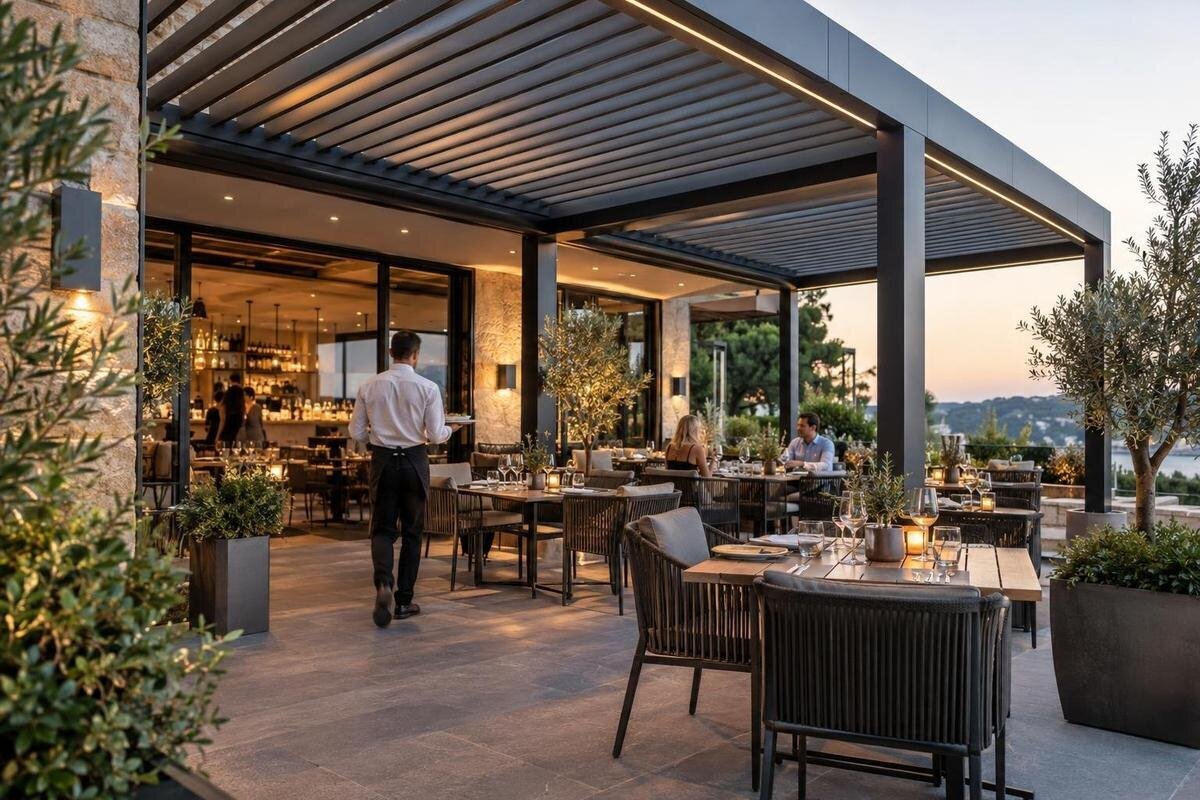
The financial case for a restaurant pergola depends on the additional business it can support, not simply on the sales recorded on the patio. A pergola does not create bookings automatically, and its name alone cannot establish how many days the space will be usable. Build the case from the restaurant’s own service records, an actual floor plan, project-specific quotes and realistic operating expenses. The model below separates added seating from additional covers, then compares net contribution with the full investment without promising a revenue increase.

Define what “pay for itself” means
Before modelling anything, define what “cover its costs” means for this restaurant. A simple payback test asks when incremental cash contribution from the project equals the one-time investment. Choose the time horizon in advance and state whether you are testing cash recovery, a target return or a wider business case; these answer different questions. A project can eventually repay its cost but miss the owner’s preferred timeline, while a sales forecast can look large and still leave little contribution. Record whether financing, tax treatment, future replacement and maintenance reserves belong in the calculation, and ask the accountant to confirm relevant accounting assumptions. Use the same definition for every proposal and write it at the top of the worksheet.
Build a without-project baseline and a with-project case for the same months and service periods. Only their defensible difference belongs in the project benefit. A patio guest who would otherwise sit indoors is not automatically a new cover, and all sales made outdoors are not automatically caused by the structure. If the patio already operates during part of the year, its existing covers, labour and sales are the baseline, not a gain. Keep convenience, appearance or customer experience in a separate qualitative note unless you have a credible way to value it. Record the source and date for each important assumption so someone else can follow the calculation.
Count service days the project can actually add
A usable service day is a date when the restaurant is open, has staff to serve the patio and can operate the proposed setup under confirmed site arrangements. It is narrower than a calendar day in the patio season and different from a day when the restaurant happens to be open. Begin with a dated record of when the existing patio was bookable, opened, closed early or could not be used. Record reasons separately—weather, staffing, maintenance, site constraints or low demand—because the pergola project may address only some of them. Do not count a date as recovered simply because it was unavailable; the design and operating plan must support that use.
Build the estimate month by month and, where records allow, by day of week and service period. Compare dates when the proposed patio could operate with those when it would remain unavailable without the project; the difference is the number of additional service days. Allow for seasonal staffing, scheduled closures, planned maintenance and the restaurant’s real opening hours. When assessing a proposal for the Bloomcabin Bioclimatic Pergola, ask the project team which operating conditions the estimate should reflect. Tie each additional day to the proposed setup and operating plan rather than treating every shoulder-season date as newly bookable.
Count additional seats on the floor plan
Use a current floor plan and verify key dimensions on site before counting seats. Show the proposed footprint alongside tables, chairs, doors, staff routes and the space needed to serve diners. Include paths used by customers and staff, not just the area where furniture could fit. Have qualified professionals review applicable access, fire and planning matters for the actual layout; a theoretical seating rectangle is not a substitute for those checks. A layout that adds tables but obstructs a route or makes service impractical does not provide usable restaurant capacity. Keep the plan for the exact configuration being costed, so a later change to the footprint triggers a revised seating count.
Count net-new seats, not every chair visible in the finished layout. Subtract places moved from indoors or from an existing patio, along with any seats displaced by the proposed footprint or circulation needs. If a building connection is part of the concept, show the proposed Bloomcabin Wall-Mounted Pergola on the plan and have the project team confirm the connection and footprint. Keep the seating count tied to that layout, rather than to the product’s nominal area. The measured plan should show how many additional seats remain after the operator’s service needs and applicable reviews are considered.
Forecast additional covers from actual demand
A seat is potential capacity, not a cover; a cover is one guest served. Translate seats into covers using the restaurant’s actual service pattern, including seating duration, turns, party mix, table combinations, opening hours and available staff. Review bookings and point-of-sale records for comparable dayparts. Distinguish a guest who was turned away from one who was waitlisted or simply chose an indoor table. A full waitlist is not proof that every person would book a different setup. Use demand evidence from the business rather than a general patio occupancy rate or an assumed increase in bookings.
For a working estimate, calculate potential covers for each service period from usable seats, observed turns and a conservative, demand-supported occupancy assumption. Cap that figure at what comparable bookings, reliable records of turnaways or other restaurant records can support. Then subtract covers that would simply move from an existing seating area. When assessing the Bloomcabin Pergola for the project, take the seating count from the confirmed layout and the demand estimate from the restaurant’s records. Add only net-new covers across the selected timeframe; do not count the same guest once as a new service day and again as an unrelated sales gain.

Calculate contribution and payback
Estimate contribution per cover rather than treating the average bill as profit. Start with sales after discounts for comparable covers from the restaurant’s own records, then deduct costs that rise with each added cover, such as food and beverage inputs, packaging and transaction charges where applicable. Check whether outdoor service has a different menu or sales mix before using the restaurant-wide average. Put added costs that occur by service day, such as an extra scheduled shift, in a separate line. Do not deduct the same cost both in the per-cover contribution and again as a daily expense; consistent treatment matters more than a complicated spreadsheet.
Let I be the full upfront project cost, Q_t the net-new covers in period t, M_t the contribution per cover after variable costs, U_t the days the project is used, C_t the additional cost per use day and F_t other recurring project costs. Net project contribution for period t = (Q_t × M_t) − (U_t × C_t) − F_t. Simple payback occurs when cumulative net contribution reaches I. For a proposal based on the bioclimatic model, use the cost of the quoted configuration and the covers estimated for its proposed layout. If the cumulative total never reaches I within your chosen horizon, the model does not show payback in that period.
Include the complete upfront project cost
A product price, if available, is only one possible line in the investment. Ask what the project scope includes, then account for relevant design or site measurement, professional reviews, site preparation, delivery, assembly or installation, and any planned changes to drainage, surfaces, lighting, electrical work or furniture. Include application or review fees where they apply to the project, plus the cost of reorganizing service or temporarily closing an area during work. Do not assume that an item is included because it appears in a concept image. A written list of inclusions and exclusions makes competing project quotes easier to compare.
Keep the same configuration and scope when comparing costs, and record the currency and timing of each amount. For a quote covering Bloomcabin’s regular pergola model, distinguish the quoted supply costs from any separately priced project work. Ask the supplier and project team to identify exclusions, then include those costs using a quote or a documented business estimate. Keep estimated amounts clearly labelled so they are not mistaken for confirmed prices. If applicable taxes or financing affect the cash decision, have the restaurant’s accountant confirm how to reflect them rather than inserting an unsupported assumption.
Budget for ongoing costs and service disruption
The project can create costs after opening as well as before it. List added cleaning time, routine maintenance, any supplier-recommended service, repairs or replacement reserves, and staff time for setup or operating procedures. Include utilities only for features actually included in the proposed configuration, and check with the insurer whether the project changes the business’s coverage or cost. Consider furniture storage or movement and any recurring work needed to keep the patio ready for service. Base each line on supplier information, a quote or the restaurant’s own labour records, rather than assigning a generic annual allowance without explanation.
For a configuration identified on the regular pergola product page, ask the supplier for the corresponding operating and care information. Use it to identify the tasks the restaurant would need to budget for, then state who would do the work and how the cost was estimated. Carry recurring costs into each period of the payback model. Include downtime in the operating plan where service could be interrupted, but do not turn an unverified possibility into a fixed expense. Keep one-time commissioning or setup costs separate from repeating costs so they are not counted twice.
Test the case against weaker assumptions
Prepare a central case based on the best available records and a conservative case using less favourable demand, service-day and cost assumptions supported by evidence. An optimistic case can be useful for seeing what would need to be true, but it should not become the budget forecast. If a wall-mounted model is one candidate, evaluate its own layout, quotation and operating assumptions rather than transferring figures from a different configuration. Use ranges drawn from the restaurant’s records or confirmed project quotes; do not add an invented occupancy lift to make the payback period look shorter.
Then test how the result changes if fewer additional covers are served, usable days are lower, labour costs more, or the project scope changes. Check each variable separately to find what matters most, then combine the main downside assumptions to see whether the investment still meets the owner’s chosen timeframe. If the result depends on several favourable assumptions happening together, treat that as a material risk, not a dependable forecast. The worksheet can also identify what information is missing, such as a confirmed site layout or better records of turnaways, before the business decides whether to proceed.
Confirm the site and commercial project requirements
Before committing to a model or cost, assemble the operator’s requirements and an accurate plan of the actual restaurant site. Show the intended seating, entrances, service routes, neighbouring doors, obstructions and the locations of relevant existing services. A qualified project team can identify what further measurements or technical review are needed. Have applicable access, fire and planning matters reviewed for this specific layout by the appropriate qualified professionals; requirements and constraints depend on the project and location. Do not use a generic patio plan to stand in for an assessment of the real site.
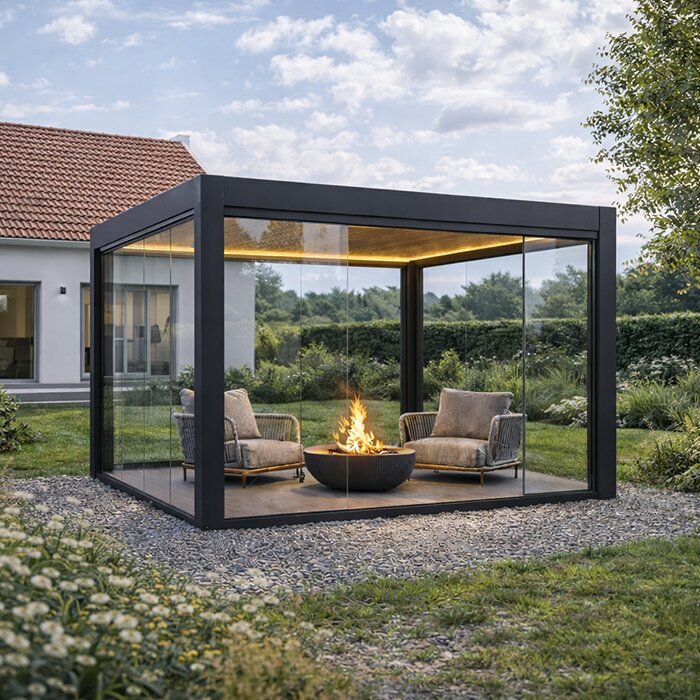
A product listing or image does not establish that a model is suitable for commercial restaurant use, that it fits the building or that the proposed layout can be approved. If you are starting with the wall-mounted product listing, present the actual building and intended service setup for project-specific review. Ask the supplier what can be confirmed for that configuration, and have any structural or installation questions assessed by qualified professionals. A commercial project enquiry is most useful when it includes the operator’s requirements, actual floor plan and questions about the applicable site reviews.
Measure results after the patio opens
Set up the measurement plan before work begins so the restaurant has a fair baseline. Record patio opening and closing dates, hours available, seats in use, bookings, covers served, turnaways, sales and the related variable costs. Track extra labour, cleaning, maintenance and closures separately. Where possible, compare similar months, days of the week and service periods rather than comparing one busy stretch with a different season. Note material changes in hours, menu, staffing or restaurant operations that could also affect results. These records make it easier to distinguish a genuine change in patio capacity from a broader change in the business.
After opening, update the calculation with actual costs and net contribution for each period, then compare cumulative results with the original project cost and chosen timeframe. If service days or covers fall short, revise the remaining forecast instead of carrying forward the original assumption unchanged. Do not attribute every movement in restaurant-wide sales to the pergola; compare the defined patio measures and explain limitations in the records. Keep any customer-experience or operational benefits separate from measured financial payback unless the business has a credible way to value them.
Frequently asked questions
What is the simplest payback formula?
For each period, calculate contribution from net-new covers, then subtract the project’s additional operating costs. Add those net amounts over time and compare them with the full upfront project cost. The model shows payback only if the cumulative amount reaches that cost within your chosen timeframe.
Should I count patio sales or profit per cover?
Use contribution per additional cover, not gross sales. Deduct costs that vary with each cover, then account separately for added costs per service day or year. Also exclude guests who would have dined elsewhere in the restaurant, since their patio sales are not necessarily new business.
How do I estimate usable service days?
Review dated records of when the patio opened, was bookable or could not be used, and why. Count only dates when the proposed setup and operating plan support service. Consider staffing, scheduled closures and site constraints as well as weather; do not assume every date in a longer season becomes usable.
Can I count every new seat as a new cover?
No. A seat is capacity, not proof of demand. Subtract seats displaced elsewhere, then estimate covers using the restaurant’s actual turns, service hours, staffing and demand records. Count only additional covers the restaurant could realistically serve, rather than applying an assumed increase in occupancy.
What should I verify before committing to a project?
Use the restaurant’s actual floor plan and operator requirements, and obtain a project-specific scope and cost. Have qualified professionals review applicable access, fire and planning matters for the site. A product listing or image identifies a model; it does not confirm that a particular configuration suits a commercial location.
A restaurant pergola can cover its costs only if demand-supported additional contribution is enough to offset the full project and operating costs within the business’s chosen timeframe. If the estimate depends on assumed bookings, unconfirmed service days or a product name standing in for a site review, the answer is not ready yet. A careful model makes that uncertainty visible—and can show that a smaller scope, a different timeline or no project is the more credible decision.
