
Rotating and Retractable Pergola Louvres: How They Differ
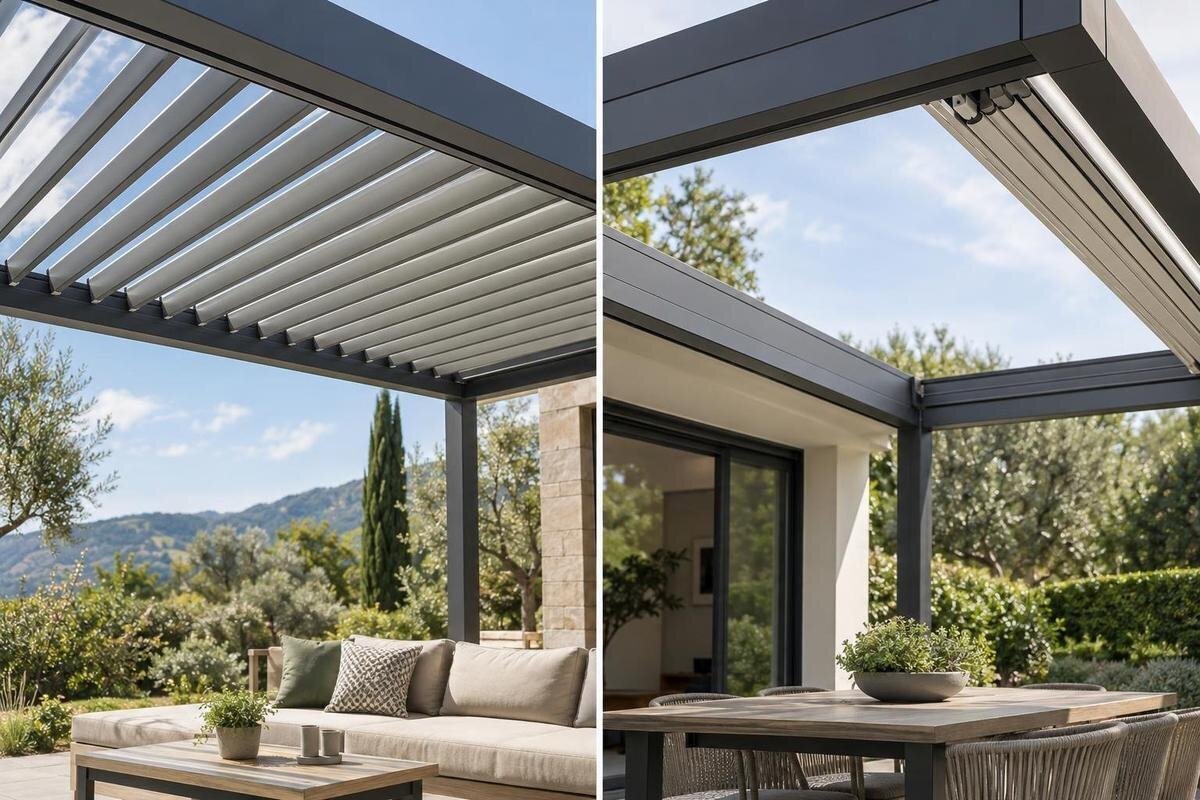
Pergola roof systems
Rotating and retractable pergola louvres both allow you to adjust the roof, but they do not create the same opening. Rotating blades pivot in place; retractable blades travel along guides and gather away from part of the roof. As a result, one mechanism changes the angle of the blades, while the other can change how much of the roof remains covered by louvres. Neither movement, by itself, confirms rain performance, controls or the amount of clear sky. The useful comparison begins with the operating diagram for the exact model, not a broad product label.

Rotating and retractable describe different movements
The key difference is the direction of movement. A rotating louvre turns around a fixed pivot line: its angle changes, but it stays in its place across the roof. A retractable system moves its louvres along guides so they slide or gather toward a designated part of the frame. In broad terms, rotation changes each blade’s pitch while leaving its position across the roof largely unchanged; retraction changes how much of the roof footprint the blades occupy. The word “retractable” usually points to travel along a track, although product terminology is not perfectly consistent. A diagram should show whether the motion is a pivot, a slide or both.
Some designs combine movements: the louvres may tilt to vary their angle and then slide to uncover more of the roof. Others use only one motion. These labels describe how elements move; they do not provide a complete list of available positions, controls or weather performance. This guide compares the mechanisms generally and should not be read as a claim that every type is available in a particular product range. The Bloomcabin Bioclimatic Pergola listing identifies a model, but the name alone cannot confirm how its louvres move. Match the exact configuration to a manual or operating diagram that shows pivot points, travel arrows and end positions.
Rotating louvres stay in the roof opening
With rotating louvres, the assembly remains above the same roof bay while the blades tilt. At one angle, their broader faces may intercept more direct sun; at another, the spaces between blades may admit more light and air. The exact effect depends on blade shape, spacing, permitted angle and the sun’s position, so “rotating” is not a promise of a particular shade level. In a diagram, look for a fixed pivot or shaft and arrows showing an arc of movement. If the blades also travel along rails, the system has a second action to verify. The pivot remains in one location even when the blades are open.
Because the blades remain overhead, rotating them does not usually move the entire roof covering out of sight. Even at a more open angle, blades and supporting frame still occupy the roof opening. This can suit someone who wants to adjust shade without moving all the elements to one side; it may not meet a preference for a broad, unobstructed view straight up. When considering the Bloomcabin Wall-Mounted Pergola page, keep mounting style separate from roof movement. Compare the blade positions shown for the configuration you want: the important distinction here is whether the blades remain across the bay as their angle changes.
Retractable louvres move to a stored position
A retractable louvre roof changes the area occupied by its blades. In a common arrangement, connected louvres or roof sections travel along rails or guides and gather near an edge or another designated storage zone. Moving them aside can leave a larger portion of the roof directly open to the sky than a tilt-only arrangement. The frame, rails and gathered stack may still be visible or occupy part of the opening; “retractable” does not mean the whole structure disappears. The route, amount of travel and final opening vary by model, so the label alone is not a dimension or guarantee of a completely clear bay.
Check the drawing for the end position: do all louvres gather at one side, does the stack occupy part of the opening, and does a cross-member still span it? Some products move only part of the roof, and some use a sequence that tilts before sliding. The Bloomcabin Pergola listing gives an area range of 9–24 m², which describes overall size rather than the extent of louvre travel. Keep those measurements separate when comparing layouts. Match the movement drawing to the size and configuration you are considering, then locate both the uncovered area and the gathered blades within that layout.
What remains overhead when the roof opens?
To compare the actual opening, look at the roof in its end positions rather than rely on the word open. Rotating louvres change their angle but continue to span the roof bay; depending on their position, gaps may widen, yet the blades remain overhead. Retractable louvres can gather into a smaller zone and leave a larger uninterrupted area elsewhere. Rails, perimeter frames and cross-members may remain in either arrangement, so “open” does not necessarily mean an empty rectangle. A useful drawing labels the clear opening separately from the pergola’s overall footprint and shows the louvres at each stop. This matters most if your aim is to see more sky, rather than simply adjust shade.
Relate that opening to how you use the terrace. A dining table, a doorway or a preferred view may sit below a different part of the roof, so the side where blades collect can matter as much as the size of the opening. Compare a plan view with a side view: one helps locate the gap, and the other shows whether stacked blades or a cross-member interrupt it. If only a general product photograph is available, ask for an open-position drawing for the model and configuration. Avoid planning around an assumed opening before you know where the louvres will end up.

How each system changes shade and airflow
With a rotating roof, partial settings let you choose among blade angles. That changes the combination of direct sun, shade and gaps above the terrace; the effect shifts with time of day, blade direction, spacing and nearby obstructions. It is more accurate to think of rotation as adjusting the overhead filter than as a promise of a particular shaded area. Retraction changes the proportion of roof directly exposed to the sky: where blades have moved away, they no longer provide shade. Neither mechanism can be compared by the words “open” or “closed” alone; check the positions shown and consider how much control you want.
Airflow is similarly site-dependent. Angled louvres can change the route light and air take through the roof, while retracting them removes more of the overhead barrier across the uncovered section. Walls, screens, nearby buildings and wind direction still affect conditions below. If adjustable shade is your main priority, compare the available blade positions; if a broad sky opening matters more, compare the clear opening and stack location. When reviewing the Bioclimatic Pergola model listing, separate these two priorities rather than treating an open roof as a single setting. Consider which positions would be useful above your seating area at different times of day.
Rain protection depends on the closed roof
Rain performance is separate from roof movement. In a closed position, rotating louvres may meet or overlap, but how water is contained and directed depends on their profile, joins, seals, roof geometry and drainage design. A retractable roof has a position where louvres have moved away; precipitation can reach the uncovered part. When the blades return, how well the roof manages water still depends on the exact construction and operating position. Neither “rotating” nor “retractable” is a weather rating, and a closed-looking roof should not be assumed to be watertight.
Check the product documents for an explanation of the closed position, where water is intended to go and any stated limits on use in particular conditions. If keeping an outdoor area dry is essential, look for explicit rain-handling information for the exact configuration rather than relying on a general image or category name. For the model on the Bloomcabin Wall-Mounted Pergola page, consider rain handling separately from its attachment to the house. Your comparison should distinguish the uncovered roof position from the position intended to manage rain. For site-specific performance questions, use the manufacturer’s guidance and consult a qualified professional.
Allow space for guides and stored louvres
Movement also affects the space the roof mechanism needs. Rotating louvres generally turn within the roof area, so there is no separate bay for the blades to collect, although pivots, linkages and any drive components still occupy part of the frame. A retractable system needs a travel path and a place for its louvres to gather. That stack may sit at an edge, take up part of the opening or influence the view, depending on the design. Track runs, end stops and the stored position should appear in the product drawing; a simple top view of the closed roof may not show them.
Compare those drawings with fixed features near the pergola, including eaves, gutters, lights, posts, doors or windows that open into the same area. Check both the open and closed roof positions, not only the outside footprint. The Bloomcabin Pergola model page lists an area range of 9–24 m²; use this to compare overall size, not moving-part clearance. On the layout, distinguish the outside frame, the route of any travelling blades and their stored position. Have the supplier or a qualified installer review any uncertainty about attachment, access or clearance, particularly where a nearby feature could occupy the same space as a moving roof element.
Manual or powered operation is a separate choice
Manual versus powered operation is a separate choice from rotating versus retractable movement. Either kind of mechanism may be offered with different controls, depending on the model; a motor does not prove that louvres retract, and manual operation does not prove that they only rotate. Ask how the roof moves through each position, whether a hybrid design requires a sequence and what comes with the configuration you are considering. Motors, remote controls, sensors and automatic weather responses are not universal features and should not be inferred from a product category or photograph.
If operation is powered, confirm the stated controls and operating limitations; if it is manual, check where the control is reached from and how it moves the roof. Ask what the owner should do if a powered mechanism is unavailable, rather than assuming a manual override exists. When comparing the wall-mounted model listing with another configuration, record the control method separately from the roof movement. This avoids treating a difference in controls as a difference in the opening itself. For a hybrid mechanism, also note how the controls manage tilting and travel. Leave electrical work or structural integration to qualified professionals.

Maintenance and weather limits are model-specific
Maintenance questions differ with the moving parts. A rotating design has pivot areas and associated linkages; a retractable design may also have guide tracks and a collection point where debris could interfere with travel. That does not mean one type is maintenance-free or that every system needs the same cleaning or lubrication. Ask which areas owners can access, how to clean them, what products are permitted and whether routine checks are specified. Do not apply oil or cleaning methods based on a generic description; follow the instructions for the exact mechanism to avoid damaging seals, finishes or moving parts.
Seasonal instructions and weather limits belong in the same review. Confirm the maker’s guidance for leaving the roof open or closed during wind, snow or extended periods without use, and check any stated operating or load limits. For a product identified through the Bioclimatic Pergola model information, keep maintenance tasks separate from restrictions on when the roof may be moved or left in a particular position. Record both so that a convenient opening does not become your assumed setting for every season. If exposure, support or clearance is uncertain at your site, ask a qualified professional to assess it; the mechanism label is not a rating.
Matching roof movement to your priorities
Choose the movement that matches the overhead result you want. If you want to alter the angle of shade while blades stay over the same roof bay, a rotating mechanism is the relevant description. If your priority is to move louvres away and expose more of the sky, a retractable mechanism is the relevant description, subject to the space its stack occupies. If a diagram shows both motions, compare every position rather than forcing the product into one category. Write down what you want from closed, partly open and fully open positions before comparing models; those are easier to verify than a general preference for a flexible roof.
A useful comparison records whether blades pivot, whether they travel, how much clear opening remains, where any stack sits, and what the documents say about rain, controls and maintenance. Then confirm that each detail belongs to the exact model and configuration—not merely a product family or marketing term. This keeps the choice focused on the practical difference: rotating louvres regulate their angle in place, while retractable louvres can leave a larger part of the roof uncovered by moving out of it. Any hybrid needs its own operating diagram.
Frequently asked questions
How can I tell whether a pergola roof rotates or retracts?
Look at the movement arrows and end-position drawings. A fixed pivot with an arc indicates rotation; guides or rails leading to a gathered position indicate retraction. If the drawings show both motions, the system is a hybrid. Ask for a diagram that matches the exact model and configuration rather than deciding from the product name.
Do rotating louvres create a fully open roof?
Not usually. Rotating louvres change angle but remain over the same roof area, so they can leave gaps while still occupying the overhead zone. The frame may remain too. Check the open-position drawing if your priority is a large, unobstructed view of the sky.
Does a retractable louvre roof keep rain out?
The mechanism name does not establish rain performance. When louvres are retracted, the uncovered area is open to the sky. When they are in a closed position, water handling depends on the model’s design and documentation. Check the stated rain-handling details for the exact configuration.
Can a louvred roof both rotate and retract?
Some designs combine both movements: the louvres can change angle and travel along guides. The sequence and available positions vary by model. Look for an operating diagram that shows each action and the final positions, rather than assuming a roof uses only one mechanism.
Does retractable mean the roof is motorized?
No. Retractable describes how the roof elements move; manual or powered describes how that movement is operated. Check the model documents for the actual controls and included features. A motor, remote, sensor or automatic response should not be assumed from the roof type.
Think of rotating as angle adjustment and retractable as a change in where the louvres sit. The former keeps blades over the roof bay; the latter can uncover more of it but needs a defined travel and storage path. For any model, the decisive comparison is the documented open and closed positions, along with the relevant weather and maintenance limits. That makes it easier to choose a roof whose movement matches how you want the terrace to function.
