
Squeaking Pergola Mechanisms: When Maintenance Is Needed
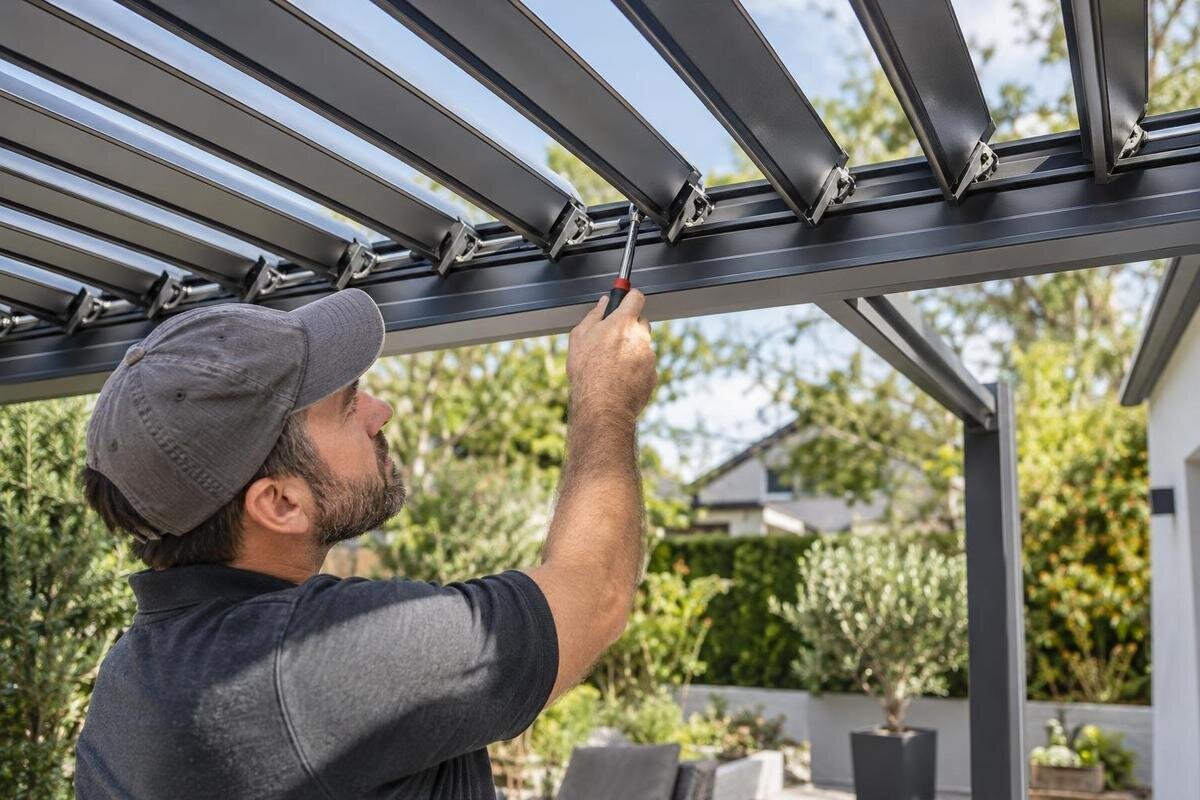
Pergola care
A squeak from an operable pergola roof or another moving component is a clue, not a diagnosis. Sound can travel through the frame, and its pitch alone cannot identify which part is involved. The useful evidence is when it happens, where it seems loudest, whether it repeats, and whether movement has changed. Record those observations from a safe position before cleaning, lubricating or adjusting anything. Then compare them with the instructions for your exact model. A recurring or worsening noise, especially alongside uneven movement or visible damage, calls for service rather than trial-and-error maintenance. A short, consistent record is more useful than guessing from the sound alone.

Before you inspect 1
What a pergola squeak may indicate
A squeal, chirp or rubbing sound can be consistent with friction at a moving contact, but it does not identify one. The frame may carry sound away from the source; a noise that seems to come from one beam could begin at a different joint or nearby fitting. Debris, contact, wear or a change in alignment are possibilities, not conclusions you can draw from pitch. A recording is useful evidence, but it cannot prove which part needs cleaning, lubrication, adjustment or replacement. Even a familiar-sounding noise may have different causes on different designs, so avoid diagnosing it from a video of another pergola.
Compare the sound with the pergola’s usual operation, if you know that baseline. Note whether it is new, intermittent or gradually becoming louder, and whether movement still looks and sounds even. A one-time faint squeak with no other change is not proof of failure, but it is worth recording and checking against the manual. Conversely, a quiet mechanism is not evidence that scheduled care can be skipped. The noise helps you decide what to report; the manufacturer’s schedule and the actual condition determine what maintenance is appropriate. If the structure is new to you, do not use another owner’s sound or routine as its baseline; start a dated record while the details are fresh.
When in the operating cycle does it happen?
Use the normal operating sequence only if the mechanism is moving as expected and the instructions allow operation. Note whether the squeak occurs as the roof opens, closes or changes position, and whether it starts at the beginning, at one point in the travel or near the end. Record whether it happens in one direction or both, and whether the sound lasts for a moment or throughout movement. If motion has become uneven, delayed or difficult, do not cycle the roof repeatedly just to reproduce the sound; stop and seek guidance. Never bypass a control or push a motorized part by hand.
Include the exact model wording from the order record or manual, together with any serial or reference number you can read without removing a cover. If the paperwork names a Bloomcabin Pergola, copy that name rather than relying on a resemblance to another model. Also record the roof or control type, if known, using the maker’s own terms. These details help service staff identify the installed version and check the appropriate documentation before suggesting a product, part or procedure. If a detail is missing or uncertain, say so rather than filling it in from a similar-looking product.
Before you inspect 2
How to locate the sound safely
Try to locate the apparent sound from outside the moving area, not by reaching under or into the roof. Use stable landmarks—such as a named corner, beam or side—and define your viewpoint in your notes. For a structure beside a house, “house side” and “outer side” are clearer than “left” unless you say which way you are facing. Sound can travel along connected frames, so describe the point as “loudest near” rather than declaring a particular bearing, track or joint to be faulty. If another adult helps listen, keep everyone outside the mechanism’s travel area and use normal controls only. Stop movement before changing listening positions.
Take a wide photo from ground level with the pergola stationary, then a closer view only if it can be captured safely without climbing or moving a cover. Record audio from the same safe position; do not place a phone on a beam or follow the roof as it moves. Mark the apparent area on a copy of the image or describe it in words, without attaching tape, chalk or a tool to any component. If your documents identify a Bloomcabin Bioclimatic Pergola, include its full model name with the photos and location notes so service staff can relate the observations to the correct unit.
Record the pattern and conditions
Record the date, whether the roof was opening or closing, the apparent location and how often the sound occurred. Add conditions that may help a technician compare reports: recent rain or wind, whether the structure was wet or dry, approximate temperature if known, and how long it had been since it last moved or was maintained. These details are clues, not a diagnosis; for example, a noise after wet weather does not establish that moisture caused it. Do not operate the structure in conditions its manual rules out simply to test a theory. If nothing unusual about the weather stands out, record that too.
Use the same description each time: a short squeak halfway through closing near the outer-right corner, heard twice, is more useful than “it sounds bad.” Note whether the noise also occurs while the pergola is still, only in wind, or only during movement; if you cannot tell, say so instead of trying a risky test. If the order record calls it a Bloomcabin Wall-Mounted Pergola, define “house side” and “outer side” from one consistent viewpoint. If the manual uses different names for a position or control, use those terms, then add a plain-language explanation. A simple count of occurrences is more useful than repeatedly operating the roof to get a precise number.

Before you inspect 3
What visible signs to note at rest
At rest, make only a visual check from a safe position. Note obvious new debris, a visibly displaced cover, a loose-looking part, a crack or a change in the roof’s alignment; do not tug or twist anything to see whether it moves. If previous photos exist, compare them without assuming that every gap or seam is a fault. A leaf on an accessible surface may be worth reporting, but it does not prove the mechanism is obstructed. Clear only what the model’s instructions identify as a user-cleaning task, and only if it is safely reachable without entering the moving area. Record what you saw before changing anything.
Do not climb onto the pergola, lean into tracks, remove a fascia or guard, loosen fasteners, or probe a gap with a tool. Those actions can alter the condition, create a hazard or make it harder for a technician to tell what happened. If a part appears detached, bent or out of place, keep people clear and leave the mechanism alone; do not try to realign it. A photograph taken from the ground is a useful observation. Dismantling a cover or moving a component to get a closer look is not an appropriate way to locate a squeak.
Follow the maintenance schedule for the exact model
Follow the maintenance interval and tasks in the manual for the exact installed model; do not infer them from a general pergola-care article or from the fact that another unit looks similar. A squeak can be a reminder to review those instructions, but it does not automatically mean “add lubricant.” The listed care might involve inspection or cleaning, while lubrication or adjustment may not be an owner task at all. Even a quiet mechanism still needs any maintenance specified by its manufacturer. Treat the schedule as separate from symptom-led service: the first governs routine care, while new noise may require diagnosis.
If your manual is missing, ask the seller, manufacturer or installer for the version that matches the model and its configuration. If your purchase records identify the regular Bloomcabin Pergola, use that name when requesting instructions. A product page can help you recognize the name, but it is not a substitute for the correct care instructions. Check your purchase documents and warranty terms before performing work; reviewing them does not establish that a particular repair is covered. If an instruction is unclear, or it requires access to the drive, wiring, concealed parts or adjustments, leave that task to qualified service rather than relying on a generic online video.
Before you inspect 4
Why lubrication by guesswork can make matters worse
A general-purpose spray, household oil, grease or silicone product may be incompatible with a particular surface, seal or moving assembly, and a spray can spread beyond the point you intended. Residue may also attract dirt or hide the original sound. A product marketed for hinges is not automatically suitable for a pergola; another owner’s method may apply to a different material or mechanism. Do not layer products or add more in hopes of quieting the sound. Only use a maintenance product when the instructions for your exact model specify the product or type, location and method. Applying a second substance after the first can also make the original condition harder to assess.
For a bioclimatic pergola model identified in your paperwork, follow its exact service instructions rather than assuming that an apparent hinge, track or pivot needs lubrication. Do not force the roof, tighten parts, change travel stops, adjust a motor, remove covers or open electrical equipment to reach a suspected source. If the manual lists an owner-accessible task, follow it exactly and only under its stated conditions. If you cannot identify the specified point or product, stop and ask the manufacturer or a qualified technician. Advice for another system does not establish where lubrication is permitted on yours.
When to stop operating and call for service
Stop operating and arrange an assessment if the squeak comes with binding, jerking, uneven travel, a sudden bang or grinding, a new gap or misalignment, or any part that appears loose or damaged. Do not keep pressing the control to see whether it will clear. Keep people clear of the moving area, do not force the roof by hand and do not remove guards or covers. These signs do not identify the failed part, but they make further trial-and-error use a poor way to investigate it. Tell anyone else who uses the pergola not to operate it until the condition has been assessed.
A recurring sound that is becoming louder, occurring during more of the roof’s travel or returning soon after an approved maintenance task also deserves prompt follow-up, even if movement still seems normal. Describe what changed and what work was done, rather than repeating the work or trying another product. When arranging service, use the exact model name from your documents, such as the wall-mounted Bloomcabin Pergola if that matches your paperwork. Do not assume that wall-mounted and freestanding designs share mechanisms or replacement parts; ask service to confirm. If the noise occurs while the structure is still, report that rather than moving parts to reproduce it.

Before you inspect 5
What to include in a service request
Send a concise symptom record rather than a guess at the cause. Include the exact model and serial or order reference, the date the noise began, direction and stage of movement, apparent location, conditions and any change in operation. Attach a short audio or video clip only when it can be recorded from a safe position; add a wide photo of the stationary structure to show your location reference. Say which observations are uncertain. Do not remove a panel to photograph a label or expose wiring, and do not edit the clip in a way that changes the sound.
List maintenance already performed, including the date and the product or method, and say whether it was specified in the manual or completed by a technician. If your paperwork identifies the Bloomcabin Pergola model, give that full name with the reference details; the product listing itself does not verify a part number. For a replacement request, have the supplier confirm the component and compatibility against your exact version rather than ordering by shape or colour alone. A record of prior repairs also helps prevent repeating an unapproved attempt.
Keep a record after maintenance or repair
After the manufacturer or technician identifies an approved task, keep a dated record of what was done, by whom, and with which specified product or part. Note the manual or service reference used, where available. On the next normal operation, record whether the squeak has stopped, returned or changed, and under what conditions; do not deliberately repeat movements to stress-test it. A temporary quiet period is useful information, not proof that a worn or misaligned component has been repaired. If the noise returns, send the update with the earlier log rather than starting the diagnosis over.
If service confirms that repair or replacement should be considered, include the symptom log and model record in an enquiry about approved options. If your documents name this model, the Bloomcabin Bioclimatic Pergola product page can serve as an identity reference, but it does not establish compatibility with existing parts or suitability for your site. Have the supplier or service professional verify the proposed option against your installation and documentation before you commit. Keep the assessment of the noise separate from the purchasing decision: identifying a new product does not establish that it is the right remedy for the existing mechanism.
Frequently asked questions
Does a squeak mean the pergola needs lubricant?
No. A squeak can have several causes, and the right maintenance depends on the mechanism and its manual. Check the scheduled care instructions, then record whether the noise repeats or movement has changed. Use a lubricant only if the instructions for your exact model specify the product and application point. Otherwise, ask the manufacturer or a qualified service provider rather than trying a general-purpose spray.
Can I keep using the pergola if it squeaks?
If it was a single brief sound and movement appears unchanged, record it and consult the manual instead of repeatedly testing the mechanism. A recurring or worsening squeak needs follow-up. Stop operating it if there is binding, jerking, uneven travel, a sudden bang, visible damage or a loose-looking part, and arrange an assessment.
How can I locate the sound safely?
Listen from outside the moving area and use fixed landmarks to note where the sound seems loudest. Because sound can travel through the frame, describe an apparent location rather than naming a faulty joint. Take photos or record audio from a safe position, without climbing or reaching into the mechanism. Do not place a device on a moving component.
Does a squeak after rain or a cold spell mean the pergola is fine?
Not by itself. Record the weather and whether the structure was wet or dry, but do not assume those conditions caused the noise or make it harmless. Check the model-specific instructions and report a recurring sound or any change in movement. Never operate the pergola in conditions its manual excludes just to reproduce the symptom.
What should I include in a service request?
Provide the exact model and any serial or order reference, when the noise began, the direction and stage of movement, its apparent location, the conditions and any change in operation. Include safe, unaltered photos or audio and list maintenance already performed. Say which details are uncertain; do not dismantle anything to expose a label or inspect the mechanism.
The aim is not to silence every squeak immediately; it is to distinguish scheduled care from a symptom that needs service. A dated note about timing, apparent location and movement pattern gives the manufacturer or technician useful evidence without requiring you to adjust the mechanism yourself. Let the exact model’s instructions govern routine maintenance and the observed condition guide how quickly you seek help. A quiet mechanism still needs any scheduled care, and a temporary change after an unapproved product is not proof that the underlying issue is resolved.
