
Buying a Used Pergola: Parts and Reinstallation Risks
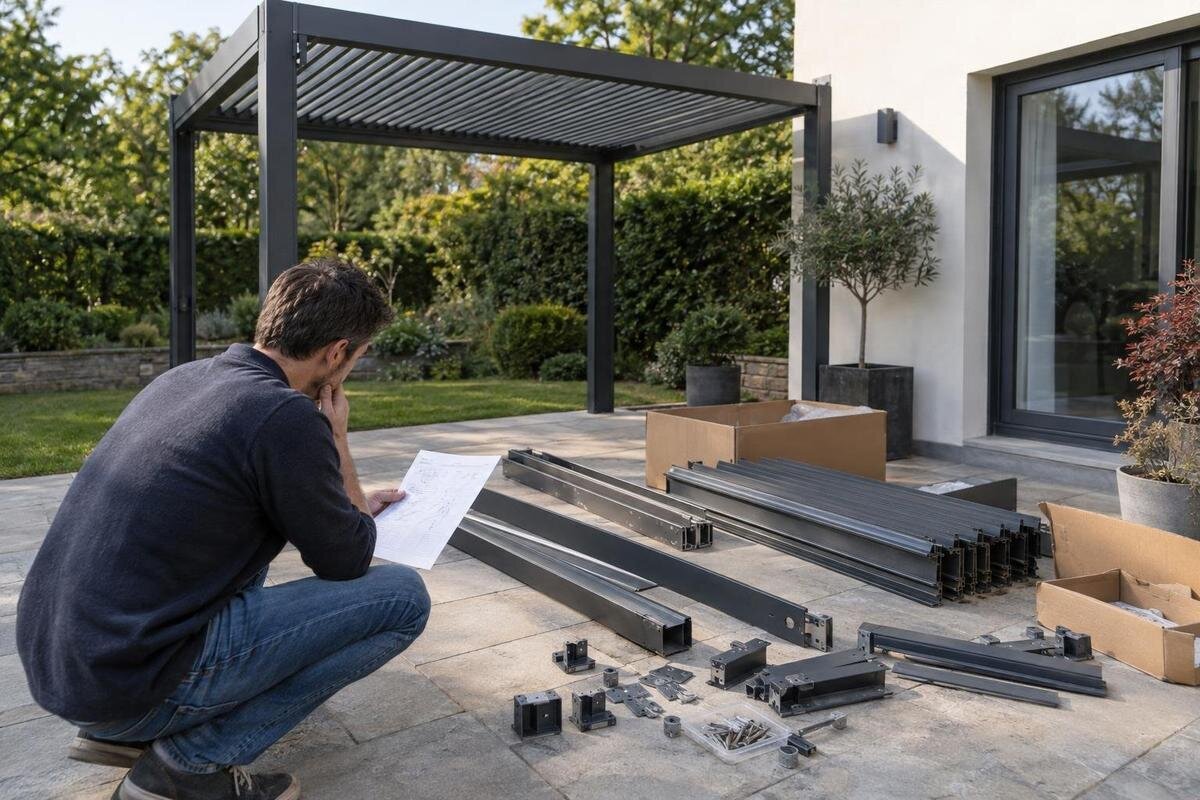
Pergola buying guide
A second-hand pergola can look complete in a listing and still be costly to reinstall. Drawings may be missing, a small bag of fasteners may have disappeared, or the old layout may not suit the new property. Inspect it as a specific, documented kit—not simply a frame—and price the move, repairs and new-site work before committing.

Used pergola inspection 1
Confirm the make, model and original configuration
Ask the seller for the manufacturer, exact model or series, approximate purchase date, original size and configuration, and any options; photograph every identification label. Note whether it is freestanding or attached to a building, and whether the roof is fixed, adjustable or motorized. Those details determine which drawings and parts list are relevant. If the seller calls it bioclimatic, compare the name with the current Bloomcabin Bioclimatic Pergola listing, but do not assume an older unit is the same generation or uses interchangeable parts. Similar photos, colour or general shape cannot establish exact identity. Ask whether it was ordered as a standard kit or altered after purchase; substitutions and additions may not appear in general product imagery.
Compare the description with an invoice, order confirmation, product label, installation manual or clear assembly markings. Ask what has changed since purchase: replaced members, added screens, altered drainage, relocated holes or removed accessories. Find out whether it has been moved before, how pieces were marked during dismantling, and whether anything was bent, cut or drilled. If no label remains, request close-up photos of any codes and exact names from the paperwork. Keep gaps visible in your notes instead of guessing. When the seller can identify only a broad product family, ask the manufacturer or a qualified installer whether the records are enough to assess this particular kit before you pay.
Get the drawings and the original kit list
Request the original plan and elevation drawings, installation manual, component or packing list, and order sheet showing the options supplied. Documents for a similar current product are not a substitute for records of the used unit. If you are comparing the used kit with the Bloomcabin Wall-Mounted Pergola, keep the two sets of documents separate: the current model name does not identify the used unit’s bracket pattern, wall connection or included hardware. Check that the model reference and drawing revision are legible on each document. A useful parts sheet gives codes and quantities; drawings can show member lengths and how the assembly was intended to sit. Save complete copies, including notes and detail pages, not just the cover.
Compare the paperwork with the assembled structure before it is dismantled. Mark differences directly on a copy: an extra post, a changed beam, a replacement motor or a missing cover may point to a non-standard kit. Ask the seller to explain each discrepancy and provide invoices or records for replacement parts, if available. If instructions have been lost, do not rely on a generic online video as the only assembly plan; it may show another size or revision. Ask whether the original supplier can still identify the configuration or advise which documents a future installer needs. If the seller cannot resolve a difference, price it as an unknown, not as a confirmed part.
Used pergola inspection 2
Count every part before paying
Make a count against the exact parts list, with the pergola assembled if possible and again as it is taken apart. Identify posts, beams, cross-members, rafters or louvres where applicable, brackets, end caps, covers and any drainage pieces shown in the documents. Do not assume that an accessory in a photo—such as lighting, a screen or a side panel—is included in the sale. If you are also considering the Bloomcabin Pergola, compare its confirmed inclusions with the seller’s itemized inventory, rather than comparing product photos alone. Note each component’s part code, quantity and condition beside the corresponding line on the original list. Record anything you cannot identify so it can be checked before collection.
Small hardware deserves its own check. Count the specified bolts, screws, washers, clips, brackets and connector plates, and check whether they are in labelled bags or mixed together. A pile that looks plentiful may still lack a particular length or connector needed at a critical joint. Record anchors separately: some may have remained at the original site and will not travel with the frame. Ask the seller to state in writing which fasteners and accessories are included, which are missing and whether any are generic replacements. Do not assume a hardware-store substitute is equivalent; check the model documentation or ask a qualified installer to confirm any replacement. This count provides a basis for budgeting for missing parts and makes clear what the seller means by a “complete kit.”
Inspect for damage that affects reassembly
Inspect every accessible member, joint and connection in person, not only in wide listing photos. Look for bends, twists, cracks, distorted holes, loose or damaged joints, corrosion, peeling or damaged finishes, missing seals, water staining and evidence of improvised repairs. These clues do not prove a component is unusable, but they identify issues that a buyer should not price as cosmetic without assessment. Photograph defects beside a ruler or another reference for scale, and capture both the overall part and close-ups of the affected area. Pay particular attention to connection points and cut edges, where damage may be less obvious from a distance.
Ask when the damage occurred and whether the structure has been exposed to impacts, repeated dismantling or long periods in storage. Check the underside and faces hidden by overlaps where accessible, and compare parts that should match for shape and hole locations. If the seller has already taken it apart, ask for photos of the assembled pergola and note which image shows the exact kit being sold. Do not force a stuck joint or test an unfamiliar moving assembly by hand; a qualified person can assess uncertain parts. If a key post, beam or connector looks compromised, pause the purchase until the replacement part and repair approach are confirmed, rather than assuming the frame can be made sound.

Used pergola inspection 3
Calculate the full reinstallation cost
Use the asking price as only one line in the budget. Add the cost of careful disassembly, labour, loading, transport, unloading, secure storage, replacement parts and fasteners, assessment, and reinstallation. Include new site work such as a suitable base or wall connection where needed, plus qualified electrical work if powered components are part of the kit. A move can also add time if pieces must be identified or repaired before installation. Ask service providers for itemized estimates based on the actual drawings, photographs and inventory; a rough figure based on “a pergola” will not resolve unknowns about this specific used assembly.
Then compare that total, including a reserve for unresolved items, with the cost of a separately configured new option. You can request a quote for the current Bloomcabin Pergola as a comparison, but first confirm the configuration and included work so that both budgets cover the same project requirements. Keep purchase, transport, missing parts and installation in separate lines so you can see what the saving depends on. If essential connectors or operating components have no confirmed replacement route, their cost remains unresolved; do not hide that uncertainty in a small allowance. Record which estimates depend on parts availability or further inspection. A used kit may still suit a project, but the comparison should show both the expected saving and the costs you cannot yet establish.
Measure the new site against the actual assembly
Measure the new location against both the drawings and the actual parts. Record the intended outside footprint, post centres, height and projection, then compare them with doors and windows, eaves, vents, trees, paths, drains and service locations. A structure that fitted the seller's patio may conflict with a different access route or overhang at yours. For a wall-attached design, have the wall, proposed fixing zone and connection details assessed for this installation; the Bloomcabin Wall-Mounted Pergola model is a catalogue reference, not proof that a similar used unit fits your wall. Do not rely on an advertised nominal size when post locations or projections determine the usable space.
Draw the pergola footprint on a simple site plan and note the clearances needed for doors, movement around the posts, maintenance access and any operation of roof parts. Record changes in orientation and which edges face the home, neighbouring boundaries or drainage routes; they can alter how the space is used and where runoff travels. Compare every dimension with the actual kit, since a modified or replacement member may change the old drawing. Ask the intended installer to review the measurements before purchase, especially if the structure is custom-sized or the site is uneven or constrained. If the drawings and recovered pieces disagree, resolve the discrepancy rather than planning around an estimate.
Used pergola inspection 4
Treat the base and anchors as a separate project
Treat the seller's old footings and anchors as part of the old installation, not automatic assets for the new one. Their spacing, condition, position, substrate and connection details may not match the recovered frame or the new site. Ground conditions, drainage, existing services and local seasonal movement can also affect the base design. Do not infer suitability because the old pergola stood securely, or because a post seems to line up with an existing hole. Have a qualified installer or structural professional assess the new location and the manufacturer's drawings before deciding what can be reused. This is a separate check from confirming the parts count: complete hardware does not prove that the base is right.
Ask exactly what will remain behind when the seller removes the structure and what will travel with it. Base plates may be removable while anchors, concrete or other site-specific work stays behind; only inspection and the sales terms can establish what is included. Include removal, repair or disposal of anything left at the old property in the handover plan. If replacing the used kit is an alternative, assess a current Bloomcabin Pergola configuration on its own installation documents rather than assuming either unit can reuse the old base. The new site's installer should specify what information is still needed before approving an anchoring approach. Avoid buying on the promise that “the old holes should work.”
Verify motors, controls and moving roof components
For an adjustable or motorized roof, make a separate inventory of every moving part and its operating components. Record the number and condition of louvres or other roof pieces, pivots, links, end pieces, motor assemblies, controls, remotes, sensors and cables only where these are part of the seller's configuration. Photograph labels and connector ends without opening electrical housings. Ask for a safe demonstration in the assembled setup; do not force a mechanism, energize damaged equipment or attempt electrical diagnosis yourself. A bioclimatic model listing identifies a product category, but it does not establish that a used motor, control or roof component is compatible with that model.
Request the original operating instructions, control model numbers, wiring documents if supplied, and any service or repair history. Ask what happens to the controls and remotes during transfer and whether any settings, pairing or commissioning steps are required; have a qualified professional handle electrical checks and reconnection. A short video can show that the system moved at the time it was filmed, but it cannot confirm condition after transport or prove all parts are present. Check with the manufacturer or a specialist whether replacements for a missing or obsolete-looking part can be identified before purchase. If the roof cannot be demonstrated safely, value it as unverified and make the inspection or repair responsibility explicit.

Used pergola inspection 5
Confirm permissions, insurance and responsibilities
Confirm that the seller owns the pergola or is authorized to sell and dismantle it, and agree which manuals, drawings and accessories transfer with it. Check the proposed removal and new installation with the relevant property owner, landlord, condo or strata corporation, or owners’ association, where applicable. Ask the municipality which local requirements apply to the specific project rather than assuming that an earlier installation settles the question. If you are also considering a new wall-mounted pergola, keep its proposed installation details separate from those of the used kit when making these enquiries. Verify any required approvals before arranging removal. Permission to remove the structure from the old property and permission to install it at the new one are separate matters.
Ask your insurer what coverage applies while the kit is being dismantled, transported, stored and installed, and whether the proposed contractor or work needs to be documented. Do not assume the seller's insurance, an old permit or a previous installation transfers to you. Put responsibilities in writing: who disconnects powered components, takes down the frame, supplies lifting and transport, protects the parts, repairs the old site, and handles new foundations or electrical work. Confirm whether the installer is willing to assess and reinstall a used structure, what is excluded and how unknown damage will be dealt with. Clarify who pays for a missing part discovered after pickup; that question can be more consequential than a small difference in the asking price.
Record the sale and handover terms
Before paying, create a written handover record with the exact model information, itemized included parts, missing items, disclosed defects, available documents and agreed accessories. Identify who is responsible for dismantling, loading, pickup, transport and any work left at the old site, and set out what happens if the inventory differs at collection. Keep dated photographs tied to the parts list. If a deposit or other condition is part of the deal, record it in the sale terms and make the wording clear to both parties; do not rely on a casual promise about replacement parts, compatibility or “everything in the photos.”
Walk away, or delay the decision, when the seller cannot establish ownership, refuses a reasonable inspection, has no usable identification, or cannot explain major changes and missing components. The same caution applies if damage affects critical connections, a motorized system cannot be assessed, or a qualified installer will not confirm that the job can be priced. If you still want to proceed, list every unresolved issue and assign a cost or responsibility before committing. A sound purchase is not defined by age alone: it depends on evidence that the particular structure can be identified, transported, completed and installed safely at the new property.
Frequently asked questions
Can any pergola be dismantled and reinstalled?
No. Whether a particular kit can be moved depends on its exact configuration, condition, available parts and installation documents, as well as the new site. Have a qualified installer assess the structure and proposed location before treating it as reusable.
Which parts should I count especially carefully?
Check connectors and small fasteners as well as the main posts and beams. Also account for covers, brackets, drainage pieces and any moving-roof components shown in the kit documents. Record accessories separately so photos do not create confusion about what is included.
Do I need the original drawings?
Drawings and a parts list make it much easier to identify the kit and check what is missing. They do not prove that the pergola suits a different site, so compare them with the actual parts and get the proposed installation assessed.
Can I reuse the old footings or anchors?
Do not assume they will suit the new installation. Their location, condition and connection details may not match the kit or destination. Ask a qualified installer or structural professional to assess the new site and the pergola’s documentation.
Does a warranty transfer when I buy a second-hand pergola?
Do not assume it does. Ask the seller for the original warranty terms and seek written confirmation from the manufacturer about whether any coverage transfers and what it applies to. If that cannot be confirmed, include the uncertainty in your decision.
The sensible buying threshold is not whether the pergola looks intact, but whether its identity, parts, condition and new-site requirements can be verified well enough to price the work. A complete kit with clear records still needs a fresh assessment for its destination; an attractive frame with missing drawings or unknown anchors may not be a bargain. If costs or compatibility remain uncertain, pause until those gaps are resolved or compare a separately specified alternative. That turns the purchase into a manageable handover rather than an assumption that yesterday’s installation will work again.
