
What to Consider When Buying a Pergola for a Poolside Terrace
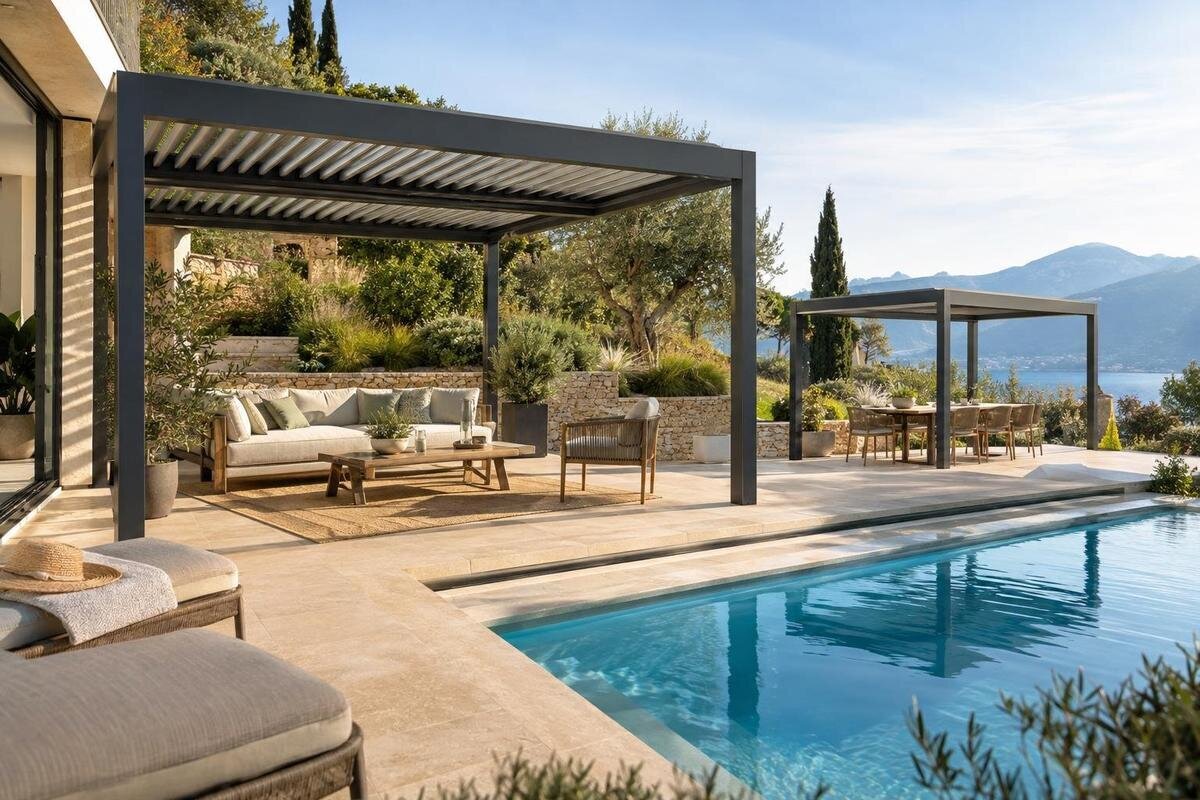
Pergola buying guide
A pergola beside a swimming pool can make a terrace more comfortable to use, but the right choice depends on how the area is laid out, not simply on a product photograph. Before buying, decide where people will sit, how they move between the house and pool, where shade is needed and which parts of the terrace must stay clear. Then compare the pergola’s measured footprint, roof arrangement and installation requirements with those needs. This guide focuses on the buying decisions that matter beside a pool, from mapping the terrace to checking product details and the scope of an order.

Decide how the pergola will be used
Decide what the pergola should do on an ordinary pool day and whether it will also serve as an everyday seating or dining area when nobody is swimming. You might want a shaded place to sit after a swim, cover for a table, or space for loungers beside—but not in—the route to the water. Each use needs a different furniture arrangement: chairs need room to pull back, while loungers need space to recline and pass. If you want to combine activities, sketch them together so one does not make the other awkward. Think about the time between swims too: someone may want to read, eat or dry off without shifting furniture. A product that looks generous in a photograph can still leave too little room once furniture and people are in place.
Write down the main activity, the number of seats or loungers, the usual time of use and the kind of shade you prefer. Add fixed requirements, such as keeping a view across the pool or leaving a place for a pool cover; rank occasional needs below everyday ones. Decide what must sit beneath the pergola, rather than merely nearby, so a table is not partly outside the intended shade. A product page such as Bloomcabin’s pergola listing is a comparison point, not a plan: record only features and measurements that the page confirms, then test them against your brief. The staged arrangement is not proof that it will fit your terrace.
Measure the terrace and mark the footprint
Measure the usable terrace, not just the overall paved rectangle. Note the pool edge, coping, corners, changes of level, walls, doors, steps, fixed posts and any narrow strip beside the house. Record the measurements and the points from which you took them on a simple plan, taking more than one measurement along an irregular edge. The narrowest clearance matters more than an average width. Then outline the full stated pergola footprint and mark every support position; include roof projection if the product information gives it. A gap that looks generous on paper can disappear when a post meets a doorway or the pool edge. Do not estimate size from a website image or model name.
Place the intended furniture on the same drawing, including chairs pulled out and loungers in the position people will actually use. Show door swings, steps, storage for the pool cover and the route for bringing it out. Distinguish overall product dimensions from the usable shaded area and the gap between supports; they are not interchangeable. For the bioclimatic Bloomcabin pergola page, use only dimensions or drawings actually supplied and confirm the exact support layout before ordering. If a key measurement or the distance between supports is missing, request it rather than judging from the picture. A quick mark-out on the terrace can help test the plan.
Keep pool access and working space clear
Plan an unobstructed route from the house to the pool and around the parts of the terrace people use most. Include the pool steps or ladder, any gate or access point, and the approach to seating; avoid making people weave between support posts, chairs and the water’s edge. Think about the route taken when carrying towels or equipment, not only the empty paving. A pergola should define a comfortable seating zone without turning a normal path into a narrow passage or making the pool difficult to reach. Check the route with chairs pulled out and people seated, not just when the terrace is empty; furniture can narrow a path once it is in use.
Mark equipment and maintenance needs as well as people’s movements. A cover may need space to open, fold or be stored; cleaning tools, service access and safety equipment should remain reachable. Follow the clearances in the pool’s own instructions and the advice of the person responsible for its installation or maintenance rather than choosing a universal distance from a general guide. A pergola is an overhead structure, not a pool barrier or a substitute for pool safeguards. Use tape or removable markers to show proposed support positions, then check that doors, gates and pool equipment remain accessible before comparing models.
Choose the position for the shade you want
Shade moves as the sun changes, and the same pergola may shade a table at one time while leaving it exposed later. Think about the hours when the terrace is actually used and which area matters most: dining seats, loungers or a clear patch of paving. Observe existing shadows at those times, including shade from the house, trees and neighbouring structures. If poolside use changes with the season, remember that the sun’s angle changes too; one afternoon is not a complete guide. A few notes or photographs taken from the same viewpoint can help you compare what you see.
Mark the intended shaded zone on your plan, then check the proposed roof orientation and support positions against it. Open overhead members, a fixed covering and adjustable elements will not give the same shade pattern, so ask what the specific option can do and how it is operated. Do not treat a label such as “all-day shade” or a catalogue image as proof of coverage. The Bloomcabin pergola product page can form part of your comparison, but rely on the roof description and drawings actually supplied; ask for clarification if they do not show where the shade is expected to fall. If furniture may move, consider whether the shaded area still works in its usual positions. Be precise about the zone and time you care about when comparing options.

Check shade and rain claims for the roof
Decide whether your priority is partial shade, a changeable level of shade, shelter from rain or a balance that still keeps the terrace bright. These are not interchangeable promises. Open overhead members, a solid covering and adjustable panels differ in how much sun and sky reach the area; a covered roof also raises questions about runoff and where water will fall. A pergola should not be assumed to make a pool terrace rainproof. Ask for the roof construction, operating method and any stated limitations in writing before treating it as all-weather cover. If rain protection is essential, make it a requirement to verify rather than an assumption.
The word “bioclimatic” on a listing does not, by itself, tell you how the roof is adjusted, how much shade it provides or whether it manages rain. For the bioclimatic pergola listing, look for the precise description and instructions, then check who operates it and what upkeep it involves; do not fill gaps with assumptions based on familiar product terms. Consider how much daylight reaches nearby rooms and whether the roof may direct water towards the pool, a doorway or the route people use. If the published details do not answer that, request a product-specific explanation from the seller or installer. Check any stated conditions for opening or closing the roof rather than assuming the mechanism can be left in any position.
Ask about materials and poolside cleaning
A pool terrace can involve a different cleaning routine from a sheltered seating corner. Splash, wet surfaces, airborne debris and the products used to maintain the pool may all be relevant to care, but suitability cannot be judged from a finish in a photograph. Check the exact material and finish stated for each component, along with cleaning methods, protective treatments and restrictions on detergents or contact with pool water. If your pool uses a particular treatment system, mention it when asking for guidance rather than assuming all outdoor finishes respond alike. Do not treat the appearance of a coating as evidence of its composition or durability.
Ask what routine care is expected and whether any parts need occasional attention; also consider how you will reach areas that are high or difficult to clean. Confirm whether compatible replacement parts or touch-up products are specified, if those matter to you, and keep the instructions for future reference. The Bloomcabin’s wall-mounted pergola listing should be assessed from its own published material and maintenance information, not from the general appearance of the pictured structure. If warranty terms are supplied, check whether they set cleaning or maintenance conditions. Check whether routine rinsing or a pressure washer is permitted, and follow the stated method rather than choosing a cleaner for the terrace surface alone. Treat unclear chemical compatibility as unresolved until the exact product is addressed.
Choose between freestanding and wall-mounted placement
The terrace may suit a freestanding pergola, an arrangement attached to the house or a different position altogether; the right form depends on the site and the product’s stated installation method. A wall-mounted position changes where supports sit and how the roof meets the building, while a freestanding position uses floor area within the terrace. Compare the space used by supports, the wall interface and access to doors rather than assuming one arrangement is inherently easier or better. Check windows, doors, eaves, pipes and other fixed features where a structure would meet or stand beside the house. Include the view from indoors when deciding which side should remain open, and keep access to the exterior wall and its fittings in mind.
If a product is identified as wall-mounted, check which wall and fixings are specified, whether those suit the actual construction and what checks the installer requires. A page such as the wall-mounted Bloomcabin pergola listing identifies an option to investigate; it does not establish that a particular house wall is suitable. Have an appropriately qualified installer assess the connection and support requirements before ordering, especially where the terrace surface or building fabric is unknown. If the assessment rules out a proposed location, move the structure or compare another installation arrangement instead of treating a product drawing as a site plan.
Check height, clearances and visual scale
Width and length are only part of the fit. Check overall height, clear height beneath the roof, roof projection and space needed for any moving element, where the product information states them. A low structure can feel cramped above loungers or a table, while a very tall one may give less useful shade at the intended spot; the effect depends on its design and position. Consider nearby eaves, doors and windows, and whether the roofline keeps the pool visible from the house. Compare these vertical clearances with your tallest intended furniture and with how people use the terrace. Ask whether a published height is the overall height or the clearance beneath the structure; those figures answer different questions.
Look at the proposed outline from the views you use: indoors, at the pool edge and from the main seating place. Think about colour and proportions, but let confirmed dimensions lead the decision; perspective can make a large structure look compact. For the bioclimatic Bloomcabin pergola option, use product drawings or measurements if available and ask about any omitted clearances. Check whether it would shade windows or block a view you want to keep. If the structure looks balanced from the house but dominates the pool-facing view, revise its position or size before purchase. Styling matters, but it should not conceal a post in the wrong place.
Confirm the base, installation and delivery arrangements
Before ordering, have the proposed position assessed against the actual terrace surface, ground conditions and the pergola’s documented fixing requirements. Existing paving is not automatically a suitable base, and a nearby wall should not be assumed capable of supporting an attachment. Ask a competent installer to identify any preparation, support and drainage considerations; do not rely on a generic online diagram for an engineering decision. If the ground falls, the surface is uneven or water collects near proposed supports, make those facts part of the site assessment before agreeing the final position. Mention drains or service routes that could affect the work.
Check how the parts will reach the terrace and where assembly can take place without blocking pool access or damaging paving, doors or planting. Measure the narrowest gate or passage and consider any turn in the delivery route; a structure that fits once assembled may be difficult to bring to the site. Ask whether the quote includes delivery, assembly, site preparation and packaging removal, and what remains your responsibility. For the Bloomcabin pergola page, compare any installation information actually supplied with the installer’s assessment; a product listing cannot determine site conditions on its own. Where permissions, a tenancy or shared-property rules may apply, check the relevant requirements before committing rather than leaving them until installation is booked.
Compare the full order, not just the product name
Put options side by side using the same questions for each: confirmed footprint and support positions, roof design, shade controls, materials and care, installation requirements, inclusions and stated exclusions. Record unavailable information as unknown instead of treating it as a feature. A comparison sheet separates an attractive photograph or a short label from details you can act on. Set a budget for the full project, allowing separately for delivery, installation and site preparation; when those figures are missing, do not treat the product price as the total. If quotes differ, compare the same scope rather than looking only at the headline amount.
Before placing an order, review the final drawing or specification against your measured plan and furniture layout. Confirm product identity, colour and options, package contents, delivery access, assembly scope, aftercare information and the seller’s stated terms; ask for missing details in writing. Check that any promised shade or weather performance appears in the product documentation rather than being assumed from a category name. A sound choice is the option whose verified details fit your poolside routine and whose installation has been considered for the actual site—not necessarily the one with the most elaborate description or largest roof. Keep a copy of the agreed details with your order.
Frequently asked questions
Will a pergola shade the whole pool terrace?
Not necessarily. Coverage depends on the specific roof design, its position, surrounding shade and the time of day. Decide which area you want shaded and when, then check product drawings or ask for a product-specific explanation. Do not assume a photograph or general pergola label promises all-day shade across the terrace.
How much space should I leave beside the pool?
There is no single figure that suits every terrace and pool layout. Keep the usual route to the water, access points, pool cover and maintenance equipment clear, and follow the pool’s own instructions. Mark proposed posts and furniture on site; if clearances are uncertain, ask a qualified pool or installation professional to assess the layout.
Can a pergola keep rain off poolside furniture?
Only if the specific roof is designed and described for that purpose; the word pergola is not a weather guarantee. Check the documented roof construction, limitations, operation and water runoff. Ask where rainwater will drain so it does not create an issue at the pool edge, doorway or main walking route.
Can I attach a pergola to the house beside the pool?
Possibly, but the wall, fixings and proposed position must be suitable for the particular building and product. Check windows, eaves and services, and have a competent installer assess the connection. A wall-mounted label on a product page does not prove that your wall or terrace is suitable.
What should I confirm before ordering?
Check the measured footprint, support positions, usable height, roof details, stated materials and care, installation requirements, delivery access and everything included in the quote. Match these against your poolside plan and ask for missing information in writing. Keep the final product details and installation scope with the order.
The best pergola for a poolside terrace is the one that fits the measured space, keeps access and maintenance routes clear, and provides the type of shade its product details actually describe. Give equal attention to materials, roof care and installation requirements. When the dimensions or fixing information leave an important question unanswered, resolve it before ordering; a careful comparison now is more useful than trying to make an unsuitable layout work later.
