
Buying a Pergola for Your Coastal Property

Coastal pergola buying guide
Buying a pergola for a coastal property in Ireland means weighing the site as carefully as the style. Salt carried by wind, moisture and local exposure can affect choices of frame material, protective finish, fittings and fixing method. Conditions can vary across a single garden, so a general coastal label or product photograph does not confirm suitability. This guide explains what to compare before ordering: the exact spot, roof arrangement, dimensions, installation requirements and the maintenance specified by the manufacturer.

Assess exposure at the proposed spot
Coastal does not describe one fixed level of exposure. A pergola behind a row of buildings may face different conditions from one beside an open shoreline, and distance from the sea alone cannot tell you how much wind-driven salt reaches a particular spot. Map which sides are open, the directions from which weather reaches the garden, and any walls, hedges or neighbouring buildings that provide shelter. Salt marks on existing windows, railings or garden furniture can offer useful clues, but they are not a test of how a new frame will perform. Note whether the area receives direct spray, airborne salt or mainly rain and moisture, so you can describe the site accurately when asking about a model.
Look beyond the points where the posts will stand. A gap between buildings, a corner of the house or an exposed garden edge may feel different from the centre of a patio; a boundary wall may shelter one side while leaving another open. Record how the space is used, where people sit, and how close it is to doors, paths and planting. Note any surfaces that stay damp or collect deposits, and where water drains after rain. If possible, observe the spot in more than one type of weather rather than judging it on a calm day. A simple plan of the house, boundaries, open aspects and intended footprint gives an installer more useful context than the word coastal alone.
Compare frame materials and finishes
Start with the stated frame material and protective finish, rather than a general claim that a pergola is durable. Salt deposits and moisture may increase corrosion risk for susceptible metals and may affect protective finishes, especially if a coating is damaged. Ask for the precise material or grade, the coating or treatment, and written confirmation that the exact finish is intended for the exposure you have described. A colour sample or close-up photograph cannot answer that. The Bloomcabin pergola product page is one place to review stated details; do not infer its material or coastal suitability from the name or image, and ask about anything that is not specified.
For timber, ask which species and treatment are used, how the finish should be maintained, and whether exposed ends or joints need particular attention. For metal, check whether the same protection is present on cut edges, connections and less visible parts, and how damaged coating should be repaired. Mixed-material construction raises another question: the maker or installer should confirm that fittings and surfaces are compatible where they meet. If a warranty is offered, read its written terms for coastal exposure, cleaning and finish maintenance rather than assuming that a general outdoor-use statement covers every condition. Choose based on the care routine you can realistically follow, not on the material name alone.
Confirm the fixings and connections
A frame is only one part of the connection system. Request an installation drawing or parts list that identifies post bases, brackets, bolts and other fixings, and states which items are included. Ask whether the supplied parts are specified for the materials and exposure you have described, and whether the same information applies to every connection. The word stainless or galvanised on its own may not give enough detail; ask for the actual grade or coating where relevant. The linked pergola product page can start a comparison, but only the written model instructions or a clear answer from the maker can establish which fixings are specified.
Check the full assembly rather than swapping parts to suit what is already on site. A base plate, anchor and substrate are intended to work together; using a different fastener or changing the support can alter the installation. Ask what surface or wall construction the instructions assume, which parts the installer must supply, and what happens if your actual conditions differ. Do not select a screw, anchor or footing size from a generic example or photograph. In an exposed coastal setting, have a qualified installer assess the proposed connection and follow the product-specific documentation; a general article cannot specify a suitable fixing for every ground or wall.
Choose a roof style for your intended use
Decide what you want the roof to do before comparing styles: provide shade, keep an open-air feel, offer some shelter from light rain, or create a more covered seating area. These expectations are not interchangeable. Depending on the models available, an open roof, adjustable louvres, a retractable cover or a more continuous roof will provide different types of coverage. Ask what the maker means by weather protection and how the design handles rainwater; do not assume that a roofed pergola is watertight. When reviewing a separate pergola product page, use its stated roof description and diagrams, rather than a photograph, to compare coverage, drainage and required clearance.
Moving roof parts bring operating and maintenance questions. Ask how they are meant to be positioned in changing weather, whether the instructions set conditions for operation, and how the parts should be cleaned or serviced. If you are considering screens, lighting or other accessories, confirm that they are compatible with the exact model and ask whether they change any instructions for use. Do not rely on general advice that a particular roof position will reduce wind exposure or improve protection. Consider whether you can reach the controls and carry out the care the maker specifies, as well as whether the roof suits the way you plan to use the space.

Measure the footprint and usable space
Use a measured plan rather than an approximate patio size. Check the overall roof dimensions and the footprint of the posts; product diagrams may show different measurements, so ask what each one includes. Allow for any roof projection, channels or downpipes specified, and note obstacles such as eaves, gutters, pipes, trees and lights. Mark where doors and windows open, along with steps and access to storage. Compare the stated dimensions with these clearances and leave the movement space you actually use. The listed pergola page can be compared with your sketch, but take measurements from product documentation rather than estimating from an image.
Plan furniture and circulation as well as the frame. A dining table needs room for chairs to move back; a walkway needs to remain clear; and a roof overhang may affect where shade falls and where rainwater is directed. Consider views, privacy and existing planting without placing posts where they will make access or maintenance awkward. Mark the proposed post positions with tape or temporary markers so you can judge the footprint in the garden. Check the surface and any slope against the installation drawing, and ask where water is expected to drain. If exact dimensions are not stated, get them in writing before committing.
Confirm the base and installation method
Installation begins with what the posts can be fixed to, not just the pergola kit. Soil, concrete paving, an existing patio and a raised deck present different questions; a surface that looks solid is not automatically an approved anchor point. Ask for the model’s installation guide and permitted base options, including any requirements for level, support or drainage. Do not assume that one footing or slab size suits every pergola or ground condition. Give the installer details of the site and its exposure, and ask them to confirm the proposal against the maker’s instructions. Flag sloping, soft or recently altered ground before ordering rather than expecting an assembly team to resolve it on the day.
Make the installation arrangements clear before you place an order. Use another pergola listing as a reminder to look for a model-specific guide rather than rely on a catalogue image. Confirm whether base plates, anchors and other fixings are included, and whether groundwork or surface preparation is separate. Measure the route from the delivery point to the garden and note gates, steps, narrow passages and overhead obstructions; handling the frame may require more space than its final footprint suggests. Ask who is responsible for checking the base, assembling the pergola and dealing with a mismatch between the site and the instructions. A qualified installer should answer technical questions about the actual substrate.
Check wind guidance for the exact configuration
At a coastal property, an open aspect can make wind a significant part of the buying decision as well as a source of salt spray. Ask for model-specific wind guidance, including any stated limits and the conditions in which they apply. A figure without its installation assumptions, roof position or accessories may not tell you whether the product suits your garden. If the pergola has adjustable parts, ask how each specified position affects operation and what changes when screens or other accessories are fitted. Assess the other pergola listing using the same questions as any alternative: a product name or roof style does not establish how it behaves in gusts. Describe the exposure you observed and request a clear answer for the exact configuration.
Ask what the instructions require before strong winds, while the pergola is unattended, and when accessories are in place. Do not assume that a roof should be left open or closed, or that screens can remain fitted, unless the model guidance says so. If you have more than one possible location in the garden, describe each to the supplier or installer; a position that feels sheltered from one direction may still be exposed from another. A pergola should not be treated as a storm shelter or as safe to occupy in every condition. The relevant limits and operating advice must come from guidance for the exact product and installation.
Understand the maintenance routine
Ask for the maintenance instructions before buying and check that they address the finish and fittings actually specified. Salt can leave deposits on exposed surfaces; do not assume that rain removes them or that a particular hose, cleaner or tool is safe for every finish. Follow the maker’s stated cleaning method and frequency, including any advice for joints, drainage paths and moving roof parts. Find out how to deal with a scratch, whether touch-up materials are specified, and whether repairs should be handled by a professional. If the instructions are vague, ask for written guidance before treating the surface. Harsh cleaners, abrasive pads or pressure washing may damage a finish that otherwise looks robust.
Maintenance also means being able to reach and inspect exposed faces, roof channels and connections. Consider whether the pergola will be easy to clean or service, whether furniture or planting will block access, and whether you can follow the care interval the maker specifies. If reaching a roof or connection would involve a ladder or removing parts, ask what access is expected. Keep the care instructions with the order documents and note visible changes such as corrosion, peeling finish, loose fittings or altered operation. Do not repair structural or moving parts by guesswork; contact the maker or a qualified installer for an assessment. If a warranty is offered, check what maintenance records it requires and what exclusions apply.
Compare freestanding and attached layouts
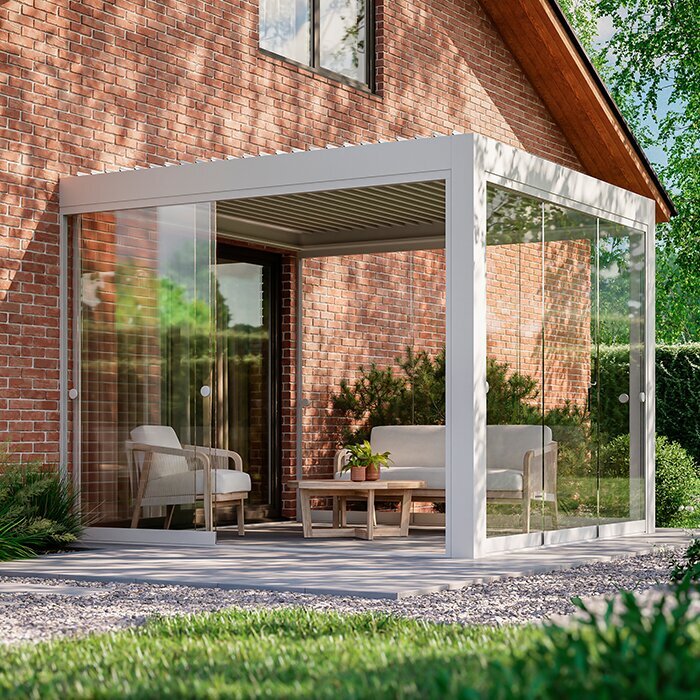
A freestanding pergola and one attached to a house have different installation questions. A freestanding layout needs a suitable base for its posts and enough room for the intended footprint. An attached layout depends on the condition and construction of the wall, the specified connection and how the installation meets the outside of the house. Neither option is automatically better for a coastal site, and a wall should not be assumed to remove the need for ground fixings or make the structure sheltered. Use the catalogue entry to review whichever product details are actually stated, then ask what the chosen layout requires at your property.
For an attached design, have the proposed fixing point and surrounding wall assessed by a qualified installer. Cladding, insulation, eaves, gutters and existing drainage may affect where a connection can be made and how water is managed; a photograph of the exterior cannot confirm what lies behind it. Ask who is responsible for sealing the junction and what the installation instructions say about the particular wall construction. With a freestanding layout, check that the posts will not obstruct paths, doors or maintenance access and that the base requirements suit the surface. Compare both arrangements by how they fit the building and garden, not only by appearance.
Compare the written order details
Before ordering, compare like with like. For each option, record the exact dimensions, frame material, finish, roof arrangement, included fixings, base requirements, wind guidance and maintenance instructions. Note which details are stated in the product information and which still need an answer. The second catalogue page can be reviewed using the same list; do not fill gaps in one listing by assuming another product has the same parts or installation requirements. If a supplier uses a broad description such as suitable for coastal conditions, ask what that means for the exact model and the exposure you have described. Written information makes it easier to spot differences before they affect the order or installation.
Confirm the practical arrangements too: who installs the pergola, what site preparation is expected, which parts or fixings are supplied, and what access is needed for delivery and assembly. Ask what is excluded from the installation arrangements and what to do if the delivered parts or site do not match the agreed instructions. Keep answers about the product, installation and care together so that the installer can work from the same information. A clear order is not only about the frame or roof; it should set out the assumptions on which the proposed assembly and upkeep depend. Resolve unanswered technical questions before committing rather than relying on a verbal impression.
Frequently asked questions
Is any pergola automatically suitable for a seaside home?
No. Seaside exposure varies from site to site. Ask whether the exact model, finish, fixings and installation method are suitable for the conditions at your property.
Which frame material is best for a coastal pergola?
There is no universal best. Compare the exact material and protective finish, the fittings used with it, and the manufacturer’s care instructions for the exposure you expect.
Can salt air affect a pergola?
Salt deposits and moisture may affect susceptible metals or finishes. The risk depends on the materials, protection, exposure and upkeep, so follow the instructions for the specific product.
Can I leave the roof in any position when it is windy?
There is no general answer for every design. Check the model’s guidance for each roof position and any accessories, and follow its instructions for changing conditions.
What should I confirm before placing an order?
Confirm dimensions, materials, finish, fixings, base requirements, wind guidance, maintenance and installation responsibilities. Get answers that are specific to the model and your site.
For a coastal property, the right pergola is the one whose materials, finish, connections and care requirements make sense for the conditions at your home. A design that fits the patio but leaves its fixing method or operating guidance unclear is not a complete match. Compare the written product information with the way you intend to use and maintain the space, and have the proposed installation assessed against the actual ground or wall. That keeps the purchase grounded in your site rather than in a broad coastal label.
