
Buying a Pergola for an Outdoor Kitchen
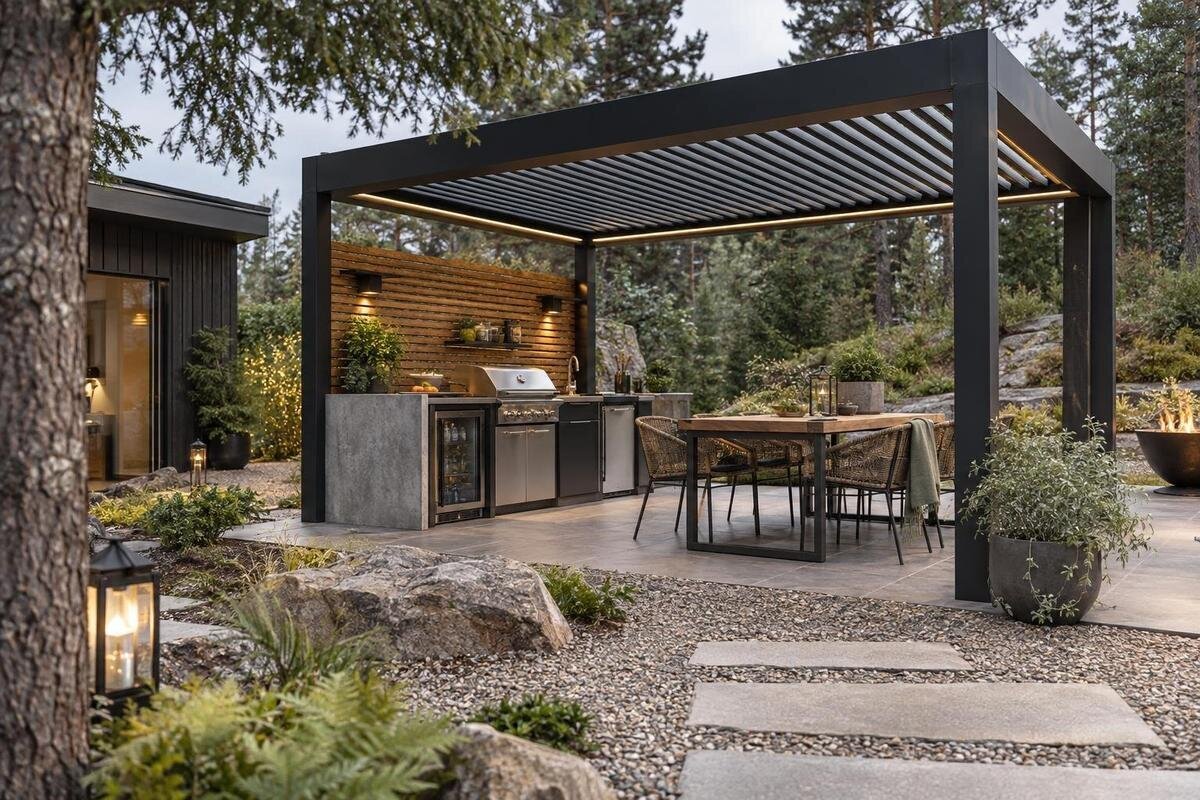
Pergola buying guide
An outdoor kitchen changes what a pergola needs to do: it must fit around cooking, preparation and serving, while its position and roof make sense for shade, smoke, movement and weather. The useful buying decision begins with the kitchen layout, not with a frame style. Measure the equipment and the space around it, decide which tasks need cover, then compare product information and installation needs. This guide explains what to settle before you order and which details should be confirmed for the specific model and site.

Before you buy 1
Plan around the way you cook
List the kitchen elements before browsing pergolas. A barbecue alone calls for a different plan from one that also includes a separate prep worktop, sink, storage or serving counter. Note each item’s dimensions from its maker and how it is used: a lid or door may need room to open, while a person preparing food needs a clear working edge. For equipment that can be approached from either side, mark which side needs access. Separate the zone that needs overhead cover from seating and circulation space that could sit outside it. This prevents the pergola’s overall footprint being mistaken for usable kitchen space and gives you a practical brief for comparing product drawings.
Think through an ordinary meal from carrying ingredients outside to clearing away afterwards. Decide who cooks, where utensils and plates are set down, how food reaches the table and whether guests will pass behind the person at the barbecue. Mark these activities on a simple garden plan, including the door or path used most often. If several people will be outside at once, avoid making the main route cross the cook’s working position. Your routine affects how open the space should feel and where shade matters. If you plan to add storage or a fridge later, reserve a place for it now rather than leaving an awkward gap beside a support.
Measure the full working area
Measure the whole cooking zone, not just the appliances. Record the dimensions provided for each unit, the worktop depth, the space needed to open lids, doors and drawers, and the maker’s stated clearances. Include chairs when pulled back, room to set down serving dishes and the route between the kitchen and house. Those measurements describe the usable area; the pergola’s outer footprint is a separate figure. Posts, frame edges and any projections may affect circulation, so check the dimensioned drawing and how the seller defines the footprint. Keep a note of anything not shown and have an installer assess it rather than filling gaps with an estimate.
Before settling on a size, mark the proposed boundary on the paving with tape or a temporary chalk line, then walk the routes you expect to use. Represent cabinets or equipment with boxes and test doors, barbecue lids and chairs in their open positions. This makes tight turns and obstructed paths easier to spot than on a product photograph. When considering the Bloomcabin pergola listing, look for a dimensioned plan and verify whether the stated measurements refer to the whole frame or another part of it. Check the mark-up from the door and seating positions too. If the drawing does not answer a question, ask the seller before ordering.
Before you buy 2
Choose a layout that keeps routes clear
Select a working arrangement before selecting a frame. A straight run can keep cooking and preparation along one side, leaving the middle open; an L-shaped plan can place prep and cooking around a corner; an island makes access possible from several sides but uses space in the centre. These are layout choices, not guarantees of fit: actual equipment dimensions and the route to the table still matter. If separate prep and cooking units are planned, decide how one person will move between them without carrying hot items through the serving area. For a compact space, simplify the arrangement rather than squeezing every task under the same roof.
Draw the main paths between the house, kitchen, dining area and garden gate. Avoid arranging the barbecue, serving counter and seats so people routinely pass behind someone handling hot food or opening equipment. Keep access to doors, windows and existing paths in the plan, and consider whether a chair or trolley could narrow a route once it is in use. A useful layout gives the cook room to work while allowing others to pass without cutting through the preparation zone. If the site cannot provide that separation, placing dining furniture outside the pergola may be more practical than enlarging the covered kitchen.
Put shade where it is useful
Think about when shade is needed, not only where the kitchen sits on a plan. Observe the patio at the times you expect to cook and eat; the sun’s position changes through the day and across the year, so a fixed roof may not shade a particular worktop at every relevant time. Decide whether cover matters most over the cook, the prep surface, the dining table or a combination. Those priorities help define the pergola’s position before you compare dimensions. Nearby buildings and trees can cast additional shade, but their effect should be considered in the actual garden rather than assumed from a sketch.
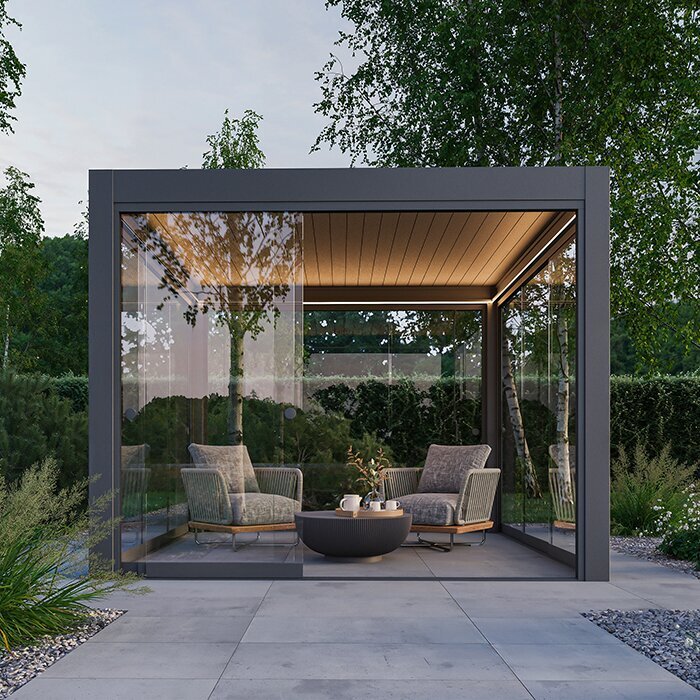
Roof descriptions need to be read as model-specific information. An open or slatted design, a fixed cover and a roof with moving elements can differ in the shade, openness and rain protection they provide; a product label alone does not settle those details. If comparing the bioclimatic pergola listing, check exactly how the roof is described, what adjustment is possible, how it is operated and what the manufacturer says about shade and weather. Do not infer that it closes fully or provides a particular level of shelter from the word bioclimatic or from an image. Match the written details to the tasks you want under cover.
Before you buy 3
Check heat and smoke before choosing a roof
Check compatibility between the cooking appliance and any structure above it before ordering. Barbecues and other cooking equipment can produce heat and smoke, and a roof or side element may change how these travel. Different appliances have different installation instructions, so use the guidance for the exact appliance rather than a general clearance found elsewhere. The pergola maker must also confirm whether the specific structure is intended for the proposed position. Do not guess from a photograph, assume every material is suitable beside a hot appliance or rely on a broad category name. If either set of instructions is unclear, ask the supplier or a qualified installer to review both products together.
Consider smoke direction as well as the cook’s footprint. Note nearby doors, windows, vents and seating, and think about where smoke will go in the conditions in which you usually cook; an enclosed corner can behave differently from an open patio. Smoke may also affect neighbouring outdoor spaces, so take their position into account when planning. Leave final clearances and any extraction or ventilation decisions to the appliance maker and a qualified professional. If you are reviewing the Bloomcabin bioclimatic-pergola page, treat its product description as a starting point only, not proof that a barbecue can be placed beneath it. Plan gas, electrical or water connections with the relevant qualified trades before the layout is fixed.
Assess weather exposure and rainwater
Assess the site’s exposure and the level of shelter you actually want. An open garden, a sheltered patio and a position beside a house can experience rain and wind differently; choose against the conditions at the proposed location, not a broad impression of the garden. Check whether the manufacturer publishes limits or installation guidance for wind, rain and other exposure, and ask which statements apply to the exact model. A frame described for outdoor use is not automatically a weatherproof room, and an image taken in calm conditions tells you little about performance in poor weather. Decide what you will do when conditions make outdoor cooking uncomfortable.
Plan where water will go as well. If the chosen design collects or redirects rain, the product information should explain the arrangement; do not assume the roof protects worktops or equipment, or that water will drain away from cooking and walking areas. Think about splash, wet storage and the route from the house when carrying food. For the Bloomcabin pergola product page, look for model-specific statements and installation details, then check unanswered questions with the seller. Where drainage or the patio surface affects the plan, ask the installer to assess the site. Shade and rain protection are separate requirements, so decide how much of each the kitchen needs.
Before you buy 4
Check whether a wall-mounted design suits the site
Decide whether a wall-mounted arrangement or a freestanding one can work at the proposed spot. A wall-mounted format changes where the structure meets the house and how the space is used; it is not simply a way to add a roof beside any wall. A nearby door, window, gutter, vent or service can affect the position, and the wall itself must be assessed for the proposed fixing. The name on the wall-mounted pergola listing does not establish compatible wall types, fixings or suitability for your house. Ask a qualified installer to review the wall and site before treating that option as viable.
A freestanding layout has its own siting questions: the actual support positions may take up floor area and need to fit around paving, paths and kitchen equipment. Compare the support layout in the technical drawing with the route from the house and with any services already in the ground or on the wall. Keep access to external doors, windows and maintenance points clear. Neither format is automatically better; the useful choice is the one that fits the site, leaves the work area practical and can be installed as specified. If the drawing is unclear, request a site assessment rather than relying on an approximate sketch.
Compare specifications and what is included
Compare product information line by line rather than choosing from a styled photograph. For each model, record its overall measurements, roof description and operation, what is included, any stated weather guidance, installation requirements and the materials or care information supplied by the manufacturer. Check the exact version or configuration, because a category page or general image may not answer a model-specific question. Use the Bloomcabin pergola’s product details as one page to review in the same checklist as any other options you are considering. If a key dimension, fixing detail or compatibility statement is missing, ask for it in writing before paying.
Separate the pergola purchase from work that may be needed to complete the kitchen. Ask whether the quoted package includes the frame, roof parts, fixings, delivery, assembly and any accessories you expect; do not assume these are bundled. Cost the appliance, worktop, site preparation and professional installation separately where applicable, so comparisons reflect the whole project rather than a single headline price. Read the seller’s terms for payment, delivery, returns and warranty instead of assuming another product’s terms apply. Keep the answers with your plan: they can prevent a gap between what you thought you ordered and what arrives.

Before you buy 5
Understand roof operation and maintenance
Compare roof types by function, not just appearance. A fixed cover may offer a different balance of permanent shelter and daylight from an open or slatted roof; a roof with movable sections may give options but introduces a mechanism to operate and maintain. These are general trade-offs, not a claim that every pergola offers each type. Write down what you want the roof to do during cooking, in bright sun and in light rain, then check that the specific model’s documentation answers each point. If you want rain cover, ask how the roof behaves and what limits apply, rather than treating shade and waterproofing as the same feature.
Ask about everyday operation and upkeep before settling on a mechanism. Confirm whether any moving parts need manual handling, a power connection or clear space around them, and who is qualified to install or service that arrangement. Find out how the manufacturer expects the roof and frame to be cleaned, what to do with cooking residue or fallen leaves, and whether parts need periodic attention. The label on the page for the bioclimatic pergola is not an operating manual: read the instructions for the exact model and ask about unclear maintenance points. Easy access to the roof for routine care is part of a workable kitchen layout, not an afterthought.
Confirm site preparation, delivery and installation
Before ordering, ask an installer to assess the proposed position and identify any site preparation needed. A paved patio is not automatically suitable for every fixing method, and existing ground, drainage or buried services can change what is practical. Do not try to resolve structural questions from a product photograph or an online sketch; use the manufacturer’s installation documents and qualified site advice. If the outdoor kitchen includes water, gas or electrical services, coordinate their intended routes and appliance positions with the relevant qualified trades before fixing the pergola location. Agree who is responsible for each part of the work so the frame, cooking equipment and services are planned together.
Check access for delivery and assembly as well as for daily use. Measure narrow gates, turns and the route to the patio, and confirm with the seller how components are delivered and what assembly arrangements are available; do not assume installation is included. If a wall-mounted layout remains on your shortlist, read the wall-mounted pergola product details alongside the installer’s site assessment rather than treating the listing as approval for your wall. Ask how the finished structure will remain accessible for cleaning and future repairs. These practical details are easier to settle before an order than after parts arrive or the kitchen is in place.
Frequently asked questions
Can a pergola go directly over a barbecue?
Do not assume that it can. Heat and smoke, the appliance’s required clearances and the pergola’s design all matter. Check the instructions for both products and ask the manufacturer or a qualified installer to confirm whether the exact combination and position are suitable.
How large should a pergola for an outdoor kitchen be?
Measure the equipment, worktops, open lids and doors, access routes and any seating you want under cover. Compare those measurements with the pergola’s overall dimensions and support positions. The space between supports is not necessarily the same as the usable area.
Will a pergola keep an outdoor kitchen dry?
That depends on the specific roof design and the manufacturer’s stated performance. Shade does not automatically mean rain protection, and rain can reach an open-sided area from different directions. Check the model’s documentation rather than relying on its name or a photograph.
Is a wall-mounted pergola better than a freestanding one?
Neither is automatically the better choice. A wall-mounted design needs a suitable fixing location, while freestanding supports also take up space and need to fit the site. Have a qualified installer assess the proposed position and compare it with the product’s installation information.
What should I confirm before ordering?
Check the exact model’s dimensions, roof details, included components, installation requirements and care information. Confirm delivery access and whether assembly or installation is included. Where the plan involves a barbecue, utilities or structural fixings, get advice from the relevant manufacturers and qualified professionals.
The right pergola for an outdoor kitchen is the one whose confirmed footprint leaves equipment usable, whose roof suits the kind of shade or shelter you need and whose installation works at the chosen site. Map cooking and serving routes first, compare written details for the exact model, then settle questions about heat, utilities or fixings with the relevant professionals. That gives you a sound basis for comparing options and ordering a structure that fits the way you plan to cook outdoors.
