
Buying a Pergola for Rain Protection: Roof and Drainage Limits
Pergola buying guide
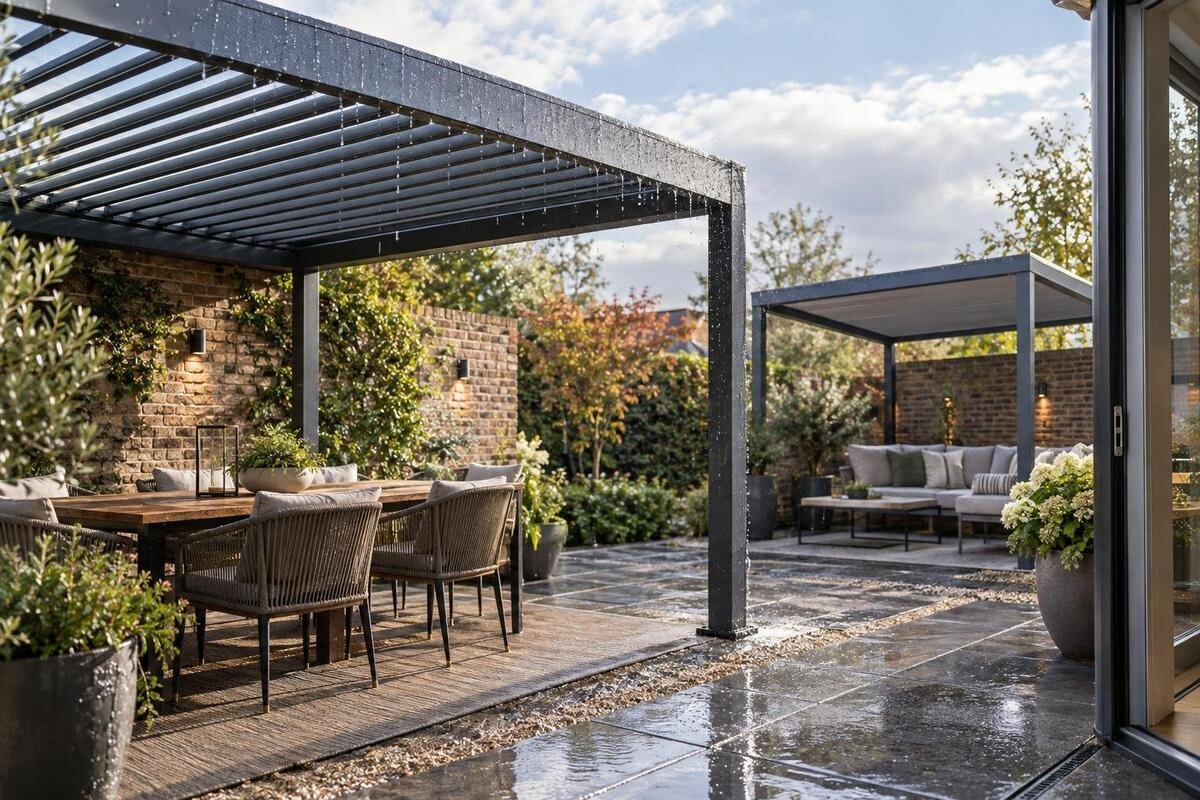
A pergola can make an outdoor area more usable in showery weather, but the word itself does not promise a dry space. Rain protection depends on the roof you choose, how its edges and joints are detailed, whether water is channelled away, and how wind exposes the open sides. Before buying, look beyond the roof image: establish what the specific configuration is designed to do, where rainwater will go and what conditions are excluded. That gives you a fair basis for comparing products and avoids paying for a style that does not match the level of shelter you need.

01
What rain protection means in practice
Rain protection has two separate parts: keeping water from falling directly through the roof and managing the water that runs off it. A roof can reduce rain over the area beneath it without making the space fully dry. The sides may remain open; wind can carry rain in from the edges, and drops can bounce from paving. Think about the part of the patio you want to use, not just the outline of the roof. If a dining table, doorway or outdoor cushions are the priority, decide what level of wetting you can accept and whether protection is needed from more than one direction. State that requirement before comparing styles, so a supplier can answer a concrete question rather than a general one.
Read wording such as “water-resistant”, “waterproof” and “weatherproof” in context. These labels do not automatically tell you whether a claim applies with the roof open or closed, in light showers only, or to a particular fabric, seam or drainage arrangement. Ask for the precise written specification for the model and configuration being quoted, including stated limits and exclusions. If the seller cannot confirm how the roof performs in rain, treat that as an unanswered buying question rather than assuming the most favourable meaning. Ask whether the claim excludes wind-driven rain or water entering at the edges. A clear answer also makes comparisons with other pergolas more meaningful.
Compare roof styles by their behaviour in rain
Roof styles handle rain in different ways, so compare their behaviour rather than choosing by label. An open-slat roof leaves gaps through which rain can fall. Adjustable blades may change the opening, but a closed position is not proof of a watertight surface: the joints, perimeter and route into any drainage channel matter. For an adjustable system, ask what “closed” means in the documentation and whether the maker describes it as rain-shedding or fully watertight. Ask whether rain performance is stated for the exact roof setting you expect to use. A general listing such as the Bloomcabin pergola listing is a starting point for comparison, not evidence of a particular roof type or rating; confirm the details attached to the configuration you would order.
A retractable fabric cover offers a different trade-off: when retracted, the area is exposed, and when extended its rain suitability depends on the material, construction and the maker’s stated conditions. Seams, edges and the way a fabric is supported can affect how water is shed, so do not judge by appearance alone. A fixed roof can provide continuous overhead coverage, yet its joints, edges and drainage still determine whether water reaches the seating area. A solid-looking panel in a photograph cannot settle those points. For any style, request the roof description and operating limits in writing, and compare a system intended to shed rain with one described only as providing shade. If a term is unclear, ask the supplier to explain it plainly.
02
Check the roof coverage against the space
Check the roof footprint against the ground area you want sheltered. A product’s overall dimensions may refer to the posts, roof edge or another measurement, so confirm which points are measured before drawing the pergola on a plan. Consider the position of chairs when pulled out, the route to a door and whether an overhang covers those areas; do not assume the roof projects beyond the supports. Include post positions, the table and path clearance in your sketch so you can see which seating remains under cover. A compact roof can leave the edge of a table exposed, while rearranging furniture may matter more than adding nominal coverage. Ask for a dimensioned drawing or written measurements for the actual option, then compare them with your patio.
Coverage also depends on gaps, joins and where rain approaches from. With an open-sided structure, wind-driven rain can enter beneath the roof even if the central area is sheltered; splash can add to the wetting close to walls and paving. Look for product information that identifies which sides remain open, how the roof meets its frame and what the supplier means by protection. When reviewing the bioclimatic pergola listing, use the written configuration details—not a product name or image—to establish whether the roof can be adjusted and what its rain performance is. Confirm that any dimensions and claims relate to the exact position or roof setting you intend to use. Never infer a seal or rating from the term “bioclimatic”.
Trace the drainage route from roof to ground
Trace water from the upper surface to its final outlet. Ask whether gutters or channels form part of the selected pergola, whether they are integrated into the design or supplied separately, and whether downpipes are included. Some descriptions mention a drainage feature without explaining what arrives with the order, so check the inclusions and exclusions line by line. Find out where the outlet sits and whether its position can be chosen; that detail affects where water falls beside the structure. A listing such as the wall-mounted pergola listing does not establish the drainage arrangement—check the specific product information and, if it is unclear, get the supplier’s answer before purchase. Confirm whether the system collects water from every roof edge or only particular sections.
Ask how the system is intended to carry water when the roof is in each position you plan to use. A channel may collect runoff, but collection is only one part of the route: water still needs to leave the frame without spilling onto the wrong part of the patio. Ask whether outlets need to remain unobstructed and what inspection or cleaning the maker expects. Leaves, moss and other debris can affect open channels or gutters, so access matters as well as capacity. Find out whether a downpipe is part of the design or a separate component, and how its position relates to the furniture below. Do not assume that an internal-looking gutter, visible edge or small outlet in a photograph tells you how the complete path works.
03
Choose a suitable place for runoff
Work out where the discharge could land before settling on a layout. A concentrated flow at one corner may leave a doorway, path, step or seating area wet, even if the roof itself keeps most rain off. Water can also collect on paving where the local fall is inadequate or where existing drainage is already busy; a product page cannot assess those site conditions. Mark likely outlet points on a simple plan and notice nearby thresholds, walls, planting and places people walk. Consider that runoff from the pergola will meet rain already falling around the garden, rather than arriving in isolation. The aim is not to calculate runoff yourself, but to identify conflicts early and raise them with the supplier or installer.
Ask what is included to move water from the pergola to an appropriate destination, and whether that destination suits your garden. A downpipe that ends beside a path is not the same as a considered discharge route. If the proposal involves connecting into existing drainage, directing water near the house or changing a paved area, get a qualified installer or drainage professional to assess the site and explain the options. Avoid accepting a verbal assurance that water will “run away” without knowing where it goes. The right solution depends on the layout, surfaces and existing drainage, so confirm it for your space rather than assuming a standard outlet will suit every garden.
Assess exposure and the position beside a house
Consider how much rain reaches the structure from the sides. A sheltered corner beside a house may behave differently from an exposed position, but nearby walls do not close the pergola or make the roof-to-wall junction watertight. Note the direction from which weather usually reaches the seating area, the location of doors and any surfaces that can splash water upwards. If you want to keep a particular zone drier, map it in relation to the open sides and roof edge, and think about wind from more than one direction over the year. Use the Bloomcabin pergola product page as a reference, but assess the site and chosen configuration together.
For a wall-mounted option, ask how the roof meets the building and who confirms that detail for your particular house. Do not assume a standard attachment includes a weather-tight junction, flashing or protection against water tracking down the wall; those points depend on the specified system and installation. Confirm what the product supplier provides, what the installer is responsible for, and which matters require a competent building professional. Where the wall surface, roof edge or existing drainage makes the arrangement uncertain, have it reviewed before ordering. This check matters even if the pergola itself has a stated rain claim, because the junction is part of the site arrangement. A catalogue photograph cannot settle it.
04
Ask for specifications for the exact configuration
Request information that turns a broad claim into a buying decision. Ask for the exact roof type and configuration, a dimensioned drawing, the rain performance stated for each roof position, and any limits on wind, intensity or duration if the maker publishes them. Ask how water is collected and discharged, which parts are included and whether accessories change the arrangement. A name or category label, including the page labelled bioclimatic pergola, is not a substitute for these details. If a seller uses “all-weather” or “waterproof”, ask what the phrase means for this product and whether it is supported by written product information. Keep the answer with your quote, including the exact version or model reference.
Then check the documents that apply to the exact order: installation requirements, maintenance instructions, exclusions and any relevant warranty terms. Confirm whether the quoted configuration includes the roof, gutters, outlets and any controls you have discussed, rather than relying on a display or illustrative image. If a specification lists a component as optional, find out what changes if it is omitted and whether the rain claim still applies. Ask who will resolve questions about the junction with a house or the destination for runoff. A useful answer identifies the component, its role and any stated limitation; vague reassurance is not enough to compare one offer fairly with another.
Compare product pages and quotations fairly
Use a like-for-like comparison table when reviewing several pergolas. Record the covered footprint, roof style, rain claim, open and closed conditions, included gutters and downpipes, outlet location and any exclusions. Add the expected installed configuration rather than comparing a base listing with a quote that includes extras. While reviewing the wall-mounted design page, distinguish what the page actually states from the questions you still need answered. Include itemised costs for any required additions and installation, if quoted, so that a lower headline price is not mistaken for an equivalent package. This helps you focus on what affects shelter and drainage rather than comparing names or images.
Separate confirmed specifications from assumptions in your notes. Mark each item as stated, to be confirmed or not offered, and ask the seller to resolve gaps before you commit. Check that the dimensions and drainage details relate to the same version; a feature shown in one image may belong to a different configuration. Also ask whether changes to the position or optional components affect the quoted rain protection. Compare the exclusions as carefully as the included items, including who is responsible for any connection or site-specific work. This makes it easier to spot when two offers are not genuinely comparable and gives you a written record of what you are buying, without treating a photograph as a promise.

05
Check maintenance and operating limits
Rain management is not finished once a pergola has been assembled. Find out how the roof, channels and outlets are meant to be inspected and cleaned, and whether maintenance guidance differs between moving and fixed parts. Leaves and dirt can build up around a water route, so ask what access is needed and which cleaning methods the maker permits. Check whether routine upkeep is the owner’s responsibility or part of a separate service, without assuming it is included in the price. Ask if any areas are difficult to reach and whether a professional should carry out that work. Treat the bioclimatic pergola product page as an entry in your comparison, then obtain maintenance instructions for the exact option you choose.
Also establish how the roof is meant to be used as the weather changes. If it can move between positions, ask what the manufacturer says about leaving it open, closed or retracted during rain, and whether there are stated limits that require it to be moved or secured. Do not infer safe operating conditions from a general claim of rain protection; ask for the instructions and follow them. A pergola selected for shelter should still be treated as an outdoor structure with defined limits, not as a sealed room. Clear instructions help you use the roof as intended and avoid assumptions that could undermine its performance.
Decide what level of shelter you need
Before choosing, rank the result you need: occasional cover over a table, a drier route to the back door, or a more consistently sheltered seating area. These are different targets. For a modest level of overhead cover, occasional gaps or wind-blown rain may be acceptable; if you need the same area to remain dry in persistent or side-on rain, ask whether the chosen product is designed for that expectation. A pergola roof cannot by itself guarantee that every part of an open-sided space stays dry, so make the trade-off explicit rather than relying on a broad category name. Decide which surfaces or activities matter most and what can still get wet.
Use the Bloomcabin pergola page—alongside any other pages in your shortlist—as prompts for a final written check, not as proof of unlisted features. Confirm the exact roof, dimensions, water route, side exposure, inclusions, installation responsibilities and limits. If any one of these changes your decision, resolve it before paying or booking work. A suitable choice is the one whose documented performance, drainage plan and site arrangement match the level of rain cover you expect, including what will still get wet. That keeps the buying decision grounded in the delivered specification.
Frequently asked questions
Will a pergola keep patio furniture dry in rain?
Not necessarily. A roof may limit direct rain, but open sides, gaps at the roof and wind can still wet the area. Check the stated performance for the exact configuration and consider whether the furniture sits within the roof’s actual coverage.
Does a bioclimatic pergola have a waterproof roof?
The label alone does not establish that. Ask for the rain-performance details for the particular roof setting, along with information about joints and drainage. Confirm whether the claim excludes certain weather conditions or operating positions.
Are gutters and downpipes included with every pergola?
There is no single rule for every model. Gutters, channels and downpipes may be included, optional or absent, so check the inclusions for the exact configuration and quote. Ask where water leaves the structure as well.
Where should a pergola’s rainwater drain?
That depends on the garden and where the outlet sits. Check that water will not be directed onto a doorway, path or seating area. If it needs to connect to existing drainage or the route is unclear, ask a qualified professional to assess the site.
Will a wall-mounted pergola keep rain out at the house wall?
Do not assume so. A wall-mounted design does not automatically mean the roof-to-wall junction is weather-tight. Ask the supplier and installer how that detail is handled for the specified system and your particular house.
Rain protection depends on the whole route from roof to outlet, as well as the pergola’s position and open sides. Choose against the written performance of the exact configuration and the way runoff will be managed on your site. If any part of that picture is unclear, resolve it before ordering; a roof image alone cannot tell you how dry the space will be.
