
Buying a Pergola with Lighting for Evening Use
Pergola buying guide
Evening lighting can make a pergola more useful after dusk, but the right choice depends on more than the look of a glowing roof. Before buying, work out what needs to be lit, where the power will come from and whether the fittings are included. Then consider how the arrangement fits your seating, access routes and surroundings. A little planning makes it easier to compare options on the same basis and avoid ordering a structure whose lighting needs extra parts or work you had not allowed for.
Plan around the way you will use the pergola after dark
Begin with the activity you want the pergola to support after sunset. A table used for dinner needs light falling on plates and faces without shining directly into anyone’s eyes. A seating area may call for softer, broader illumination, while the route between the house and the garden needs clear visibility underfoot. One fitting will not necessarily do all three jobs. Sketch where people will sit, stand, serve food and walk, then mark which places need reliable task lighting and which can remain more softly lit. Include any existing house or garden lights so you do not plan to duplicate useful illumination.
Think about how often and for how long you will use the lights. A quick cup of tea on a summer evening places different demands on controls and power from regular dinners, reading or entertaining later in the year. Consider who will operate them: an easy-to-reach switch may be more useful than an app if several people share the space. Put chairs and the table in their intended positions before marking likely light points, and allow for people moving around them. If furniture moves between seasons, note how that might change the areas you want lit. A plan based on your normal routine is more useful than choosing from a photograph alone.
Compare brightness, beam spread and colour
Brightness and distribution are related, but they are not the same decision. If a product gives output in lumens, use that figure to compare options, not as a promise of how bright the table will feel. Mounting position, beam spread, shades and surrounding surfaces affect the result. Compare the output of all supplied fittings as well as the figure for each one, where both are provided. A single concentrated source may light one spot strongly and leave the edges dim. Several points may spread light more evenly. Use a pergola product listing to see what details are stated, then check whether the documented positions suit your own seating plan.
Colour temperature affects the appearance of the light and the way colours look beneath it. Some people prefer a warmer, softer effect for relaxing; a cooler tone can feel clearer for tasks. Neither is automatically right, so compare any available description or sample before choosing. Dimming can help when the same space is used for dinner and quieter evenings, but do not assume that a fitting is dimmable just because it uses LEDs. Check that the lights, control and any required components are confirmed as compatible. If a listing does not give output, colour or control details, ask for them rather than comparing on appearance alone.
Choose a lighting style that suits the structure
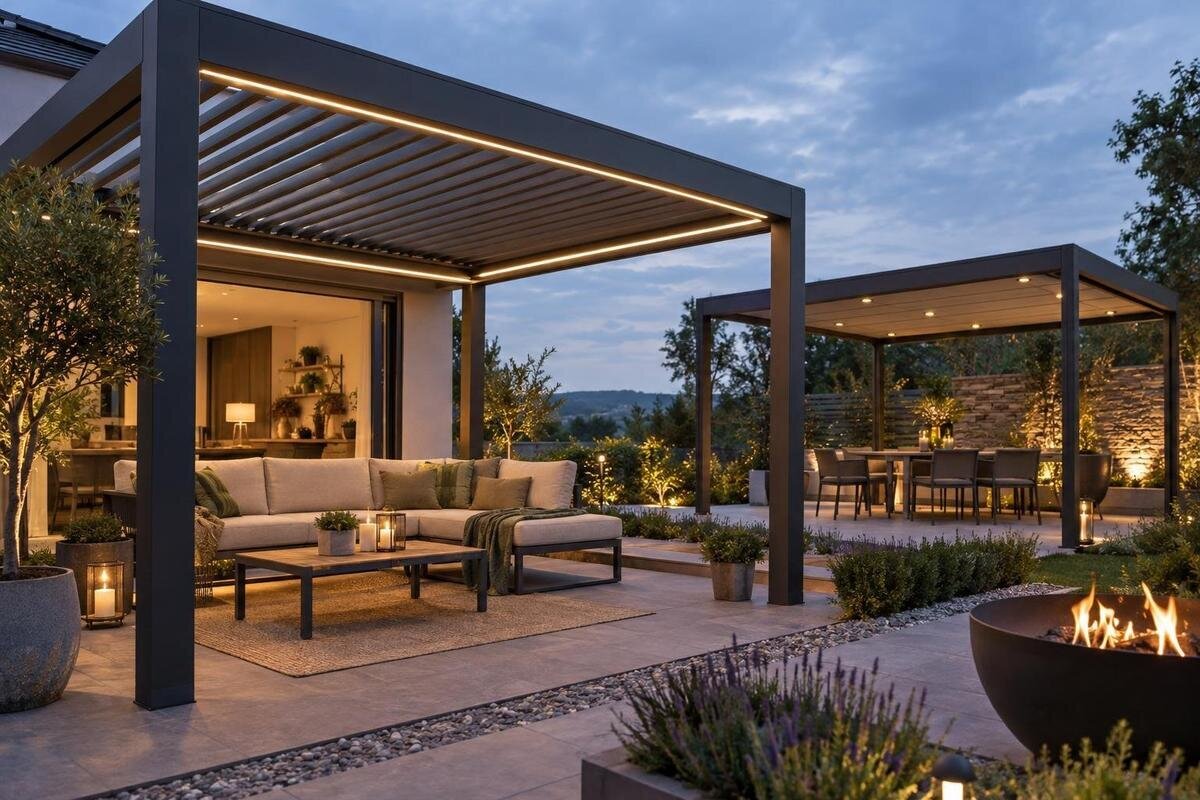
Integrated linear lights, spotlights, pendant fittings and decorative string lights create different effects. A linear source can provide broad illumination, while a spotlight directs light towards a chosen area. A pendant may suit a table if there is an approved fixing position; decorative strings may add atmosphere but may not provide enough task light on their own. Portable lanterns are easier to reposition, although their runtime and charging routine still matter. These are general options, not features to assume are included with a pergola. Check the manufacturer’s guidance before attaching any separate fitting or accessory to the structure.
Compare the actual type and position of each supplied light, not just the style of the finished image. Ask whether fittings are built in, supplied separately or optional, and how they can be reached for cleaning or replacement. If you are considering extra lights, confirm both the attachment method and outdoor suitability for the exact product. Another pergola page can be a useful place to check what information is provided, but a product image alone cannot confirm the fitting type, compatibility or package contents. Treat any detail not stated in the listing as a question to resolve before ordering.
Check the power source before choosing a position
Power affects where the pergola can go and what work may be needed. A permanently connected lighting system may suit frequent use, but it needs a suitable supply and a planned route. Plug-in lights still depend on an appropriately located outdoor socket and a suitable connection. Do not assume that a household extension lead is a suitable permanent solution across a patio or walkway. If mains power is being considered, ask a qualified electrician to assess the proposed supply, route and components before you settle on a position. This helps you compare the full setup rather than choosing a location that later proves awkward to serve.
Solar and battery-powered options can reduce dependence on a fixed supply, but each has practical limits to check. Solar output depends on charging conditions, panel placement and the product’s stated battery capacity; a shaded position may not perform as expected. Battery lights need charging, and their stated runtime may depend on the brightness or mode used. Check the specifications for the exact model and ask how the panel, battery and lights are intended to work together. When comparing a listed pergola option, treat power requirements as a question for the product information, not something to infer from its appearance.
Confirm which lighting components are included
A pergola listing or photograph does not necessarily show everything supplied with the order. Confirm whether the lights are included, and if so, the number and type of fittings. Ask whether any power unit, transformer, cabling, connectors, control or mounting parts are included where relevant. Clarify whether the lights are part of the quoted package, optional extras or separate products. The listed pergola option is a starting point for checking the stated details; if an important item is not specified, request written confirmation for the exact model and configuration you intend to buy.
Compare the full cost of the setup, not only the structure or light price shown first. Separate costs may apply for accessories, assembly or electrical work, so establish which items and services are included and which you would need to arrange independently. If you plan to add lighting later, ask whether the manufacturer permits the fitting and whether the proposed components are compatible. Keep a written list of confirmed inclusions and any separate work needed. That makes it easier to compare options on the same basis and reduces the chance of discovering that a necessary part was not part of the order.
Choose controls that suit everyday use
Think about how you want to switch the lights on and off when people are already seated. A straightforward manual switch may suit a simple arrangement; a remote or app may be useful if the controls are difficult to reach. Those are options to compare, not features to assume. Check whether a control is included, where it can be used and whether it depends on batteries, a hub, an account or a network connection. If several people will use the pergola, consider whether they can operate the system without needing to learn a complicated sequence.
Separate controls can be useful when the table needs brighter light than the rest of the seating area, but only if the system supports independent zones. Dimming and timers may also be available on some arrangements; confirm the exact function and compatibility rather than relying on a general description. Decide which features you will actually use and which would add complexity without helping your routine. When reviewing the relevant listing, look for explicit control details and ask about anything missing. A simple, clearly described setup can be easier to live with than a more elaborate one whose requirements are unclear.
Position lights to reduce glare and dark spots
Plan light positions from the places where people will sit and walk, not just from the view of the pergola from the garden. A fitting that shines into someone’s eyes can make a well-lit table uncomfortable. One source may also cast shadows across a surface or leave a route dim. Consider whether light should fall on the table, seating or walkway, and whether those areas can be illuminated without directing a beam at eye level. Use the manufacturer’s layout information, where available, to understand where the supplied fittings sit before deciding that the arrangement suits your plan.
Look at the proposed effect from more than one viewpoint. Sit in the intended chairs, stand at the table and check the view from the house windows. Consider whether light could spill towards a neighbour’s property or into a room where it would be distracting; there is no need to make the whole garden bright just because the pergola is lit. Mark possible positions on a sketch and, if practical, assess the area from those viewpoints at dusk. The product details may help establish the stated fitting positions, but your seating arrangement and surroundings will determine whether those positions feel comfortable.
Check the lighting plan against the garden layout
Measure the proposed footprint against the way the garden is used. Note door openings, windows, paths, steps, existing seating, trees and any fixed outdoor lights. Check that furniture will fit without blocking a route, and that people can move around the pergola comfortably. Trees and nearby walls can alter how light reaches an area or create shadows, while existing lighting may already cover part of the patio. A simple sketch showing the pergola, furniture, power source and main routes can reveal conflicts before you compare specific products.
The light plan needs to work with the chosen position and the documented structure, not just look attractive in a catalogue image. Check the stated dimensions, fixing approach and any available layout drawings for the exact model. If the pergola is close to a wall, consider how the intended fixtures will illuminate the areas farther away and where a power route might be assessed. A pergola product page is not a substitute for confirming those details: use the product information and supplier’s answers to compare the actual arrangement with your site.
Verify outdoor suitability, installation and upkeep
Check that the lights and their electrical components are specified for the outdoor location you have in mind. Look beyond the lamp itself: a power supply, connector, control or cable may have different requirements. If a protection rating is stated, ask which component it applies to and whether it covers the complete proposed setup. A general phrase such as weather-resistant is not enough to establish that every part is suitable for your location. Read the manufacturer’s instructions for the exact model and ask for clarification where the information does not cover the exposure or arrangement you are considering.
For mains-powered lighting, have a qualified electrician assess the proposed supply, connection and route for your site; avoid making electrical decisions based on a product photograph. Think about upkeep as well: can you reach the fittings for cleaning, and can a lamp or component be replaced if it stops working? Ask about replacement parts and support, and read any written warranty terms rather than assuming what they cover. P2 may help you identify what is specified for that listing, but professional advice is needed for site-specific electrical questions.
Compare like-for-like before placing the order
Make a comparison note for each option with the same details: lighting style, number and position of fittings, stated output, colour, controls, power source and any supplied accessories. Record what is included in the product price or quote, what is separate, and whether assembly or electrical work needs to be arranged. Mark missing information clearly instead of treating it as included. This gives you a fair comparison between a simpler package and one with additional features, without letting a photograph or headline description stand in for the practical details.
Before ordering, confirm the exact model and configuration, the documented dimensions and the planned position in your garden. If an answer about the lights, controls, power components or installation arrangements matters to your decision, ask for it in writing. Check the stated delivery and assembly arrangements for the order, and retain the product information that relates to the version you chose. Where mains power is involved, resolve the proposed supply and route with an electrician before committing to a location. These checks leave fewer assumptions to sort out once the pergola and lighting are on site.
Frequently asked questions
Can I add lights to any pergola?
Do not assume every fitting or attachment will suit every pergola. Check the manufacturer’s guidance before fixing anything to the frame, and confirm that the light and its electrical components are intended for the location. If the arrangement needs a mains connection, ask a qualified electrician to assess it.
Are integrated pergola lights better than separate lights?
It depends on the layout and how much flexibility you want. Integrated lights can give a coordinated appearance, but check what is included and how components can be replaced. Separate lights may offer more choice, provided their attachment, outdoor suitability and compatibility are confirmed.
Which power source should I choose?
Choose according to how often the lights will be used and what the site can support. Mains-powered lighting needs suitable professional planning; solar and battery options depend on charging, placement and runtime. Compare the stated requirements for the exact product rather than assuming one source will suit every garden.
How bright should pergola lighting be?
There is no single brightness figure for every pergola. Consider the areas you need to see, where the light will fall and whether its spread will leave dark patches or cause glare. Compare stated output and fixture positions, and look for dimming only if the product confirms that it is supported.
Should I speak to an electrician before ordering?
If you are considering hard-wired or plug-in lighting, or are unsure about the power route or outdoor connection, speak to a qualified electrician before committing. They can assess the proposed setup for your site. This is especially useful before you finalise the pergola position.
Good pergola lighting is not simply the brightest option or the most elaborate control system. It is an arrangement that puts useful light where you need it, avoids glare, suits the garden’s power options and is easy to operate. Take your seating and route plan into the comparison, confirm exactly what is supplied, and resolve any mains-power questions with an electrician before you commit. That way, your choice is based on the evenings you actually expect to spend beneath the pergola, rather than on a catalogue image alone.
