
Buying a Pergola for a Windy Location: What to Consider
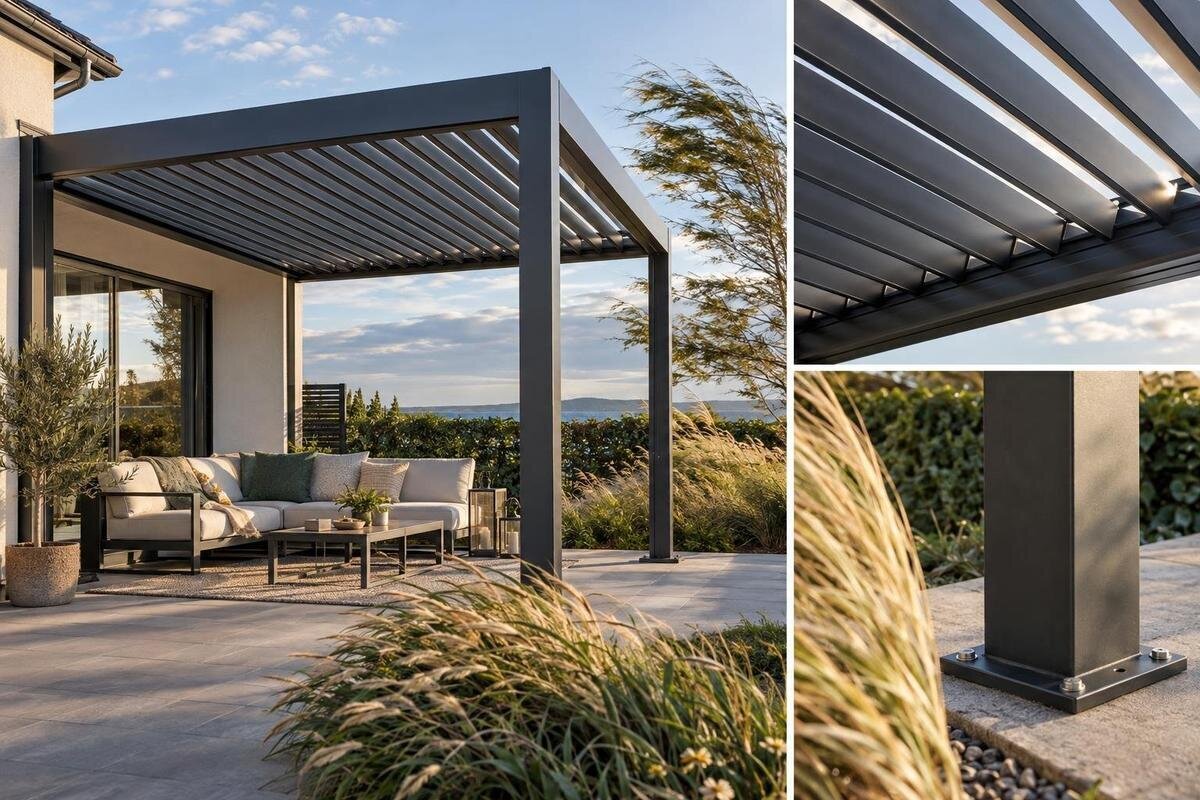
Pergola buying guide
Buying a pergola for a windy location is a site decision as much as a style choice. Wind changes as it meets buildings, boundaries, trees and changes in level, so the exact proposed position matters more than a general label such as exposed garden. A sheltered corner can still experience gusts; an open boundary or gap between buildings can bring a different pattern from the rest of the garden. Before comparing finishes, assess the spot, then check the roof and side arrangement, the complete frame and the fixing requirements in the manufacturer's guidance. A product photograph or name is not proof of wind suitability. This guide explains what to establish before you place an order, and when a qualified assessment is sensible.

Assess wind at the exact pergola site
Walk the garden at different times and note where gusts are felt, which directions recur, and whether a boundary, hedge or neighbouring building changes the flow. A visit on a calm day tells you little about conditions in stronger wind, so observations over several breezy periods are more useful than a single impression. Record whether the proposed position is open to a field, exposed along a boundary or partly screened. These are clues, not a wind rating: conditions at the height of a pergola roof can differ from what you feel at ground level. Focus on the exact footprint rather than labelling the whole garden sheltered or exposed.
Use a simple sketch to compare possible locations, if you have more than one. A position beside the house may be calmer in one wind direction but more exposed in another; an opening between buildings or along a side passage may channel gusts. Include where people enter, sit and move through the garden, so a location selected for shelter does not obstruct doors, paths or access for maintenance. Do not rely on a hedge or fence as the only reason a spot seems usable: it may redirect air rather than remove the issue. Reassess if you plan to change a boundary or surrounding planting.
Look beyond apparent shelter
Buildings and boundaries can provide some shelter, but their effect varies with wind direction and distance. Air passing over a roof or around a corner may be turbulent on the sheltered side, and a narrow gap can channel it. The quietest point in calm conditions is not necessarily the least demanding position in gusts. Do not treat a fence, wall or nearby shed as a wind screen unless the pergola instructions explicitly allow the resulting arrangement. Nor does an open garden automatically make a particular model unsuitable: the question is whether its documented use and fixing method cover the site. Consider exposure from more than one direction, not just the prevailing one.
A wall-mounted design adds another question: the property wall is part of the support system, not simply a convenient place to attach a frame. Wall construction, condition, attachment location and the product's approved installation method all have to match. The presence of a nearby wall does not establish that it can take the required forces. If you are comparing one, Bloomcabin's wall-mounted pergola page identifies the product, but its name alone does not confirm compatibility with your wall or wind conditions. Ask for the exact fixing requirements and have the wall assessed by a suitably qualified professional if its construction or condition is uncertain.
Compare roof and side arrangements
Roof and side features alter the surfaces exposed to the wind. A solid cover, open framework, slatted arrangement or retractable canopy can behave differently, but the label alone cannot show how an assembled pergola is intended to be used in gusts. The roof's position, dimensions, gaps, frame and fixings work together. Avoid a broad rule such as assuming an open roof is always safer or a heavier cover is always more secure. Look for instructions that describe the permitted roof positions and any wind-related limits for the actual design. An adjustable system still has manufacturer-defined operating conditions.
Side screens, blinds, curtains or panels can change the wind exposure too, even when they are described as optional accessories. Check whether the technical guidance covers the pergola with each chosen accessory fitted, and whether a removable part has to be secured or taken down in specified conditions. A bioclimatic label is not itself a statement about wind performance. On the Bloomcabin bioclimatic pergola page, identify the model, then look for its actual roof description and wind instructions; do not infer how the roof moves or what setting is suitable from the name.
Use material specifications, not appearance
A frame's material is useful information, but it cannot answer the wind question on its own. Performance depends on the complete design: the size and shape of the frame members, their joints, any specified bracing, roof connections and base fixings all matter. A heavier-looking structure is not automatically the better choice, and a material name does not reveal grade, thickness, finish or the strength of its connections. Compare the stated construction details for the complete model, rather than deciding from a photograph or a short label. Ask about finish and maintenance separately from structural suitability.
Read the information for the frame, roof components and supplied hardware, and note any limits or maintenance instructions. If something is not stated, treat it as an unanswered question rather than filling the gap with assumptions about timber, aluminium or steel generally. Bloomcabin's pergola product page can identify the item under consideration; rely only on construction details and documents actually provided for it. A comparison table can keep each model's stated materials, dimensions, connectors, fixings and wind guidance in separate columns. Leaving blank entries visible makes missing information easier to spot and helps prevent an attractive finish from outweighing an important installation condition.
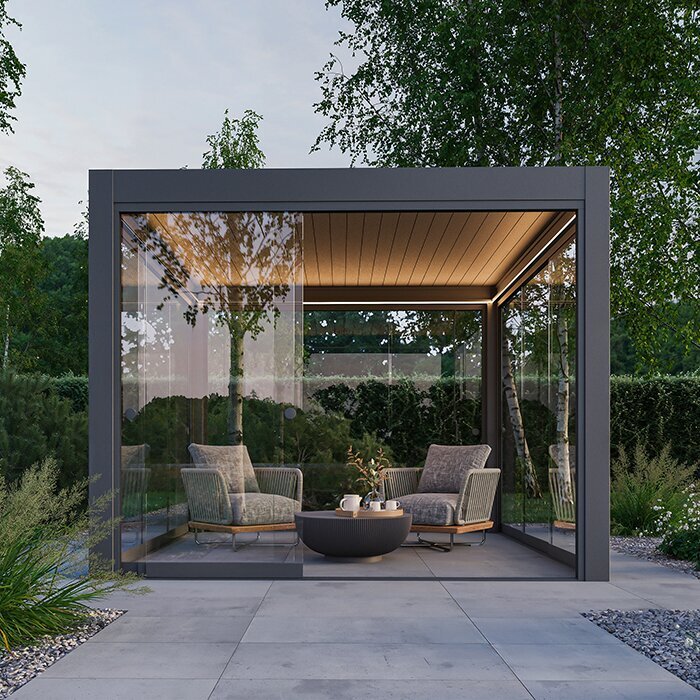
Check the complete roof dimensions
Check the dimensions of the assembled structure, not just the spacing between posts. Overall roof width and projection, height, overhangs and the way the pergola sits near a building all affect what wind meets and how much clearance remains around it. These are factors to verify, not inputs for a home-made wind calculation; footprint alone cannot tell you whether a product suits the site. Check the manufacturer's assembled dimensions and whether a roof or side option changes them. The position should also leave access for assembly and future operation, within the clearances stated in the instructions.
Ask whether the stated wind conditions apply to the exact size and configuration you intend to order, including optional panels or an altered roof position. A dimension sheet and a wind limit answer different questions, so one cannot replace the other. When comparing Bloomcabin's bioclimatic pergola listing, check the measurements and configuration details only where they are actually supplied; do not infer dimensions from the product image or the word bioclimatic. If the listing gives only headline measurements, request an assembly drawing and relevant technical guidance before deciding where the pergola could go.
Match the fixing method to the supporting surface
A pergola's feet and fixings are part of its wind performance: the frame has to transfer forces to a suitable supporting surface or structure. Soil, paving, decking and concrete are not interchangeable, and a surface that feels solid underfoot may not be approved for the product's fixing system. Check the required base type, fixing locations and any site-preparation conditions in the manufacturer's instructions. Do not assume that fixings supplied with a kit suit every garden, or substitute different anchors to solve an unclear requirement. The right answer depends on the exact model and on the condition of the surface beneath it.
For a wall-mounted option, the same scrutiny applies to the building fabric and attachment details. The Bloomcabin wall-mounted pergola listing identifies a product; it does not prove that a particular wall or surface is suitable. Before ordering, give the installer or qualified professional the model documentation, proposed location and details of the supporting surface, and ask whether the specified installation can be carried out there. Avoid estimating anchor capacity or improvising a fixing plan yourself. If the surface, fixings or installation method cannot be confirmed, pause the purchase until an appropriate assessment resolves the gap.
Ask for a stated wind limit
Look for a wind-performance statement that relates to the complete pergola, not just a general phrase such as sturdy or weather-resistant. Useful documentation should identify the relevant model and set out any stated wind limit or conditions of use, including the roof position, side panels and required fixing arrangement where relevant. Ask what a figure or classification means and what assumptions it relies on; a rating for a different configuration or support does not answer your question. Do not turn a published figure into a decision about local exposure without the necessary expertise. Match the manufacturer's stated conditions to the site, seeking qualified advice where necessary.
If information is missing, ask the supplier or manufacturer for the relevant instructions or technical sheet for the exact model and configuration, ideally in writing. For the Bloomcabin pergola listing, treat the product name and image only as identification; wind suitability has to come from the actual product documentation. Record the answer alongside the proposed base, wall or ground type, and confirm that it applies to your intended installation rather than a different setup. If the response stays vague, treat that as an unresolved buying risk, not as permission to assume the model can be installed anywhere.
Understand operation during windy weather
The buying decision includes how the pergola must be managed when the weather changes. Check whether the instructions call for a particular position for an adjustable roof, or require a canopy, screen or panel to be retracted, secured or removed in certain conditions. These rules are model-specific: one design's procedure cannot be applied to another, and there is no universal open-or-closed setting for all pergolas. Find out how long a change takes, whether it requires access to a control or fitting, and whether the people who use the garden can carry it out safely. It is worth knowing the procedure before ordering, not after installation.
Ask whether the operating rules cover the combination you plan to buy, not just the basic frame. If accessories are ordered separately, check that the documentation identifies the compatible parts and any additional restrictions. The listing for Bloomcabin's bioclimatic pergola can confirm which product you are considering, but use the manufacturer's instructions to establish what its roof does and how it is to be managed in wind. A pergola is a poor fit if its required storm procedure cannot realistically be followed at your site; do not rely on memory, guesswork or assumptions based on another model.

Allow for installation and ordering checks
Bring installation into the purchase decision before selecting a delivery date. Ask who is responsible for assembly and whether a qualified installer needs to review the location, access, supporting surface and manufacturer's instructions before you order. A site visit may reveal a clash between the intended position and the specified fixing method while there is still time to reconsider. Also check the route for carrying parts to the garden and the working space around the footprint. A product that cannot be brought to the installation area or assembled as specified may not be a practical purchase, even if its final position appears workable.
Before paying, compare exactly what the order includes with what installation will require: the frame, roof or side parts, specified fixings, any separate accessories and site preparation should be clear. For the page for Bloomcabin's pergola, note only the information the listing actually gives, then ask about unresolved items. Read the current delivery, returns and cancellation terms, and clarify how to raise technical questions. Do not assume a component or service is included because it appears in a photograph. Keeping written answers with the product details helps prevent a mismatch between the chosen configuration and what arrives.
Make the decision against documented conditions
Before choosing a style, see whether the shortlist passes four checks: the exact position has been assessed in more than one wind direction; the product documentation covers the intended roof and side configuration; the specified fixing method matches the actual wall or ground; and someone qualified can resolve any site question the documentation cannot settle. If an answer is missing, do not compensate with a different colour, a larger-looking frame or unapproved hardware. Move to another position or model only if its requirements can be documented for that arrangement. This separates a considered buying decision from a guess.
Wind exposure can change during the life of a pergola as trees grow or are pruned, boundaries change, or nearby structures are added or removed. Keep the operating and maintenance instructions, and follow the manufacturer's inspection guidance rather than setting your own schedule. After unusual weather, if anything looks displaced, loose or damaged, stop using the structure and arrange an appropriate assessment before returning it to use. Recheck roof and accessory procedures if the setup changes. These checks do not guarantee that a model will suit every exposed garden; they keep the decision tied to the conditions and instructions for the actual installation.
Frequently asked questions
Can any pergola be made suitable for a windy garden?
No. Suitability depends on the complete design, its permitted roof and side configuration, the fixing method and conditions at the site. Do not assume that extra, unapproved bracing or anchors will make a model suitable. Look for guidance that covers the intended installation, and get a qualified assessment if site requirements are unclear.
Is a wall-mounted pergola better in wind?
Not automatically. A wall-mounted design depends on both the pergola's fixing requirements and the construction and condition of the wall. The product name does not establish that a particular wall is suitable. Check the manufacturer's instructions and have the proposed attachment assessed if there is any doubt.
Should I open a louvred roof or retract a canopy before strong wind?
Follow the instructions for the exact model. There is no universal open-or-closed position that applies to every roof, canopy or pergola. Check what the manufacturer says about operating positions and any fitted screens, and make sure the required procedure can be followed at your site.
What wind rating should I look for?
There is no single figure that suits every exposed garden. Look for the manufacturer's stated wind limits and conditions, and check that they apply to the exact size, roof position, accessories and fixing arrangement you plan to use. A qualified professional can help relate that guidance to the site.
What if the product information does not explain wind or fixing requirements?
Ask the supplier or manufacturer for instructions and technical information for the exact model and configuration. If the answers still do not establish what fixing method and conditions are allowed, pause the order and seek a qualified site assessment. Do not fill gaps with assumptions based on a photograph or product name.
A sound buying decision connects the conditions at the exact site with the pergola's documented roof and side configuration, wind guidance and fixing requirements. Once those points align, compare appearance and size within the options that suit the installation. If the documents do not resolve a question about the wall, ground or operating procedure, pause rather than guessing. That keeps the choice focused on a pergola and installation that can be properly assessed for the garden you have.
