
Is a Ceiling Fan Suitable for Your Pergola?
Pergola planning
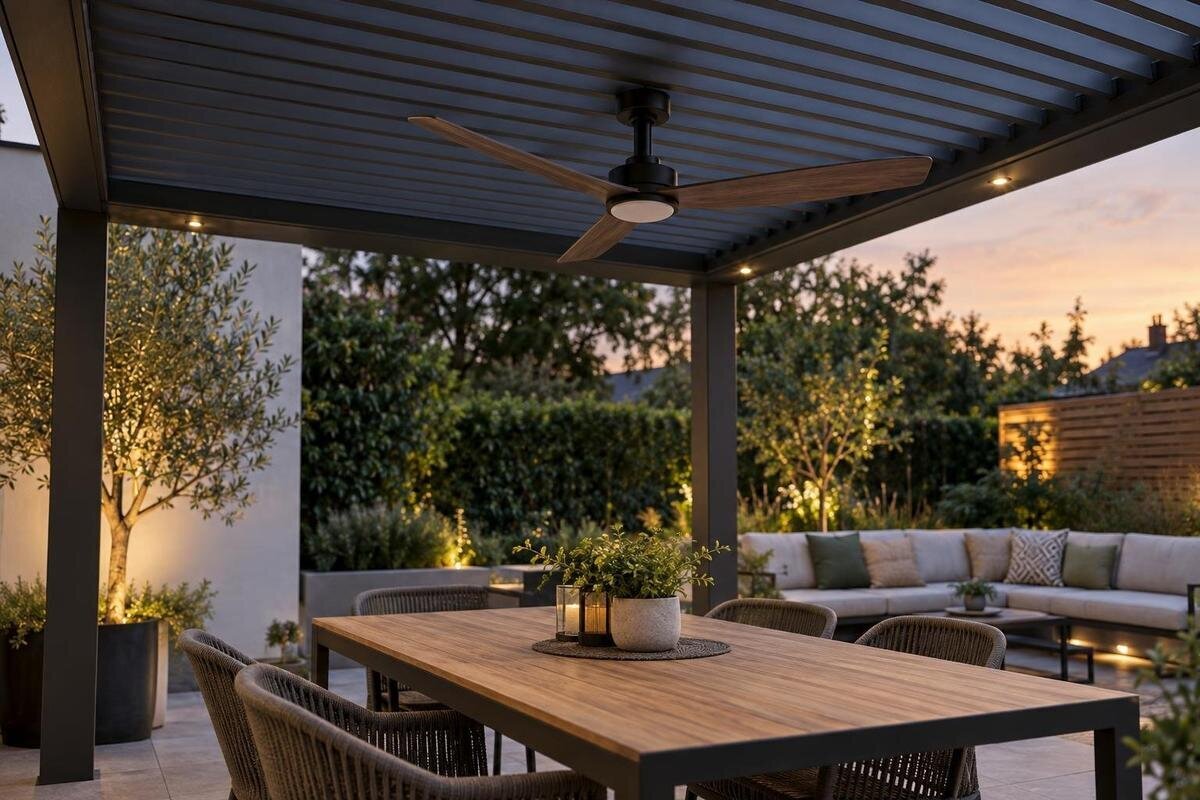
A ceiling fan can be compatible with a pergola, but there is no reliable yes or no based only on the word pergola or the fan's weight. The exact frame, fixing point, fan, exposure and electrical arrangement all have to match. A rotating fitting adds operating forces as well as weight, while an open or adjustable roof can create clearance and weather questions that do not arise indoors. This guide explains what to verify before buying or arranging installation, and what evidence to request instead of relying on a general assurance.

01
Compatibility depends on the exact pergola and fan
There is no blanket yes or no for pergolas as a category. Compatibility depends on the exact model and configuration, the roof and frame, the proposed fixing point, the fan and its specified bracket, and the conditions in which it would run. Two structures can look similarly solid yet have different permitted attachments. A choice of roof or accessories may also change the space available for a mount. A product photograph, a fan's stated weight or a general description such as robust is not evidence that a particular overhead fitting is approved.
Treat this as four related but separate checks: the support is approved for the fan's weight and operating forces at that point; the blades have the clearances required by the fan maker; the complete fan is suitable for the actual outdoor exposure; and the electrical arrangement is appropriate. One positive answer does not settle the others. If you are identifying a product for a compatibility query, the Bloomcabin Pergola product page names the model, but its listing alone does not establish a fan-ready mount or load allowance. Describe the configuration you plan to order rather than asking whether fans suit pergolas in general. Keep the proposed fan and position consistent across all four checks, so that an answer about one arrangement is not inadvertently applied to another.
A moving fan creates more than a static load
A ceiling fan is not simply another static light fitting. It has weight when switched off, and in operation its rotating blades and motor transmit movement through the bracket and supporting member. Starting, stopping and normal running vibration create repeated forces; a fault or imbalance can change them. Outdoor air movement may also affect the conditions in which the assembly is used. The relevant question is not whether the frame looks strong or the fan seems light, but whether that particular structure and mount are approved for the appliance's operating conditions.
Ask whether the approval covers the fan, bracket and any extension at the exact proposed point, not just a general support member. Where a manual gives a load figure for another purpose, that figure is not automatically approval for a ceiling fan; do not try to turn it into an allowance by subtracting the fan's weight. A manufacturer or appropriately qualified structural professional can say what evidence is needed. The regular Bloomcabin Pergola listing can help identify the product in that request. Include the fan's mounting details alongside its stated weight, so the question concerns the complete suspended assembly rather than the motor alone. If the answer addresses only how much weight the frame can hold, clarify whether it also covers the forces produced while this fan is running.
02
The fixing point must be approved
Identify the support behind the intended fitting, rather than judging the surface by appearance. The mounting point must be one the pergola manufacturer has approved for this use or one assessed by an appropriately qualified structural professional. Approval should cover the attachment as installed, including the bracket, any plate or extension, and how it connects to the supporting member. A frame section that carries a roof component is not automatically designed to take a suspended rotating appliance. Nor does an approved point for one accessory make nearby sections suitable.
Pay particular attention if the roof has adjustable louvres, sliding panels, a retractable cover or other moving parts. Do not attach a fan to a moving part unless the exact product documentation explicitly permits it; a nearby fixed member may still obstruct roof movement or be outside the approved mounting area. Use the Bloomcabin Bioclimatic Pergola page to identify the model, then specify the selected roof and accessories in your request. Ask for written approval naming the fixing point and any restrictions on roof operation. A marked drawing helps distinguish the proposed support from an adjacent roof component, especially where several parts meet above the seating area. The answer should identify where the bracket may be attached, not merely say that a fan can be fitted somewhere beneath the roof. Do not modify the frame on assumption.
Check clearance around the full blade sweep
Check the full space swept by the blades, not just the size of the canopy around the mounting point. Follow the fan maker's drawing for blade span, housing, mounting arrangement and specified gaps; the blade tips, lowest part of the assembly and space above users all matter. Compare these with beams, roof parts, walls, posts, screens, lights and other equipment. Check the required headroom and any access needed for installation or maintenance. Use the instructions for the particular fan, rather than borrowing a clearance from another model or assuming one universal figure.
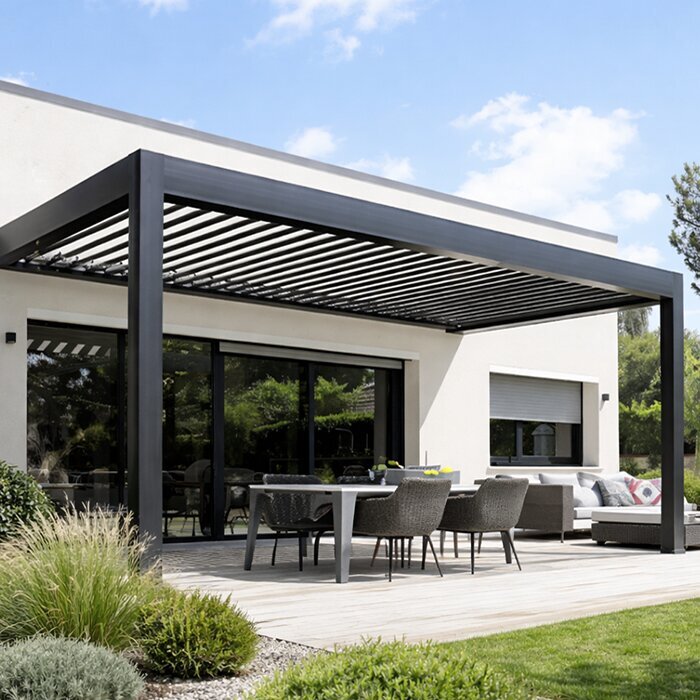
Repeat the check in every roof position and with the accessories that will actually be fitted. A fan that clears a closed roof may conflict with a moving louvre, a deployed screen or another fitting. Plan around how the space is used too: people stand, chairs move and a dining table may not stay in the same place. A fan need not be visually centred if another position is the one approved. For a wall-mounted layout, identify the model using the Bloomcabin Wall-Mounted Pergola listing, then mark the proposed centre and full blade circle on a plan for review. Include the adjacent wall and any other fittings in that drawing. Record the mounting arrangement as well: the same blade diameter does not settle headroom if the proposed bracket or extension changes the fan's position beneath the roof.
03
Match the fan's outdoor rating to the exposure
An outdoor label does not answer every exposure question. Confirm that the exact fan model and its components are permitted for the proposed location under the maker's instructions. Terms such as sheltered, damp or wet location can have model-specific meanings, so use the manual's definitions rather than advertising shorthand. If the fan includes separate controls, a receiver or a light kit, check that the instructions cover the complete arrangement. A model intended for a sheltered area may not be approved for direct rain or wind-driven moisture.
Consider how the pergola is used and what sits above the fan. An open roof or one that changes position may expose it to rain, splashing, condensation or different air movement; surrounding walls do not necessarily make an outdoor space enclosed. Sun exposure, temperature range and, in some locations, salty air may matter if the maker specifies limits. If an IP or location rating is stated, ask what equipment and exposure it covers; it does not prove that the pergola can support the fan. When enquiring about the bioclimatic model listed by Bloomcabin, describe the roof positions in which the fan would remain installed, as well as those in which it would run. This gives the fan supplier a clearer description of the location than simply saying that the appliance will be under cover.
Have a qualified electrician review the electrical plan
Structural approval and electrical suitability are separate. The fan's instructions may specify a supply, controller, mounting arrangement or conditions for controls and optional lighting. A pergola's existing lighting provision, a roof control or a nearby outlet does not automatically satisfy those requirements. A fan with an integrated light may also have different controls or connection requirements from the fan alone. An approved mounting point does not show that a circuit, connection or control scheme is appropriate for the appliance.
Give a qualified electrician the exact fan manual, proposed position, pergola documentation, roof-control details and information about the location's exposure. Ask the electrician to assess the supply, protection, isolation, controls and cable route; this article is not wiring guidance. Include the Bloomcabin Pergola model details when identifying the structure, together with the options selected for your order. Explain whether you want to operate the fan and any integrated light separately, and describe the other controls already planned for the pergola. These are requirements to discuss, not assumptions about what the existing provision can accommodate. Keep the electrical assessment separate from structural approval, but use the same marked plan for both. That avoids an electrical proposal referring to one position while the support assessment covers another.
04
Consider weather and how the roof operates
A ceiling fan under a pergola operates in the air around it; a roof overhead does not make the space a sealed room. Natural breezes, gusts and changes in shelter can affect whether the fan is being used within the maker's stated conditions. Read the operating and stop-use instructions for the exact model, including what to do when conditions change. Do not assume that a fan approved for outdoor installation can be left running in every kind of weather, or that closing a roof creates indoor conditions.
Think about the roof positions in which you expect to use the fan. If the roof opens, closes or adjusts, find out whether the fan may run in each position and whether the maker specifies an operating sequence; do not assume the systems can be used together in every combination. Consider whether overhead airflow would be useful in the seating area you have chosen, given the natural air movement there. Identify the seats you actually want to serve rather than choosing the centre of the roof for appearance alone. If the approved mounting position is away from that area, consider whether the fan still meets your intended purpose before buying it. A ceiling fan circulates air; it does not enclose the pergola, shelter people from rain or change the outside air temperature. Compatibility includes permitted and useful operation, not just an attachment that fits.
Do not improvise a mount when approval is missing
If the exact support is not approved, do not try to make it suitable with a convenient clamp, improvised plate, generic light bracket or extra fixings. Such changes can alter how forces reach the frame, and a visually substantial member or spare space beside a beam is not approval. The same caution applies to cutting, drilling or attaching equipment to a roof element because it appears convenient. An accessory is acceptable only when the pergola or fan documentation, or a relevant professional assessment, covers that exact arrangement.
Ask whether an approved fan mount exists for the model, or whether an appropriately qualified structural professional can assess a proposed alternative before any work. If neither route is available, leave the overhead fan out rather than making a trial installation. A freestanding fan may be an option only if its own instructions allow the intended outdoor location and placement; it avoids relying on the pergola as an overhead support, but has separate electrical and placement considerations. For an enquiry about Bloomcabin’s wall-mounted model, explain which overhead position has been considered and why approval remains unresolved. This keeps a request for an alternative focused on the actual obstruction or support issue. Moving the proposed fan to another member does not settle the question unless that new point and attachment are assessed too.
05
What to request from the pergola supplier and electrician
Send the pergola supplier the exact model, selected configuration, roof type, options and a drawing showing the proposed fan position. Include the fan maker and model, the weight stated in its manual, the bracket and any specified extension, and whether there is a light kit. Ask in writing whether the supporting point and full attachment are approved for the fan's operating forces, what documentation supports that answer, and whether it changes with roof movement or accessories. A response that says only that the frame is strong or the fan is light does not answer those questions. If the quote is for Bloomcabin Bioclimatic Pergola, include the precise configuration from the order as well. Present the information together so the supplier can respond to one defined proposal. Where an answer has conditions, record which part of the proposal each condition affects rather than reducing the response to a simple yes.
Give the same plan to the electrician, together with the fan and pergola manuals and any information about roof controls. Ask what is needed for the chosen fan and location, whether its controls and any light kit suit the proposed arrangement, and what needs to be confirmed before installation. Clarify who is responsible for each decision: the fan supplier can explain the appliance's limits, while the pergola documentation or a structural assessment must address the support. Keep the written answers with the product records, and revisit them if you change the fan, bracket, position or roof option.
When is a pergola ceiling fan suitable?
Treat the proposal as a yes only when the records cover the same exact combination: pergola model and configuration, approved support and attachment, fan and bracket, blade clearances in relevant roof positions, outdoor exposure and electrical plan. A general answer about a similar pergola or a different fan does not automatically carry across. Before buying, check that the instructions and approvals do not contradict one another and that any required professional assessment is documented.
Keep the decision open if a check is missing, rests on verbal reassurance or is left to be decided after mounting. The arrangement is unsuitable if the maker's instructions exclude the exposure, no acceptable support can be confirmed, or the blade path conflicts with the structure or its operation. Distinguish an unanswered question from a confirmed incompatibility: the former needs clarification, while the latter means the current proposal cannot proceed. If the exact fan has not been chosen, wait to seek a final answer until its manual and mounting details are available. Likewise, a later change of bracket or position needs to be considered against the original approval rather than treated as a minor substitution. A clear no is more useful than treating the pergola's appearance as proof that an overhead fan is suitable.
Frequently asked questions
Can I fix a ceiling fan to a pergola beam?
Only if the exact beam and fixing arrangement have been approved for that fan and its operating forces. A beam that supports part of the pergola, or feels sturdy, is not automatically suitable for a rotating appliance. Ask for written approval covering the fan, bracket and proposed fixing point.
Can a ceiling fan be attached to an adjustable louvre?
Do not assume so. A louvre is a moving roof part, and the fan could interfere with its movement or be outside the permitted mounting area. Use it as a fixing point only if the documentation for the exact pergola explicitly approves that fan arrangement and its operation.
Does an outdoor-rated fan work under any pergola?
No. The fan maker's instructions must permit the actual exposure at the proposed location. Rain, wind-driven moisture and changes in roof position can affect that assessment. An outdoor rating does not confirm that the pergola can support the fan or that the electrical arrangement is suitable.
Is a covered pergola automatically suitable for an indoor fan?
No. A roof does not necessarily make an outdoor space equivalent to an enclosed room, and the fan maker may not permit that model in those conditions. Check the instructions for the exact fan and the conditions beneath the pergola rather than relying on the roof as protection.
Who should confirm a pergola ceiling-fan installation?
Ask the pergola manufacturer or an appropriately qualified structural professional about the support and fixing point. Check the fan maker's instructions for clearance and outdoor use, and have a qualified electrician review the electrical plan. Each answer should refer to the same fan, location and pergola configuration.
A pergola ceiling fan is suitable only when the exact support, fan, clearances, outdoor conditions and electrical plan have all been considered together. If those checks agree in the relevant documentation, you can make the decision on evidence; if they do not, leave the fitting out until the missing approval is resolved.
