
ZIP Screens Versus Outdoor Curtains for a Pergola
Pergola buying guide
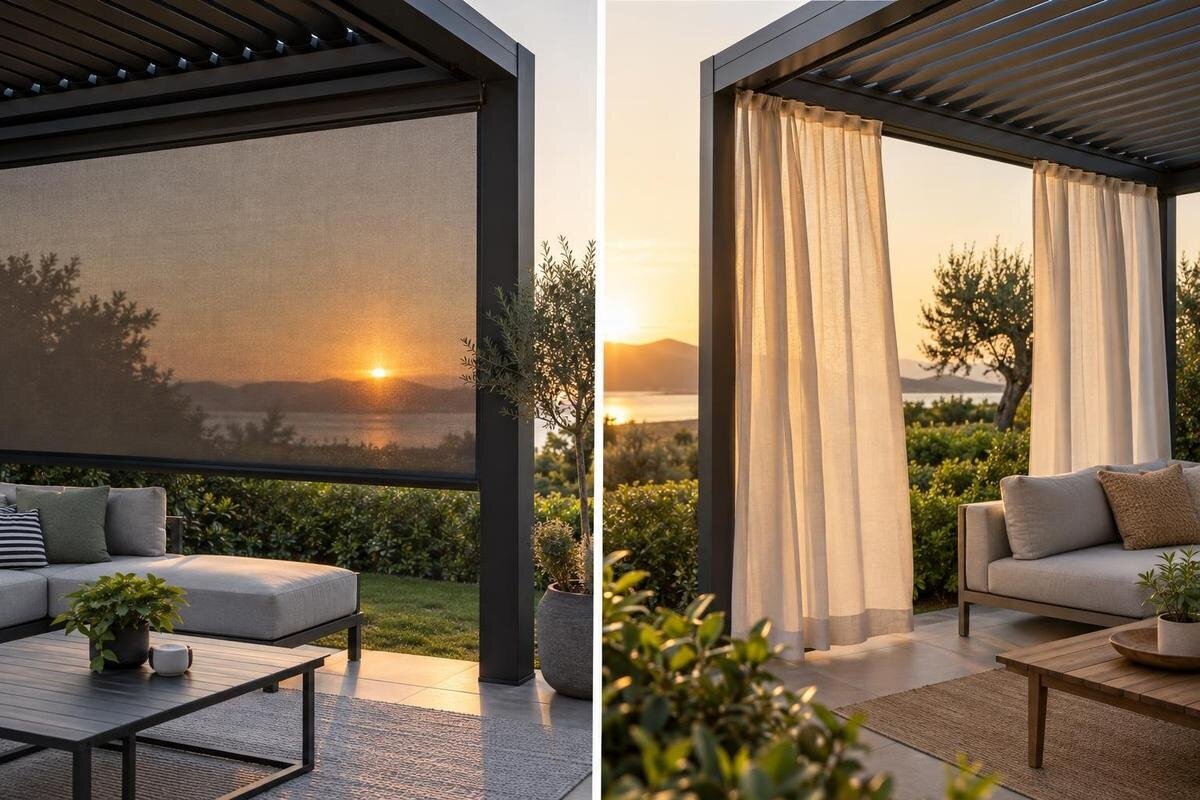
Choosing between ZIP screens and outdoor curtains comes down to more than appearance. A ZIP screen follows guides and is usually raised as a panel; a curtain hangs and gathers. That difference affects deployed behaviour, airflow, care and the wind guidance you need to check. The fabric and mounting arrangement still matter more than the category name, so compare the actual accessory proposed for your pergola before ordering.

How ZIP screens and outdoor curtains differ
A ZIP screen is a side panel whose fabric edges are held in guides as it moves between raised and lowered positions. In a genuine ZIP arrangement, the edge is designed to engage with those guides. Outdoor curtains are panels suspended from a rail, track or rod, usually drawn sideways and gathered at an end. That difference in support explains the basic contrast: a screen follows a defined path across an opening, while curtains hang in folds and may move more freely. Some screens are operated by hand and others by a motor, but neither the control method nor the precise guide design follows from the category name.
The labels also do not tell you exactly what the material does. Screen fabrics differ in weave, openness, colour and opacity; curtain fabrics differ in weight, lining, overlap and panel design. Those details affect the view through the material, the shade it provides and how much air can pass. Do not infer that either option keeps out rain, insects or wind simply from its name. Check the product information for the fabric and mechanism you are considering, and establish whether the side treatment is included with the pergola, offered as an accessory or sourced separately.
How a deployed ZIP screen behaves
When lowered, a guided screen spans the opening along its tracks. That can give the side a more consistent outline than loose fabric gathered into folds, but the finished result still depends on the dimensions, guides and fitting. If it retracts upwards, ask where the screen sits when raised and how much space its housing needs. Check how the lower edge works, whether the panel can stop part-way and what control is supplied. A guided edge is not proof of an airtight or weather-tight seal; gaps and clearances depend on the specific system and installation.
Measure the opening you want to cover, including the points where the guides and housing would sit, rather than relying on a photograph. If your shortlist includes the Bloomcabin Bioclimatic Pergola, ask whether a named ZIP-screen accessory fits the exact configuration. Confirm the opening sizes it covers and how the guides are mounted. On your layout sketch, distinguish the clear opening from the space occupied by the proposed screen components: you need to understand both the coverage and what remains accessible. Ask for dimensions showing the screen fully raised and fully lowered, as well as any permitted intermediate positions. This lets you compare its everyday use with curtains on the same opening, rather than comparing two unrelated product photographs. Keep the accessory name alongside the pergola model in your enquiry so that the reply refers to the combination you actually intend to buy.
How outdoor curtains behave when drawn
Curtains usually move across a rail or track, with the fabric stacking at one or both ends when open. The number of panels, their overlap and the way they are held back vary. Some systems are designed for regular drawing; others may be better suited to a fixed position. When deployed, loose fabric can shift or flutter in a breeze, and gaps between panels or at the edges may remain. Those behaviours are part of the appeal for some settings, but they mean a curtain will not necessarily present the same flat, guided span as a screen.
Before choosing curtains, check where the gathered fabric will sit and whether it would narrow a doorway or interfere with the route around the pergola. Find out if tie-backs are supplied, whether panels can be removed and how the track is supported. For the Bloomcabin Wall-Mounted Pergola, confirm which curtain rail or other side accessory, if any, is offered for the exact model. Ask whether the proposed curtains draw to one end or divide between both ends, and mark those positions on your sketch. Compare how easily you could reach and gather each panel from beside the furniture you plan to use. Also consider whether you want the whole opening uncovered or would usually leave some fabric drawn. These questions help you choose a panel arrangement that suits daily use; the appearance of curtains in a photograph does not answer them.
Privacy depends on fabric, gaps and lighting
A screen can soften a view without blocking it, particularly if its fabric is made to let you see through. A denser or more opaque fabric may obscure more, but the amount depends on the material and lighting. Curtains can provide a more solid visual barrier when the panels are opaque and overlap enough, while sheer cloth may leave a clear view. Check a fabric sample from both sides of the pergola; a small sample is more informative than relying on labels such as “privacy screen” or “outdoor curtain” alone.
Consider the side that needs screening and the places from which people will look in, then check the top, bottom and panel joins for possible sightlines. At night, lighting inside the pergola can make a view through some fabrics more apparent, so judge samples in conditions that resemble your usual use. When considering the Bloomcabin Pergola, request samples for the proposed side accessory rather than assuming the pergola listing establishes its privacy. Decide whether you want to obscure the seating area completely or simply make it less exposed while retaining a view out. Compare screen and curtain samples against that same aim, from both inside and outside. For curtains, include the proposed overlap in your assessment; for a screen, ask about the uncovered edges. This separates the fabric’s opacity from gaps in the finished arrangement, which are two different reasons a view might remain.

Airflow changes with the fabric and opening
An open side offers the least obstruction to air moving through that opening. A screen made from permeable mesh may allow some airflow while still covering the side, but the fabric’s construction and the area covered matter. A more solid screen can restrict airflow further. Curtains may leave gaps between panels or at their edges; when drawn across, dense fabric can obstruct more, and loose panels can move with a breeze. Neither category guarantees a particular level of ventilation when deployed.
Think about the pergola as a whole: closing one side may make a difference to cross-flow if there is no other open route. Ask whether the manufacturer publishes information about the selected fabric’s air permeability, rather than treating its visibility rating as an airflow figure. If you are considering the bioclimatic pergola model, compare the actual accessory fabric and the amount of side coverage you plan to use. Record which sides would normally stay open when the screen is lowered or the curtains are drawn. Then consider whether that arrangement also meets your privacy needs: leaving a gap for air may leave a view into the seating area. Compare both options in the positions you would genuinely use, not only fully open or fully closed. If fabric information is unavailable, keep that uncertainty separate from what you can establish about the opening and layout.
Side shade depends on the sun and the coverage
A side panel can reduce low-angle sunlight from the direction it covers, but the useful side changes as the sun moves. Sketch where the sun reaches the seating area at the time you expect to use it, then consider which opening needs coverage. A screen or curtain on another side will not solve glare from an uncovered direction. Also check the width of the panel and the position of doors or other openings: sunlight may still pass through uncovered areas, between panels or around the edges.
Fabric samples help you judge brightness and view-through, but do not assume that colour alone tells you how much shade a material provides. Ask for any relevant fabric information the supplier publishes and consider the sample in daylight. When reviewing the wall-mounted pergola model, confirm which side accessory is available and what remains exposed when it is fully deployed. For this comparison, focus on how you would adjust the coverage during use. Would you want to uncover the whole side once direct sunlight has passed, or leave part of it screened for privacy? Ask which positions the proposed system supports and whether those positions are covered by its operating guidance. Compare the resulting view and access as well as the shade. A fabric that looks appealing on its own may not suit the way you want to open and close the side throughout an afternoon.
Plan operation and clearance around the pergola
A screen’s guides, lower edge and raised position need to work with the opening and the way you use it. Ask where its operating control is and whether the system is manual or motorised; the ZIP label does not answer that. For curtains, check the rail, the space needed for gathered fabric and any tie-backs. In either case, consider door handles, the route between the house and garden, and furniture placed beside the opening. A side treatment should not make routine access awkward when it is open or closed.
Mark the intended coverage and the fabric’s open position on a simple sketch, then compare both states with your furniture and door movements. Check the dimensions with the supplier instead of assuming that a picture shows the clearance available on your installation. If the regular pergola model is on your shortlist, request drawings or dimensions for its proposed side accessory before committing to a layout. Include the route you use while carrying food, moving chairs or entering from the garden, not just the space needed to stand beside the panel. Check whether you could reach the screen control or curtain tie-backs without shifting furniture. If the opening is also your usual entrance, consider how often you would have to raise the screen or draw the curtains aside. The most useful layout is one that accommodates both the covered position and the routine of opening it.
Care depends on the fabric and mechanism
A guided screen has tracks and moving parts that may collect dust or debris, while its fabric needs care suited to its own material. Ask for the maker’s cleaning instructions, including how to deal with dirt in the guides and whether the screen should be fully dry before being retracted. Do not force a panel that is sticking or use a cleaning product simply because it is suitable for another outdoor fabric. Follow the instructions for the system you have, and check its fabric, guides and fixings periodically for visible wear or damage.
Curtain care varies just as much. Some panels may be removable; others may not be designed to come off for washing. Check whether the fabric can be washed, how it should dry and whether the rail or any tie-backs need separate care. For the Bioclimatic Pergola listing, request care information for the specific side accessory. Compare the work involved rather than assuming that either category is easier to maintain. For curtains, ask how removal and refitting work and consider where you would handle and dry the panels if removal is permitted. For a screen, consider access to the fabric and guides for the cleaning described in its instructions. Read the care requirements before selecting a fabric, especially if you have limited space for drying or storage. This gives you a practical basis for choosing a system you can look after without turning routine cleaning into an awkward task.

Wind guidance must match the exact configuration
Neither “ZIP screen” nor “outdoor curtain” is a wind rating. A deployed panel presents fabric across an opening, but its response depends on the material, dimensions, guides or fixings and how it is mounted. A limit or instruction for a different size, accessory or installation cannot automatically be applied to yours. Ask for the manufacturer’s documented guidance for the exact screen or curtain, on the exact pergola model, and check whether the instructions distinguish between fully open, partly open and deployed positions.
Find out what the maker says to do when conditions change, and follow the instructions supplied for that system. If there is no clear guidance, request it before ordering rather than relying on phrases such as “wind resistant” or on experience with another product. For the Wall-Mounted Pergola listing, ask specifically about the proposed screen-and-pergola or curtain-and-pergola combination. Read any stated limit together with the required operating position: a figure alone does not tell you whether it applies while the fabric is deployed. Ask the supplier to clarify any ambiguous use of terms such as open, closed, raised or retracted, so you know which position the instruction means. Keep that guidance with the operating instructions for the accessory. If you are unsure whether a proposed fixing or mounting arrangement is suitable, ask the supplier or a qualified installer to assess it.
Verify compatibility and availability before ordering
Compatibility means more than finding a screen or curtain that appears to fit the opening. Give the supplier the exact pergola model and configuration, the side or sides to be covered, and the measurements of each opening. Ask for the accessory’s precise name, mounting arrangement, available dimensions and control method, and confirm whether it is included or sold separately. If several sides are involved, check that each proposed accessory is suitable for its own opening rather than assuming one confirmation covers the whole setup.
Availability is a separate question from fit. Ask the seller to confirm, for your chosen configuration and address, whether the exact accessory is currently orderable and what the current supply position is; a product image or another model’s listing is not confirmation. If timing matters, request the relevant lead-time information before placing an order. Then compare the option against your priorities: guided coverage and a compact raised position, or hanging fabric that gathers to the side. A confirmed match, clear wind instructions and care information make that comparison meaningful.
Frequently asked questions
Are ZIP screens more wind-resistant than outdoor curtains?
Not by category name alone. A guided edge does not establish a wind limit, and a curtain’s fabric and fixings vary too. Ask for the manufacturer’s guidance for the exact accessory, size, mounting and deployed position on your pergola. Do not transfer a rating or instruction from a similar-looking product.
Can a ZIP screen let air through?
It can if the chosen fabric is permeable, but the amount of airflow depends on its construction and how much of the side is covered. Ask for fabric-specific information where available; a description of visibility through the fabric is not, by itself, an airflow specification.
Do outdoor curtains provide more privacy?
That depends on the fabric, overlap and gaps. An opaque panel can obscure a direct view when properly drawn, while a sheer curtain may not. A mesh screen may allow a view through it. Check samples from both sides and consider how the fabric looks when the pergola is lit after dark.
Can I leave either option lowered all the time?
Do not assume that either can stay deployed in every condition. Follow the instructions for the exact screen or curtain system, including any guidance on wind, cleaning, drying and storage. If those instructions are unclear, ask the supplier or manufacturer before deciding how you will use it.
How do I check that a screen or curtain fits my pergola?
Give the supplier the exact pergola model, the side or sides to be covered, and the opening dimensions. Ask for written confirmation of accessory compatibility, what is included, the mounting arrangement and the operating method. Also confirm current orderability and request the accessory’s care and wind guidance.
Compare each option both deployed and fully open: note what remains uncovered, where the material sits and how it changes the route around the pergola. Then base the choice on the fabric, care requirements and wind guidance for the exact accessory. Choose the guided screen or hanging curtains whose confirmed configuration best suits the privacy, airflow and everyday access you want.
