
Pergola Privacy Panels: Fixed or Sliding?
Pergola privacy planning
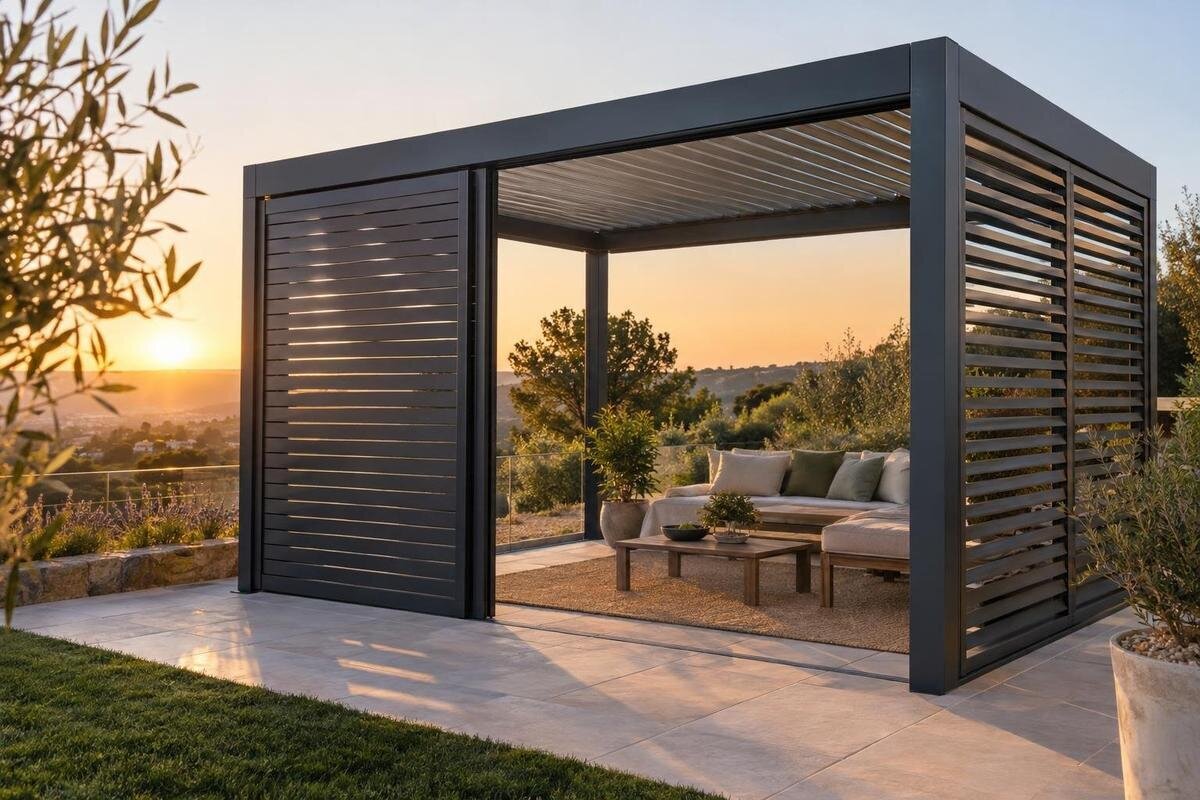
Choosing between fixed screens and sliding privacy panels is less about which option is universally better than what each side of the pergola needs to do. A fixed screen keeps a visual boundary in one place; a sliding panel can move to cover or uncover part of a side, provided its layout allows useful movement. That affects privacy, access, outlook and the feeling of openness. Plan each side separately: identify the view you want to screen, the route that must stay clear and where a moving panel will sit when it is open. Then confirm the proposed screen for the exact pergola model. A model name or product image does not establish that a panel is included or compatible.

Before you choose 1
Fixed screens and sliding panels serve different needs
A fixed screen stays in its chosen position, blocking the same view each time the pergola is used. There is no daily opening position to manage, and the screen can be limited to the section that needs it rather than treated as an all-or-nothing enclosure. A sliding privacy panel can move to uncover or cover part of a side, but only if the particular system travels far enough and has somewhere suitable to park. Sliding does not automatically mean the whole opening clears; the usable gap depends on the panel arrangement. The practical difference is a permanent screened area versus one you can reposition.
Neither format is inherently more private. An opaque screen blocks a direct view only across the area it covers, so its position, width and end gaps matter more than whether it moves. A sliding panel may screen one sightline in one position and expose it in another; a fixed screen cannot adapt if use changes. When considering the Bloomcabin Pergola listing, compare the proposed side-screen arrangement separately from the base pergola. Mark the view each panel position is meant to block, rather than choosing on the strength of the labels 'fixed' or 'sliding'. This gives you a clear basis for comparing coverage.
Map the sightline you actually want to block
Begin with the places where privacy matters: a chair where you read, the dining table or the route from the back door into the garden. From each spot, note the direct view that feels exposed, such as a neighbouring seating area, a shared boundary or a window at a similar level. A quick plan with arrows is more useful than labelling an entire pergola side 'private', because one narrow angle may be the issue while the rest of the outlook is welcome. Record whether people are usually seated or standing; a sightline that misses someone at the table may still cross the route when they get up. If the view matters only during one activity, mark that as well.
Repeat the check from both ends of the covered area and around its corners. A fixed panel might block a straight view but leave a diagonal one around its edge; a sliding panel can create the same gap when moved. Draw each panel in every position you expect to use and see which arrows remain open. This checks ordinary eye-level views around the pergola, not privacy from every possible direction. The aim is to screen a particular view without making a larger visual barrier than necessary. If the view changes from the seat to the doorway, show both viewpoints rather than choosing from one convenient spot.
Before you choose 2
Keep doors, gates and walking routes clear
Mark every route before choosing a panel: the back door, side gate, path between house and lawn, and the way people reach the table. Include room to pull a chair back or carry things through; drawing only the closed furniture footprint can make a passage look wider than it feels in use. Note a door swing and any turn where people need to pass, not just a straight line across the terrace. Where a route crosses the side you want to screen, a fixed panel may put privacy and access in conflict. A sliding panel helps only if its open position provides the clearance needed, not merely a small gap at one end.
Think about how often the route is used. If that side must stay clear for everyday trips, having to move a panel each time may be inconvenient; if access is occasional, a sliding arrangement may work better. If you are considering the Bloomcabin Wall-Mounted Pergola, include the door and gate routes in your layout enquiry. Show where people enter, where they turn and which passage needs to remain open during normal use. Do not infer the access layout from the model name or listed size: ask how the proposed configuration would accommodate these movements.
Account for where a sliding panel parks
A sliding panel needs room for its full movement, not just space for the opening you hope to gain. Ask which section it travels across, where it stops and how much of the side remains covered in each position. Depending on the actual design, it may overlap another section or have a defined stopping point; do not assume it stacks compactly, clears the full side or can stay at any intermediate point. Those details determine whether 'open' means a useful passage or simply a different screened area. Put the proposed movement on your plan before deciding where permanent furniture will go, and make sure you know whether the open position is the one you need for access.
Show chairs, planters and storage on the same drawing. A chair pulled back, a tall pot or an item left in the panel's path can obstruct movement or stop it reaching its intended position. A table placed too close may leave no comfortable route even after the panel is open. Include the space occupied by the parked panel as well as its path of travel. For the Bloomcabin Pergola model, request the travel distance and clearances for the exact panel arrangement before fixing furniture in place. The pergola's overall area does not describe how much space its proposed screening needs.
Before you choose 3
Use a fixed screen where the privacy need is constant
A fixed screen is a natural candidate when the same view is unwanted in most uses and that side does not need to serve as a route. It provides a stable visual boundary without asking anyone to move a panel before sitting down. It can make the privacy zone easier to plan, because the covered section stays in one place and the intended sightline is screened consistently. The question is not whether fixed screens are simpler in every case, but whether the permanent position will remain useful as furniture, access and the way the terrace is used change. If there is no practical reason to vary the screen on that side, sliding movement may add little value.
Before settling on a fixed position, check whether it would cut off an outlook you value or reduce daylight from that side at the times you use the terrace. Mark its outline on the plan and compare it with the sightline: extending the screen beyond the area needed to block the view may add enclosure without improving privacy. Use this outline when discussing fixed-screen options for the pergola shown on the model page. Consider the view from inside the seating area as well as the view towards it. Keep other sides open where they do not need a barrier, rather than assuming more covered area is always better.
Sliding panels for changing privacy and access needs
A sliding panel is useful where one side has two genuine jobs: screening a view during a meal, for example, and remaining open as a route at another time. Write down both positions rather than relying on 'adjustable' as a general promise. For each, note which sightline is covered, what route remains available and whether the panel can stop where required. Some arrangements may allow only a defined range of travel; confirm the actual option rather than assuming it can pause anywhere. If there is no practical reason to change the screen, moving parts may add complexity without improving everyday use. Decide which position will be the normal one, not just what you might want on an exceptional occasion.
Test the plan against ordinary use. Is the screen meant to stay open most of the time and close only when guests arrive, or will someone move it several times during a gathering? Consider whether those changes would interrupt people sitting at the table or using the passage. For an enquiry about the Bloomcabin Bioclimatic Pergola, describe how you expect to alternate between the two positions and ask which sliding option, if any, supports that arrangement. Request a movement diagram or an equivalent description showing where the panel sits and where the opening remains in each position.
Before you choose 4
Keep airflow and outlook in the plan
An opaque panel changes more than the view across the section it covers. Compared with an open side, a solid panel interrupts airflow through that part of the pergola and reduces the visual connection with the garden; it may also change how much daylight reaches the space from that direction. The overall effect depends on how much side is covered and on the panel itself. That is why privacy should be mapped to particular sightlines rather than treated as a reason to enclose every side. Keep openings where you want a breeze, an outward view or easy movement, and do not assume screening can be added without changing openness.
Look at corners as well as long runs. One screen may be enough for a direct view, while adding a second side could interrupt more of the outlook and airflow than the problem requires. Conversely, two short sections may leave a diagonal view between them. Sketch the uncovered sides as deliberately as the screened ones. When comparing side options for the Bioclimatic Pergola model, ask about the proposed panel's material and opacity; the model listing does not establish those details. These characteristics matter when assessing the balance between screening and openness, not just the panel's position on a drawing.
Confirm compatibility with the exact pergola model
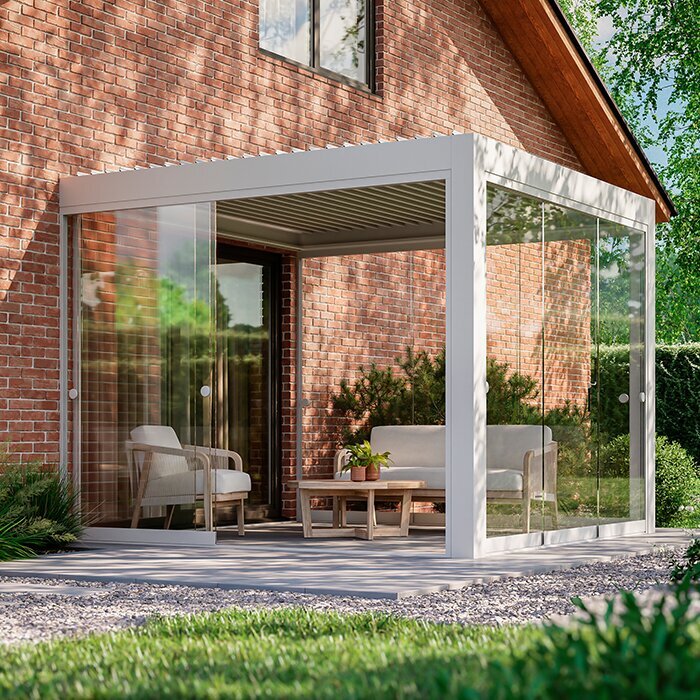
A category comparison can help you plan, but it cannot confirm what a particular retailer offers. Before treating a fixed or sliding privacy panel as an option, verify that it is approved for the exact pergola model and the side you want to screen. Ask how much of the side it covers, whether it stays fixed or moves, the path it follows and what clearances it needs. Check how corners are finished and whether the proposed panel can be combined with other side elements. Request a model-specific answer for the complete arrangement; a general reference to screens does not prove that your chosen configuration is available. A simple sketch should show both the privacy line and any opening you need.
Keep model identity and accessory information separate. The Wall-Mounted Pergola product page identifies the wall-mounted model and lists an area range from 9 to 24 m²; neither fact confirms a panel type or side configuration. The regular pergola listing also gives a range from 9 to 24 m², without establishing which screens are included or approved. In your enquiry, distinguish the base pergola, separate accessories and the complete arrangement being offered. Ask for the panel details alongside the layout so that you can see whether the quoted items match the screening and openings you have planned.
Before you choose 5
Consider operation, cleaning and long-term use
A fixed screen has no sliding movement to operate, but still needs to be accessible for ordinary cleaning and inspection. A sliding screen adds a mechanism, so ask how it moves, what routine care is required and whether any guide or track must be kept clear. Do not assume every panel uses the same hardware or maintenance method. Check that the surfaces you will clean are reachable and that furniture, planters or stored items will not block access to moving parts. The instructions for the actual accessory should guide cleaning and care; a general comparison cannot replace them. Consider whether access for routine cleaning remains possible in the screen's usual position.
Think about who will use the screen and how often. If it will be moved regularly, understand the normal opening and closing process before choosing it, including where the user stands and how they reach the operating point. If the pergola is mostly set up for one kind of use, a fixed arrangement may be practical. For an operation or care enquiry concerning the wall-mounted pergola model, identify the proposed panel as well as the base pergola: the model page does not describe a separate panel's operation or care. This helps you compare the routine involved, rather than considering adjustability alone.
Compare fixed and sliding layouts
Make one scaled or roughly proportioned sketch per side, with the house, openings, furniture and main eye-level views marked. For a fixed screen, draw its permanent footprint. For a sliding panel, draw at least the closed and open positions, including where it parks. Then check the plan against the times you use the pergola: can people reach the table, move through the necessary route and still get the view covered? A drawing exposes conflicts while there is still room to change the layout. Try the privacy check from both seated and standing positions, and include the furniture as it is used rather than only when neatly pushed aside.
Finish with a side-by-side schedule: side, view to screen, fixed or sliding, normal position, route that must stay clear and compatibility still to confirm. A mixed layout can make sense—a fixed screen on a consistently exposed edge and a sliding panel where access changes—but only if each option is approved for the exact model. Leave a side open when there is no clear privacy reason to cover it. That avoids turning one concern into several visual barriers and gives the supplier a precise description of the arrangement you want checked. If the open position is essential to access, record that as a requirement, not a preference.
Frequently asked questions
Are sliding privacy panels more private than fixed screens?
Not by themselves. An opaque panel blocks a direct view only across the area it covers. A fixed screen stays in that position, while a sliding panel can change which part of the side is screened and may leave a gap in either position. Compare the actual coverage with the sightlines from where people sit and stand.
Can I combine fixed and sliding panels around one pergola?
You can plan a mix, such as a fixed screen where the privacy need is constant and a sliding one where access changes. Whether that combination is available depends on the exact pergola model and accessories. Ask for compatibility on each side, including any corner arrangement; do not assume separate options can be combined.
How much of the side will a sliding panel open?
That depends on its travel and parked position. A layout may leave part of the side covered or allow only defined stopping positions, so sliding does not guarantee a full-width opening. Ask for a diagram of the exact panel in both positions, then compare the clear route with doors, furniture and the access you need.
Does an opaque panel make a pergola private from every direction?
No. It interrupts direct views across the area it covers, but gaps, corners and uncovered sides can leave other sightlines open. Privacy also depends on where people sit or stand. Plan around the particular views that matter, and check that adding more panels will not unnecessarily restrict access and openness.
Are fixed or sliding screens included with a Bloomcabin pergola?
The product information provided identifies pergola models and an area range, but does not establish which privacy accessories are included or compatible. Do not treat a screen in a planning sketch as part of the package. Ask about the selected model's side options and the exact items and configuration being offered.
Fixed screens suit views that need consistent screening; sliding panels are useful when a side needs to switch between privacy and a usable opening. Neither choice needs to be applied around the whole pergola by default. Match each side to a real sightline, map the access routes and parked positions, then confirm the option for the exact model. A good layout blocks unwanted views without making everyday movement harder or reducing openness unnecessarily.
