
Pergola Rain Sensors: What They Detect and Do Not Detect
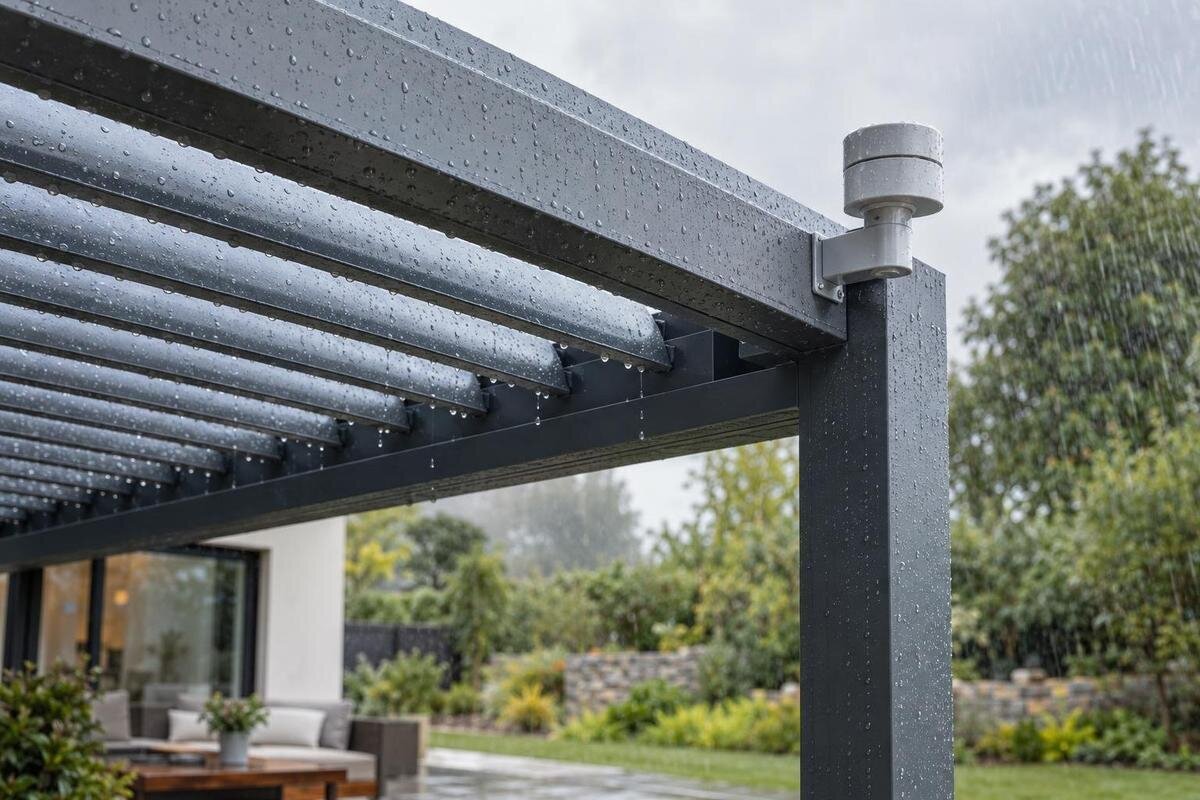
Pergola roof controls
A pergola rain sensor responds to a defined condition; the name alone does not tell you when it triggers or what the roof will do. The sensor supplies an input, while a compatible controller and roof mechanism determine whether that input becomes a movement, a stop or an alert. Its reading is local, too: it cannot describe every part of the terrace or predict the next shower. Before relying on automation, check the exact sensor, settings, programmed response and operating limits in the documents for the model being considered.

What does a pergola rain sensor detect?
A pergola rain sensor measures or reports a condition at the sensor itself. Depending on its design, that may be a wet or dry state, moisture reaching a defined threshold, or another specified input. These descriptions are not interchangeable. A simple state signal does not tell you how much rain has fallen; assume a more detailed reading only if the manual names it. The term “rain sensor” identifies a purpose, not the measurement method or the detail available to the controller. For a buying decision, look for the measured variable and the precise condition treated as rain, not just the device’s label.
Rainfall around the patio and the sensor’s reading can differ. The roof may be wet while a sheltered sensing point remains dry, or the sensor may register water before the area beneath the roof does. A reading also says nothing, by itself, about whether water is entering at a joint or where it will run off. If a roof has more than one independently moving area, do not assume that one sensor describes each area equally; the manual should explain how its input is used. Treat the signal as local evidence, not a map of the whole structure.
How does a rain trigger reach the roof controls?
With automated pergola controls, the functional chain is a sensor signal, a controller rule and a compatible roof drive. Each link must be present and configured for the next to act. A sensor can register wetness without the roof moving if it is used only for an alert, is not connected to a supported controller, or has not been configured for automatic action. Compatibility depends on the exact components, not just broad terms such as “motorised”. When considering the Bloomcabin Bioclimatic Pergola listing, distinguish the roof model from the control package being offered. The model name alone does not confirm a sensor, motor or controller. Ask the supplier to identify the components together so you can follow the signal from detection through to the intended response.
Look for the rule between reading and command. Does one wet indication count, or must it persist? Is there a threshold or confirmation interval? Can the response be delayed, and is it blocked while the roof is already moving? A connection diagram may show where a signal goes without explaining the operating settings, so find the user instructions as well. If a document says “rain input”, “weather contact” or “automatic close”, ask what each term means in that configuration. Check whether the response can be enabled, paused or overridden by the user, and whether the manual identifies the default.
What action can follow a rain signal?
The action after a trigger is accepted depends on the system. A controller might command the roof to move to a supported position, stop a movement or provide an alert; it might not move anything if automatic operation is not part of the set-up. The key question is which output is documented for the matching controller and roof. When reviewing an offer for the Bloomcabin Pergola model, ask for a description of the actual response rather than a general promise of rain protection. Confirm whether the command applies to the whole roof and whether a person can intervene. A useful explanation should distinguish what the sensor reports, what the controller commands and what the roof is expected to do.
Even a documented move to a “closed” position does not automatically mean a watertight cover. Roof design, side openings, joints and drainage all affect what the position achieves; they are separate from the sensor’s ability to detect a trigger. A sensor command cannot turn a roof into a sealed enclosure unless the system documentation specifically supports that description. Read what the rain position is intended to do and how water is managed. If furniture or electronics need to stay dry, do not treat the sensor response as a guarantee that every item beneath the pergola will be protected.
Which trigger and reset settings matter?
Three settings are easy to confuse: the threshold, which defines what counts as rain; any confirmation or response delay; and the reset condition that clears the wet state. Ask whether the threshold is fixed or adjustable and how it is expressed. A confirmation delay may be intended to filter a brief signal, while separate wet and dry thresholds may reduce repeated switching near a boundary. These are possible design choices, not standard features. When comparing a control package offered with the Bloomcabin Bioclimatic Pergola model, keep these settings separate: changing what counts as rain is not the same as changing how long the controller waits. Find out who can make adjustments and whether the instructions explain their effects. If no adjustment is available, record the fixed behaviour rather than assuming a setting can be altered later.
Drying behaviour matters after the rain stops. A sensor can return to a dry state while the controller leaves the roof in the position reached during the shower; another arrangement could require a manual command before it moves again. Check whether the system waits for the sensing element to dry, uses a delay before clearing the rain signal, reopens automatically or simply reports that rain has stopped. Clearing a rain signal and returning the roof to its previous position are different events, so ask about both. This distinction is particularly useful if you expect the roof to reopen without anyone attending to it. Establish whether the reset behaviour can be changed by the user or installer, or whether it is fixed, and note the documented default.

What weather information is outside the sensor’s scope?
Rain sensing is not forecasting. A local sensor cannot predict a shower that has not reached its sensing point, and a wet or dry signal cannot tell you whether rainfall will intensify or stop. Nor does one reading describe conditions across a whole terrace. If a system claims to estimate rainfall rate or use remote weather data, verify that as a separate capability in its documentation; do not infer it from the sensor’s name. A weather forecast and a local wetness trigger answer different questions, and one does not automatically provide the function of the other.
The sensor does not inspect the roof either. It cannot verify that drainage channels are clear, identify a leak, measure water collecting in an unobserved spot or prove that the space beneath is dry. Rain may reach the sensing point while being driven sideways into an open area; the reverse can happen if the sensor is sheltered. Treat a rain input as one signal for a programmed action, not as a report on every surface or proof that stored items will remain dry. Any claim about the roof’s performance needs to be checked against the roof documentation, not inferred from the sensor.
Does a rain sensor detect wind or snow?
A rain sensor is not a wind sensor. Wetness does not provide a wind-speed reading or indicate gusts. Nor does a rain input assess snow load or identify hail and ice as separate conditions. If a roof system has other weather inputs, each one and its operating limits need to be documented separately. An automatic response to rain therefore does not establish what the system does in strong wind, freezing conditions or other weather. Check the structure’s own operating instructions for its limits rather than substituting rain behaviour for them.
If more than one sensor feeds a controller, ask how simultaneous signals are handled: which command takes priority, whether movement can be interrupted and whether manual operation changes the response. These are questions about the control logic, not assumptions to make from the presence of a rain sensor. For an offer based on the Bloomcabin Wall-Mounted Pergola, ask the supplier to explain any combined-weather controls included in that particular configuration. The explanation should cover what happens when inputs call for different actions, not merely list the sensors. Keep that operating sequence separate from the roof’s weather limits: knowing which command takes priority does not, by itself, establish the conditions in which the roof may be used.
Why does sensor location matter?
Location shapes the signal. A sensor exposed to a shower may get wet while the roof beneath it is still mostly dry. One tucked behind an overhang or sheltered by nearby structures may stay dry while rain reaches more exposed parts. Splash or runoff could also affect a reading if the approved position is close to a surface that sheds water. These examples do not prove that a sensor is faulty; they show why the sensor’s location and the roof’s exposure are related but not identical. The important question is where the device is intended to sense conditions in relation to the roof.
Use the installation instructions to establish the approved position, exposure and access for checks or cleaning. Do not move a wired sensor or choose a site solely for convenience; follow the supplied instructions and use a qualified installer where the work requires it. If your quote lists the Bloomcabin Pergola, ask the installer to relate the proposed sensor position to that roof and its surroundings. Discuss any overhang, nearby structure or runoff mentioned in the placement instructions, rather than choosing a position simply because it is easy to reach. Keep the agreed location with the system details so that later checks refer to the installed arrangement. The aim is to understand where the reading comes from, not to assume it represents every part of the terrace.
What should the system documents confirm?
Before buying, ask for the exact roof, motor or actuator, controller and sensor model names, then request the relevant manuals and compatibility information. Check whether the sensor is part of the quoted package, a listed option or a separate component; none of those arrangements can be inferred from the pergola type. The documents should state what the sensor measures, the trigger condition, any delay, the output command and how the rain signal clears or resets. Keep the component names alongside those answers so that a description of one package is not mistaken for another. When comparing offers, an unanswered question is worth recording explicitly rather than filling the gap with an assumption. If two documents conflict, ask the supplier which configuration is being offered and which instructions apply to it.
Also establish what the user can see and do. Is there a status light or notification? Is manual control available? How is a failed reading or loss of sensor connection reported, and what test and cleaning procedure is allowed? Ask who is responsible for commissioning and who should handle faults, without trying to diagnose wiring yourself. If the Bloomcabin Bioclimatic Pergola product details are your starting point, use the quote to identify the proposed controls and the instructions that explain them. Ask the supplier to distinguish an indication that the sensor is wet from confirmation that a roof command has been completed. These answer different questions: one concerns the input, while the other concerns the resulting action.

How should a rain sensor be tested and maintained?
Testing should follow the procedure for the exact system. A sensor-only test may confirm that an input changes, but not that the controller sends the intended command or that the roof reaches its documented position. Ask whether the recommended check exercises the complete sequence and whether it can be run without unexpected movement. Do not improvise a water test around electrical parts or use a method the manual does not approve. Keep people clear of a moving mechanism and follow the system’s safety guidance during any test.
Maintenance is equally model-specific. Check whether the sensing area needs periodic cleaning, which method is permitted and whether an indicator should be checked afterwards. Do not scrape, coat or dismantle the sensor unless the instructions say to; changes could alter its readings or damage it. If the response becomes inconsistent, record the conditions, indicator and observed action, then contact the supplier or installer rather than adjusting hidden controls. For an installation identified on your quote as the Bloomcabin Wall-Mounted Pergola model, keep the separate sensor and controller details with that record. Describe whether the sensor appeared to register rain, whether a command followed and what the roof did. A clear account separates a detection concern from a movement concern without requiring you to diagnose either.
Choosing a rain-control set-up for your pergola
Choose automation around the job you want done. If the aim is to move the roof while nobody is outside, check that the specified rain input triggers a supported automatic movement, what position it selects and whether the system indicates a fault or missed movement. If you only want a prompt, verify what form the notification takes and whether someone still needs to act. In either case, decide what should happen after the sensor dries and how you will operate the pergola if the sensor is unavailable. These are functional requirements, not features to infer from a product name.
Use the exact offer and manual rather than labels such as “smart”, “weather-ready” or “automatic” to judge a set-up. When reviewing the Bloomcabin Pergola product details, compare the proposed package against the functions you actually need: the trigger, action, reset, manual alternative and weather limits. Record which answers are confirmed for the configuration being supplied and which remain open. This makes it easier to distinguish a useful automatic response from an alert that still requires someone to act. It also prevents a feature described for one control package from becoming an expectation for another. Where the response is still unclear, plan to supervise roof operation according to its instructions rather than relying on assumed automation. The choice should rest on understandable behaviour, not on how many control features appear in a description.
Frequently asked questions
Can a pergola rain sensor tell when a shower is on the way?
No. It responds to the condition at its own sensing point, according to its defined logic. Rain that has not reached the sensor cannot trigger it unless the system also uses a separate forecast or weather-data input, which would need to be documented.
Will a rain sensor automatically close the pergola roof?
Not necessarily. Automatic movement depends on a supported connection between the sensor, controller and roof mechanism, as well as the configured response. Check the manual for the exact combination to confirm whether rain triggers movement, what position is selected and how the response can be overridden.
Can it tell the difference between light and heavy rain?
Only if the specifications say that it measures rainfall intensity or rate. A wet/dry signal or threshold reading reports the defined condition, not necessarily the amount of rain. Do not infer rainfall totals from how long the system remains in its rain response.
Does a rain sensor protect against wind?
No. A rain input does not report wind speed or gusts, and it does not assess other weather limits. Check separately whether the system has documented wind sensing and what the roof’s own operating instructions say.
Can I test or clean the sensor myself?
Follow the approved test and cleaning method in the manual. Ask whether the test checks the sensor alone or the full control sequence. Avoid opening electronics or improvising a water test; for wiring, access or persistent faults, contact the installer or supplier.
Rain sensors are best understood as one input in a specific control chain. They respond to a documented condition at a particular location; the controller decides whether anything follows, and the roof’s design defines what that movement achieves. They do not provide a forecast, assess wind or prove that a terrace will stay dry. For a clear buying decision, match the sensor, controller and roof model by their documentation, then confirm the trigger, delay, response and reset in plain terms. That gives you a realistic view of what the automation can do and where you still need to make the call.
