
Frost and Frozen Pergola Louvres: When Not to Operate
Pergola weather care
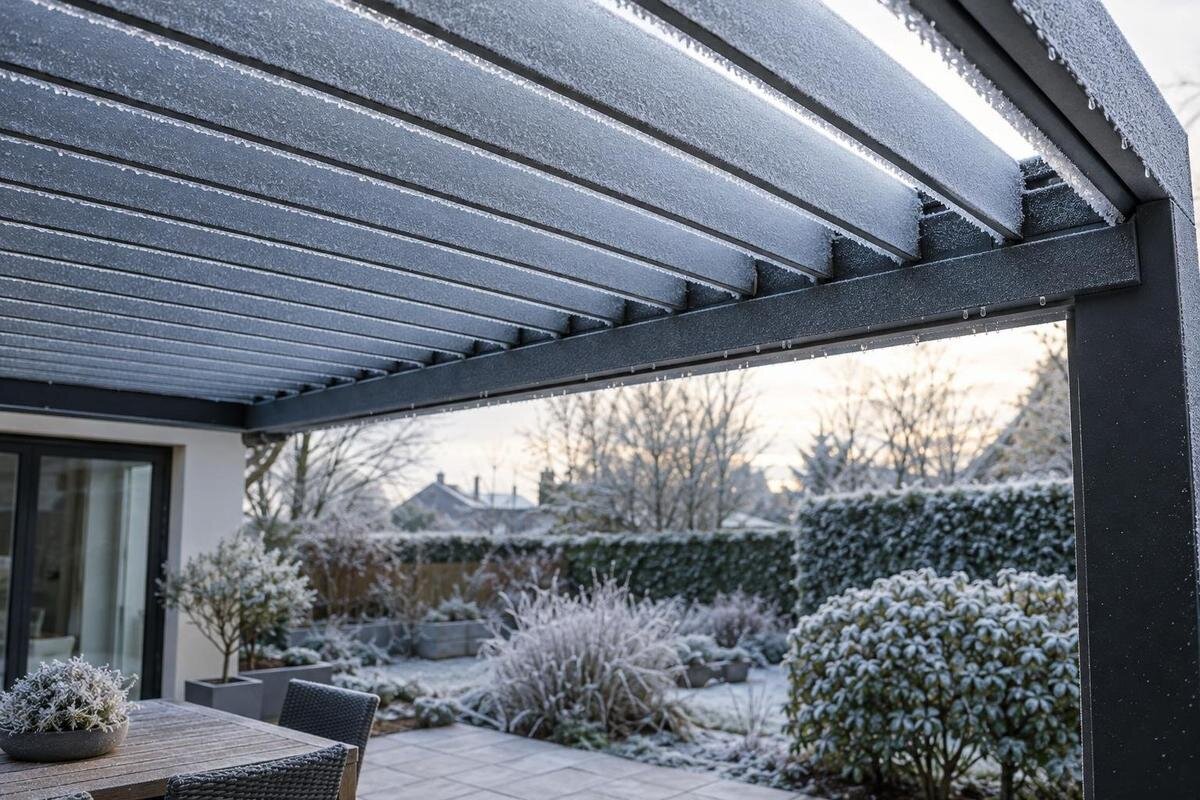
Frost does not need to cover an entire pergola roof to stop its louvres moving. A thin film at a pivot, linkage or drainage point can restrict a part even when the rest of the roof looks clear. If the louvres feel stiff, stop part-way or make an unfamiliar sound in freezing conditions, stop operating the roof. Forcing a roof that may be iced can turn a temporary blockage into damage and a service problem.

01
Why frost can stop pergola louvres
Frost can interfere with a louvred roof without making every blade visibly white. Moisture left by rain, condensation or an earlier thaw can sit in narrow clearances around moving parts. If those surfaces cool below freezing, the water may form a thin bond between components. An air-temperature reading is only a clue: it cannot show whether water remains inside a joint or whether that part has thawed. A frosty morning does not prove that every louvre is locked, either. Temperature alone cannot confirm that the roof is safe to operate, so do not treat a brief rise in daytime air temperature as a clearance test. Freeze-thaw changes can also leave fresh moisture where the mechanism had seemed clear.
Depending on the roof design, several pivots or connected parts may need to move together. Ice at one point can prevent the mechanism from moving even while other parts remain free. A control may respond without visible roof movement, or a manual system may feel resistant, but neither symptom identifies the cause. The fact that the roof moved freely yesterday is no guarantee that a wet joint is clear today. If you are identifying an installed unit listed as Bloomcabin Bioclimatic Pergola, match the exact product details and control arrangement to the correct instructions. The model name alone does not state a cold-weather limit or approved release procedure.
Where ice can form on a louvred roof
Ice can form along blade edges, between overlapping surfaces, at pivots or where connected parts meet. Those small contact points matter: a thin layer can restrict movement even when most of each louvre appears clear. The blade that looks most frosted is not necessarily where the obstruction is, and some moving parts may be partly hidden in housings. Use only a safe ground-level view; do not reach between louvres or remove covers to inspect them. A visual check can tell you to stop, but it cannot prove that hidden joints are ice-free. Do not test a gap with a tool. Use the model’s diagrams and instructions to understand what can be inspected safely.
Water management adds another possible freeze point. Where a model routes rain through channels, gutters and outlets, water retained at a low point or around an outlet may freeze after the blade faces have thawed. Leaves or dirt can also affect drainage, but poking at an icy outlet or pouring water into it is not a safe way to investigate the problem. When reviewing a product such as the Bloomcabin Wall-Mounted Pergola, ask for the drainage diagram for the precise configuration and the manufacturer’s clearing instructions. The drawing can show the intended water route; it cannot confirm that an iced mechanism is ready to move.
02
Signs that mean you should stop operating the roof
Treat any change in behaviour as a stop signal, not an invitation to make one more test movement. Warning signs include a blade that no longer lines up with its neighbours, movement that slows or stops, a new click, grind or strained sound, or, on a motorised roof, a motor you can hear without visible movement. A hand-operated roof may also feel unusually stiff. These signs can have causes other than ice, so they are not a diagnosis; in freezing conditions, however, the possibility of an obstruction is enough reason to stop. Do not keep cycling the roof to find out whether the sound repeats or the louvres will move further.
Record what happened before conditions change: the time, recent weather, roof position, which control was used, and whether there was movement or an unfamiliar sound. If you can take a photograph from a safe place on the ground, capture the visible position without climbing or touching the frame. Avoid putting your hands into blade gaps or standing beneath an area where ice may fall. If your paperwork names the Bloomcabin Pergola, use that product name when asking for the matching instructions, and include any identification-label or control details; a product name alone may not identify the installed control.
Why forcing a seized mechanism can cause damage
The moving parts are designed to work together. Pushing against a frozen blade can load components that are not iced; with a motor, repeated commands may keep asking the drive to move against resistance, while extra leverage on a manual control can strain or twist a connection. That can damage parts or disturb alignment, even if the roof shifts a little. One blade freeing does not prove that the other pivots are clear. A partial movement may instead leave the mechanism uneven. Stop as soon as you meet resistance or the roof stalls, rather than trying to make it complete a cycle.
An emergency release or hand override is not automatically a way to clear ice. Some systems may describe a manual procedure for a fault or power interruption, but that does not mean it is suitable for a frozen mechanism. Use an override only where the instructions for that exact model expressly permit it in this situation, and follow the stated steps. When comparing the bioclimatic pergola from Bloomcabin, ask where the cold-weather response, manual-release guidance and service instructions are documented. Do not assume an override is safe because it is available, or improvise a procedure that is not in the manual.

03
What to do when the louvres may be frozen
Once you suspect ice, release the normal control and stop issuing commands. Do not hold a button down, repeat the same movement or ask another person to try from a different control. Keep hands, tools and children clear of blade gaps and moving parts. If ice or meltwater could fall, keep people away from the area beneath the roof. If the louvres are part-way open, do not assume returning them to closed is safer: movement could put force through a mechanism that is still frozen. Leave the roof where it is until the instructions for that model say what to do.
Find the operating instructions for the exact model and control system, using the original documents, an accessible identification label or the supplier; do not climb the structure to read a label. Look for explicit wording on frost, ice, a stalled roof and any permitted manual release. General guidance on rain or wind does not answer those questions. If the instructions give a thaw or service procedure, follow it; if they are silent, ask the manufacturer or installer before attempting movement. When reporting a Bloomcabin wall-mounted model, include the product name, control type and symptoms, not just a photograph of a blade.
Methods to avoid when clearing ice
Do not try to melt ice with boiling or warm water, salt, household or road de-icer, solvents, a hair dryer, heat gun or flame unless the manufacturer expressly approves that method for the exact system. Liquids can run into gaps and refreeze elsewhere; chemicals or concentrated heat may affect finishes and moving parts. Added water can also make paving slippery as it drains or freezes. A quick change in one visible spot is no proof that hidden pivots or the drive are clear. If the instructions give no approved treatment, do not experiment with a household remedy or add lubricant to try to free the mechanism.
Nor should you chip, scrape, pry, strike or pull the louvres by hand. A tool can mark an edge or damage a connection, and pushing from below can put force through linked parts that are still blocked. Do not climb a ladder or stand on the frame to reach ice, and do not remove covers or fasteners for a closer look. Even a light tap is an attempt to move a mechanism without knowing where the ice is. The Bloomcabin Pergola product page identifies a named product; cleaning and clearing methods need to come from its model-specific operating or maintenance instructions. Keep clear if ice may fall.
04
When to consider operating the roof again
There is no universal waiting period or air temperature at which every pergola roof is ready to move. Sunlight can warm the exposed faces while a shaded pivot, enclosed drive area or recess still holds ice; a roof that looks dry from below may also retain moisture elsewhere. Follow any model-specific thaw and restart instruction. Do not invent a rule such as waiting a set number of hours, relying on one mild afternoon or using a forecast temperature. If you cannot tell whether ice remains, do not make a test movement to find out; keep the roof still while you seek guidance.
Restart only when the manufacturer’s stated conditions are met and the areas named in its guidance are clear. Follow the prescribed control sequence from a safe position; do not run repeated cycles to test it. If the roof moves hesitantly or unevenly, sounds different, or stops, release the control and stop again rather than trying to complete the movement. For a future purchase, ask for written frost and operating-temperature guidance for Bloomcabin’s bioclimatic model before deciding what winter operation you can rely on. A product page identifies a model; the operating limit must come from its instructions.
If the roof remains stuck after the thaw
If resistance continues after the manufacturer’s thaw procedure, do not assume that more force or more time will solve it. Ice may remain in a hidden area, or the problem may involve debris, misalignment or a fault; an unfamiliar sound or louvre position cannot distinguish these. A blade that sits crooked, a control that gives no visible movement, or any sign of damage is reason to stop using the roof and request an inspection. Do not reset repeatedly, dismantle a drive unit or adjust linked parts to see whether they move. Leave diagnosis and repair to the appropriate technician.
Give the installer or manufacturer useful facts: the exact model and any reference number, control type, roof position, weather conditions, when the issue began, what command you used and what happened. A photo of the visible position can help if taken safely from the ground; do not climb or stand under falling ice to get a closer view. If your paperwork identifies Bloomcabin Wall-Mounted Pergola, quote the product name, include the details from the identification label and ask for advice matched to the installed configuration. Stop operating until you receive instructions.

05
What to check in the model-specific instructions
Read the operating and maintenance documents for the exact pergola and control system, not a generic guide or a manual for a similar-looking roof. Look for an operating-temperature range, explicit frost or ice instructions, what to do if louvres stall, whether an emergency release is allowed in those conditions, and who should carry out service. The relevant information may be in separate documents. If a manual does not address freezing, do not interpret silence as permission to operate; ask the supplier for the current version and a written response to your question. Keep the documents accessible before a cold spell, rather than relying on memory.
Keep movement limits separate from weather-performance claims. A drainage diagram explains the route water should take; it does not set an operating limit for the mechanism. Any rain, wind or snow information for a model is not automatically permission to move its louvres in frost. If a supplier refers to a controlled observation, ask which model, configuration, louvre position and conditions were involved, and whether the result applies to your installation. If side screens or an enclosure are planned, check that the advice covers that combination. A demonstration or another model’s data does not establish a universal guarantee.
Preparing for frost without guessing at the roof position
Prepare in suitable, thawed conditions rather than trying to do maintenance once ice has formed. Follow the schedule and cleaning methods in the model’s instructions. If they call for keeping channels or outlets clear, use the prescribed method and access; leaves or dirt can affect drainage, but do not poke an icy route or remove covers without permission. Avoid adding lubricant or adjusting moving parts unless the manufacturer directs it. Note any recurring stiffness or unusual noise while conditions are mild, and report it before the next period of freezing weather instead of waiting for the roof to seize again.
Ask in advance what position, if any, the manufacturer recommends for a roof that will remain unused in freezing weather. There is no universal open-or-closed winter setting: the answer depends on the model’s instructions, and changing position after frost appears can be the wrong time to discover the procedure. Side screens or enclosure panels do not by themselves prove that the roof mechanism is protected from ice, so confirm the guidance for the complete configuration. If advice is missing, plan to leave the roof unused during suspected icing rather than relying on a guessed setting. Keep the installer’s or manufacturer’s contact details accessible to everyone responsible for the pergola.
Frequently asked questions
Can I operate the louvres if there is only a light frost?
Not automatically. A light surface frost can coexist with ice at a pivot or connection, which may not be visible. If you see ice, notice stiffness or hear an unfamiliar sound, stop operating the roof. Follow the instructions for your model rather than making a test movement because the blades look mostly clear.
Can I use a manual override to free a frozen roof?
Only if the manufacturer expressly permits that procedure for your exact model and for a frozen or obstructed roof. A hand control is not a tool for applying more force. If the instructions do not cover the situation, leave the roof still and ask the supplier or installer.
How long should I wait before trying again?
There is no universal waiting time or air temperature that applies to every pergola. Sheltered joints can thaw later than exposed surfaces. Follow the model-specific thaw and restart instructions; do not rely on a set number of hours or test the roof while ice may remain.
Can I use warm water or de-icer to clear the ice?
Not unless the manufacturer expressly approves a specific method for your model. Water can run into gaps and refreeze, while chemicals or direct heat may affect components or finishes. Do not experiment with household treatments.
What if the louvres remain stuck after the ice has gone?
Stop operating the roof and do not keep resetting, pushing or dismantling it. Ice may remain out of sight, but other faults can look similar. Record the model and control details, note what happened, and request model-specific advice or an inspection.
The safe response to ice or unusual resistance is to pause, not apply more force. Frost may be hidden in a joint or drainage route, so clear-looking blades and a responsive control do not prove the mechanism is free. Use the instructions for the exact model, and leave the roof still if they do not explain what to do. Resume operation only when the manufacturer’s stated conditions are met.
