
Replacing Pergola Seals: How to Identify the Correct Profile
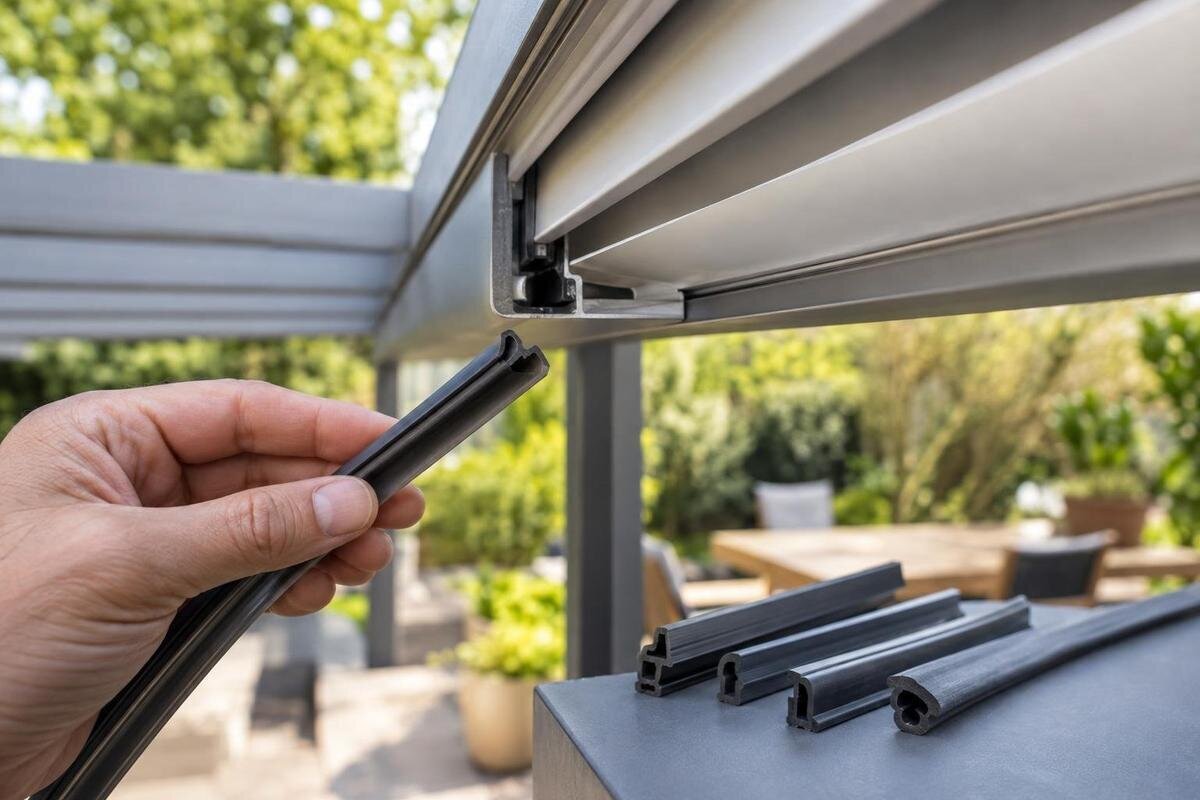
Pergola spare-parts guide
When a pergola seal looks worn, or a gap appears, the visible strip is only part of the identification problem. A replacement has to suit the channel and the joint it serves; similar colour or apparent width is not enough. Before ordering, establish the exact pergola model, record where the seal runs, and photograph its cross-section and condition. This guide explains what to collect, how to describe it to a spare-parts supplier, and when to stop rather than pull out or cut a substitute. It does not assume that one profile suits every pergola.
Why the seal’s location matters
A pergola seal is identified by the part it mates with, not simply by colour or apparent width. Depending on the design, its cross-section may include a flat face, a lip, a hollow section, ribs or a shaped retaining foot; these are examples of profile features, not confirmation of what your pergola uses. The replacement must suit the relevant channel and meet the adjoining surface in the intended way. Two strips that look similar from the side can differ at the edge that holds in the channel or at the face that closes the joint. A generic strip cut to length may still be the wrong part, even if its material and colour seem similar.
Locate the joint associated with the visible issue and describe it in plain terms: a roof edge, a frame junction, or a meeting point between fixed and moving components. Do not assume that every pergola has the same arrangement. Note the side, height and length of the run, and whether the seal is present, loose, split, flattened or missing. A drip, draught or visible gap is a clue, not proof that the seal has failed: water may appear some distance from where it entered, and a gap may have another cause. Record whether the problem is local or appears along a longer run. That distinction helps the supplier understand what needs identifying without turning a symptom into a diagnosis.
Identify the pergola model first
Before looking for a seal code, identify the pergola itself. Check the original order confirmation, invoice, installation paperwork or identification label for the manufacturer, full model name and any serial or reference number. Note the purchase or installation date and recorded options if known. Copy the wording rather than shortening it. If your paperwork names a Bloomcabin Wall-Mounted Pergola, keep that exact model reference in the enquiry. A model name can help support locate the relevant documentation, but it does not identify the profile fitted in a particular channel. Distinguish an order number from a model or serial number by retaining the label used in the original record. If the pergola was supplied with additional components, include their recorded names when they relate to the joint in question; do not combine several references into a single, abbreviated model description.
Do not infer the model from the structure’s footprint, colour or current appearance. A similar-looking pergola, or an online photograph, is not a reliable substitute for your own records. Keep the model, size and seal location as separate details: a pergola’s overall dimensions do not establish the shape of a component. If an identification label and the order paperwork differ, photograph or copy both references and ask the supplier which one to use. If you cannot find a serial number or installation date, say so rather than estimating.
Map the seal to its channel
Make a simple sketch of the pergola and mark where the seal runs. A plan view and a side view may be enough; add another view if it makes a junction easier to understand. Choose a clear reference point and state your viewpoint, such as looking from the house towards the garden where that applies. For a freestanding structure, name a fixed landmark instead. Label the sides and distinguish individual runs so that terms such as front, left or outside cannot be interpreted differently by someone looking at your photos.
Trace each suspected seal line and note which surfaces it meets. Mark corners, changes of direction and points where one run appears to meet another. If there are several similar-looking seals, give each a separate label rather than describing them all as the roof seal or frame seal. Also note whether a run is next to a fixed or moving component. If seeing it properly would require moving a mechanism, pulling a panel or opening an assembly, do not force access; use the product instructions or ask service support how it should be identified.
Inspect the old seal without pulling it out
From a safe, accessible position, look at the seal as it sits in the channel. Note whether it appears continuous or divided into sections, where its ends meet, and whether the visible damage is a split, flattening, detachment or missing piece. Photograph the joint before touching anything, so the supplier can see how the seal was fitted. If a section appears loose, record exactly where it is rather than assuming the whole run needs replacing. Avoid reaching from an unstable position or removing nearby parts just to get a better view.
If a piece has already come away, keep it intact and label its position and orientation. Do not trim the end to create a neater sample, clean it with a solvent or add adhesive; the existing shape and condition are useful evidence. Put the pergola model, such as Bloomcabin Pergola, and the sample location on separate lines on the label. Keep loose pieces from different runs separately so that their locations remain clear. If you no longer know where a piece came from, mark its location as unknown rather than assigning it to the nearest gap. Photograph both ends if their condition differs, and explain which end was already exposed. If the seal is still seated, leave it in place unless the relevant instructions or a service professional confirm how it should be removed.

Record the profile, not just its width
The most useful view of a profile is its cross-section: the shape seen from the end of an exposed or already loose piece. If you have a suitable sample, note its overall width and height, then describe features such as a lip, hollow section, rib, groove or shaped foot. Use a ruler or callipers without compressing the material, and write down the units. These details help support identify a part or drawing; they are not a specification for making a replacement yourself. Label the measurement record with the model, for example Bloomcabin Bioclimatic Pergola, and the run shown on your sketch. Add arrows to a copy of the end-view photograph to show where each dimension was taken. This makes it clear whether a figure describes the whole profile or only one visible feature, without relying on terms such as small, thick or wide.
An old seal may be flattened, stretched, brittle or otherwise distorted, so do not present a measurement from a damaged sample as exact. Mark it as approximate and describe the condition. Colour and how soft the strip feels are weak clues on their own: different profiles can look similar, while age can alter a seal’s appearance. If no cross-section is exposed, do not insert a tool or prise open the channel to obtain one. Send a clear photograph of what can be seen and ask the supplier whether a drawing, further measurement or professional inspection is needed.
Measure each run and note its orientation
Record the length of each suspected run separately from the cross-section measurements. Note the number of runs, whether each length is measured or estimated, and where it begins and ends. If the route is safe and accessible, use a consistent reference for the measurement and write it down in metres or millimetres. Do not climb or dismantle an assembly to measure a hard-to-reach section. Keep these figures with the model record, using the Wall-Mounted Pergola model listing to check the model wording where relevant. Distinguish the length of the complete run from the length of a damaged or missing section. If you can measure only the visible portion, identify its endpoints on the sketch and say that the remainder was inaccessible; do not present a partial measurement as the total required length.
Mark the direction of the sample or installed seal where you can tell it, and record any corners, joins or changes in the channel. These details can matter when a supplier checks whether one profile serves all the locations you have identified. Do not order an arbitrary length on the assumption that it can simply be cut to fit. Ask whether the confirmed replacement is supplied as a particular section or length, whether trimming is specified in the relevant instructions, and how corners or joins should be handled. Follow the confirmed method rather than improvising with a similar-looking strip.
Take photographs that show the fit
Take one wider photograph to show where the seal is on the pergola, one closer view of the joint and, if visible without moving anything, a close-up of the profile or a loose end. Make the images sharp and well lit, and include a ruler beside an exposed edge if a scale would help. Keep the scale in the same plane as the seal, without pressing on or distorting it. Photograph the seal and channel from more than one angle only where it is safe and useful; do not dismantle parts to improve the view.
Give each image a caption that identifies the run and viewpoint, such as the garden side, looking towards the house. If you use filenames, include the model wording and location rather than labels such as photo one or close-up. You can check the model wording against the product page for Bloomcabin Pergola where it matches your records. Use the same run labels in the captions, sketch and measurement notes, so the supplier can connect an overview with its close-up. Say when a close-up shows a detached sample rather than the seal in place. Include an unmarked original if you also send a version with arrows or labels. A small, organised set of clear images is more useful than many nearly identical pictures.
Check the seal reference in the documentation
Look through the paperwork supplied with the pergola for an assembly manual, technical drawing, parts list or reference to replacement components. Check that the document matches the model and any recorded options for your unit; instructions for a similar-looking pergola may not apply. If a diagram shows the area, note its page or figure number and copy any part code exactly as printed. The Bioclimatic Pergola product page can help you check the model name, but only applicable component documentation or supplier confirmation can establish a seal reference. Include the document title and any version or date shown alongside the code, so support knows which drawing you used. If several items appear near the same joint, describe which one you believe is the seal and leave that identification open for confirmation.
If the documentation does not identify the seal clearly, send the model details, location sketch, measurements and photographs to the manufacturer or spare-parts supplier. Ask them to confirm the exact profile and whether it matches the channel on your unit. If a parts diagram is ambiguous, point to the particular view rather than choosing the nearest-looking item yourself. Ask what further evidence they need if the seal is missing or too damaged to measure. A confirmed part code and location are more useful than an order based on a broad description such as black rubber strip.

Make a complete spare-parts request
Put the information in a consistent order so the supplier can distinguish the pergola from the component. Include the full model name, any serial or order reference you have, the seal’s location, the number and length of runs, and the profile features or measurements you recorded. Attach the labelled photos and mention whether you have an intact loose sample. State the problem you observed, such as a split or missing section, without presenting it as a confirmed diagnosis. Use the Wall-Mounted Pergola product page as a model-name reference only where it matches your unit. Open the enquiry with a brief description of what you need identified, then give the supporting details. Keep unknown information clearly marked rather than leaving support to interpret a blank field. If more than one seal is involved, list each run separately and identify which photographs and measurements belong to it.
Ask directly for confirmation of the profile or part reference, its compatibility with your exact model and channel, and whether the same component is used at each location you have marked. Clarify the required quantity and supplied length, and ask what installation method applies or whether a service professional is needed. If the pergola is still covered by purchase terms, check the relevant documents before disturbing the seal. If a part is not listed in your paperwork, ask what approved replacement or service route is available rather than selecting an unverified substitute.
When to involve a service professional
Leave the seal in place and seek qualified service if identifying it would require working at height, removing a panel, opening an assembly or moving a mechanism you cannot access safely. The same applies if the channel looks bent or damaged, a component is loose, or the seal appears to be part of a moving system. A split or water mark does not, by itself, show whether the seal or another part is responsible. Do not force a mechanism or attempt an adjustment simply to expose the profile; use the applicable instructions and service requirements.
For a handover, share the model and serial details, location sketch, photographs and any part code already found. Include the Bloomcabin Pergola model reference if it matches your records, while leaving the professional to confirm the identity of the installed unit and the correct component. Ask them to distinguish a failed seal from damage to the channel or adjoining parts and to explain the approved replacement method. Make clear which observations were made with the seal in place and which came from a loose sample. After the assessment, keep the confirmed component reference and the location it applies to with your pergola records. If several runs were inspected, note which require replacement and which do not, rather than treating every similar-looking strip as the same repair.
Frequently asked questions
What information identifies a pergola seal profile?
The cross-section and the channel it fits are key, along with the pergola’s exact model and the seal’s location. Record distinctive features such as a lip, rib or retaining edge. Colour and apparent width alone are not enough to confirm a match.
Can I use a universal rubber strip instead?
Do not assume a generic strip will fit because it has a similar colour or width. The profile may not retain correctly or meet the adjoining surface as intended. Ask the supplier to confirm a replacement against the existing channel and your pergola details.
Do I need to remove the seal to measure it?
No. Photograph the seal in place and measure an exposed edge if it is safely accessible. Keep any piece that has already come away. Only remove a fitted seal if the relevant instructions or a service professional confirm the appropriate method.
What if the old seal is missing or too damaged to measure?
Photograph the channel and surrounding joint without dismantling them, then provide the exact model and the seal’s location. Mark any measurements as estimates and explain that the original profile is missing or distorted. Ask support what further evidence is needed.
Can I replace only one section?
That depends on whether the confirmed replacement profile and the joint allow a partial replacement. Ask the supplier to verify the profile, joins and installation method for your unit before ordering a single section; do not assume that a cut length will work.
Getting a replacement right is largely a record-keeping task before it becomes a fitting task: identify the model, map the joint, preserve the profile evidence and request a confirmed match. When the channel or seal is inaccessible, damaged or part of a moving assembly, leave it intact and involve service support. A matching profile and documented fit provide a more reliable basis for repair than a strip selected by colour, material or approximate width.
