
LED strips or spotlights beneath a pergola?
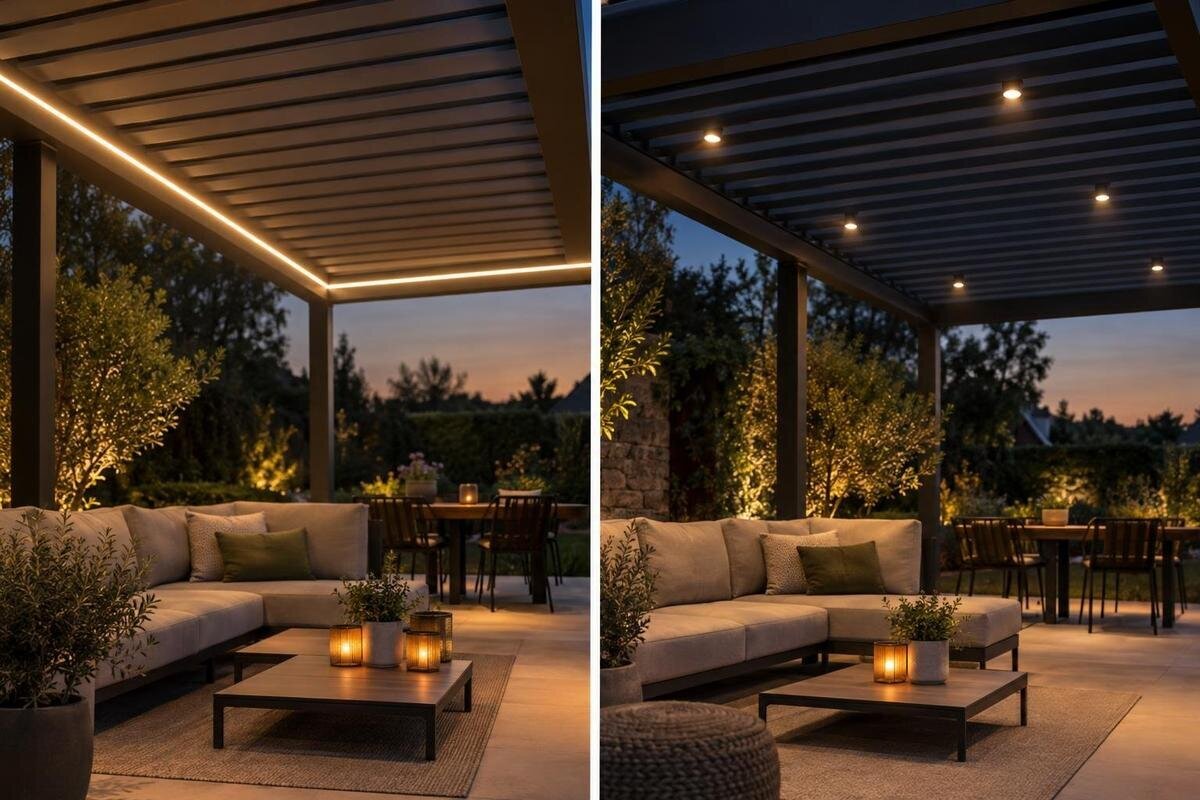
Pergola lighting
LED strips and spotlights can both provide light beneath a pergola, but they create different patterns. A strip gives a continuous line of light; spotlights produce separate beams. That affects coverage, whether a bright source is visible from a seat and what may need replacing later. Neither format is automatically more even, more comfortable or easier to maintain. Compare the exact fittings at mounting positions documented for the chosen pergola, then check their optical details, outdoor suitability and access for maintenance before treating either option as workable.
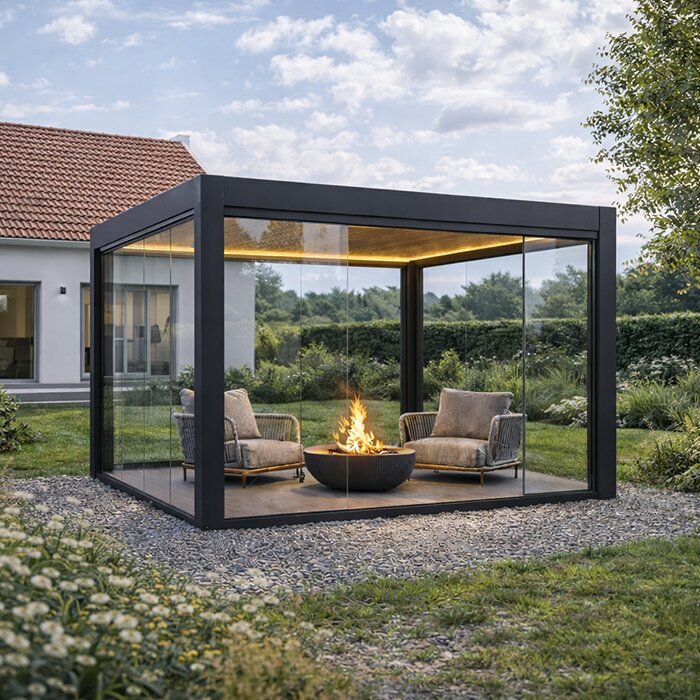
Before you choose 1
Strips and spotlights create different light patterns
A strip and a spotlight differ first in the shape of the light source. An LED strip extends along a line, so an approved continuous mounting route can create a continuous visual edge after dark. That describes the source rather than how evenly the whole pergola will be lit. A line aimed towards a wall, set behind a lip or interrupted at joins may put light in a different place from a strip facing the seating area. Its optical cover, orientation, mounting height and output all affect what reaches a table or floor. The same strip length can look different when concealed or exposed, so compare the complete assembly, not just the bare strip. The term ‘LED strip’ alone tells you little about brightness, spread or visual comfort.
Spotlights produce separate beams from distinct points. Their spacing and direction determine whether beams overlap, leave darker gaps or concentrate on selected surfaces. A neat row can still create uneven pools if the beam is narrow or the fittings are poorly matched to their spacing; a broad beam is not automatically glare-free. Counting spotlights against metres of strip is not a useful comparison. Ask what each exact fitting is designed to illuminate and review its distribution information in the proposed positions. The question is how the finished pattern will work in the pergola, not which format looks simpler in a catalogue photograph.
Confirm the pergola's approved fitting positions
Before comparing appearance, identify the exact pergola model and the positions its manufacturer documents for lighting. A photograph of a clear underside is not mounting approval. Members, joints, drainage paths, access covers and any moving parts can have specific functions; do not assume a fitting, cable or driver can be added without affecting them. Ask for a manual or drawing that marks permitted positions for the exact fixture. The plan should show not only the light itself but also the route and service access for associated equipment. If no position for the proposed fitting is documented, a flat surface alone is not enough to treat it as suitable.
The Bloomcabin Pergola listing identifies the regular pergola and gives a listed range of 9–24 m²; neither the model name nor that range establishes whether lighting is included, which mounting points are approved or what electrical preparation is available. Use the exact model and chosen configuration when requesting a drawing, so the answer refers to the structure you are considering. Ask the supplier to name the proposed fitting and position rather than simply confirming that lights can be added. A generic photograph or verbal assurance is not a substitute for documented approval.
Before you choose 2
How an LED strip spreads light
Where the manufacturer documents a continuous mounting route for a compatible linear fitting, an LED strip can create an unbroken line of light. That may suit a design that calls for a defined edge or continuous glow, but the line itself does not guarantee even illumination across the floor. A run along one side may favour nearby surfaces while the far side receives less, depending on its direction, height and optics. A diffuser or profile can change the appearance only if it forms part of the specified assembly. A strip's total length says little about spread unless its output and optical design are known. Ask for a layout showing what the line is intended to illuminate.
Clarify whether the proposed strip is one continuous run or several linked sections, how corners and joins are handled, and where the driver and service access will be. Interruptions may affect the appearance; a strip that has to be shortened, extended or enclosed must also be compatible with its own instructions. Do not assume that a generic strip fits an existing groove or can be altered to suit. When discussing the Bloomcabin Bioclimatic Pergola configuration, ask for the proposed strip route and compatible profile to be identified on the product-specific drawing. Include any cover or mounting assembly in that request, so you can judge the finished line rather than the strip alone.
What spotlight beams can cover
Spotlights send separate beams from distinct positions. They can bring light to selected surfaces when the exact fitting's beam and approved orientation support that purpose; not every model can be aimed, so do not count on adjustments that are not documented. A narrower beam tends to form a more defined pool, while a broader distribution can spread light across a wider area. The actual result also depends on distance, mounting angle and output. Ask for beam details or published distribution information for the exact product rather than guessing from the lens or housing. Name the intended target, too: a fitting aimed at a table may not light nearby seating in the same way.
The gaps between beams matter as much as each pool. Beams may overlap, while a layout with points that are too far apart can leave noticeable darker patches. A plan should show fitting positions and target areas, not just a row of symbols; this makes it easier to distinguish broad coverage from separate accents. For the Bloomcabin Wall-Mounted Pergola, ask which spotlight positions are documented and whether the proposed fittings have fixed or adjustable beams. Use those positions and aiming options in the comparison: a drawing based on a fitting that cannot be mounted or aimed as shown does not represent an available lighting option.
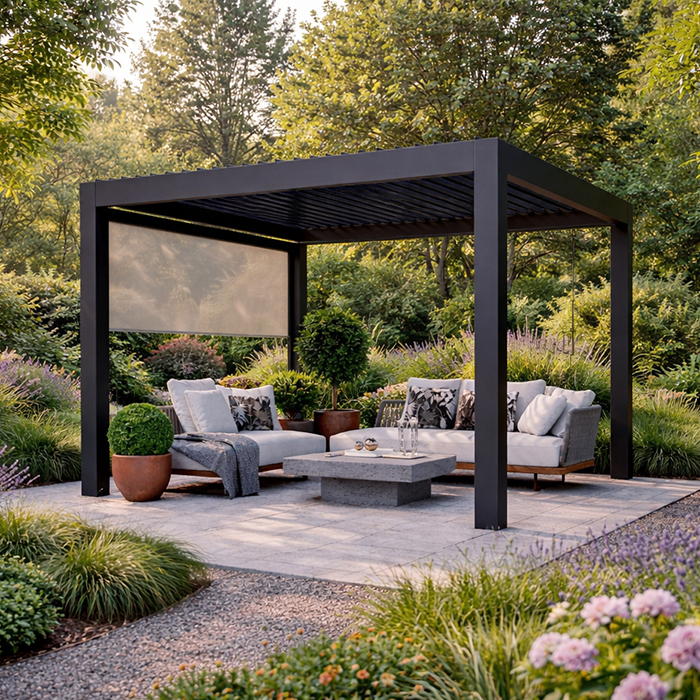
Before you choose 3
Compare coverage using the actual layout
A fair comparison starts with a simple plan of the pergola footprint, usual seating or table positions and the mounting points that are actually approved. Ask for the strip and spotlight proposals to be shown against that same plan using the exact fitting information. That makes it easier to see whether a line mainly lights an edge or reaches towards the centre, and whether separate beams overlap across the useful area. You should not have to calculate coverage yourself: a supplier or qualified lighting professional can explain the expected distribution. If a diagram shows only icons, without the fitting identity or scale, ask what assumptions sit behind it.
The Regular pergola product page gives a listed range of 9–24 m², but that figure alone cannot tell you the right strip length or spotlight count. Pergolas with the same area can have different proportions, support positions and furniture layouts. Also compare the same operating conditions: a fitting's stated output does not describe where all its light goes. Ask whether the proposed plan accounts for mounting height, direction, beam data and any diffuser. If dimming is proposed, compare the options at a compatible, clearly stated setting. This is more useful than choosing by wattage, number of spots or metres of strip.
Check glare from usual viewing positions
Glare depends partly on what people can see from the places they use, not simply on whether the source is a strip or a spotlight. If a strip is directly visible, it can read as one bright line; an exposed spotlight can appear as a bright point. Diffusion, shielding and orientation may change the impression, but only when those treatments form part of the exact fitting and its approved mounting arrangement. Neither format is automatically soft or comfortable. A product description or daylight photograph cannot settle how bright the source will seem after dark, when the surrounding space looks different.
Check the source from normal seated and standing positions in the proposed layout, rather than considering it only from below or in a product image. A realistic visualisation or sample using the exact fitting can make a visible line or point easier to judge. For a layout based on the bioclimatic pergola product page, request views that show the proposed lights from the usual seating positions, with any specified shielding in place. Keep the configuration consistent across the strip and spotlight proposals. This lets you compare the visibility of the sources, rather than differences between two unrelated illustrations; mounting approval remains a separate check.
Before you choose 4
Replacement parts and maintenance access
Choosing a format does not tell you what can be replaced. Some strip systems use separately replaceable sections; others are integrated into a profile or supplied assembly. A fault might involve the light section, driver, connector or a larger unit, depending on the design. Spotlights also vary: the light source may be a replaceable lamp or module, or part of a fitting that is changed as a whole. These are product-specific arrangements, not guaranteed advantages of either format. Ask for the maintenance instructions and parts list, including how to identify the correct replacement part later.
Ask how a technician reaches the fitting and whether access would require disturbing nearby components. When considering the wall-mounted pergola model, request the service-access details for the proposed lighting configuration from the pergola and fitting documentation. A part may be easy to source yet awkward to reach at its approved position, so compare access as well as the replacement part. Confirm which light sections, drivers or complete fittings are identified for the exact installation, and keep the fitting's product code with the paperwork. Do not infer a removable cover or service hatch from appearance alone: the replacement comparison needs to account for how the work would actually be carried out.
Verify outdoor suitability and electrical compatibility
Both options need to be assessed as complete outdoor assemblies, not just by looking at the visible light. Check the specified rating and permitted conditions for the strip or spotlight, its profile, driver, connectors, joins and control gear; different components may not have the same protection. Exposure can vary across a pergola, and a sheltered-looking position does not remove the need to follow the manufacturer's stated limits. Ask which rating applies to each part and whether the proposed position is within its documented use. A rating belongs to the exact product and conditions, so do not transfer it from a similar-looking fitting.
Use the Bloomcabin Pergola model details to identify the structure and chosen configuration when discussing the electrical requirements. Its listed size range is not an electrical design or approval for an accessory. Give a qualified electrician the pergola manual, exact fitting documentation and documented mounting positions so they can assess the supply and compatibility of each proposal. Include any separate driver, dimming equipment or remote controls in that assessment, rather than discussing only the visible lights. The comparison should cover the complete strip and spotlight systems; existing electrical preparation should not be assumed to suit either option without checking the specified components.
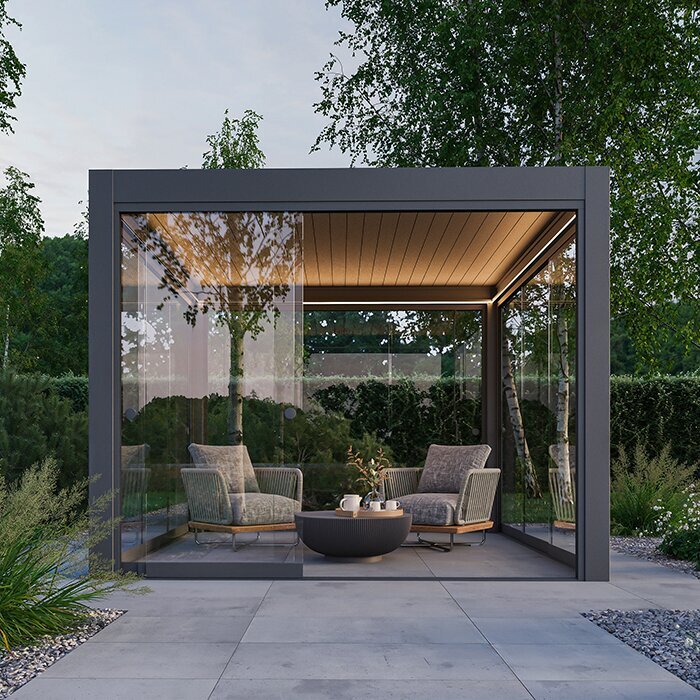
Before you choose 5
Compare the complete lighting specification
Compare the full specified setup rather than the price of strip per metre with the cost per spotlight. One quote might list visible fittings only, while another may include a profile, driver, controls, accessories, wiring or labour. Ask for each item and responsibility to be stated, along with any replacement parts or work included. The aim is not to assume one format costs less; it is to compare like with like and understand what remains outside the quote. If two options cover different scopes, an apparent saving may simply reflect components that have not been included. Check whether future replacement parts are listed separately.
Controls are part of the comparison too. Ask whether the proposed lights are compatible with the chosen switching or dimming arrangement, whether strips and spots can be controlled separately if desired, and what equipment that would require. These functions depend on the exact fitting, driver and control, not the format alone. When requesting a quote for the bioclimatic pergola model, have the supplier list the included lighting and control options explicitly. Keep product codes and the configuration answer with the quote, so a later change of fitting or driver can be checked against the specified controls rather than assumed compatible.
Choosing a strip, spotlights or a combination
A strip can be a suitable choice when a continuous line is the intended effect and the exact pergola has a documented linear fitting position, a compatible assembly and clear maintenance access. It may be a poor match if the approved run gives uneven coverage, puts the source directly in view or cannot be reached for maintenance. Spotlights can suit a layout where approved mounting points and the exact beam information show how the intended areas will be covered. They are not inherently more precise: a fixed beam may leave gaps, and an adjustable fitting is useful only where its permitted aiming range serves the intended area.
A combination is worth considering only if the pergola documentation supports both types, the plan explains what each adds and the electrical controls are compatible. Otherwise, two formats can add cost and maintenance without resolving the coverage problem. Ask for the combined option to be shown on the same plan as the strip-only and spotlight-only proposals. That comparison should make clear where the line provides useful coverage and where separate beams add something it cannot provide. If the combined layout relies on an undocumented position or assumed service feature, ask whether a documented alternative exists before treating it as an available option.
Frequently asked questions
Are LED strips always more even than spotlights?
No. A strip creates a continuous line, but that does not ensure even light across the pergola. Its direction, height, output and optics matter. Spotlights can overlap or leave gaps depending on their beam shape and approved positions. Compare the documented distribution of the exact fittings.
Can I fit a strip under any pergola beam?
No. A surface that looks suitable in a photograph is not proof that it can support a fitting. Check the pergola manual or obtain documented approval for the exact mounting position, and confirm that the proposed fitting and its associated equipment are compatible.
Are spotlights easier to replace?
Not necessarily. Some have a replaceable lamp or module; others may need the whole fitting replaced. LED strips also vary, from replaceable sections to integrated assemblies. Check the maintenance instructions, parts list and access requirements for the exact products.
Can I combine LED strips and spotlights?
A combination can be considered if the pergola documentation supports both types of fitting and the proposed layout and controls are compatible. Ask for a drawing that shows what each type is intended to illuminate. Do not assume that two formats can share the same supply or control equipment.
What should I request before choosing?
Request the pergola manual, a drawing of approved fitting positions, the exact fixture information, relevant outdoor-use ratings and a clear replacement route. Have a qualified electrician assess electrical compatibility. Ask for the strip and spotlight options to be compared against the same layout.
Choose a strip for the continuous line it can provide, or spotlights for the separate areas their beams can cover—not because either format is assumed to be more even or easier to maintain. The better option is the one that works from the pergola's approved positions, keeps bright sources out of uncomfortable sight lines and allows practical replacement access. A combination makes sense when each type has a distinct role in that same layout.
