
Can a Louvred Pergola Keep Out Heavy Rain?
Pergola rain protection
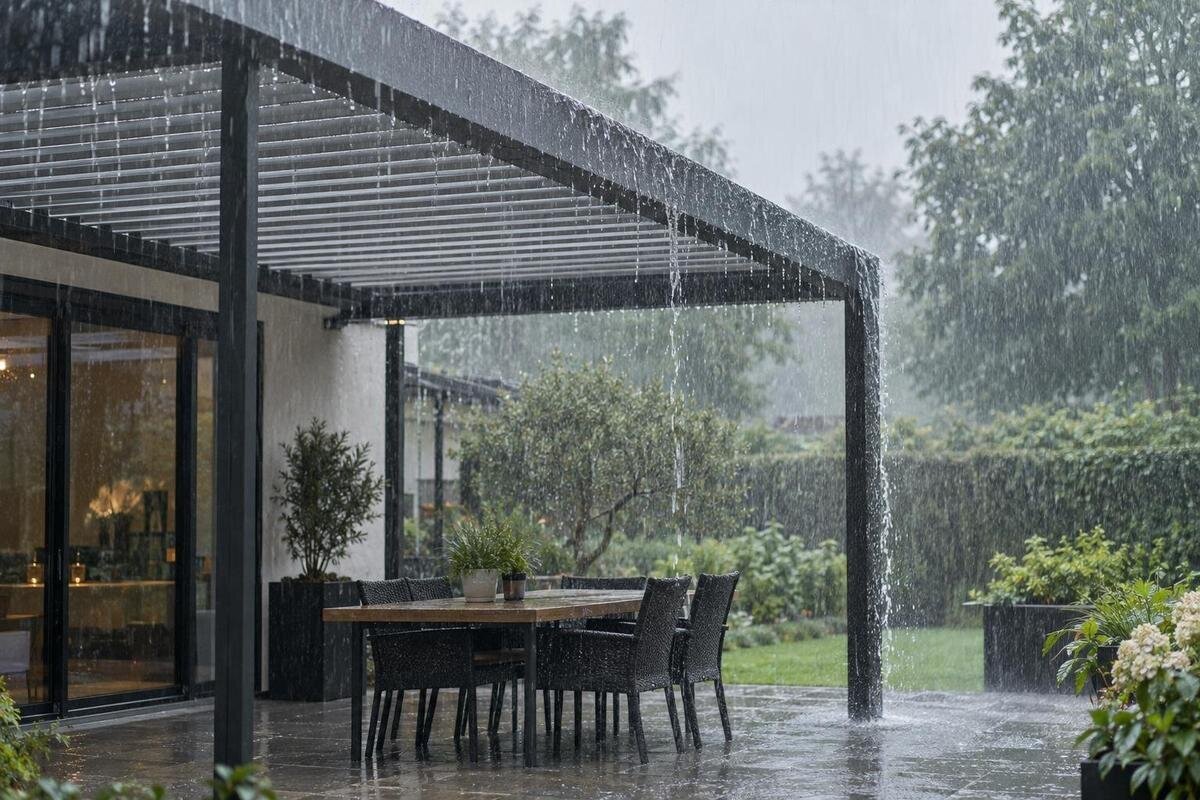
Can a louvred pergola keep out heavy rain? It may divert rainfall effectively with the roof closed, but “weatherproof” alone does not tell you what happens in a downpour. The result depends on the roof, drainage route, wind and exposed sides. Here is how to assess the evidence for the exact model and setup you are considering.

What heavy-rain protection actually covers
Heavy rain is not a single test condition. A louvred pergola may shed rainfall when its roof is fully closed, but the label alone does not show whether a particular model stays dry through prolonged rain, whether water can pass at blade joints, or how its drainage route copes. “Watertight” needs to be tied to a named model, a specified roof position, the conditions tested and the result observed. Without those details, treat a broad weather claim as an indication of intended function, not a promise for every downpour. Rain falling vertically and rain driven beneath the perimeter also present different demands; a test that addresses one should not be read as evidence for the other.
Separate roof shedding from keeping the whole area dry. A closed roof addresses rain from above; it does not automatically close the sides, seal a wall junction or prevent overflow if an outlet cannot carry water away. A sheltered table may remain usable in a shower while exposed seating gets wet in gusts; those are different outcomes. Clarify whether you expect protection for people directly beneath the roof, furniture near the edges, or items that cannot tolerate any wetting. If you need a consistently dry, enclosed space, ask about the complete roof-and-enclosure configuration and its documented limits, rather than relying on the pergola category alone.
Check what the rain test covered
Ask what the test actually covered. Useful details include the exact model and configuration, whether the louvres were fully shut, how rain was applied, how long the observation lasted, whether wind was present, which sides were open or enclosed, and what was recorded underneath. Ask whether any water appeared at blade joints, the perimeter, a wall junction or a collection channel. A statement such as “rain tested” is difficult to apply if it leaves out the setup and result. The wording of the result matters too: distinguish an observation about the roof surface from one about the entire sheltered area. If the report identifies where water appeared, keep that detail rather than reducing the result to a simple pass or fail. It helps you understand whether the observation concerns a roof joint, an exposed edge or another part of the assembly. A meaningful answer describes both the outcome and the conditions, not just the label used to describe the product.
A controlled observation may answer a narrower question than outdoor weather. A test without wind, for example, cannot tell you how much rain will be driven through an open side; a short exposure does not establish behaviour during prolonged rainfall. Ask whether the result means no visible ingress under the test conditions, no leakage at a particular point, or something else, and whether the tested system included its drainage route. A listing such as Bloomcabin Wall-Mounted Pergola identifies a product, not its rain-test result. Request evidence for the precise version and, for a wall-mounted setup, the roof-to-wall junction.
Trace the drainage route from roof to outlet
Follow water from the blades to the place where it leaves the structure. On a roof designed to manage rain, the route may involve shaped blades, a collection channel, gutters or outlets; the exact arrangement is model-specific. A useful drainage diagram should show each change of direction and discharge point, rather than only an attractive roof view. If water has to cross a joint or pass through an enclosed post, identify that part of the route and how the instructions expect it to work. Do not infer a concealed drainage system just because the roof appears seamless.
Compare the diagram with the configuration being quoted. Ask which side or outlet receives water, whether any outlet must remain clear, and where run-off goes after it leaves the pergola. This matters where the layout is close to a wall, a corner or an existing drain: the intended route needs a clear exit. Do not assume a generic sketch covers every size or side arrangement. The seller or installer should identify the drawing for the model, any accessory and the installation orientation. If the drawing does not match the proposed setup, it is difficult to apply the performance claim with confidence.
Wind-driven rain enters at exposed sides
Wind changes where rain arrives. Even when the blades form an overhead cover, wind can push drops sideways beneath the roof and into open edges; the roof does not act as a wall. Exposure can vary around a structure, so a test with closed sides is not evidence for a version with an open side, and the reverse is also true. Check which sides were protected in the documented setup, whether the roof-to-wall edge was included and what conditions the result applies to. Do not assume that a sheltered corner or nearby boundary removes wind-driven rain.
Describe your intended arrangement accurately when asking for advice: whether it is freestanding or wall-mounted, which sides will remain open, and where rain tends to approach from at your site. For an enquiry about the Bloomcabin Pergola, identify the planned seating area as well as the structure. A table near the centre and a chair beside an open edge represent different expectations of shelter, even beneath the same roof. Note any nearby wall or boundary that forms part of your proposed layout, but do not assume it provides the same protection as a tested side enclosure. This gives the supplier a clear question to answer: does the available rain information address the exposed area you intend to use, or only rainfall from above?

Drainage capacity during a downpour
A downpour sends more water to the roof over a shorter period than lighter rain. If water reaches a collection route faster than it can escape, it may rise or overflow; an obstructed outlet can also change what happens. These are general drainage risks, not a rating for any particular pergola. Ask whether the model documentation sets out the rain conditions the drainage route is intended to handle, whether the roof needs to be fully closed to drain as tested, and how the route should be kept clear. Do not infer capacity from the roof area or appearance alone: the performance document needs to match the model.
Find out what the advertised rain protection covers. Does it include the blades, collection channel and outlets, or only the roof panels? Is discharge guided to a particular location, or does the setup rely on connecting a separate drain? When enquiring about the Bloomcabin Bioclimatic Pergola, ask how those parts relate to the configuration in your quotation. Distinguish the point where water leaves the pergola from its onward route across or away from the site; these are separate parts of the drainage question. The quotation should make clear which elements are included and which need to be addressed in the site plan. That avoids comparing a complete proposed arrangement with a roof-only description. Photographs and the model name cannot settle these details.
Joints and installation can affect the result
Potential water paths include blade ends, overlaps, corner joints, the roof perimeter and any connection to a wall. This does not mean a particular model leaks; it means that drainage from the main roof surface is only part of the question. Ask for drawings or close-up details showing how the design handles those points, and whether the rain test included them. A photograph can show the visible finish, but it cannot establish how a joint behaves in prolonged rain. If the evidence refers to a specific installed arrangement, check that it matches the version and accessories you are considering.
At a wall or adjoining frame, ask which connection details apply and what assumptions the installation instructions make about the existing surface. When considering the wall-mounted pergola, include the proposed wall connection in the enquiry rather than treating it as separate from rain protection. A product-page image can help identify the arrangement you mean, but it cannot replace installation instructions or a connection drawing. Have a qualified installer assess the site and follow the product documentation; do not drill, alter or seal a junction based on guesswork. Clarify who will assess the existing surface and who will provide the connection detail for the proposed work. Also ask how the roof perimeter and moving parts are treated. These questions concern the junctions in the finished installation, not just the appearance of the main roof.
Roof position changes the level of shelter
Roof position matters. With the blades open, gaps are intentional, so rain can pass through; a partly closed position may still leave openings. If shelter depends on the closed position, ask whether the rain performance was assessed only with the louvres fully shut and whether the operating guidance says to change position before rainfall. Follow the instructions for the specific model rather than assuming the roof can be closed at any moment or in every condition. A claim about a closed roof does not cover a ventilation position, a transition or a part-open state unless the evidence says so.
Ask how to handle a shower that begins while the roof is open, whether the blades need to be fully closed for water to drain as tested, and whether the instructions set limits on operation in rain. For Bloomcabin’s regular pergola, match the operating guidance to the exact mechanism and configuration rather than assuming every pergola uses the same controls. Think about the position in which you intend to leave the roof when the space is not in use, as well as the position you prefer while sitting underneath it. These are practical operating questions, separate from the result of a test with the roof already closed. If the model does not provide overhead shelter while open, that limit should be reflected in your plans for using the space.
Side enclosures need their own evidence
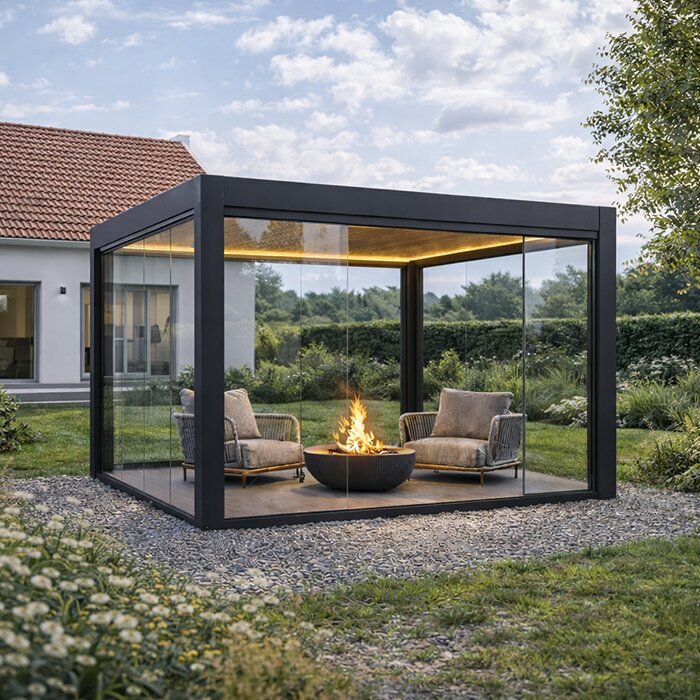
Adding screens, glazing or another side enclosure changes the assembly and its junctions; it does not automatically make a pergola watertight. A rain test with sides enclosed applies only to that arrangement if the tested configuration matches the one you intend to use. Check whether the report includes the doors or openings, the upper connection to the roof and the edges where panels meet. An enclosure may change where water is directed, so ask whether the drainage diagram and performance evidence cover the roof and sides together, not as separate pieces.
Ask which enclosure options are specified for the exact pergola model and whether rain performance has been assessed with those options in place. If you are comparing options for the bioclimatic pergola, describe which sides you want enclosed and which openings you expect to use. That description is more useful than simply asking whether glazing makes it waterproof. Separate the arrangement with doors or panels closed from the arrangement you would use for access or ventilation: evidence for one should not be taken to cover the other. Where the available information concerns only the overhead roof, it does not answer the enclosure question. If keeping everything dry is essential, assess the combination of roof, sides and connections as a whole, rather than adding together separate claims about individual components.
Comparing model-specific rain information
When comparing quotations, keep the rain information for each model alongside its proposed configuration. Record the roof position, open or enclosed sides, rain and wind conditions, observed result and drainage arrangement in the same order for each option. This makes differences easier to spot without treating every use of “weatherproof” as equivalent. Keep any stated installation assumptions or drainage maintenance requirements with the result they qualify. If one response gives detailed test conditions and another offers only a broad description, the two do not provide the same basis for comparison. An unanswered question should remain visible rather than being filled in from another model’s documents. The aim is to understand the scope of each claim, not to rank products by the strongest-sounding wording.
For the Bloomcabin wall-mounted model, keep the proposed wall connection and enclosure details with the quotation so that a later change does not leave you comparing different arrangements. If an option is added or removed, establish which parts of the original rain information still apply. Keep the supplier’s explanation alongside the relevant model details rather than relying on a general description remembered from an earlier enquiry. Where model-specific performance evidence is unavailable, record the result as unknown; that is different from a documented failure or a confirmed level of protection. This distinction helps you compare options fairly and prevents a family name, a photograph or a broad weather claim from becoming a substitute for the information you actually received.
How dry does the space need to stay?
Decide what “keep out” means for your plans. You may want overhead cover for short showers, protection for furniture near the centre, or a space that remains dry despite wind-driven rain. Those expectations are not interchangeable. Note which sides will be exposed and whether you need the roof closed for the relevant use. If some rain entering at the edges is acceptable, a documented roof-shedding result may answer your question. If even occasional wetting is a problem, ask for evidence about the complete enclosed configuration rather than judging from the roof alone.
Use the written performance limits to decide whether the arrangement suits that expectation. When considering the Bloomcabin Pergola listing, relate the available information to where people and furniture will actually be placed, rather than judging only the outline of the covered area. If the result covers a closed roof but not open edges, decide whether that narrower level of shelter is sufficient for your intended use. Do not describe the entire patio as protected when your expectation concerns only the area directly underneath. Equally, if occasional wetting would make the space unsuitable, a roof-shedding result alone does not resolve your concern. A useful buying decision states both what the chosen arrangement is expected to provide and which rain conditions or exposed areas remain outside that expectation.
Frequently asked questions
Will a louvred pergola stay dry in a downpour?
There is no reliable answer for every model or site. A closed roof may direct rain into a drainage route, but wind, open sides, joints and outlet capacity affect what happens below. Ask for evidence tied to the exact model and setup.
Should the louvres be closed when it rains?
An open or partly open roof leaves gaps through which rain can pass. If shelter depends on a closed position, check the model’s operating instructions and whether its rain performance was assessed with the louvres fully closed.
Can wind-driven rain get underneath the roof?
Yes. Wind can carry rain through exposed sides even when the roof is closed. A roof test does not establish how much protection an open-sided arrangement provides unless those conditions were included.
What documents should I ask for?
Request the model-specific rain-performance evidence, its test conditions and result, plus a drainage diagram for the configuration you are considering. Check whether the documents cover the roof position and side enclosure you intend to use.
Does “watertight” mean no water will reach the patio?
Not necessarily. The term needs a defined test and setup. A result about rain passing through the roof does not automatically cover exposed edges, open sides, wall junctions or water discharged from the drainage route.
An adjustable roof can provide useful shelter, but a heavy-rain claim is meaningful only when tied to a specified model, roof position, drainage route, enclosure and test conditions. Ask how water is collected and where it exits, and whether the evidence reflects the sides and exposure you intend to have. Then judge the pergola against the level of dryness you actually need; “louvred” is not a storm guarantee.
