
Manual or Motorised Pergola Louvres: Plan Around Your Routine
Pergola guide
Choosing manual or motorised pergola louvres is primarily a question of how often you adjust them, who operates the controls and where those controls sit. A hand-operated roof can be a sensible choice for occasional changes if the mechanism is comfortable to use. A powered drive may make frequent adjustments easier, but only if its control method and power requirements suit the site. Neither label guarantees a particular handle, remote, sensor or automatic response. Compare the exact configuration being offered with your routine, not a generic idea of what pergola louvres include.

What manual and motorised operation mean
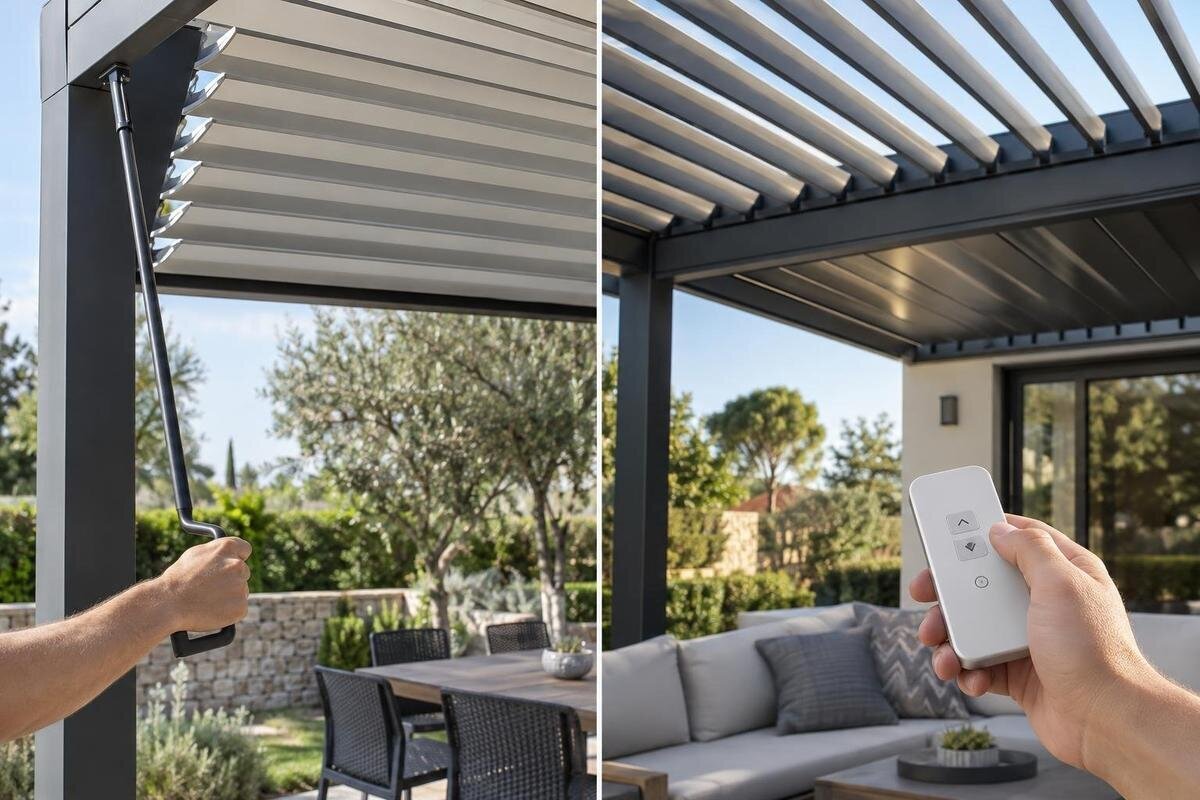
Manual operation describes how a person moves the louvres using the mechanism supplied with that configuration. Depending on the design, this may involve a crank, handle or another hand control; the effort, range of movement and number of actions can differ. The word 'manual' does not tell you whether a handle is fixed or removable, where it is stored, or how long a full adjustment takes. Motorised operation uses a powered drive, but it does not necessarily operate by itself: a person may still need to issue each command. A switch, remote or other interface is available only if the offered system includes it.
Treat roof type and control method as separate specification questions. A product described as bioclimatic does not, by itself, confirm that its louvres are motorised, sensors are fitted or a particular control is included. The Bloomcabin Bioclimatic Pergola listing identifies a named model; its name is not proof of a specific operating configuration. Ask for model-specific documentation and a written description of how the roof moves, what is supplied and which options are available. A category label or gallery image cannot answer those points.
How often will you adjust the louvres?
Count likely adjustments over a normal day or week, rather than judging by how often you use the pergola. If you expect to change the louvres in the morning, alter them again later and reset them in the evening, each movement is part of the routine. Several short visits to the terrace might involve fewer changes than one long afternoon spent moving between dining and relaxing. Include any adjustment you expect to make before leaving the space, rather than counting only changes while you are sitting beneath the roof. If the louvres usually stay in one position and move only for occasional gatherings or seasonal changes, manual operation may be sufficient. There is no universal number of adjustments at which a motor becomes worthwhile: comfort, effort, reach and the particular mechanism matter as much as the count. Note the movements you would expect over a few ordinary days before deciding.
Picture the actual task. Would you be content to leave your seat, reach the control, move the roof and check its position each time, or would a command from a more convenient spot change how often you use it? That convenience exists only if the system's interface works from the place you intend to use it; a motor does not guarantee a remote or phone app. Think about who will make adjustments when you are hosting or someone else is looking after the garden. Frequent changes may favour powered operation, but only if reach and power needs are practical too.
Check that the controls are within comfortable reach
Stand where the control would normally be used and consider the whole movement, not just the starting position. A manual handle may need space to turn, and garden furniture, a wall, planting or a narrow route can make access awkward. Confirm whether you can operate it from a normal standing position without leaning across a table or stretching to reach part of the mechanism. If a handle must be removed between uses, decide where it will be kept and whether every likely user can find it. Check access with furniture in its usual place, not only when the terrace is empty.
With a motorised system, the reach question shifts from the mechanism to the control itself. Find out whether you use a fixed switch, supplied remote or another documented interface; do not assume a wall-mounted switch or phone app is available. Ask where a fixed control can be positioned and whether you can reach it from the seating area. For a portable control, consider where it will normally be kept and whether other users will know where to find it. The Bloomcabin Wall-Mounted Pergola listing identifies a wall-mounted model, but its control position and reach need to be confirmed for the proposed setup. If you expect to operate it while seated, ask for a practical demonstration from there. Include your usual dining and lounging positions in that check: a control beside the door may be convenient when entering the terrace but less convenient once everyone is seated.
Consider everyone who will use the controls
Think about the people who will operate the louvres, not only the person who orders them. With manual control, hand strength, grip, repeated turning and the length of the movement all affect whether the mechanism feels comfortable for different users. If more than one person will use it, invite them to try the actual control at a demonstration and complete the full movement. Ask to see the normal operating action in both directions, following the instructions, rather than judging from a few easy turns. Notice whether the user needs to change their grip or stance partway through and whether that feels manageable. Distinguish between being able to operate the mechanism once and being content to use it repeatedly during an ordinary week. That is a more useful comparison than simply asking whether the handle feels light.
Motorisation can remove the need to turn a handle, but it is not automatically easier for every household. Users still need to understand the interface, reach it and see what the louvres are doing. Ask how movement is stopped or reversed, if the system allows that, and whether a button must be held while the roof moves. If children, guests or several adults will use the space, clarify who is expected to operate the system and what controls are provided. Do not assume that a powered interface will be obvious to someone who has not used it before.

Compare the exact model and included controls
Before comparing controls, pin down the exact roof and model being offered. 'Pergola', 'louvred roof', 'manual' and 'motorised' describe different aspects; one label does not establish the others. For example, the Bloomcabin Pergola page identifies a regular pergola model, but that name alone does not establish an adjustable louvred roof or a manual control. Match the model identifier in the quote to the current product documentation, and ask the seller to describe the actual roof movement. This matters when an image or broad category page shows more than one product type.
Ask for an itemised description of the chosen configuration: the louvre mechanism, motor if any, control method, and every sensor or automation feature expressly included. Check what is supplied, what is optional and what is not offered; do not infer a feature from the words 'bioclimatic' or 'motorised'. Clarify whether the quoted scope includes the electrical connection, any control unit and setup, or whether another professional must provide part of the work. When comparing two offers, mark any item included in one but listed separately in the other. Keep essential controls separate from optional conveniences so you can see what each configuration actually provides. Written confirmation gives you a fair basis for comparison and prevents an add-on being mistaken for standard equipment.
Plan for power before choosing motorised operation
Motorised louvres rely on a specified power arrangement, but the word 'motorised' does not tell you whether that means a fixed electrical supply, a plug-in unit, a low-voltage system or another setup. Do not infer the requirements from a photograph or from a different pergola model. Ask for the current instructions for the exact motor and control package, including the stated supply and any siting constraints. If the pergola is being planned alongside paving, decking or other finished work, raise cable routing early so the installer can assess the site rather than work around assumptions.
Where a supply is required, have a qualified electrician or installer confirm the appropriate arrangement using the system documentation and site conditions. Ask what the controls do during a power cut, whether a manual override exists and how a fault should be handled. Do not assume the roof can be moved by hand when power is lost. When considering the Bloomcabin Bioclimatic Pergola product page, request the electrical requirements for the exact configuration rather than relying on the model name. If no suitable supply is apparent, raise that before purchase so the proposed power arrangement can be assessed alongside the pergola's position.
When manual operation may suit your routine
Manual control may fit a routine with few adjustments, a comfortable and accessible mechanism, and no need for a powered drive to move the louvres. It leaves the user in direct control of each change and avoids dependence on a motor supply for that movement. That does not mean the whole pergola or its accessories are necessarily electricity-free, nor does it guarantee lower maintenance or fewer faults. Check what parts still need care, whether the handle needs storage and which operating limits apply. The important test is whether the actual mechanism feels manageable to the people who will use it.
Manual operation has a clear trade-off: every adjustment requires someone to reach the mechanism and do the work. Consider whether that task would usually fall to one person and whether the roof would still be adjusted when they were away. A control that everyone can use comfortably offers a different experience from one that only the keenest household member is willing to operate. If adjustable blades are not essential to your routine, a regular pergola listing is a separate product category to compare, not an assumed manual-louvre alternative; confirm its roof form and controls independently. For a hand-operated louvred option, weigh the effort of your expected adjustments against the convenience you would gain from powered operation.
What to confirm with a motorised system
Motorisation is most compelling when the roof is adjusted frequently or accessing a hand control would disrupt the way you use the space. A powered command can put the action at a more convenient point, but only if that is how the selected system is designed. Check whether you press and hold a control, choose from defined positions or use another documented method. Ask whether the system stops when the control is released and whether it indicates that the louvres have reached the intended position. These behaviours vary, so do not assume them from the presence of a motor.
Separate powered movement from automation. A motorised roof may still require a person to issue every command; rain or wind sensors, schedules, app control and automatic responses are additional functions only if the exact configuration specifies them. When considering the bioclimatic pergola model page, ask for the control instructions, available positions and stated operating limits. If you want to adjust the roof without going outside, confirm that the supplied interface supports that use. If an automatic function is offered, ask what triggers it, how it interacts with a user's command and whether its settings can be changed. Relate those answers to your routine: wanting easier adjustments while seated is a different requirement from wanting the roof to respond while nobody is there. Broad claims such as 'smart' or 'convenient' do not explain either function.

Ask how faults and servicing are handled
Support matters for both methods, although the questions differ. For manual operation, ask how to care for the mechanism as instructed and obtain a replacement handle or part if needed. For a motorised system, request operating and troubleshooting instructions and ask who should assess a motor, controller or power fault. In either case, get the permitted operating conditions in writing; do not assume the louvres should be adjusted in every weather condition. Clear instructions also help other household members use the system without relying on the person who ordered it.
Before committing, ask who provides installation and after-sales help, what the written warranty covers, how a fault is reported and whether service or parts arrangements apply to the chosen model. These answers depend on the actual product and terms; a general category page cannot promise them. If the wall-mounted model page is on your shortlist, use the exact model name when asking for operating documents and service information. Keep the model details, order reference and instructions together so another household member can find them if needed. Clarify who is the first point of contact and what information they would need about a problem. Knowing how to request help is more useful than assuming that the seller, installer and component supplier have interchangeable responsibilities.
Compare two exact configurations before deciding
Make the final comparison with two exact configurations, not with 'manual' and 'motorised' in the abstract. Write down the roof model, how it is operated, the position and type of control, the power arrangement, stated operating limits and the support documents supplied. Then assess each against the same routine: normal number of adjustments, who will use it, distance to the control and effort required. Separate requirements you would not compromise on from conveniences you would merely prefer. This helps you judge whether powered operation addresses a real difficulty or adds a feature you would seldom use. If Bloomcabin's regular pergola model is also being considered, keep its documented roof type separate from the comparison of louvred-roof controls.
Manual is a reasonable fit when changes are infrequent, everyone who needs to operate it can reach and use the mechanism, and a powered drive offers little practical benefit. Motorisation deserves consideration when frequent changes or awkward access would otherwise put you off adjusting the roof, provided the control, power route and support are suitable. If an advertised feature is central to your choice, ask for it to be confirmed for the exact model and written into the offer. A demonstration can show how the control feels; a clear specification should show what you are buying.
Frequently asked questions
Are manual pergola louvres difficult to operate?
It depends on the mechanism and the effort it takes to move it. Ask to try a complete adjustment, not just the first movement, and check that the handle and its reach suit everyone who will use it.
Does motorised mean the louvres adjust automatically?
No. Motorised describes how the louvres move; a person may still need to issue every command. Sensors, schedules or other automatic functions should be treated as separate features and confirmed for the exact model.
What happens to motorised louvres if the power fails?
That depends on the system. Ask whether a manual override is provided and what the instructions say about operating the roof during a power cut. Do not assume that the louvres can be moved by hand.
Do manual louvres need an electrical supply?
A genuinely hand-operated mechanism does not need a powered drive to move the louvres. Other parts or accessories may have separate power requirements, so check the specification for the complete configuration.
What should I confirm before choosing a control type?
Confirm the exact model, how its louvres move, the control method, any power requirements, the stated operating limits and the support documents available. Ask for these details to be confirmed for the configuration you are considering.
The more useful question is not which operating method sounds more advanced, but which one you will be comfortable using as part of an ordinary week. Consider how often the louvres will move, who needs to reach the controls, and whether power and support arrangements are practical for the site. Try the manual mechanism or request a demonstration of the motorised control, then compare the written details for the exact models. A choice based on the real routine and confirmed configuration is more reliable than assuming that manual always means simple or motorised always means automatic.
