
Pergola lighting for meals, reading and mood
Pergola lighting guide
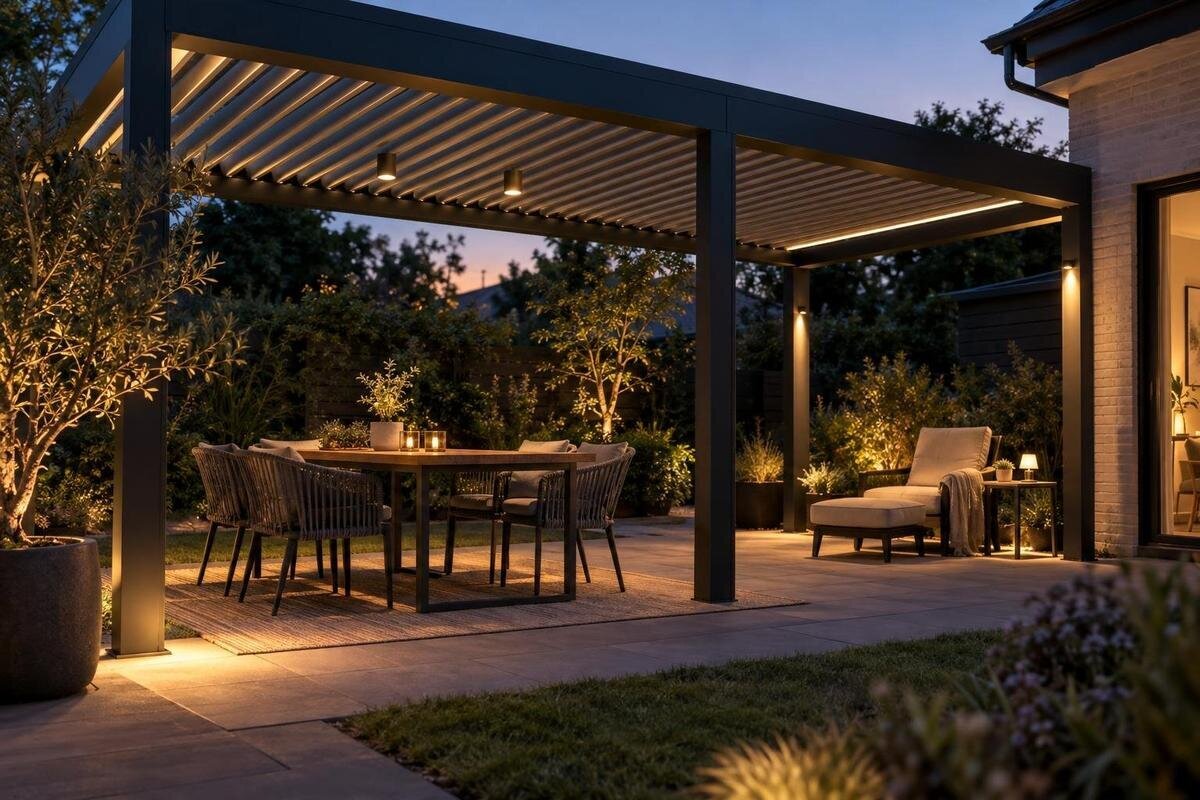
Evening lighting under a pergola works best when it follows what people do there. A table needs clear light for food, cutlery and faces; a reading seat needs a more focused pool that does not become a bright point in everyone else's view; conversation benefits from a softer background that keeps the space legible without competing with the task areas. Treat these as separate layers, then check their effect from seated positions. This guide shows how to plan for meals, reading and relaxed evenings, with practical checks to settle before the fittings and electrical work are specified.
Map the pergola around its usual activities
Before choosing fittings, list what happens under the pergola and mark where each activity takes place. Put the table, usual chairs, reading seat, doors, steps and route to the house on a simple plan. Include chairs pulled out and space to carry dishes; a plan drawn around an empty rectangle often misses the places where someone will stand, turn or pass another person. If furniture moves between dining and conversation, mark both arrangements rather than designing for a single snapshot. The aim is not yet to select a lamp or set brightness. It is to identify the surfaces and faces that need to be seen, along with the routes that should remain easy to use after dark.
Separate the plan into three kinds of need: clear lighting for meals, a focused reading position and enough background light for conversation and movement. They may overlap, but naming them separately prevents one bright source being asked to do every job. Mark which activities happen at the same time; this helps show whether zones can share light or need independent control. Add the exact pergola model and configuration being considered. If the Bloomcabin Bioclimatic Pergola is on your shortlist, include it in the drawing so the supplier can review the proposed layout against that model's permitted mounting points. Establish the activities and furniture positions before settling on individual fittings.
Plan useful light over the dining table
Dining light has a clear task: help people see food, cutlery and one another across the table. Draw the tabletop and usual seating positions, not just the centre point; include the end seats and check whether the proposed coverage reaches them. A tightly concentrated pool can leave diners at the edge in shadow, while a source in a seated person's normal view may be uncomfortable. Consider where serving dishes are placed, how hands move when food is passed and whether the table surface reflects a bright source. This gives the designer a more useful brief than simply asking for a bright table, and helps avoid judging the plan only by how striking it looks from the garden.
Check the route between the house and the table as well as the table itself. Someone carrying food should be able to move without stepping from a very bright area into a poorly lit one, and the serving route should not create distracting shadows across the meal. Keep the dining layer controllable separately from softer background lighting if the selected equipment allows it. Dimming and switching behaviour depend on compatible fittings and controls, so confirm the proposed combination rather than assuming it. For a layout using the Bloomcabin Wall-Mounted Pergola, show the supplier the table's usual position and any alternative arrangement. Ask which documented lighting positions would serve the occupied table and its approach.
Give the reading seat its own task light
Reading needs a more focused part of the plan than dining. Mark the seat, the reader's usual posture, the book or screen position and the direction of gaze. If the person uses different chairs or switches between a book and a screen, include those arrangements too. A light intended for the page should reach it without the reader's hand casting a heavy shadow; test both left- and right-handed use if the seat is shared. If two people might read at once, check whether one person's head or shoulder blocks the other's light. Avoid a source that dominates the direct view when someone looks up. The plan should describe a comfortable field of view, not just a point on the roof.
Balance the light on the page with the surrounding space. A bright reading area against an almost black pergola may feel stark, while a strong general light can remove the distinction between task and background. A lower ambient layer can keep nearby seats and routes visible while the page remains clearly lit. Decide whether the reader needs independent control and whether it can be reached from the chair. If you are considering the Bloomcabin Pergola, include the reading seat and page position in your enquiry about compatible fittings and approved mounting positions. Keep the chair's orientation on the drawing: a product photograph cannot show how light would fall on a reader in your own layout.
Use ambient light as a background layer
Ambient light is the background layer: it helps the pergola feel connected to its surroundings and lets people recognise one another and move without making the whole roof the brightest feature in the garden. Keep its role distinct from the light needed to read a page or see food clearly. The aim is a comfortable sense of space, not a decorative effect that competes with the people at the table. Look from the dining chair towards the house, from the reading seat towards the garden and from the doorway back into the pergola. If one view is washed out while another disappears, adjust the balance or position in the plan rather than adding light everywhere.
Think about where the background light reaches beyond the pergola. A bright patch on a boundary, in a neighbouring window or across a dark part of the garden can change how the space feels both inside and outside. Check the light against the actual wall, paving, glazing and planting rather than choosing its appearance from a screen. Where several sources overlap, look at them together; differences in apparent colour or brightness can make a table feel divided into separate patches. When comparing the Bioclimatic Pergola listing with your lighting plan, describe the views you want to retain from each seat. That gives the supplier a clear brief for assessing any supported ambient lighting options.

Choose lighting controls around real use
Think of the layers as separate jobs, then decide how they should work together. A dining setting might use the table light with a restrained background; reading may bring on the focused seat light while leaving the surrounding space visible; conversation may use only the softer layer. These are examples to describe to a supplier, not preset scenes or capabilities that every system provides. The practical question is whether the exact fittings and controls can create the combinations you will use. If every source comes on at once, the choice may feel limited to a bright meal or a dark, low-key evening. Decide whether the route to the house also needs its own light.
Place controls where they make sense on arrival and while seated, and consider whether guests can understand them without instructions. Clear labelling and a modest number of choices can be more useful than a complicated sequence, but the right arrangement depends on the selected equipment. Check whether dimming is supported across the specified lights and control gear; do not assume that two components described as dimmable will work together. If you are considering the model on the Wall-Mounted Pergola product page, ask which lighting and control combinations have documented support. Explain which lights you want to use together and which task lights should work independently, rather than asking only whether the system has dimming.
Check glare from seated positions
Glare is best checked from where people sit, rather than by looking up from the lawn. Mark eye positions at the dining chairs, reading seat and any lounge seats, then note whether a bright source would sit in a normal forward or upward view. Check more than one chair: someone at the end of a table can have a different view from a person beneath the same fitting. Include the view into the pergola from the kitchen or sitting room if that matters to you. This review can reveal a source that looks discreet on a plan but would be conspicuous at eye level. Note the directions people face as well as the position of their heads.
Check reflections as well as direct light. Glazed doors, pale tabletops and wet paving can return light towards the eye, while a wall or roof surface may create a bright patch beside the intended task. Where a real-light demonstration is possible, ask for it to be arranged safely using the proposed fitting; a drawing cannot reproduce brightness or reflections. A scale mock-up can still test sightlines, but it cannot prove output or outdoor suitability. If a source feels uncomfortable from a usual seat, revise its position or shielding only within arrangements approved for the fitting and pergola. Base that decision on the actual manual and qualified advice.
Account for changing daylight and roof positions
Do not judge the plan from a photograph taken at one hour. As daylight fades, the garden's brightness, the view through the pergola and the contrast between task and background change. Tree cover, nearby walls and glazing also affect the scene, so look at the actual site around the time you expect to use it. Think beyond one clear summer evening: a plan should make sense for the range of conditions in which the pergola will be used. If the table sits beside a bright doorway, the garden-facing seat may need a different balance from the indoor view. These are observations to check on site, not a universal brightness rule.
If the selected pergola has a moving or adjustable roof, ask how its permitted positions could change the way light falls, the view of a fitting and access for servicing. Do not assume a roof arrangement, fixture mount or wiring route is available unless it is documented for that configuration. Note relevant roof positions in the drawing if the roof changes during use. If the model on the Bloomcabin Pergola listing is on your shortlist, ask the supplier which of these considerations apply to its exact configuration. The supplier or qualified installer should verify any relationship between fixed lights, moving parts and the coverage you expect.
Confirm outdoor fittings and mounting with a professional
Treat electrical planning as part of the lighting brief, not as a detail to sort out after choosing a look. Give the qualified electrician the exact pergola model and configuration, annotated plan, proposed fitting details and intended control arrangement. Ask them to assess the specific manufacturer's manual, outdoor rating, permitted mounting method and the requirements for routing and access. A fitting described as suitable outdoors is not automatically approved for attachment to a particular pergola or for every exposed position. The assessment needs to match the actual fixture and structure rather than rely on a general label or an online photograph.
Ask for proposed mounting points and compatible lighting options to be confirmed in writing, and keep the final plan with the fitting and control details. If a heater is also being considered, share its exact manual and planned position at the same time so its requirements can be assessed alongside the lights; do not assume they can share a mounting point or control. When enquiring about the model on the Bloomcabin Bioclimatic Pergola page, distinguish the lighting you want from any features actually included in the selected configuration. Include servicing access in the discussion so the plan accounts for later maintenance as well as installation.

Test the layout before equipment is fixed
Before equipment is ordered, review the plan at the time of day you expect to use the pergola. Mark proposed light positions, then sit in each dining chair and the reading seat, and walk the route through the space. Have someone hold a light-coloured card at a planned position or mark that position in the drawing; this can show whether a fitting would sit in your field of view, but it tests geometry only, not brightness. Include the view from inside the house and from any seat beyond the pergola. Small adjustments on paper are easier than discovering after installation that a light is directly opposite a favourite chair.
Where a real-light trial is useful, arrange it with the actual proposed equipment through a qualified installer and follow the fitting's manual; do not improvise a temporary connection or mounting. Observe the intended activities, not just the appearance in an empty space: read a page, sit down to a meal, pass dishes and talk from the seats most often used. Notice what remains visible in peripheral view and whether reflections appear in glass or on a table. Write down revisions as changes to the plan, such as moving a task source or separating controls, rather than adding another light every time a problem appears.
Give the supplier a model-specific lighting brief
Turn the drawing into a concise brief for the pergola supplier and electrician. Name the exact pergola model and configuration, show the table and reading seat, mark routes and important sightlines, and describe the dining, reading and conversation settings you want. State whether furniture moves and how many people usually sit there; a fixed layout for four differs from one that changes for larger gatherings. Bring the proposed fitting references, manuals and compatibility information together with the plan. Make clear which requirements matter most, such as lighting the whole occupied table or allowing someone to read while others talk. This gives everyone reviewing the design the same priorities rather than leaving them to interpret a general request for pergola lighting.
Ask what is included in the selected pergola configuration and what would be specified separately; do not infer lights, controls or mounting approval from a model name or image. If you are comparing the Wall-Mounted Pergola, ask the supplier to distinguish the pergola specification from the separately agreed lighting and electrical work. Keep a copy of the final plan, fitting instructions and agreed positions so a later service or change does not start from memory. Before the order is settled, compare the proposed arrangement with the activities marked on the original drawing. The dining, reading and ambient layers should still have clear roles, even if individual fittings or positions have changed.
Frequently asked questions
What should a pergola lighting plan include?
Plan a useful dining layer, a focused reading position and softer background light for conversation and movement. Add the table, seats, doors and routes to the drawing, then check whether the chosen fittings and documented mounting positions can support each layer.
How can I light a pergola dining table without glare?
Plan light across the occupied table rather than concentrating it in the centre. Check the view from each usual seat, including where people look up, and consider shadows from diners and serving dishes. Confirm the proposed fitting and position with a qualified professional.
Where should a reading light go under a pergola?
Mark the reader's chair, page position and direction of view, then check that the page can be lit without the source sitting uncomfortably in the reader's sightline. If the seat is shared, consider both left- and right-handed use and confirm the approved position for the chosen model.
Should dining, reading and ambient lights have separate controls?
Separate control can make it easier to use a task layer without turning on every light. The workable arrangement depends on the exact fittings and control equipment, so tell the electrician which combinations matter and ask them to confirm compatibility rather than assuming dimming will work across components.
Can any outdoor light be attached to a pergola?
No. An outdoor rating alone does not confirm that a fitting suits the pergola's exposure, mounting points or configuration. Check the exact manual and documented mounting approval, and have a qualified electrician assess the proposed equipment and electrical arrangement.
A useful pergola lighting plan does not need a light on every beam. It should make food and faces easy to see at the table, provide focused light for reading and leave a softer background for conversation. Marking seats and routes, keeping the task layers distinct and checking the views from seated positions turns an attractive idea into a practical brief. Once the exact pergola, fittings and controls are known, a qualified electrician can confirm the proposed arrangement. The aim is a space that supports the way you spend your evenings, rather than one that is simply brighter.
