
Strong Winds and Pergola Louvres: Open or Closed?
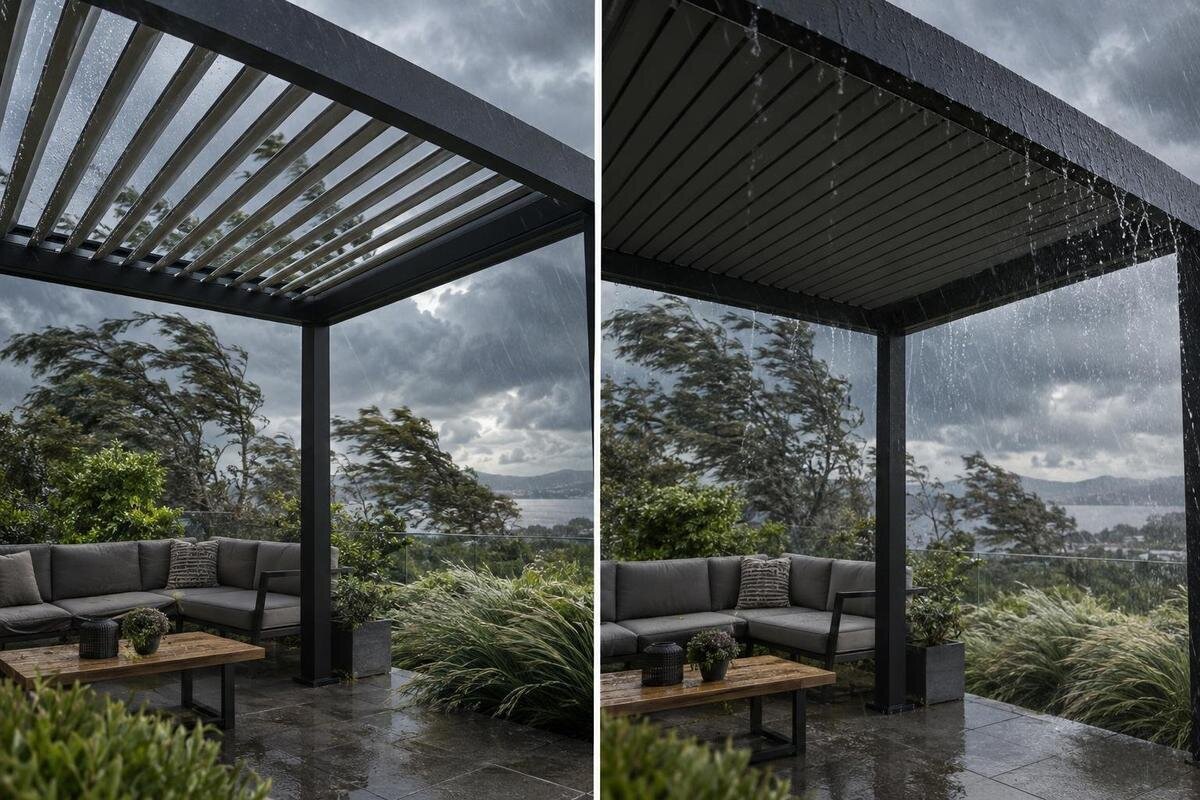
PERGOLA WEATHER GUIDE
A forecast warning can make the roof position feel like a simple choice, but open and closed are not universal wind settings. The louvre angle, frame, fixings, controls and any side panels affect how a particular pergola behaves, while its documents may distinguish a roof that is moving from one that is already parked. The safe answer must come from the operating instructions and supporting weather information for the exact model and installed configuration. This guide explains what to look for, how to read any stated limits and what to ask if the paperwork does not cover strong wind.

Document checklist 1
Why there is no universal wind setting
Louvres change the roof’s shape as they turn, changing the openings between blades and the way wind meets the roof, frame and moving parts. Even when the blades look open, the structure still has blades, supports and connecting elements in the airflow; their profile and orientation matter. A more open position does not, by itself, prove that less force reaches every part, just as a closed roof is not automatically more secure. Blade overlap, pivots, frame, fixings and wind direction vary between designs. Without those details, nobody can responsibly nominate one setting for every adjustable-roof pergola.
Two simple assumptions often lead buyers astray: that an open roof lets all wind pass through, or that a closed one forms a stronger, tidier surface. Neither is a dependable rule for a particular model. Wind can arrive in gusts and from a different direction than expected, and the permitted position may depend on how the structure was installed. The position used for rain control is not necessarily approved for strong wind. A generic tip, photograph or product category cannot substitute for the maker’s instructions. The useful question is what the exact operating guide says about the louvres under specified conditions, not which position looks less exposed.
What open and closed mean on your roof
On one roof, open may describe blades turned to leave a gap; on another, a drawing may define a particular angle, a fully rotated position or a labelled parking position. There may also be intermediate positions, so partly open is not precise enough to guide use. Find the diagram in the manual and check how its labels match the controls, including any indicator shown on the unit. If a display gives a number or preset, ask how it maps to the pictured blade position. A rain or ventilation setting should not be treated as the wind position unless the manufacturer says so.
Establish whether the instructions cover the roof while stationary, while being moved, or both. A powered roof, a hand-operated roof and an optional automatic control may have different directions; do not assume your unit has a sensor or a fail-safe setting. If an automatic feature is fitted, ask what triggers it, whether it operates the roof, and what the instructions require if power, sensor or control is unavailable. Check whether a particular position must be reached before wind arrives, rather than presuming you can move the louvres at any time. If the diagram is missing or the controls no longer match its labels, ask for the current instructions. Do not force a mechanism or experiment with angles to find a supposedly safer position.
Document checklist 2
Identify the exact pergola and configuration
Start with the identification that lets a supplier find the right paperwork: full model name, roof type, size, product variant and, if available, a serial or order reference. Record whether the frame is freestanding or attached to a building, and note any side panels or later alterations. If you still have the quotation, installation record or nameplate, compare them; the same broad product family can include different dimensions, supports or options. Check the manual’s version or date where shown, as a guide for a similar-looking roof may not match your unit. If the roof, controls or enclosure have been changed since installation, record that too.
When considering the Bloomcabin Pergola, use its exact name in your enquiry and ask for instructions matching the configuration being offered. The product page helps identify the model; it does not establish the required operating position. Compare the name on the quotation, delivery paperwork and manual, then ask which document applies if they differ. A manual for a related but different roof should not be used as a substitute. Check that any online guide you find matches the model and version. This cross-check matters before purchase as well as after installation, because the person choosing an option may not be the person who later operates the roof.
Separate operating limits from structural claims
Wind information can describe different things, and the distinction matters. An operating limit may tell you when the louvres can be moved; a limit for the roof in a fixed position may describe conditions when it is already parked. A structural design figure or test result may apply only to a stated size, louvre angle, support arrangement or test setup. These figures are not interchangeable: permission to move the roof within a stated limit does not automatically confirm what position it should occupy beyond that limit, and a stationary performance statement does not automatically authorise movement. A value without its definition or conditions is not an instruction or a blanket storm guarantee.
When asking about Bloomcabin Bioclimatic Pergola, request the technical document behind any wind figure and ask what it covers: movement, stationary use, or both; the required louvre position; and the installed configuration. Check the units and whether the value refers to gusts, an average or another stated measure. A forecast figure cannot be compared reliably with a limit that uses a different basis. If the document lists separate conditions for operating and leaving the roof in place, keep those directions distinct. Ask the supplier to explain unclear terms in writing before you operate; do not fill a gap with an assumption based on the product name.

Document checklist 3
Find the instruction for windy conditions
Search the operating instructions for an actual action, not merely a statement that the product is intended for outdoor use. Useful headings may include wind, weather, roof operation, louvre positions, controls, limits or emergency operation. A usable direction should identify the relevant position or condition and say whether to adjust before wind arrives, stop movement above a stated point, or leave the roof in a specified state. It should also say whether guidance changes with any screen, wall or other configuration. If the only wording is something broad such as close in bad weather, ask the supplier what that means for this model and when the instruction applies. Check for advice about conditions as they approach a stated limit, not just once it is reached.
For the regular Bloomcabin Pergola listing, first confirm the roof configuration being offered, then ask for the operating guide that applies to it. The word pergola alone does not establish whether a model has adjustable louvres, much less which wind position applies. Match the manual’s diagrams to positions available on the controls; if an intermediate position is permitted, check whether it is covered in wind. If the guide says not to move the roof above a stated condition, do not wait until gusts arrive and then try to reposition it. If it gives no wind-specific direction, do not convert a rain setting or general sales suggestion into one; request clarification from the manufacturer or supplier.
Read weather evidence in context
Some manufacturers or installers may provide controlled observations, test notes or other weather-performance evidence. Read the conditions alongside the outcome. Ask which exact roof, size, louvre angle, supports, fixings and side-panel arrangement were observed, and whether wind came from one direction or more than one. Find out how the wind was recorded, whether the report refers to a steady wind speed or gusts, what was monitored and for how long. Ask where wind was measured if that information is provided. A picture of a roof after an event does not answer these questions, and an outcome for one setup cannot automatically be applied to a different installation.
When considering the Bloomcabin bioclimatic pergola model, ask for evidence linked to the exact version and installed arrangement. Check whether the report records movement, damage, water entry, continued operation or simply a visual observation; these are different outcomes. A controlled observation is useful only within its recorded conditions, and it is not automatically a certificate or a promise of performance in every storm. If the supplier uses a broad weather term, ask what evidence supports it and whether that evidence includes the louvre position and configuration you plan to use. Find out whether observations were repeated or limited to one event, and keep any report with the manual.
Document checklist 4
Include side panels and enclosures
A pergola with side screens, blinds, sliding panels or glazing is not necessarily covered by guidance written for the roof alone. Added surfaces can change how wind reaches the frame and how the combined structure behaves; the permitted state may depend on whether a panel is open, closed or removed. Do not assume that opening a screen makes a roof setting safer, or that closing all sides is covered by the same limit. Each planned combination may need its own confirmation. If you intend to fit an enclosure later, ask about approved combinations before choosing it rather than treating each component as an independent accessory.
For the Bloomcabin Wall-Mounted Pergola page, use the model name when asking whether the instructions cover the attached configuration and any proposed enclosure. The supplier should identify which roof and side-panel positions are permitted together and whether the relevant installation details are covered. A drawing for a different model, or a demonstration with no sides fitted, is not enough to confirm that your planned setup is included. Do not add panels or change their position in strong wind unless the maker’s instructions say how to manage that combination. If the documents are silent, ask before fitting or using the extra elements.
Consider the installation site
Documents describe a model under stated conditions; your site adds another part to the question. An open garden, a gap between buildings, a corner or an exposed upper position can produce different wind conditions from a sheltered area, while nearby walls and planting may alter how gusts reach the roof. A wall or hedge may shelter one direction without doing so from others. These examples do not create a universal rule about a safe angle. They are details to disclose, especially if the supplier’s evidence assumes a particular exposure or wind direction. A forecast for a nearby location cannot confirm the precise conditions at the pergola.
If the Bloomcabin Pergola model is the one you are assessing, tell the supplier or installer where and how it will be mounted, what surrounds it and which enclosures are included. Ask whether the documents are relevant to that arrangement and whether a qualified professional needs to assess the installation. Do not calculate a site limit from a photograph, a general forecast or an online rule of thumb; a specialist should interpret any technical assessment. Keep the site description with your copy of the manual, so future users do not mistake general model information for site-specific advice.

Document checklist 5
What to do when the wind is already picking up
If the wind is already picking up, do not head outside, climb onto the structure or reach into moving parts to test a setting. Follow the model’s instructions only if they clearly cover the conditions and the controls can be used without putting anyone at risk. If the manual says not to operate above a limit, do not try to reposition the louvres after that limit is reached. If it gives no direction, there is no safe universal fallback to announce as open or closed; do not experiment in gusts. Wait until conditions are safe to seek model-specific advice.
If you are seeking advice about Bloomcabin’s bioclimatic pergola, provide the model or serial reference, current louvre position, installed panels and any warning or fault shown by the controls. Do not repeatedly cycle the roof, force it if it resists or bypass a control. If there is an override or alternative operating method, use it only as the manual directs. If the roof is moving abnormally, damaged or has a loose part, keep people clear and do not use it until an installer or other qualified professional has assessed it. Arrange that assessment when conditions allow; do not stand beneath the structure to inspect it during gusts.
Documents to check before choosing a setting
Before buying, or before relying on a roof setting, gather a matched document pack: current operating instructions for the exact model; a specification or installation record identifying its size and support arrangement; a wind or weather statement that separates movement from stationary use; and a diagram defining any required louvre position. Where performance evidence is offered, ask for the report and its test or observation conditions, including configuration and wind measurement. If screens, blinds or glazing are planned, include their instructions and any document showing the approved combination. Check whether the documents are current and apply to the installed version. A general product description helps with identity but does not replace these operating details.
Put the questions plainly: What position does the manual require in strong wind? At what conditions must movement stop? Does a stated figure refer to gusts or another measure, and to which installed configuration? Are controls or accessories covered? For the Wall-Mounted Pergola product listing, include the exact model name and the actual attachment details in the request. If the paperwork does not answer, ask the manufacturer or supplier to identify the right document and explain it in writing; an installer can confirm which installation details apply. Keep the reply with the instructions so everyone using the pergola has the same guidance.
Frequently asked questions
Are open louvres always safer than closed ones in strong wind?
No. The way wind meets a roof depends on its louvre design, frame, fixings and installed configuration. Use the wind instructions for the exact model; do not infer the safer position from how much of the roof looks exposed. If the manual gives no wind setting, ask the manufacturer or supplier rather than relying on a general tip.
Does a pergola’s wind rating tell me when to move the louvres?
Not necessarily. A stated figure might concern a roof that is already in position, a particular test setup or the conditions for operating the mechanism. Ask which one it describes, what louvre position is required and whether the figure refers to gusts or another measure. A number on its own is not an operating instruction.
Can I reposition the roof after the wind has picked up?
Only if the operating instructions allow movement in the conditions, and you can use the controls without putting anyone at risk. If the guide says not to operate above a stated limit, do not try to reposition the roof once that limit is reached. Avoid going outside in unsafe gusts to test another angle.
Do side panels or a wall-mounted arrangement change the advice?
They can change which configuration the instructions cover. Ask for guidance that matches the attachment, roof and every screen, blind or panel you plan to use. Do not assume that a roof-only observation or instructions for a different arrangement apply to your complete setup.
What should I do if the manual gives no wind setting?
Do not guess between open and closed or copy advice for another model. Give the manufacturer or supplier the exact model and installation details, including any side panels, and ask for the relevant operating instructions and a written explanation. If the weather is already unsafe, do not go out to experiment with the roof.
For louvres in strong wind, open and closed are not universal safety instructions. The relevant answer is the position—and whether to move the roof at all—stated in the operating guide for the exact model, installation and any permitted side panels. Read wind figures with their definitions and conditions; do not treat a product name, forecast or general tip as a substitute. If the documents do not explain what to do, avoid testing positions in gusts and ask the manufacturer, supplier or installer to identify the guidance for your pergola.
