
Squeaking Pergola Mechanism: When to Arrange Maintenance
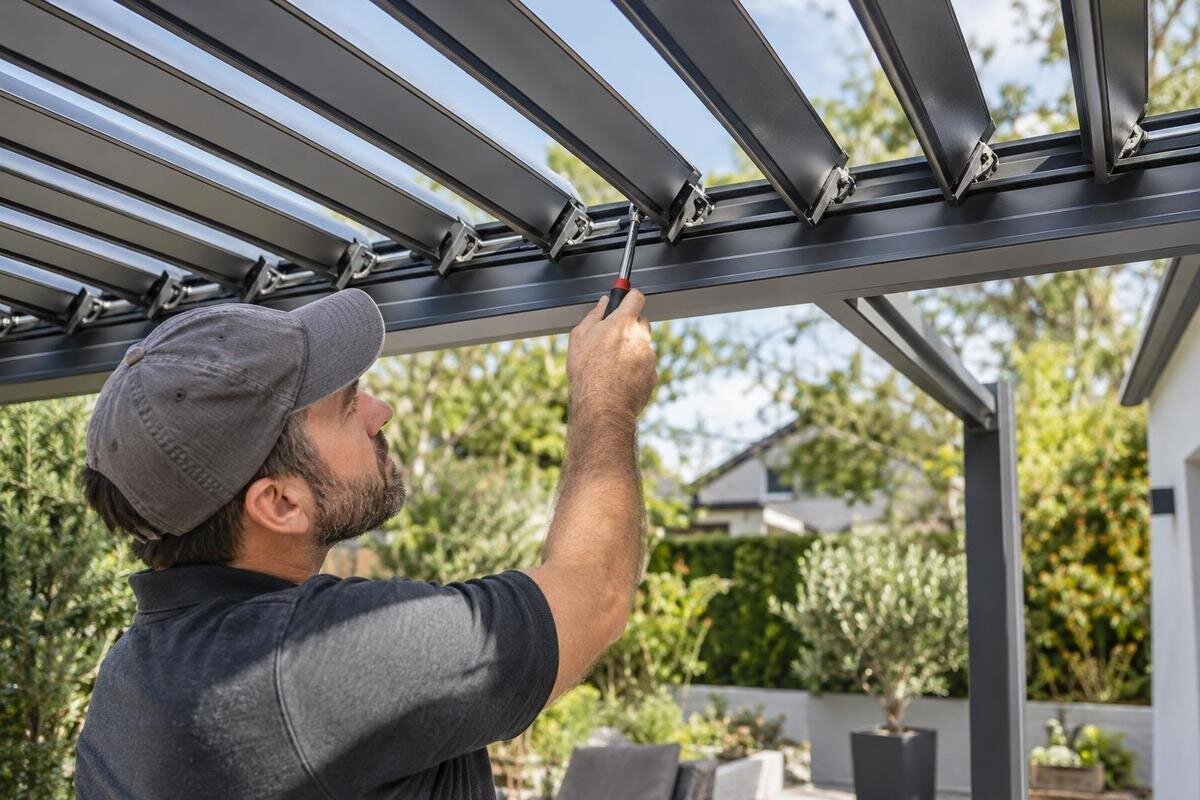
PERGOLA MAINTENANCE
A squeak from a pergola is a symptom, not a diagnosis. When it happens, how often it returns and where it seems to come from can help you decide whether maintenance is needed. A persistent or worsening noise, especially alongside resistance, uneven movement or visible damage, deserves attention. Record what you observe and follow the instructions for your exact model; do not oil, tighten or dismantle parts by guesswork.

Before arranging maintenance 1
When a squeak needs attention
A single brief squeak that does not return is not enough to identify a fault. Make a note of it, then pay attention during ordinary use rather than repeatedly opening and closing the pergola to reproduce the sound. A recurring squeak, a change from the way it sounded before, or noise that continues through more of a movement is a stronger reason to request maintenance. Frequency, duration and change over time matter; the sound alone cannot tell you whether the cause is friction, a component shifting, contact between parts or noise travelling along the frame.
Arrange an inspection promptly if the sound comes with resistance, uneven or jerky movement, a new knock or grinding noise, a part that appears displaced, or visible damage. Stop using the affected mechanism instead of trying to force it through a cycle. Keep clear of moving parts and follow the manual's normal user guidance for stopping it. When making an enquiry, separate the noise from any other warning signs: for example, explain whether movement changed at the same time or whether the squeak appeared first. Include the precise model name from your order details or manual. If you own a Bloomcabin Pergola, use that name rather than a vague description of its appearance. State whether you are asking about a noise with otherwise normal movement or reporting a mechanism that you have stopped using. That distinction makes the reason for your request clear without attempting to diagnose the fault.
Record the timing and pattern
Describe the sound in relation to an ordinary movement. Does it happen at the beginning, part-way through, near the end, or throughout? Note whether it occurs in one direction or both, and whether it is a single short squeak or a repeated series. If the mechanism is stiff, uneven or behaving differently, stop and report that rather than trying to map every stage. A clear description of what you noticed naturally is more useful than a set of results from repeated tests.
Record whether the pergola was moving or still, and note the date and any relevant conditions, such as wind, rain or a recent change in use. If the noise happens only occasionally, write down how often it has occurred and whether its duration or volume seems to be changing. Keep entries brief and consistent so that you can compare them later: date, movement or rest, apparent location, duration and any accompanying symptom. Distinguish something you observed from something you cannot recall; an unknown detail is better than a guessed one. Use the model name from your paperwork, such as Bloomcabin Bioclimatic Pergola, to label the record. You do not need to create a detailed diary of every use. The useful information is whether the same pattern returns, changes or disappears during ordinary operation, not how many times you can reproduce it.
Before arranging maintenance 2
Locate the sound without approaching moving parts
From a safe position on the ground, note the area where the sound seems loudest: one side, one end, the centre, or near a wall or another fixed surface. Treat this as an approximate location, not a diagnosis. A frame can carry sound away from its source, so an apparent squeak near one corner does not prove that the nearest joint is responsible. Avoid putting your head or hands near a moving mechanism to get a clearer sound, and do not climb onto the pergola.
A short video recorded from a safe, steady position can preserve the sound and show what was happening at the time. Keep enough of the pergola in view to make the apparent location understandable, rather than concentrating only on a close-up of one part. In the accompanying note, describe the area using a fixed reference, such as the end nearest the house, and explain where you were standing. This avoids ambiguity when someone else views the recording. If your paperwork identifies a Bloomcabin Wall-Mounted Pergola, include that exact model name with the clip. Describe a suspected source cautiously: say that the sound seems to be near the wall-side area rather than naming a faulty joint. Do not remove covers, approach moving parts or run a cycle solely for filming. If a safe recording is not possible, a written description is still useful.
Check whether the sound comes from the pergola
A noise heard while the pergola is still, or at the same time as a change in weather, does not by itself prove that an internal mechanism is squeaking. Note whether wind, rain, a nearby branch, a gate or another garden item is moving. If the sound seems to come from close by, record that as context rather than assuming you have found the cause. Sounds can travel, and a nearby object may move at the same time without being responsible.
A squeak that occurs alongside movement is more clearly associated with operation, but it still does not identify a particular component. If another person can listen from a safe position during ordinary use, their impression may help you describe the apparent location. Ask them to describe what they heard before comparing it with your own impression, rather than directing them towards a suspected part. If you disagree about the location, record both descriptions instead of selecting one as certain. A sound heard near the wall by one person and near the centre by another is worth describing as uncertain. The aim is to give the service provider a clear account of the observations, not to reach a diagnosis between you.

Before arranging maintenance 3
Visible marks, debris and displaced parts
From a safe position, look for obvious changes in the visible parts around the area where the noise seems to occur. You might note a new rubbing mark, debris caught in view, a missing or displaced-looking piece, or a part that appears out of line. These are observations to pass on, not proof of what has failed. Do not pull at anything, test whether a fastener is loose, put fingers into a gap or remove a cover to get a better view.
Take a photograph from a safe distance if it can show the visible change clearly. An overall view can establish where the area is, while a second photograph may show the mark or object more clearly if it is visible without approaching the mechanism. Label the images by location and date, and describe what you can actually see: a mark on a surface, material in a gap or a piece that looks out of line. Avoid presenting those observations as proof of wear or failure. If you have an earlier photograph of the same area, include it to explain what appears to have changed; do not claim a change if the earlier view is unclear. Confirm whether your unit is the standard Bloomcabin Pergola model using its paperwork. Follow the matching manual for any owner-level cleaning or inspection rather than assuming that the photographed area should be brushed, sprayed or adjusted.
Use only approved maintenance products and methods
Applying lubricant may seem like an obvious response to a squeak, but there is no universal product or method for pergola mechanisms. Different components may require different care, or may not be intended for owner-applied lubricant at all. Do not use household oil, grease, silicone spray or a penetrating product because it is recommended in a general online guide. The wrong treatment may be unsuitable for a particular component, seal or surface, and it can make the original symptom harder to assess.
Check the manual for the exact model and, where stated, its version or revision. Follow only the product, location, application method and interval it specifies. Read the whole relevant passage rather than taking a product name out of context: permission to use a treatment on one component is not an instruction to apply it wherever a squeak seems to occur. For a pergola from the Bloomcabin bioclimatic range, confirm the model details against your own records before choosing instructions. If the guidance is unclear or unavailable, ask the manufacturer, installer or service provider before applying anything. Explain which component or area you are asking about and whether any treatment has already been used. A useful reply should clarify both whether this is an owner-level task and which method applies. Do not substitute a similar product or adapt instructions from a different model.
Before arranging maintenance 4
When to stop operating the mechanism
Stop operating the mechanism if movement becomes stiff, jerky or uneven, if a new impact or grinding sound occurs, or if a part appears loose, displaced or damaged. Do not force it through resistance or run it several more times to see whether the noise clears. If the sound is becoming louder or more frequent while movement changes, report both symptoms together; that combination gives a service provider more context than the squeak alone.
Keep hands and other objects away from moving parts. Do not adjust fasteners, remove covers or open an electrical enclosure as a way of investigating the noise. If the mechanism does not stop through normal user controls, keep clear and follow the manual or contact qualified service rather than improvising an electrical or mechanical fix. If the pergola appears unstable or visibly damaged, keep people away from it and arrange a qualified inspection before using it again.
What to include in a maintenance request
Give the service provider the exact model name, your order reference and any identification details that are accessible without removing parts or covers. For a Bloomcabin wall-mounted model, check the full name against your order record rather than relying on its position beside the house. Add the approximate installation date if you know it and say when the squeak first appeared. Present the information in a simple sequence: what you first noticed, how often it has returned and what, if anything, has changed since. Describe whether it happens at rest or during movement, when in the movement it occurs and whether the mechanism now behaves differently. Finish by stating its current condition, including whether you have stopped using it. Keep the observed symptoms separate from your suspected cause, and mark uncertain details as unknown. This gives the recipient a readable account without requiring them to extract the timeline from several messages.
A short recording with sound can be useful if it was made safely during ordinary use. Include a brief note about where you stood, what was moving and any visible change shown in the clip. If the squeak is difficult to hear, give its approximate position in the recording rather than describing the whole clip as evidence of a fault. Send only the material that helps explain the current issue; several near-identical recordings can make the important change harder to identify. Mention previous maintenance or products used, including when and where they were applied if you know. If another person carried out the work, distinguish what their record says from what you remember. This gives the service provider a clearer history without treating an assumption as a confirmed fault.

Before arranging maintenance 5
Who should inspect or repair the mechanism?
For an inspection or repair, contact the manufacturer, installer or a service provider familiar with the exact model. If your records identify the Bloomcabin bioclimatic model, share the full model name and any available identification details so that the provider can confirm the relevant instructions. Ask what information they need and whether they recommend leaving the mechanism unused until it is inspected. Make the purpose of the enquiry clear: you are seeking an assessment of the squeak and any associated change, not requesting a particular repair based on a guess. Ask them to distinguish the proposed inspection from any work that might follow, and to explain which maintenance method or replacement parts are approved for your unit. Leave internal mechanism work, electrical diagnosis and wiring to qualified service. Do not treat a general maintenance recommendation as confirmation that a specific component needs replacing.
Have the manual and purchase or installation records to hand if available. Check the terms that apply to your product and ask whether any proposed treatment or work could affect them; do not assume that a squeak is automatically covered or excluded. After an inspection, request a clear record of what was found, what work or parts were used, and any approved follow-up care. That account helps you explain a later recurrence without relying on memory or repeating a treatment that has not been confirmed for the model.
Monitoring the noise and recording repairs
There is no universal service interval that can be set from the presence of a squeak alone. Follow the maintenance schedule in the correct manual, and request an assessment when the sound persists, returns regularly, worsens or comes with a change in movement or visible condition. A single sound that does not recur can be recorded and watched during ordinary use, provided there are no other warning signs. A squeak alone does not prove that maintenance is overdue or that a component needs replacing.
After authorised service, keep the written account of the findings, work completed, products or parts used, and any follow-up interval. Add it to your original notes so that a later enquiry can distinguish the initial symptom from a recurrence after work. Notice whether the same sound returns during ordinary use and describe whether its timing and apparent location match the earlier noise. Do not assume that every later squeak has the same cause, or repeat a treatment simply because it was used before. If a component replacement is recommended for your Bloomcabin Pergola model, ask for compatibility to be confirmed against the exact unit, not just the product name. Keep the distinction between monitoring and maintenance clear: observing a non-recurring sound does not mean carrying out a repair, while a recurring or worsening symptom is a reason to seek a fresh assessment.
Frequently asked questions
Does every squeak mean a part is worn or broken?
No. A sound by itself does not identify its cause or show how serious it is. A one-off squeak may not return, while a persistent or worsening noise, particularly alongside a change in movement or visible damage, is a reason to arrange an assessment.
Can I apply oil, grease or a spray lubricant?
Only use a product and method that the manual approves for your exact model and component. There is no universal lubricant for pergola mechanisms. Avoid household products or sprays chosen by guesswork, and ask for model-specific guidance if you cannot find the relevant instructions.
Should I keep operating the pergola to find the source?
Do not run extra cycles just to reproduce or locate the noise. Note what happens during ordinary use, provided the mechanism is moving normally. If it becomes stiff, jerky or uneven, or a part looks damaged or displaced, stop operating it and arrange an inspection.
What if the squeak happens while the pergola is still?
Record that it occurs at rest and note any nearby movement, wind or rain. These details may help distinguish a mechanism noise from another sound, but they do not prove the source. If it persists or remains unclear, include that uncertainty in your maintenance request.
What should I send with a maintenance request?
Give the exact model name and, if accessible without dismantling anything, the identification details. Add a brief timeline, when the sound occurs, where it seems to come from, any changes in movement, and a video recorded from a safe distance during ordinary use.
The useful question is not simply whether a pergola squeaks, but whether the noise recurs, worsens or accompanies a change in movement. A concise record of its timing, apparent location and any visible changes gives a service provider useful context. Arrange an inspection for persistent or worsening symptoms, especially stiffness, uneven travel or damage, rather than trying treatments by guesswork. For routine care, follow the instructions for the exact model.
