
Reducing Rain Splashback Around Pergola Seating
Pergola planning guide
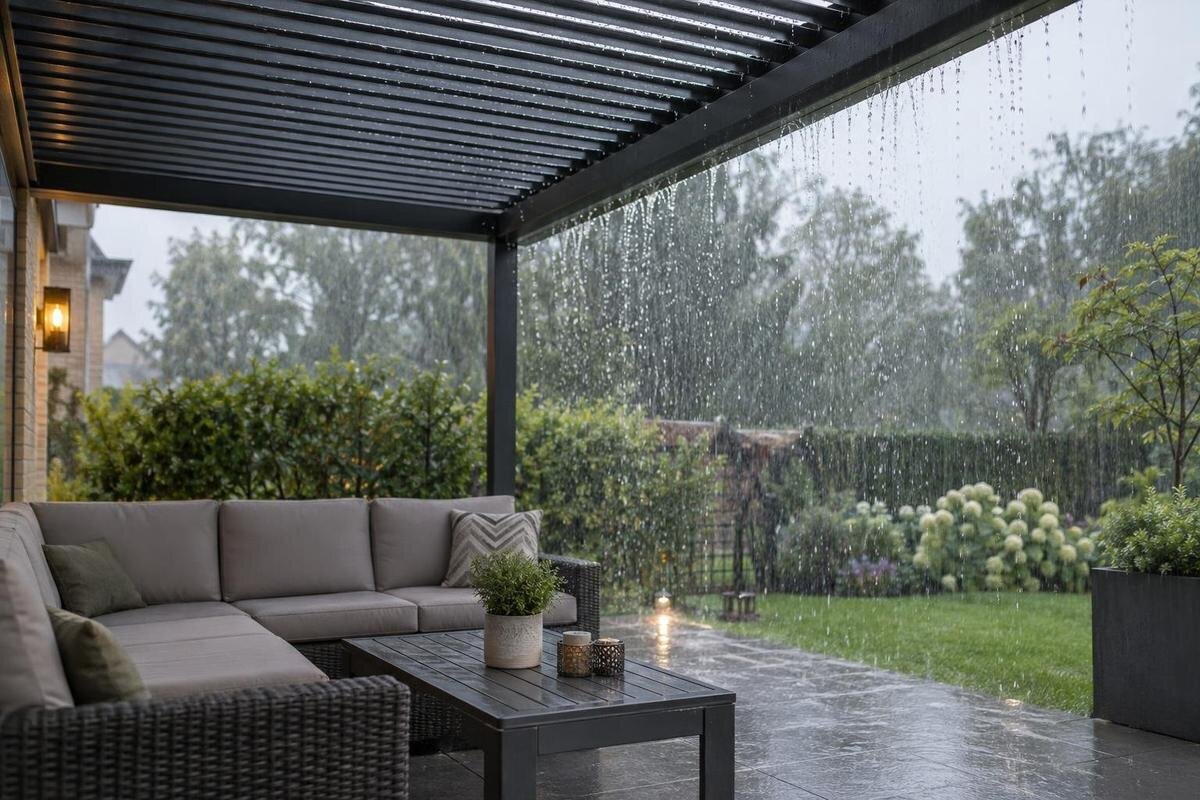
Chairs beneath a pergola can still get wet even when its roof is working as intended. Rain may hit the paving or garden edge and rebound into the seating area; surface falls, pooling, wind and furniture position all affect where droplets land. The useful fix is to trace the water at ground level, then adjust the layout or drainage route without assuming a screen or roof will keep every side dry.
Why rain reaches seats beneath a pergola
Rain landing on the paving beside a pergola can rebound into the seating area, even when the overhead cover is functioning as intended. A drop hitting a hard, wet surface can scatter upwards and sideways; the pattern changes with the surface, rainfall, wind and height of nearby furniture. A shallow puddle, paving joint or low point can alter where water collects before the next shower. Ground-level splash is not confined to the strip immediately outside the roof line, and it has no fixed radius that applies to every garden. A sheltered corner may also behave differently from an open edge, and the same area can change as the wind shifts.
Not every wet patch is splashback. Roof water may drip along an edge or fall at a discharge point, while rain blown in from the side may land directly on a seat. These sources can overlap: roof runoff that hits the paving can create a second, ground-level spray. Look for the first point that becomes wet, the direction in which droplets appear, and whether the pattern repeats along an edge or around one impact area. This distinction helps focus the remedy: moving a chair may address an exposed position, while a drainage issue needs a separate assessment. A roof's cover alone does not define a dry perimeter, so treat these clues as observations rather than proof from one shower.
Map the wet area during rainfall
Choose a safe time to observe: look from indoors or a sheltered position during rain, or examine the ground as soon as it is safe afterwards. Beforehand, make a simple plan of the roof outline, paving joints, garden edges, drains, furniture and the usual route to the seats. Mark where water first lands and where the wet area ends, rather than recording only that a chair is damp. Photos taken from the same place are useful for comparing showers. Note the wind direction, whether rain was light or driven, and whether a puddle had already formed. Do not go outside in unsafe weather just to test it.
Repeat the observation on more than one occasion if the pattern is unclear. A fixed wet line may point towards roof runoff; scattered marks beyond it can indicate wind or splash, but no single pattern proves the source. Note whether droplets reach chair legs or seats and whether water follows a route from higher ground. The Bloomcabin Pergola listing shows a 9–24 m² range; translate any proposed outline onto your site plan rather than treating covered area as a splash boundary. This comparison can help separate a layout issue from water arriving from somewhere else. A shower that misses the usual wind direction is not a complete test.
Check the paving surface and water flow
Look closely at what rain hits around the chairs. Paving type, surface finish, joints and wear affect how droplets scatter, but a material name cannot predict the result on its own. A slab may be uneven or worn; joints may hold water; a smooth area may shed it towards a lower spot. Loose gravel, mulch, lawn and exposed soil behave differently again, and saturated ground may not absorb water as expected. Check the wet surface rather than assuming that replacing one material will eliminate splash. Note whether droplets are clean or muddy, as that can help locate a bed edge or bare patch as the source. Inspect the points where rain actually lands, not only the driest-looking part of the paving.
In a shower, follow the direction of the thin surface flow, the points where it stalls and its route towards or away from the seating. A local dip can keep a patch wet after the rest has drained, so the issue may be pooling rather than a broad slope. Do not apply a standard gradient or raise one edge without understanding where the water will go. The important question is the path rain takes, not whether the surface looks level when dry. If water regularly collects beside a building, crosses a threshold or heads towards a neighbouring property, ask a qualified drainage professional to assess the site before changing levels.
Position chairs around the splash zone
Set out the actual chairs and table, then consider the space needed when someone is sitting down and when a chair is pulled back. The area beneath the tabletop is not the whole seating footprint: chair legs, cushions, a route through the pergola and access to a door can all extend towards the wet edge. If splash repeatedly reaches one side, try moving the arrangement towards the centre or to the opposite side, provided the route remains comfortable and clear. A temporary test with the furniture in its intended position is more useful than measuring from a roof post alone. Pay attention to where people rest their feet and set down drinks.
Separate occasional, wind-driven spray from the zone that gets wet in more ordinary rain. A seat that stays dry in a calm shower may still catch rain when the wind changes, so leave room to adjust furniture if the layout permits and keep absorbent cushions easy to remove. Use the Bloomcabin Pergola page when comparing the proposed covered area with the space your furniture needs. Check furniture clearance and walking space when chairs are in use, not only when they are tucked in. That gives you a more realistic picture of everyday use. Do not narrow a necessary route simply to gain distance from the wet edge.
Splash from beds, paths and soft ground
Include the garden around the paving in your inspection. Rain on exposed soil can throw up muddy droplets; a wet lawn or planting bed may send surface water onto a hard path, and that path can carry it towards a chair. Look for a higher bed, a sloping path, a bare patch or a boundary where paving collects water. Plants and loose ground cover are not automatic splash barriers: their effect depends on exposed soil, water flow and how saturated the ground becomes. The wettest point may be outside the area you first think of as the pergola seating zone. Look at the approach from each side, not just the nearest bed.
Allow space between the seating and any splash source you have observed, rather than relying on a decorative edge to stop water. Moving a chair, adjusting the seating layout or preventing a path from directing flow across the sitting area may be the simplest first response. If reworking a bed or surface, preserve a route for water to drain and avoid sending it towards a wall, doorway or another part of the garden where it will pool. When comparing the regular Bloomcabin Pergola model, draw nearby beds and paths on the same plan as the covered area. Include the wet boundaries you have observed so that the furniture layout accounts for water arriving from outside the pergola.
What side screens can and cannot do
A side screen or enclosure can reduce direct, wind-driven rain from the direction it covers, but it does not stop droplets rebounding from paving below. Spray can also pass around an open end, beneath a gap or through a partly open side; wind direction changes the result. An element that blocks one side may help in one set of conditions without making the whole seating area dry. Think of it as one part of a weather plan, not a floor-level drainage fix. Observe which direction rain reaches the seats from before deciding whether a side element addresses the problem. Rain can still arrive from above or from a separate ground-level source.
Before choosing any panel, blind or other enclosure, verify that it is offered or approved for the exact pergola and configuration. If considering the Bloomcabin Bioclimatic Pergola, ask the supplier which side options, if any, are compatible with the intended arrangement and what operating limits apply. Avoid treating a loose, improvised barrier as equivalent to a designed side system: it may change the wind and water path rather than remove it. Consider where spray could pass around the proposed screen and whether its lower edge would be beside the paving where splash begins. These details help you decide whether it addresses the observed source.
Follow water routes around the pergola
Trace how water reaches the ground around the structure, not just how it appears on the seat. Note the points where roof runoff lands, any outlet discharges, and whether a route from an adjacent surface crosses the seating area. Then follow the water onwards: it may spread, collect in a hollow or travel along a paving joint. The focus here is the effect at ground level, not a description of roof-drainage design; nevertheless, an outlet that deposits water beside a chair can increase both wetness and splash. Draw arrows on your site sketch so each source and route is visible. Do not assume that the nearest puddle is where the water originates.
Check existing drains and channels for visible blockages, and maintain them according to their instructions; clearing a blocked route is different from changing where it discharges. If a drain appears overwhelmed, water backs up, or flow enters the seating area from a wider part of the garden, do not simply divert it into a new low spot. Ask a qualified professional to assess the surface-water route and any proposed change. Refer to the Bioclimatic Pergola product page when requesting the drainage drawing for that model. Compare the discharge positions shown with your site sketch, noting where water would meet the paving and whether its onward route crosses the seating area.
Check walls, doorways and nearby surfaces
Where a pergola sits near a house wall, door or higher paved area, include those boundaries in the splash map. Rainwater can run from nearby ground to the seating, drip from an adjacent edge or bounce off paving beside a threshold. A sheltered wall can make one direction feel protected while leaving the floor wet; it does not prove that the surrounding junction is dry. Look for water marks, puddles and the direction of flow on each side of the seating, especially where paving meets a wall or door sill. Do not seal, cover or alter a threshold as a casual splash remedy. If water is entering the building, treat that as a separate issue for assessment.
If considering the Bloomcabin Wall-Mounted Pergola, mark nearby eaves, downpipes, door openings and changes in level on the proposed layout. Check whether water from these sources lands within or beside the seating zone. Include the space needed to open the door and pass behind occupied chairs, rather than moving furniture away from splash at the expense of access to the house. Compare the wet areas beside the wall with those at the open edge to see where a layout adjustment would help. If marks suggest water is crossing into the house, or its route is hidden, consult an appropriate building or drainage professional rather than relying on furniture movement alone.

Check the evidence for the exact configuration
Read any product evidence for the exact model and enclosure you intend to use. Look for stated weather limits, drainage diagrams and observations made under controlled conditions, then check which roof position, open or closed sides, and operating conditions they cover. A result for one setup does not automatically describe another. When reviewing the Bloomcabin Bioclimatic Pergola listing, ask whether the supporting information distinguishes rain through or around the roof from water travelling sideways or rebounding from paving. Those are different routes and may need separate measures. A diagram for roof outlets does not, by itself, answer a question about wet chairs at the outer edge.
A useful comparison records limits rather than relying on broad words such as weatherproof. Check whether the documented test describes rain direction and intensity, the relevant configuration and how water is expected to leave the system; if those details are absent, ask the supplier to clarify before treating the information as a promise for every shower. Do not infer storm protection, watertightness or a snow guarantee from a model name or an image. Most importantly for splashback, confirm whether the evidence concerns the roof, the side enclosure, ground drainage or more than one of these. The last two are directly relevant to water travelling from surrounding paving towards the seating.
Make changes in stages and review the result
Once you have identified the source, make changes in stages. Start with a reversible layout adjustment when the wet zone is limited to one seat or edge, then repeat the observation before undertaking ground works. If paving or drainage needs attention, agree the intended route for the water with a qualified professional, particularly where a change could affect a building, threshold or neighbouring area. Do not flatten, raise or channel the ground by guesswork. The aim is not to make every surrounding surface dry, but to prevent the established water path from reaching the seating without creating a new pooling point elsewhere. Keep a note of the original wet boundary so you can compare the result.
After an adjustment, check the same points again in comparable rain and wind, and look beyond the seat: a drier cushion is not a good result if water now stands on a path or runs towards a doorway. For a layout using the model shown on the Wall-Mounted Pergola product page, keep the seating plan, wet-area notes and relevant model documentation together. Record what changed and where water now travels, so later adjustments to furniture or screens can be compared with the original problem. Check both the wall-side route and the exposed edge rather than judging the result from one dry chair. Use more than one observation before concluding that the change worked.
Frequently asked questions
Will a pergola roof stop splashback reaching the chairs?
Not necessarily. Rain can reach seating from exposed edges, wind, roof runoff landing on paving or water bouncing off the ground. Check the evidence for the exact roof and enclosure configuration; there is no universal dry perimeter that applies to every garden.
How far from the edge should I place the chairs?
There is no reliable fixed distance. Observe where droplets land in your usual rain and wind conditions, then leave the chairs beyond the repeatedly wet area where your layout allows. Allow for pulled-out chairs and walking space, and reassess if the wind direction changes.
Can changing the paving prevent splashback?
It may help if the surface finish, uneven paving or pooling is contributing to the problem, but changing material alone is no guarantee. First trace the water route. Get qualified advice before changing levels or drainage, particularly near a building or threshold.
Will a side screen keep the seating dry?
A compatible screen may reduce rain arriving from the side it covers, but it will not stop water bouncing up from paving. Rain can also pass around or beneath it. Check the approved configuration and its stated weather limits rather than assuming the enclosure is watertight.
How can I tell roof runoff from ground splash?
Look for where the wet patch begins. Roof runoff often follows an edge or outlet before reaching the ground; splash starts where rain hits a surface and may scatter around that point. Both can occur together, so compare observations across more than one shower.
Reducing splashback means looking beyond the pergola roof to the surfaces around the seats. The most useful changes address the observed source: more space beside a wet edge, a clearer drainage route or a compatible screen where rain arrives from the side. None of these solves every water path, so judge the result across the whole seating area and its surroundings. A successful adjustment keeps the chairs drier without leaving a new puddle on the path or directing water towards the house.
