
Can a Restaurant Pergola Recover Its Cost?
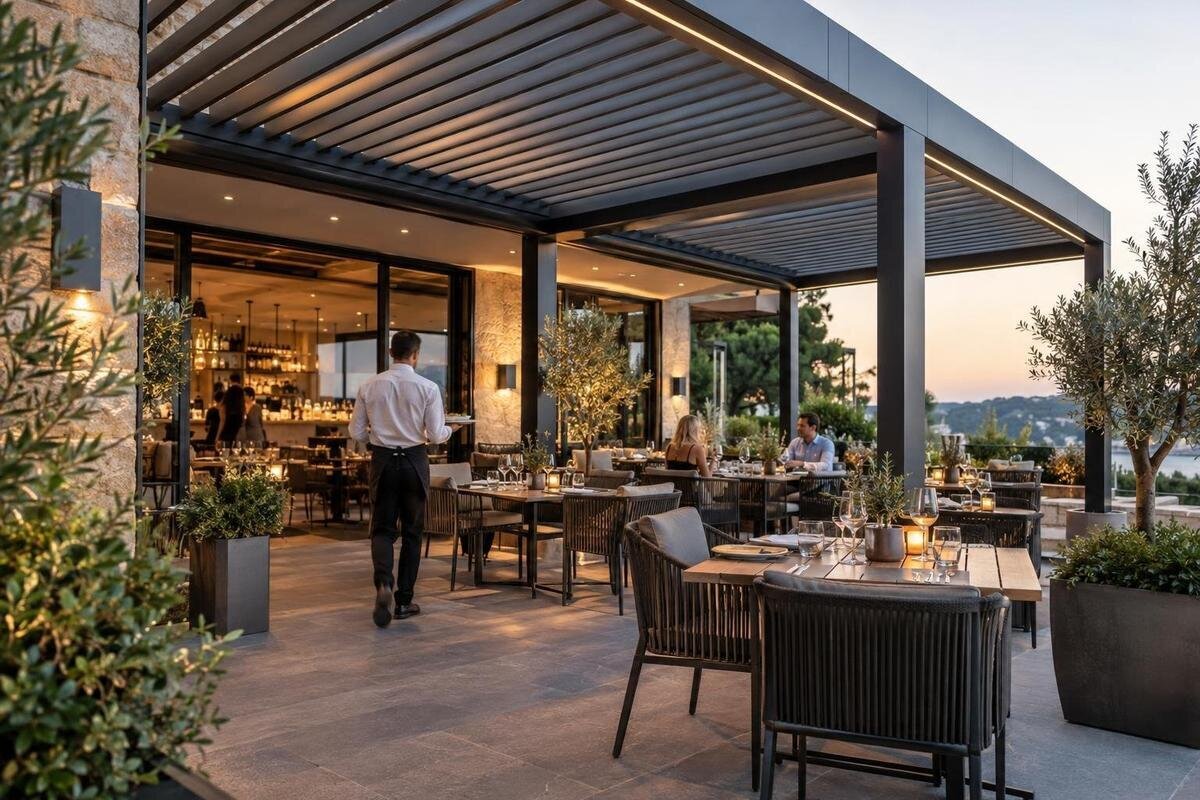
Restaurant terrace investment
A restaurant pergola can recover its cost only if the additional contribution it makes possible, after added running costs, covers the full project outlay within a period the business has chosen. More seats beneath a structure do not automatically mean more sales: some diners may simply move from indoors, and the terrace may not be usable on every shift in the forecast. Build the case from the restaurant’s own records, a measured layout and project-specific quotations. Treat extra service days and covers as assumptions to test, not a promised revenue increase. The model below separates demand, contribution and cost so a weak assumption cannot hide in one headline figure.

Define what “pay for itself” means
Before looking at figures, define “pay for itself” for this decision. In a simple screening model, the cost has been recovered when cumulative net contribution attributable to the pergola matches the initial project investment. Net contribution is not terrace takings: it is the extra amount left after the variable cost of serving those diners and added annual costs are deducted. Choose a target recovery period that suits the restaurant’s planning horizon and cash position. Without a stated period, “worth it” has no useful break-even threshold. If the proposal upgrades an existing terrace, keep its current trade in the baseline rather than treating all terrace sales as new.
Simple payback is the initial project cost divided by annual net additional contribution, when that contribution is positive and reasonably stable. It is a screening measure, not a complete investment appraisal: it does not show when cash arrives during the year, account for financing or tax treatment, or establish how long an installation will remain useful. For seasonal trade, model each year and add the cash flows cumulatively. Keep other possible benefits, such as making an existing terrace more usable, separate from the payback claim unless the restaurant can measure their financial effect. They may matter to the decision, but are not additional contribution by default.
Count only covers the project could add
Set a no-project baseline before forecasting: how many covers would the restaurant serve in the same period without the proposed investment? A booking that simply moves from an indoor table to the terrace is normally a change of location, not a new cover. It can contribute indirectly if the freed indoor seat is actually sold to someone who otherwise would not dine; count that later cover once, not the moved party. The same caution applies if the new layout replaces indoor seating, narrows a route or takes space from another use. Compare like-for-like periods and distinguish parties from covers, as one booking may include several diners.
If the preliminary brief names Bloomcabin Wall-Mounted Pergola, assess additional demand separately from the choice of model. Review booking and point-of-sale records by shift, weather, indoor occupancy and terrace use; note wait-listed parties, turned-away groups, cancellations and times when the outdoor area could not be operated. None of those signals proves that a pergola caused a sale, but together they help distinguish unmet demand from diners simply moving between seating areas. Record how the estimate was made, what period it covers and what the records miss. That makes the assumption easier to challenge before it becomes a revenue forecast.
Estimate usable service days from operating records
Define a usable service day in operational terms: a day, or more accurately a lunch or dinner shift, when the terrace could actually be opened, staffed and used for the service being modelled. Do not count every calendar day or every day the restaurant trades. A shift may be unavailable because of staffing, maintenance, private use or another operating constraint; a covered area may still be impractical on some occasions. Work at shift level where weekday lunch, weekend dinner and seasonal service have different demand or hours. If the terrace could be used for only part of a shift, do not quietly count the whole shift as usable.
Use the restaurant’s own history first: records of terrace openings and closures, bookings, sales, cancellations and staffing, alongside local weather information where it helps explain decisions. Separate observed days from assumptions about how the proposed design would change operations; do not assume that a product listing predicts weather performance. When assessing Bloomcabin Pergola, use site and operating evidence to estimate usable service days. If records are incomplete, set a cautious range and explain what is missing instead of presenting a precise annual figure. Apply the same definition of a usable shift in every scenario.
Use contribution per cover, not gross takings
Estimate contribution per genuinely additional cover rather than treating an average bill as profit. Start with the extra sales per cover on a consistent accounting basis, then deduct variable food and drink costs and other costs that rise with each guest, such as disposables or payment charges where applicable. Include extra labour when added covers require it. If staffing costs change only once a service reaches a threshold, model that step separately; a flat per-cover deduction can misrepresent a shift that needs another member of staff. Use the restaurant’s own till and purchasing records, not an industry average or a figure selected to make the investment pass.
Margins can differ by lunch, dinner, event, menu and day of the week, so use a weighted figure that matches the covers you expect to add. A higher average bill does not necessarily mean a higher contribution if food costs or staffing rise too. Do not count sales that would have happened indoors, and do not deduct the same cost twice. The result, C, should represent the incremental euros left per additional cover after variable costs, before annual fixed or recurring costs are listed separately. If the expected mix is uncertain, use a range and show how a lower contribution changes the break-even covers required.

Include the full project cost
Build the capital figure from the complete project, not the product price alone. Include the selected structure, delivery, design and site survey, preparation and any groundworks or drainage changes identified for the site, professional input, installation, and associated access, furniture or service alterations. Add lighting or other equipment only if it forms part of the proposal, with any required work costed by appropriately qualified people. Include planning-related fees or other project costs where applicable, temporary closure or lost trading during the work, and financing costs if the restaurant includes them in its investment test. Keep one-off and annual costs in separate columns.
Ask for a written, itemised quotation and check exclusions such as surveys, enabling works, waste removal, access equipment or changes to existing services. Keep estimates distinct from confirmed quotations; show uncertainty rather than treating an incomplete quote as the final total. Avoid counting work already planned for another reason as a pergola benefit. If the wall-mounted Bloomcabin model is on your shortlist, request a project-specific price and scope; its catalogue identity does not establish installation cost or commercial suitability. Use the same cost boundary for every option compared, so the lowest headline figure is not simply the least complete one.
Test the layout against real service capacity
Before translating square metres into covers, test an actual measured floor plan. Mark the proposed footprint and posts, existing doors and windows, steps, fixed equipment, table and chair positions, staff routes, queues and any area that must remain clear. Check the space needed for chairs pulled out, guests passing, staff carrying dishes and cleaning—not just a static arrangement of empty tables. A nominal seating count is not usable capacity if the layout slows service or blocks a route the business needs. Ask the operator and service team to test the intended set-up for a busy shift as well as a quiet period.
Product-area figures are only an initial filter. The Bloomcabin Pergola catalogue page lists a model from 9 to 24 m²; that stated range is not a restaurant layout, table count or confirmation that it suits the site. Request drawings and dimensions relevant to the exact project, then have the proposed plan reviewed against operator requirements and applicable access, fire-safety and planning considerations. Do not raise projected covers until the real arrangement and service plan support them. If a review requires fewer tables or a different route, update the capacity before recalculating payback.
Calculate the break-even cover threshold
Use one equation to calculate the break-even demand. Let K be the full upfront project cost in euros, T the target recovery period in years, R the added annual operating cost in euros, D the estimated usable service days per year and C the contribution per genuinely additional cover in euros. Required additional covers per usable service day = (K ÷ T + R) ÷ (D × C). The numerator is the annual contribution needed to meet running costs and recover the investment over the chosen period. The denominator is the annual contribution generated by serving one additional cover on each usable service day. This turns a total investment into a daily threshold that can be compared with demand and the reviewed layout.
Use the calculation only when D and C are positive, and keep the units consistent. It assumes the annual inputs are stable and excludes financing, tax effects and later replacement costs unless you add them separately. For seasonal shifts or uneven years, calculate each period and add net cash flows rather than forcing one average. For an option such as Bloomcabin Bioclimatic Pergola, enter the cost from the project quotation. If required daily covers exceed the reviewed layout or plausible additional demand, the chosen recovery period does not work under those assumptions. A negative contribution per cover cannot be repaired by adding more covers.
Allow for annual running costs and disruption
List recurring costs even if each seems small: routine cleaning, maintenance and inspections where specified, repairs, replacement components, extra labour for opening, closing or clearing the terrace, and energy or consumables for any included equipment. Use documented instructions and supplier estimates for the exact installation; do not enter zero simply because a listing does not show an annual charge. If upkeep is seasonal, allocate it to the period in which it occurs rather than treating it as a per-cover cost. Distinguish regular operating costs from occasional repairs, while including a realistic allowance for both in the forecast.
Also record interruption and opportunity costs that could change the result: a terrace closed for maintenance, staff time taken from another task, reduced indoor seating during installation, or a competing use of the area. Avoid double-counting staff time already included in C. If you are considering the model shown in Bloomcabin’s wall-mounted listing, ask for the care and operating information relevant to the proposed installation. Use it to estimate upkeep costs, distinguishing supplier estimates from your own assumptions. Where no reliable estimate exists, show a range and test whether the case still holds at the high end. A zero-cost assumption should be explicit, not hidden in a blank cell.
Review site feasibility before relying on the forecast
Feasibility is a financial input, not a footnote. Check who controls the site, the restaurant’s lease or property arrangements, boundaries and existing services, and whether the preferred layout leaves operations workable. Identify applicable planning, access and fire-safety reviews early, and take the actual site plan and operator requirements to the relevant qualified professional or authority. The checks depend on the project; do not assume a general product description or rough sketch answers them. Include review fees and time in the forecast, and keep unconfirmed dates out of the confirmed opening plan. Establish who will obtain each assessment so that no essential input is left unassigned.
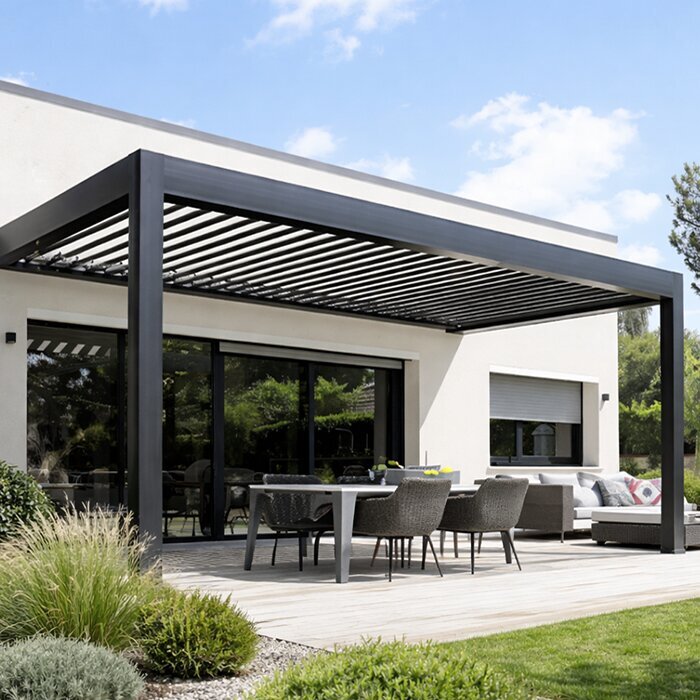
Before treating capacity or opening dates as firm figures, resolve changes required by any review and update the plan. If the regular Bloomcabin Pergola model appears in a brief, treat its product page as a model reference only—not confirmation of permission, compliance, structural fit or suitability for a commercial setting. This distinction matters to payback: a delayed or reduced project may have different costs, service dates and cover capacity. Do not include sales from a layout the operator has not been able to confirm as workable. If reviews remain outstanding, label the figures provisional and allow the forecast to be revised.
Stress-test the forecast and review actual results
Build at least three cases: cautious, central and strong. Vary the inputs that drive recovery—usable service days, genuinely additional covers per day, contribution per cover, complete project cost and annual running costs. Set the cautious case from adverse but plausible operating conditions, not a token small reduction; base the central case on records, and keep the strong case visibly separate. Do not average the strongest day into the forecast as if it occurred throughout the season. If payback appears only in the strong case, say so plainly and decide whether that downside is acceptable to the business.
After opening, compare actual results with the baseline recorded before the investment: terrace use by shift, covers that appear genuinely incremental, contribution and added costs, downtime and staffing. Note events, promotions, unusual weather or changes in indoor trade that may explain a difference; a busy weekend alone does not establish causation. Recalculate cumulative net contribution at season end and compare it with the agreed recovery path. When comparing quotations, assess the bioclimatic Bloomcabin option and any alternatives using the same demand assumptions and cost categories. Use the actual operating results to revise the next season’s forecast.
Frequently asked questions
How do I calculate payback for a restaurant pergola?
Divide the full upfront project cost by the estimated annual net additional contribution. Work out that contribution from genuinely additional covers and their contribution per cover, then subtract added annual operating costs. If the result is zero or negative, the simple payback calculation does not show a recovery. For uneven seasons, forecast each year and track cumulative cash flows.
Should every cover served on the terrace count as extra?
No. Compare terrace trade with what the restaurant would have served without the proposed project. A diner moved from indoors is not, by itself, an additional cover. Count a second sale only if the indoor seat freed by that move is actually used by someone who otherwise would not have dined.
What counts as a usable service day?
Use a consistent definition, preferably by lunch or dinner shift: the terrace must be available, adequately staffed and usable for the additional service being forecast. Base the estimate on the restaurant’s own opening, booking and closure records, and label any assumptions about future operation.
Does the pergola’s purchase price equal the project cost?
The purchase price is usually only one part of the total. Include project-specific design, site preparation, professional reviews, installation and associated changes, plus disruption during the work where relevant. Keep annual cleaning, maintenance, staffing and other running costs separate.
What if payback works only in the strong case?
That forecast has not demonstrated recovery under the cautious or central assumptions. Keep the strong case separate, review which inputs make it work and decide whether the downside is acceptable. Any non-financial reason to proceed should be assessed separately rather than presented as proven payback.
The decisive figure is not gross takings or the number of seats beneath a pergola. It is whether cumulative additional contribution, after added operating costs, can cover the full upfront investment. A defensible answer uses site-specific service days, an honest count of additional covers, a consistent contribution margin and a complete project cost, tested against cautious alternatives. If those inputs do not support recovery within the restaurant’s chosen period, the project may still be considered for other reasons, but those reasons should not be presented as proven financial payback.
