
Second-Hand Pergola: Parts and Reinstallation Checks
Pergola buying guide
Buying a second-hand pergola can look like an easy way to acquire an established outdoor structure, but a photograph of it standing says little about what will be handed over or whether it can be installed elsewhere. The key questions are practical: can the seller identify the exact model, is the full kit present and in sound condition, and can a competent professional confirm that its design and anchoring suit the new site? Paperwork, an itemised inventory and a realistic reinstallation estimate matter as much as the asking price. Treat the kit, the site and the cost of moving it as separate checks; passing one does not settle the others.

Before you buy 1
What does the sale actually include?
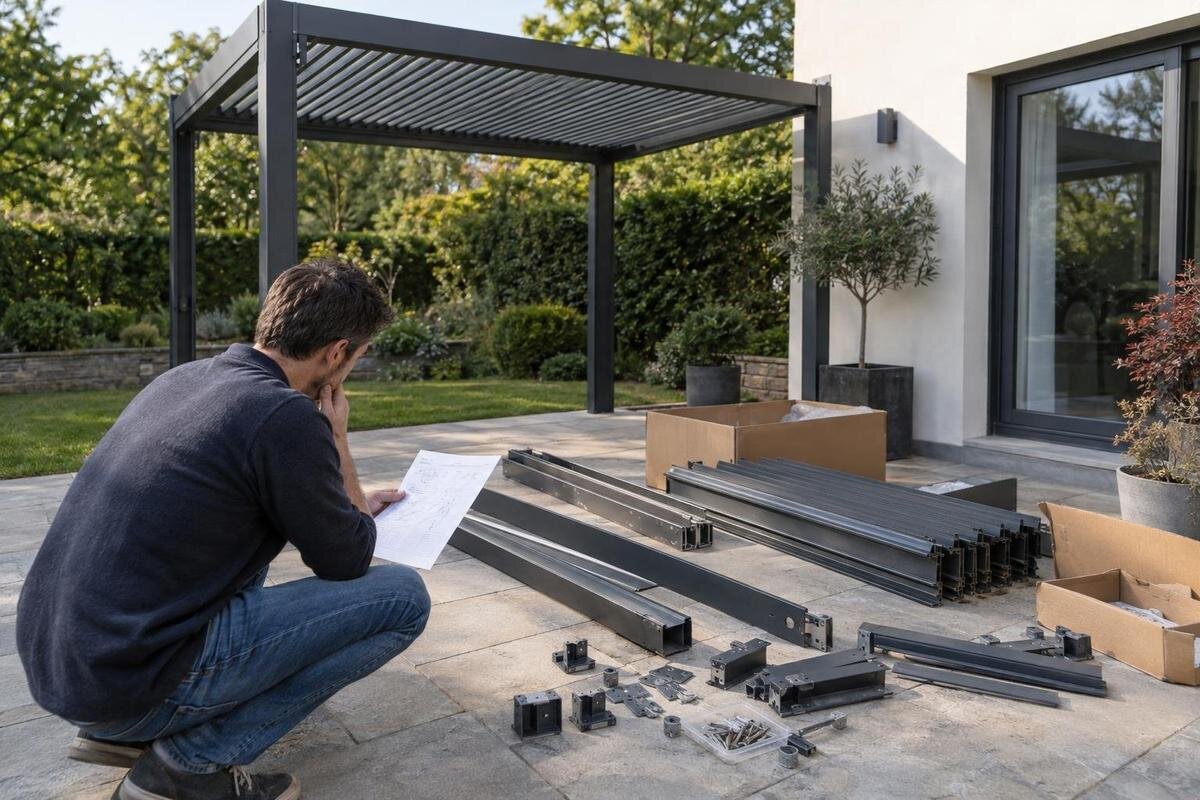
The word “pergola” can describe quite different offers: a complete dismantled kit, a structure still assembled, or a frame with only some accessories. Ask which situation applies and get a written list of every item included. Name the posts, beams, roof elements, brackets, feet or base plates and trim, plus any screens, panels, gutters, controls or lights that are present. Also ask whether visible paving, wall fittings, wiring or drainage belong to the sale or remain with the property. Treat this as an inventory, not an assumption about what a standard kit ought to contain: designs differ, and optional items may never have formed part of the original purchase.
Separate original components from later additions and identify anything the seller plans to keep. Ask whether the sale includes dismantling, loading, removal of existing bases or transport, and who is responsible for each task. Clarify whether the structure is being sold for reuse, for parts or simply as it stands, then record known faults and exclusions. Agree a collection date, access arrangements and any storage requirements; these details affect how you can collect and protect the parts. Take recent photographs of the frame, roof, labels and accessories, then match them to the inventory so “complete kit” has a precise meaning.
Paperwork that identifies the exact model
Ask for the original invoice or order confirmation and note the maker, exact model name, reference or serial number, stated dimensions, configuration and purchase date. Photograph any identification label and compare it with the paperwork. If there is no label, ask how the seller identified the kit and treat the answer as unverified. Product names and photographs can resemble one another without confirming that parts or drawings match. The Bloomcabin Wall-Mounted Pergola listing gives you a named alternative to consider, but identifying the used structure still depends on its own labels and records. Keep that distinction clear when asking about replacement parts.
Request the manual, installation instructions, model-specific parts list and original drawings. Ask whether the drawings are generic manufacturer sheets or were prepared for the configuration being sold. Look for dimensions, support positions, wall connections or base details, and any record of later alterations. Keep drawings from the old site separate from a survey of the new location: one helps explain what was built, not whether the same assembly fits elsewhere. Ask for maintenance and repair records, then contact the original supplier in writing about documents, parts or support for a later owner. Do not assume a warranty or service arrangement transfers.
Before you buy 2
A parts inventory matched to the correct model
Use the parts schedule for the exact model and configuration, not a generic list found online. If the seller does not have one, ask the original supplier whether it can be obtained from the product reference. Tick off each listed item and quantity, including posts, beams, roof pieces, joint brackets, connectors, seals, end caps and fastener packets where they are specified. Not every kit includes every example, so the supplier’s list is a better basis than a general checklist. A pile of mixed metalwork or a box labelled “fixings” does not establish that all the model-specific connections are present.
Ask for the components to be laid out or photographed with labels visible, then record missing, damaged and unidentified items separately. A fastener may be easier to replace than a distinctive bracket or support, but do not price a substitute until the manufacturer or installer confirms it is suitable. List accessories only if they are included in the sale, and note whether each is complete or partly present. If model-specific spares cannot be identified, compare the incomplete kit with an alternative such as the Bloomcabin Pergola. Ask what the alternative includes so that your comparison accounts for the parts still needed for reuse.
Condition checks for the frame and roof system
Inspect the structure in daylight and ask to see the parts close enough to assess, not only in a wide photograph. Look for bent or twisted members, cracks, loose joints, enlarged holes, missing end caps, damaged coatings and evidence of improvised repairs. Check material-specific signs where relevant, such as corrosion on metal parts or soft, split or persistently damp areas on timber. Compare matching members for differences that could indicate replacement pieces. A clean surface does not prove the condition of hidden connections, so photograph concerns and have significant or uncertain damage assessed by a competent installer or structural professional before agreeing to reuse it.
If the roof has moving parts, note whether they sit evenly and operate as described in the correct manual; a mechanism that sticks, scrapes or seems incomplete needs assessment, not extra force. Check panels, seals and drainage components for breaks or missing sections, and ask what repairs have been carried out, by whom and when. A seller’s reassurance is not a substitute for a record or inspection. If repair appears extensive, include an enquiry about the Bloomcabin Bioclimatic Pergola in your comparison. Keep the used kit’s repair estimate separate from the alternative’s quoted price and installation scope, so you can see what each route involves.

Before you buy 3
Dismantling, storage and transport history
Find out who will dismantle the pergola and whether the seller has done so before. If it is still assembled, ask for photographs of the connections, labels, roof components and accessories before removal, and have the dismantling sequence and each member’s position recorded. Identify parts with the supplier’s marks or a clear numbering system rather than relying on memory. Keep fixings with the relevant assembly. Do not let anyone cut members, force joints or discard an item as redundant until the manual or installer confirms its role. A careful record is particularly useful where the structure has been altered or the original layout was made for one specific site.
Ask how long it has been dismantled, where it was stored, whether parts were protected from moisture and knocks, and whether anything has been moved or lost. Before collection, check the actual pieces against the inventory and photograph any discrepancy or new damage. Agree who supplies packaging, loading and transport, and what access the collection vehicle will need; long or awkward pieces may require a suitable handling plan. Include transport distance and any storage between collection and installation in your planning. Do not rely on a promise that missing parts will turn up later unless the seller records it clearly.
Measuring the new site
Measure the proposed location and compare it with the pergola’s documented footprint and height, not with a seller’s estimate or a photograph. Mark the support positions, available headroom, eaves, windows, doors, paths, lights, downpipes and known service routes on a plan. Allow space to operate and maintain the structure, including clearance for any moving roof components. Check levels and where water will go. An existing patio may be a convenient surface without being a confirmed installation base; record its dimensions and condition for a professional to assess. Use the manual or a measured drawing rather than scaling dimensions from an online picture.
An attachment that worked at the old house does not automatically suit a different wall, orientation or support arrangement. Give the installer measured plans and clear photographs, and ask them to assess the used brackets and proposed fixing points before arranging transport. If you are also considering a new wall-mounted layout, use the same site plan when enquiring about the wall-mounted pergola option. This keeps both proposals tied to the space you actually have. For a freestanding structure, check how the support positions relate to paving, boundaries and underground services, rather than considering only whether the roof fits within the available area.
Before you buy 4
Foundations and fixings at the new site
Record what the original supports rested on and how the pergola was anchored, if known: for example, surface-mounted plates, embedded components or another arrangement. Ask for foundation or base drawings and photographs from the original installation, plus the fixing type and positions shown in the kit documentation. The seller’s existing pads, anchors or holes belong to the old setting; their presence is not proof that they can be reused at the new one. Do not treat a similar-looking bolt or a level-looking slab as confirmation. If this information is missing, mark it as unknown and ask an installer what assessment is needed before purchase.
At the new site, the surface material and condition, slope, drainage and concealed services may affect where supports can go. Have a qualified installer or structural professional review the actual pergola drawings and proposed ground; they should determine the anchoring and foundation requirements rather than relying on guesswork. Do not drill, adapt fixings or assume old foundations transfer on the basis of photographs. If you compare reuse with a new Bloomcabin Pergola option, ask for groundworks to be identified separately in each proposal. That makes it easier to distinguish the cost of the structure from the work needed to support it at your property.
Controls, accessories and drainage
Identify every operating part included with the kit. If it is motorised or has controls, request the exact operating manual, control unit, remotes, keys, sensors and associated components that the seller has; record anything missing or untested. Ask the original supplier about the precise model and part references before assuming that a remote or replacement component will work simply because it looks similar. Do not open electrical enclosures or connect unverified equipment. Have electrical inspection or reconnection handled by a qualified electrician. If operation has not been demonstrated, record it as untested rather than assuming it works.
Check the route for water as well as the frame: list any gutters, outlets and downpipes that belong to the pergola, note what is missing and ask where water will discharge at the new site. Do not assume drainage components from the old installation are included or will suit a different layout. Screens, glazing, lights and other add-ons also need their own inventory and compatibility check. If you are considering the bioclimatic pergola option instead, ask which operating components and accessories are included in the proposed configuration. Compare those inclusions with the used kit’s inventory, keeping optional extras separate from items needed to make it usable.

Before you buy 5
The full cost of reuse
Work out the likely cost after collection, rather than judging the offer by the sale price alone. Ask for separate figures for dismantling, transport, packaging, storage, professional inspection, missing parts, repair, foundations or other groundworks, installation and any electrical work. Include removal of old bases or disposal of unwanted components if those tasks apply. Where a wall-mounted system is relevant, request a quote for the Bloomcabin wall-mounted model as a comparison. Give the supplier the same site information used for the reinstallation estimate, and ask for exclusions to be stated alongside the quoted work. A product price alone is not an installed-cost comparison.
Compare the two routes on the same basis: model or type, measured size, included components, condition, expected work, installation scope, site preparation, paperwork and any support or warranty actually confirmed. A lower purchase price can be offset by a missing specialist part, uncertain anchoring or extra labour, while a new alternative may also have exclusions. Ask each supplier or installer to state what is and is not included. Keep uncertain repairs visible as separate items rather than hiding them in a vague contingency. If the seller will not allow inspection or provide an inventory, treat the unknowns as part of the risk, not as having no cost.
Local approvals and a documented handover
Check the proposed installation with the people responsible for the property before committing. Depending on ownership and the work, that may mean asking a landlord or property manager, a management company, the local authority or a qualified planning professional what consent or approvals apply. Do not rely on the pergola having stood at its old address as proof about the new site. Ask your insurer or broker whether moving, storing or reinstalling it affects cover, and get guidance for the actual property and project. Consent and insurance questions need locally verified answers.
Before collection, make the handover clear in writing: list included and excluded items, known faults and alterations, condition photographs, documents supplied, who dismantles and transports the kit, and any specific promise about repairs or parts. Ask the seller to confirm ownership and keep proof of the transaction; do not assume a warranty or service contract transfers. Decide which unresolved issues would stop the purchase. If model identity, component support, foundations or site approval remains unclear, pause until the relevant professional or authority answers. If you choose the listed Bloomcabin Pergola instead, record the agreed configuration and inclusions in that order rather than carrying assumptions over from the used-kit offer.
Frequently asked questions
How can I tell whether a second-hand pergola is complete?
An assembled pergola is not proof that every component or accessory is included in the sale. Ask for the exact model’s parts list, compare quantities with the seller’s inventory and check labels on the parts. Record anything missing, damaged or untested before agreeing to the purchase.
Are the original drawings enough to confirm it will fit my site?
No. They can help identify the kit and show its original layout, but they do not assess the new location. Compare the documented dimensions with a measured site plan and ask a qualified installer to review clearances, attachment points and the proposed installation.
Can I reuse the old foundations and fixings?
Do not assume so. The old arrangement may not suit the new site, and similar-looking fixings are not proof of compatibility. Give the pergola drawings and site information to a qualified installer or structural professional for an assessment before relying on the old supports.
Will the original supplier provide spare parts or honour the warranty?
That depends on the exact model, its age and the supplier’s current arrangements. Contact the supplier with the product reference, identification labels and photographs. Ask in writing about available parts, documentation, support for a later owner and whether any warranty or service arrangement can transfer.
What should I record in writing before collection?
Record the included and excluded items, known damage and alterations, documents supplied, sale price, collection arrangements and who will dismantle and transport the structure. Keep photographs and a copy of the inventory. Ask the seller to confirm ownership and note any specific promise about parts or repairs.
A second-hand pergola is worth considering when its identity, contents and condition are traceable, and a competent installer can assess the new site, supports and reinstallation scope. Price missing parts, transport and groundworks before comparing offers, then keep the agreed inventory and known faults with the sale paperwork. If the model cannot be identified or the new installation cannot be verified, pause or walk away before collection. A clear decision while the kit is still at the seller’s property is easier than inheriting unresolved questions.
