
What to Expect from Solar-Powered Pergola Lights
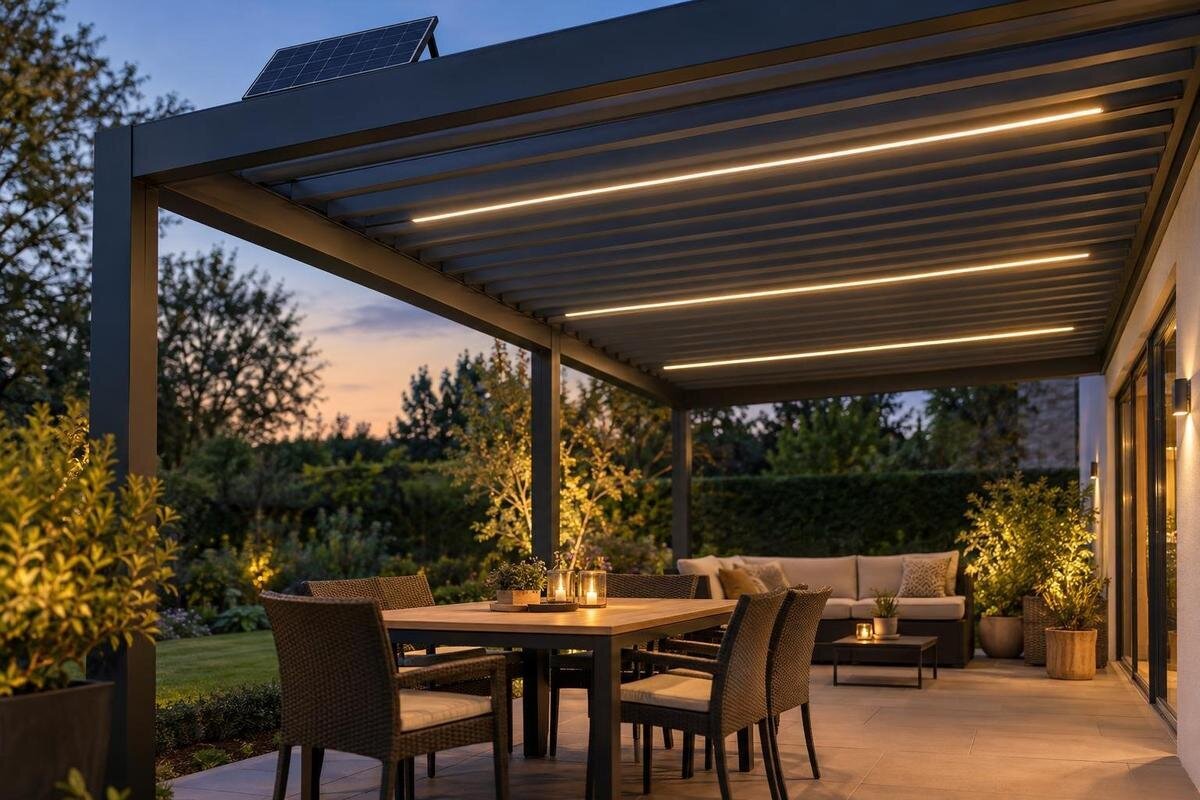
Pergola lighting guide
Solar-powered pergola lights can make evenings more inviting, but their useful output depends on how much daylight reaches the panel, how much energy the battery stores and what you need the light to do after dark. In Ireland, summer performance is a poor guide to winter charging. This guide explains which tasks are realistic, how to read runtime claims and what to verify before choosing a fitting or pergola layout.

What solar pergola lights can realistically do
Solar-powered pergola lights store energy collected by a panel in a battery and use it to run a fitting after dark. They can avoid the need for a cable to that light, which is useful when the aim is a small, local glow rather than an evenly lit outdoor room. The result is not fixed: panel exposure, battery condition, the light’s efficiency, controls and brightness setting all affect what you see. Two fittings labelled “solar” can behave very differently, so the category name is not a performance specification. Some lights dim or switch off as the reserve runs down; check which behaviour the maker states.
Think about a particular task before choosing the system. A gentle glow around seating, an accent on a planter or occasional wayfinding may be realistic if some variation in brightness is acceptable. Reading, detailed food preparation, lighting faces across a dining table or keeping a route consistently bright through the evening asks more of the equipment. Solar can still be considered, but the exact fitting must support that job for the required period and season. A visible LED does not prove that the whole pergola is usefully illuminated: corners and work surfaces can remain dim even when a light is on. Decide which areas need clear visibility and where softer light is enough.
Define the lighting task before comparing products
Write down where the light must fall, what you will be doing there and how long it should remain useful. A marker on the approach, general evening ambience, a table for dinner and a bench used for reading are separate tasks. Note whether you need continuous light or only short periods, and whether a change in brightness near the end is acceptable. Also decide what happens if the battery runs low: if a portable lantern is an acceptable back-up, the requirement differs from a space that must stay lit without an alternative. This short brief makes unlike products easier to compare.
Look at the target, not only the fitting: light at floor level may show a route but leave a tabletop too dim, while a lamp aimed at a table may leave the path dark. For steps, changes of level or other places where reliable visibility matters, do not make a small solar accent the only source. Ask for the stated output in the mode you will use, where its beam falls and for how long. A simple sketch showing furnishings, the route and the edges of the area can expose gaps. If you are considering the Bloomcabin Bioclimatic Pergola at the same time, use this lighting brief alongside your structure requirements. Compare the pergola layout and the light’s output separately so that both suit the intended use.
How Irish daylight affects seasonal charging
Seasonal charging is one reason a solar light that performs well in summer can disappoint later in the year. Ireland has much shorter winter days than summer days, and the winter sun stays low. A panel may receive fewer useful charging hours; cloud, nearby buildings, trees and pergola components can reduce exposure further. Diffuse daylight can still contribute, so overcast conditions do not automatically mean no charging, but they are not a sound basis for assuming the battery will be full by dusk. The useful question is not the annual daylight average; it is whether the panel can replenish enough energy ahead of the evenings when you need it.
Ask for information relevant to your intended season and mode, rather than relying on a best-case runtime after a full charge. Check whether the maker’s figure assumes direct summer sun, a particular battery state or reduced output, where that information is available. If the maker publishes charging guidance or seasonal estimates, compare those with your own site; a bright summer evening is not evidence of winter reliability. If you are also considering the Bloomcabin Pergola, note which months you intend to use the space after dark. Use that schedule when comparing the solar-light manufacturer’s seasonal charging information. If no winter data is available, treat the headline runtime as a favourable reference, not a promise for every evening.
Choose a panel position with daylight in mind
Panel position can matter as much as the lamp itself. Note when shade from the house, fence, tree or pergola falls across the likely panel location, checking morning and afternoon as well as the brightest part of the day. A panel hidden beneath a roof, or routinely shaded by moving roof components, may not receive the exposure expected from an open-sky test. Include seasonal changes: the sun follows a lower path in winter, and an obstruction that seems minor in summer can affect a larger part of the panel’s day. Prioritise the maker’s stated exposure over a neat but shaded location.
Some systems combine panel and light; others offer a separate panel. If a separate panel is available, confirm the maker’s permitted orientation, cable length and mounting options, and check that its position is suitable for outdoor exposure. Do not assume that a roof beam or surface is approved simply because it is convenient. When planning lighting for the bioclimatic pergola, request confirmation of the exact panel and fixture positions from the relevant manufacturer or supplier. Consider these positions alongside the shade observations for your site, including any shade from the structure itself. The panel needs both access to daylight and an approved mounting arrangement; placing the lamp where it looks best does not settle where the panel should go.

Read runtime claims as conditional figures
Treat a runtime figure as conditional. An “up to” claim may describe a fully charged battery, the lowest brightness setting or favourable charging conditions; it may not match a brighter mode or a cloudy spell. Check whether the published duration is tied to a particular mode, whether the light maintains its stated brightness for that time, and whether it gradually dims or switches off. Battery capacity by itself does not answer the question: the fitting’s power demand and control pattern matter too. Ask, “How long will this exact fitting provide the brightness I need?” rather than only, “How long can it stay on?”
Compare the answer with a real evening: a meal, a short visit after dusk or several hours outdoors. Check how the system behaves after an incomplete charge and whether a sensor, timer or dusk-to-dawn setting changes the claim. Motion-triggered use may stretch a battery reserve, but short bursts are not the same as continuous light. If figures differ between full and reduced brightness, compare the mode you will actually use and check whether the useful light lasts to the end of the stated period. If you are choosing the Bloomcabin Wall-Mounted Pergola, include your expected lighting hours in the overall plan. Request runtime information for the exact fitting before buying it on the strength of an hours figure.
Compare beam coverage as well as brightness
Lumens describe the total light emitted by a fitting, not how much reaches a table, bench or patch of ground. Light on a surface is a separate consideration: a narrow beam can make one spot bright while leaving the edges dark, whereas a broad beam spreads light over a wider area and can look less intense at any one point. Height, angle, shade and lens shape all influence the result. Ask for beam or distribution information alongside the lumen figure, and look for a diagram showing how the fitting illuminates a space at a similar mounting height, if one is available.
Map the actual footprint and tasks rather than matching a single lumen figure to square metres. The listed range for Bloomcabin Pergola size options is from 9 to 24 m²; that describes the pergola’s size range, not the brightness or coverage of a light. A larger or divided space may need more than one carefully placed source, while a small, concentrated fitting may suit an accent. Colour appearance and glare are separate considerations: a bright source in the direct line of sight can feel harsh and still fail to illuminate the surface you care about. Check the beam from seated as well as standing positions.
Plan light positions around the way you use the pergola
Mark the dining table, chairs when pulled out, seating and walking route, then identify which surfaces need useful light and which need only a soft outline. A single overhead point can create bright patches and leave the perimeter dark; placing several sources may spread light more evenly, but the number alone is no guarantee. Consider seated and standing sightlines as well as where a person approaches the pergola, so fittings are not glaring directly into eyes or unnecessarily spilling light towards neighbours. This plan helps reveal whether you need light over a task, along an edge or in more than one zone.
Controls affect both convenience and the power budget. Dimming can reduce demand if the fitting supports it; a timer can limit unnecessary hours; a motion sensor, where offered, may suit occasional pass-through better than a dining area where people sit still. Confirm that any sensor will respond to the intended approach and ask whether manual operation is available. If you are considering a wall-mounted pergola, put the wall, panel and proposed light positions on the same plan. Mark the direction of each beam and the approach that a sensor needs to cover, keeping the seating positions in view. If roof components can be adjusted, check light distribution and panel exposure in the positions you expect to use.
Verify outdoor suitability and mounting approval
Confirm that the fitting is designed for the exposure at its exact location. A light tucked under a roof can still encounter wind-driven rain, condensation, dirt and temperature changes; a panel, battery housing, cable and connector may each have different limits. Read the maker’s outdoor-use information and the relevant rating for every component, not just the lamp head. If the listing uses a general “outdoor” description without explaining where the battery or connections can sit, ask for the installation manual and clarification before purchase. Also check where any leads may run and how the maker expects the connections to be protected.
Physical fit is not the same as approved fit. Check the fixture instructions for permitted mounting positions and obtain documented approval for attaching that exact light and panel to the chosen pergola. For Bloomcabin’s bioclimatic pergola, as with any structure, do not infer compatibility from a photograph or product name. If the proposal involves a mains connection, a hybrid system or other fixed electrical work, have the exact equipment and manuals reviewed by a qualified electrician. Treat that as planning input rather than a DIY wiring task, and do not rely on an improvised extension or unapproved fastening to make a chosen fitting work.

Allow for cleaning and battery ageing
A solar panel needs a reasonably clear surface to collect daylight. Dust, pollen, leaves, bird droppings and other garden debris can reduce exposure, so ask how the maker recommends cleaning the panel and whether its mounting position will remain reachable for routine care. Follow the stated method and materials rather than scrubbing or using a cleaner that might damage the surface. Include the light, battery enclosure and connectors in seasonal visual checks, following the product instructions. If something appears damaged or loose, seek the supplier’s guidance rather than improvising a repair.
Battery performance can decline over time, so a fitting that once met a late-evening need may provide less usable light later. Ask whether the battery is replaceable, whether the maker supports replacement and what parts or servicing are available; do not assume a sealed battery can be swapped by the owner. When planning lighting for Bloomcabin’s wall-mounted pergola, consider how the panel and lamp will remain accessible for maintenance without having to alter their mounting arrangements. If a product is removable, store it only as its manual directs, and do not assume that its first-season performance will remain unchanged.
Choosing between solar and other lighting
Solar is a reasonable option when the desired result is modest and local, the panel receives suitable daylight, and you can accept some variation between evenings. It can suit accent lighting or gentle ambient light where the design does not depend on every corner being bright. It may also suit a location where routing a supply would be inconvenient, provided the exact system’s charging and mounting arrangements are approved. The decision should still rest on documented performance for the light itself, not on the broad promise of being “solar-powered”.
Consider another or supplemental source if you need dependable brightness for cooking, reading, step visibility or long winter evenings, or if the proposed panel position is heavily shaded. A professionally specified mains-powered or alternative system may be a better fit for a fixed task; any electrical option needs advice from a qualified person and checks against the exact manuals. If solar remains appealing, define the hours and brightness that matter, then compare the maker’s evidence with them. That gives you a realistic expectation before treating the pergola and its lighting as one purchase.
Frequently asked questions
Will solar-powered pergola lights work in Ireland?
They can, provided the panel gets suitable daylight and the fitting matches the job. Shorter winter days, low winter sun and cloud can reduce charging, so summer performance is not a reliable guide to winter runtime. Ask for information about the exact light and the conditions behind its figures.
Can a solar light stay on all night?
Some may run for long periods in favourable conditions, but an all-night claim depends on charge, brightness mode, battery condition and controls. Check how long the fitting maintains useful brightness in the mode you plan to use; a light that is still on but has dimmed may not meet your needs.
Are solar lights bright enough for dining?
They may provide pleasant ambient light, but dining needs depend on where the beam falls and how much usable light reaches the table. Lumens alone do not show that. Check the fitting’s beam information and runtime in the intended mode, especially if you want to use the table during the darker months.
Can I mount a solar panel on the pergola roof?
Only if the instructions and the relevant manufacturer confirm that the proposed mounting position is suitable for that exact panel and structure. The roof may also shade the panel. Check both documented mounting approval and likely daylight exposure rather than assuming that a convenient surface is suitable.
What should I check in a solar-light runtime claim?
Check the brightness mode, charging conditions and whether the figure assumes a full battery. Find out whether the light maintains useful brightness for that period or gradually dims, and whether a timer or sensor changes its operation. Compare the result with the hours you actually need it.
A solar pergola light is most successful when it is chosen for a defined job rather than judged by a headline claim. Check whether the panel can charge in the darker season, whether the fitting puts light on the right surface and how long that output lasts in its intended mode. If those answers fit your evenings, solar can provide useful accent or ambient light. When the task demands steady, broad illumination, plan for a more dependable source instead.
