
How to Tell Rain From Condensation Under a Pergola
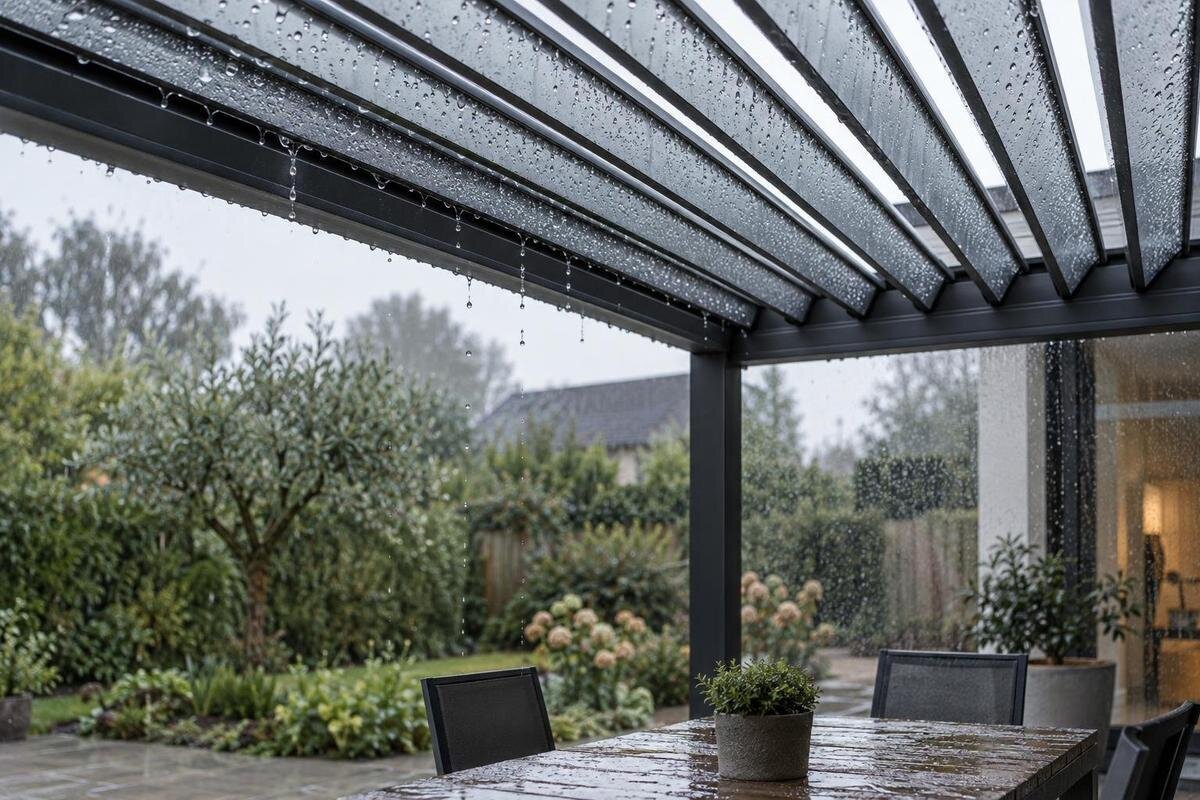
Pergola moisture guide
Droplets beneath a pergola roof are unsettling, but they do not automatically mean rain is getting through. Condensation can form on a cool underside; rain can also travel along a roof component and appear somewhere other than the entry point. The useful clues are when the water starts, where it first forms, and whether the roof, wind and rainfall conditions repeat the same pattern.

01
Droplets do not identify their source
A damp patch under a pergola is an endpoint, not necessarily the place where water entered. Condensation forms on a cool surface when moisture in the air becomes liquid. Rain can pass through an opening, run along a roof component or appear after following a designed drainage route. Each can leave drops below the roof, and a clear-looking droplet does not show where it came from. Condensation and rainwater may also be present at the same time.
The useful questions are when and where the moisture first appears, and what was happening just beforehand. Note the time, the surface that is wet, the weather and, if the roof is adjustable, its position. Separate what you actually saw from what you suspect: ‘drops on the underside beside the wall’ is a more useful starting description than ‘the wall joint leaks’. If you first notice a wet chair or table, record that too, but leave the source undecided until you have observed the roof above it. Photograph the underside from a safe place and mark the area on a rough sketch. Do not climb onto the structure, remove parts or direct water at it while you are investigating: those actions can alter the evidence and may be unsafe.
How condensation forms on a pergola roof
Condensation is liquid water formed from vapour already in the air. When the air beside a roof surface cools to its dew point, or below it, some of that vapour becomes droplets on the surface. Rain does not have to be falling. Cooling in the evening or overnight can create the conditions for condensation, while the roof surface and the air around it may change temperature at different rates. Small droplets can merge and run towards a low point before falling.
A broad spread of fine beads or a thin film across exposed parts of an underside can fit this explanation, particularly if it appears during a dry spell. However, the pattern varies with the surface, airflow and temperature; condensation can collect at joints, and it is not always evenly distributed. Describe both the droplets and their distribution: scattered beads across several surfaces are a different observation from a narrow wet line ending in one drip. If side screens or panels are fitted, note whether they limit air movement, as conditions in a partly enclosed area may differ from those in an open one. Record their position rather than simply calling the pergola enclosed. This makes later comparisons clearer if some panels were open on one occasion and closed on another. Treat the pattern as evidence to compare, not a definitive test.
02
Compare the timing with rainfall and cooling
Water that appears during rainfall or soon afterwards has a possible rain route, especially if the same timing recurs in similar weather. A pause does not rule out rainwater: it may travel along a roof component or emerge from a drainage route after the shower has stopped. Record the first drip, not only when you noticed a wet floor or furniture. Note any earlier showers as well, since an apparently dry interval may follow a period when the roof became wet.
Condensation is more plausible if moisture appears in genuinely dry conditions, often after the air and roof have cooled, and there is no clear trail from an edge or joint. Neither timing pattern settles the matter on its own: a wet roof can release rainwater later, and condensation can coincide with a shower. Distinguish the time you discovered the water from the time you saw it begin. If you returned home to find droplets, their starting time is unknown; do not record it as the end of the last shower. A useful comparison is an occasion when you saw the underside dry before moisture developed. For a Bloomcabin Wall-Mounted Pergola, ask for the exact roof-to-wall weather and drainage details, then compare them with your observations rather than treating timing as proof of how that configuration performs.
Look for the first wet area, not just the drip
Where moisture forms can help distinguish the two sources. Condensation may appear across several cool, exposed areas as fine beads before it collects. Rain entry may be more localised, with a trail from an edge, joint or connection. These are tendencies, not rules: condensate can gather at a low point, while wind-driven rain can wet a wide area beneath an open side.
Try to identify the first wet surface rather than only the point where water falls. It may run along a beam or another component before dripping, so the drop’s landing place can be some distance from its origin. Take photographs from the same safe position and mark each wet area on your sketch after different weather events. Include a wider photograph showing the location and a closer view, where possible, showing the moisture pattern. Give each area a simple reference, such as ‘wall end’ or ‘outer corner’, so that later photographs are easy to compare. If the first wet area is hidden, record that limitation rather than drawing an assumed route across the sketch. If you are identifying an existing model, the Bloomcabin Pergola product page can help confirm its name before you ask for the matching drainage diagram; do not assume a diagram for a different layout applies.

03
Include wind, roof position and open sides
Rainfall alone is only part of the weather picture. Record whether the wind was carrying rain towards a particular side, whether that side was open and whether droplets appeared at the perimeter or beneath a roof joint. Wind-driven rain can enter through an open side without passing through the roof. A drip underneath the structure therefore does not, by itself, establish that the roof has a leak.
If the design has adjustable louvres or another movable roof, note their position during the event. Avoid changing it solely to investigate the droplets, and follow the model’s operating guidance. If the position changes during normal use, record when that happened and treat the observations before and after as separate periods. Apply the same approach to screens or panels: a comparison is less useful if both the roof and the sides changed position without being recorded. You do not need to recreate uncomfortable weather conditions to obtain a matching observation; wait for another suitable occasion. When considering the Bloomcabin Bioclimatic Pergola, check the roof configuration, side enclosure and model-specific weather limits in the relevant documents. Its name alone does not establish how a selected arrangement will perform in a particular weather event.
Keep a simple observation log
A short record across both wet and dry conditions is more useful than a single inspection. Photograph the underside when it appears dry, then again if droplets form. Use a consistent set of entries: date and time, recent rain, wind direction, roof position, screen or panel position, first wet area and what happened afterwards. Where a detail is unknown, write ‘not observed’ rather than filling the gap from memory. Give the photographs the same date or reference as the written entry so they remain useful when you review them later. Include dry observations as well as dripping events; otherwise, the record shows only when a problem was noticed, not the conditions in which it was absent. Use the same view where possible, and mark where moisture first appears on a sketch. If you cannot see the surface safely from the ground, do not climb to get a closer look.
Change as little as possible between observations. Do not hose the roof, operate adjustable parts during a rainfall event or dismantle a channel to see what happens; each can change the route of water or make the cause harder to identify. If you are considering a new purchase, the wall-mounted pergola listing can help identify the model you are comparing. Ask for approved operating guidance and a drainage diagram that match the roof and any enclosure options you intend to use.
04
Signs that point towards rain entry
Rain entry becomes more plausible when drops repeatedly begin during or after showers and follow the same localised trail. Look for a recurring wet line from an edge or connection, or a drip that appears only when rain comes from a particular direction. A mark left by repeated wetting can help you locate the route, but its colour or appearance does not identify the cause. Record the weather and roof position each time rather than relying on memory.
Water may also enter at the perimeter or a connection with an adjoining structure, rather than through the main roof surface. Observe where it first becomes visible and avoid taking the drip point as the entry point. Compare the recurring wet line with nearby areas that remain dry: this helps describe how localised the observation is without deciding its cause prematurely. If the route appears only in rain from one direction, include that distinction in your report rather than saying it happens whenever it rains. Conversely, if a similar wet patch also appears in dry weather, keep that observation alongside the rain-linked evidence. For the Bloomcabin Pergola model, request documents for the precise configuration. A product name or image cannot tell you whether a recurring wet joint is an intended drainage route, a setup issue or a fault.
Check the intended drainage route
Where a pergola’s design includes channels, outlets or other drainage components, rain may follow that route before it becomes visible beneath the roof. A delayed drip can therefore still be rainwater. Compare the observed path with the drainage diagram for the exact model, including the roof position during the event. Do not assume every pergola uses the same route or that a wet spot directly below a roof component marks the point where water entered.
If the observed water seems to emerge from a joint or outlet, photograph it and note whether the same thing happens in dry weather. On your sketch, distinguish the documented drainage route from the path you actually observed. Where you cannot see a connection between two points, leave a gap rather than presenting an unbroken line as established. This keeps the question focused: is water following the intended route, or is the visible drip somewhere the diagram does not explain? Do not dismantle components or try to change a drainage path as a diagnostic shortcut. For buyers looking at the bioclimatic pergola model, request drainage and weather-performance information for the exact roof setting and enclosure combination. Use that information to understand the selected arrangement, rather than assuming that all roof positions or enclosure options have identical weather limits.

05
When condensation is the stronger explanation
Condensation is a stronger possibility when moisture forms without recent rain, appears after the roof has cooled and spreads as small beads over parts of the underside. A lack of a visible trail from an edge or joint supports that explanation, but does not prove it. Note whether the same pattern returns during another dry period and whether fitted screens or panels are present. Recurrence in dry conditions is more informative than the appearance of a single patch.
Rain and condensation can occur together, so a wide spread of beads does not rule out a separate rain route. Keep the two observations distinct in your log: record which areas wet first and whether the pattern changes after rainfall. You need not assign one explanation to the whole roof. For example, if you observe beads across the underside during a dry period and a separate wet line at an edge during rain, describe those as two patterns to investigate. Calling both simply ‘dripping’ would lose the distinction that makes the record useful. If your pergola is the Bloomcabin Wall-Mounted model, ask how the documented roof-to-wall and enclosure arrangement relates to water movement and airflow. Compare the installed setup with that information; the model name does not establish which seal or ventilation details are present.
When to seek an inspection
If observations remain mixed, share the log and photographs with the manufacturer, installer or another qualified professional who can assess the exact structure. An inspection is particularly useful when the same rain-linked trail recurs, water appears near a connection to a building, or you cannot see where it first forms. Describe the rainfall, wind direction, roof position and timing; those details are more useful than a general report that the pergola is dripping.
When choosing a pergola, ask for written, model-specific weather limits, operating guidance and a drainage diagram, and check that they match the roof and any enclosure configuration under consideration. Use a precise buying question: for the arrangement you intend to order, where should rainwater travel, and what weather limitations apply? Keep the answer associated with that configuration so it remains clear if you later change an enclosure option or roof specification. The Bloomcabin Pergola page identifies the product to discuss, but its name alone does not establish how a selected setup performs in particular conditions. This is more useful than seeking a general promise that the space beneath any pergola will always stay dry. Good documentation helps set realistic expectations and gives you a reference point if moisture appears after installation.
Frequently asked questions
Can condensation form when no rain has fallen?
Yes. Moisture in the air can condense on a cooler roof underside, including during a dry spell. Small beads that appear across a surface after it cools are a clue, not proof. Check whether the surface was already wet from an earlier shower and compare what happens on another dry day.
Does dripping after a shower stops mean the roof is leaking?
Not necessarily. Rainwater may still be moving along a roof component or through a designed drainage route after rainfall ends. Record where the first drops form and whether the same path appears during other showers. Condensation can also occur around the same time, so timing alone is not conclusive.
Why are drops appearing at one seam if the cause is condensation?
Condensation can run along a surface and collect at a joint or low point before it drips, so a localised drip does not automatically identify a leak. Look for the first wet area, the spread of moisture and its connection with rain or cooling. A repeatable rain-linked trail deserves closer investigation.
Could rain under an open side be mistaken for a roof leak?
Yes. Wind can carry rain through an open perimeter, even if water is not passing through the roof itself. Note the wind direction, which sides were open and where moisture first appears. If rain follows a repeatable route through a joint or roof edge, compare that route with the pergola’s model-specific documentation.
Should I spray the roof with a hose to find the source?
Avoid an improvised hose test. The flow and direction may not reproduce natural rain, and the extra water can make the evidence harder to interpret. Use observations from normal weather first. If a test is needed, ask the manufacturer or a qualified installer whether there is an approved method for that exact model.
The clearest diagnosis comes from a repeatable pattern, not from one wet surface: note whether droplets appear in dry weather or with rain, map where they first form, and record the roof position and drainage route. Condensation and rain can coincide, so appearance alone is not enough. When the observations remain unclear, the documents for the exact model and a qualified inspection can resolve what a visual check cannot.
