
Why Pergola Louvres Drip When Opened After Rain
Pergola advice
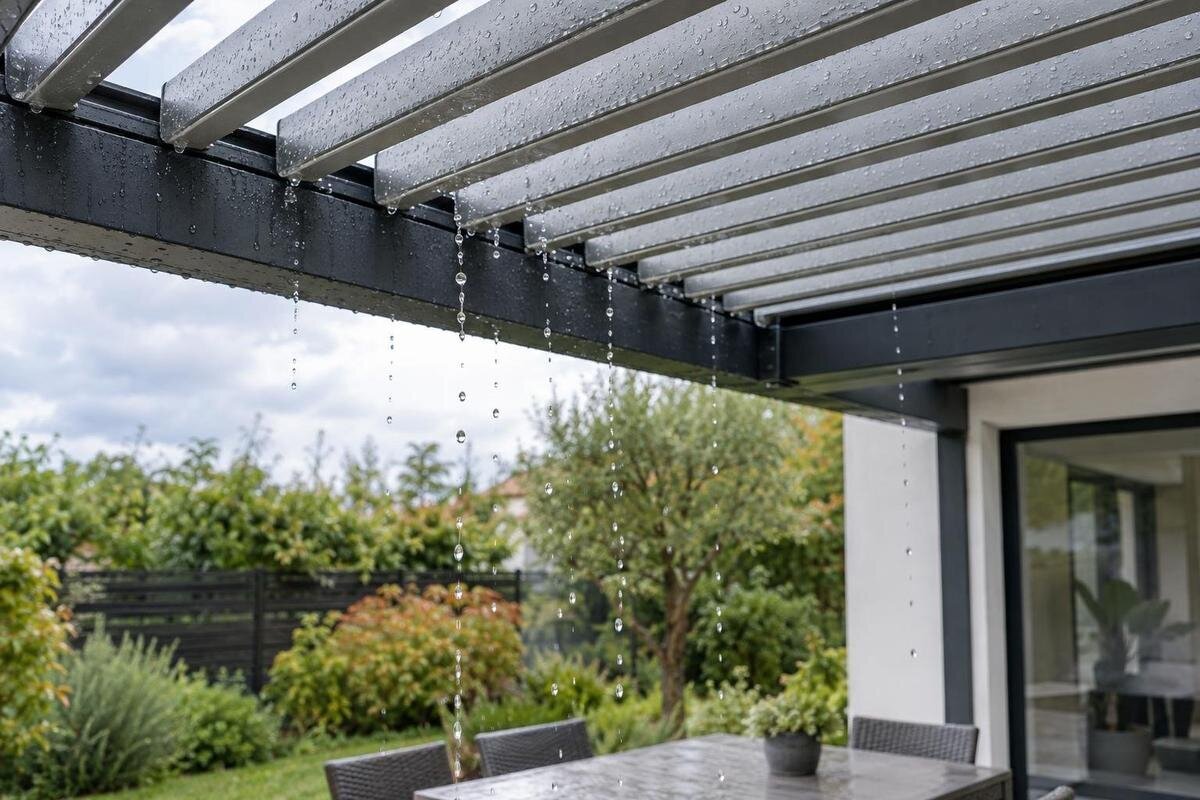
When pergola louvres drip just as you open them after rain, movement may be releasing water that remained on the blades or within part of the roof’s drainage route. That is a plausible explanation, not proof that the roof is fault-free or defective. The exact roof design, its drainage diagram and its operating instructions matter. Look at where the water appears, when it starts and whether it continues while the roof is still.

Before you buy 1
Why opening the louvres can release rainwater
A louvred roof is made from separate blades rather than one uninterrupted sheet. Rain landing on a blade can run towards an edge or the surrounding frame, depending on the blade’s profile and position. When you rotate the louvres, the surfaces change angle. A film or bead of water that had been resting on a blade may move along it and fall below. If the first drops appear as the roof opens after a shower, movement may simply be releasing water that was already on the roof rather than rain newly passing through it.
Timing is useful, but it cannot settle the question by itself. Even when most rain is carried away through a designed drainage route, surfaces may stay wet or small amounts may remain at edges and connections. Equally, drops during movement do not prove that the route is clear or that the roof is operating as intended. Notice whether water appears only as the blade angle changes or continues while the louvres are still. The exact roof’s instructions and drainage diagram provide the reference for interpreting that difference; there is no single drip count that applies to every model.
Where water may remain on or around the roof
Depending on the design, droplets may remain on the upper or lower face of a blade, along a blade end, near an overlap or where the moving roof meets a fixed frame. Some pergolas also guide rain into side channels or other parts that are not immediately visible; those are possible locations only if the particular model uses them. A drip seen below the frame may have travelled along a surface before falling, so the place it lands does not always show where the water first collected.
Use the drainage drawing to identify which parts are present on your roof and how water is meant to travel between them. It can help you distinguish a visible blade edge from a channel or outlet that is part of the designed route. Do not assume that another pergola’s layout, seals or drainage path will match yours, even if the roof looks similar. If you cannot identify the parts from the ground, note the location and ask the supplier or installer to relate it to the drawing instead of reaching into the roof.
Before you buy 2
Why the drip point can change as the blades move
Rotating a blade changes the direction in which its wet surface faces. Water that was spread thinly may gather at an edge, travel along the blade or detach once the surface is at a different angle. That means a drop can appear under a different part of the roof from the place where the rain first rested. The transition can also change which roof edges are exposed to falling water. A change in drip location during opening is therefore a clue about movement, not a reliable diagnosis on its own.
Record the point where the water lands and, if visible, the part of the roof it seems to come from. Keep those two observations separate: seeing a drop land beside a post is not the same as seeing it emerge from that post. Describe a moving drip point in relation to the blade or frame, noting whether it shifts during opening or stays in one place. This gives the installer a clearer account than simply saying that the roof leaks. If your roof is identified as Bloomcabin Pergola, include that model name with the description so the observation can be compared with the appropriate drawing. A short video from a safe position may help show the movement, particularly if a still photograph captures only where the water lands. There is no need to repeat the opening merely to obtain a better recording.
How the drainage route relates to residual drips
A roof’s drainage system is intended to carry rain along a route defined by its design. Depending on the model, that route may involve blade edges, channels, outlets or other connected parts. A drainage diagram shows which components are meant to collect and direct water; it also gives you a way to compare the observed drip location with the intended route. It does not, by itself, tell you how much water may remain on wet surfaces after rainfall or what to do with it.
The distinction is between water travelling through the intended drainage route and water leaving a wet surface as its angle changes. Ask the supplier to explain where those routes meet on the drawing, particularly around the blade ends and surrounding frame. That explanation can help you describe the location without assuming that every visible edge is a gutter or that every drop has come from an outlet. For a roof identified as Bloomcabin Bioclimatic Pergola, request the drawing that matches its configuration. Do not repeatedly open and close the louvres to try to empty the roof unless the operating instructions specifically allow that practice. Nor should a drip alone prompt you to remove a cover or put a tool into a channel. Understanding the route is useful; attempting to alter it is a separate matter for an installer.

Before you buy 3
What the timing and pattern can tell you
Water that appears as the louvres move may be consistent with retained rainwater being displaced. That observation does not establish that the behaviour is expected for your model. A drip that continues while the roof is stationary, returns from the same joint, or appears in a different place from the one shown in the drainage information is worth checking against the instructions. These clues indicate what to report, not a confirmed fault or a particular cause.
The surrounding conditions matter when comparing observations. Note whether rain was still falling or had stopped, the approximate louvre position and whether the water began before or after movement. Separate a brief release during opening from drops that continue after the blades stop; describing both as dripping after rain loses a useful distinction. If the roof is wall-mounted, record whether the water appears under a blade, at the roof edge or beside the wall, rather than assuming the wall connection is responsible. When discussing a roof identified as Bloomcabin Wall-Mounted Pergola, make that location part of your enquiry. Also distinguish a pattern you have seen once from one that has returned on several occasions. You do not need to recreate identical weather conditions: an honest account of the differences is more useful than presenting separate showers as a controlled test.
Recording what happens when the roof opens
A simple record is more useful than repeatedly operating the roof to reproduce a drip. Write down when the rain stopped, whether the roof was closed or partly open, when you changed the louvre position, where the first water appeared and whether it continued afterwards. Keep the sequence clear: rainfall, roof movement and the appearance of water are separate events, even when they happen close together. Describe the location in ordinary terms, such as the left or right edge as you face the roof, rather than guessing at a hidden channel. State where you were standing so that someone viewing the roof from the opposite side can understand the description. If you can do so safely from the ground, a short video can show the sequence more clearly than a description alone. Record what is visible without trying to identify a component you cannot see.
Compare events only when the manufacturer’s instructions permit operation, and note differences in the weather rather than treating each shower as identical. Do not climb onto the roof, reach across moving parts or place yourself beneath the roof while it is being operated. Include the model name and any identifying information available in your notes; the Bloomcabin Pergola product page can help you match a catalogue name to your purchase records. Note the installed configuration separately, including whether the roof is freestanding or attached to a wall and whether it has an enclosure. If a photograph does not clearly show the source, say so rather than marking a suspected point as certain. A short, accurate account is enough; you do not need a technical diagnosis before asking for help. Stop if the mechanism behaves unexpectedly and ask for advice.
Before you buy 4
Follow the instructions for the exact louvred roof
Opening positions, controls and operating limits can vary by roof design. The instructions for your exact model should explain how to operate it and whether there is any approved practice for opening after rain. Do not assume that a particular angle, opening speed or waiting period will drain every roof in the same way. If the manual does not address post-rain operation, ask the supplier or installer before adopting a routine based on another pergola.
Use the controls as described and do not force louvres that feel stiff, uneven or difficult to move. If the guidance sets limits for operating conditions, follow those limits rather than testing the roof outside them. When considering the Bioclimatic Pergola listing, ask how the instructions address the transition from a closed, wet roof to an open position. A useful answer should make clear whether the model has a specified post-rain procedure or whether its ordinary operating instructions apply. Do not turn an informal suggestion about waiting or opening gradually into a rule for every roof. Keep any model-specific explanation with the instructions, so everyone who operates the pergola follows the same guidance. If that explanation is unclear, ask for clarification before adopting a new routine. The aim is to understand the permitted operation, not to find an opening technique by trial and error.
Checks you can make without dismantling the roof
From a safe position on the ground, look for visible debris near any accessible drainage opening and note whether water is appearing around that area. Distinguish what you can see from what you suspect: debris beside an opening and debris inside it are different observations. Do not remove covers, seals or louvres, or put your hand or a tool into a channel. A view from below may not show a concealed part of the drainage route, so do not conclude that an outlet is blocked or clear just because it looks unobstructed from one angle. Follow the model’s cleaning instructions for any routine maintenance. These visible checks can help describe the circumstances of a drip, but they are not a way to inspect the complete drainage system or confirm its condition.
For cleaning guidance, distinguish routine care from work that requires access to concealed components. Ask which areas can be reached safely and which tasks belong to an installer or service professional. If your purchase records match the wall-mounted pergola listing, use that model name when enquiring about maintenance rather than applying instructions for a similar-looking roof. Keep any observation about dripping separate from your account of cleaning: state what was visible, what permitted maintenance was carried out and whether the pattern subsequently changed. A change alone does not establish the cause. Leave any inspection that requires access to the roof or concealed components to a suitably qualified installer or service professional. Do not attempt extra dismantling simply because routine cleaning has not explained the drip.

Before you buy 5
Rain performance and enclosure questions before buying
Before choosing a louvred pergola, ask for information about the exact roof design, not just a general description of how louvres work. Useful material includes a drainage diagram, the model’s operating instructions, its stated weather limits and any controlled observations that explain how it behaves in rain. Ask specifically what the instructions say about opening after rainfall and whether residual drips can occur as the blades move. Separate that question from how the closed roof performs during rain: an answer about one does not necessarily explain the other. For a seating or dining area, it is useful to understand where any described residual water may fall when the roof opens. Avoid treating a broad claim about rain performance as an answer to those model-specific questions.
If you plan to add sides or another enclosure, check that the guidance and limits apply to that configuration as well as to the roof alone. Do not assume an enclosure will prevent drips or that it leaves the water route unchanged; ask the supplier to clarify what configuration the information covers. When comparing Bloomcabin’s Bioclimatic Pergola page with your shortlist, keep the post-rain opening question alongside your questions about the proposed enclosure. Explain how you expect to use the space after a shower, such as reopening the roof while the furniture remains in place. This gives the supplier a concrete use to discuss without asking for an unconditional promise of dryness. Keep the answer specific to the combination you are considering, rather than carrying over an explanation given for a roof with different sides or a different layout.
When to ask an installer about repeated dripping
Ask the supplier or installer to review the behaviour if it keeps returning at one location, continues while the roof is stationary, differs from the instructions or is accompanied by an unexpected change in operation. Those observations do not prove that a component has failed; they show that a comparison with the exact roof design is needed. Avoid forcing the louvres or attempting to adjust a joint, seal or concealed drainage part to see whether the symptom changes.
Give the supplier or installer the model name, the enclosure configuration, your notes on rainfall and louvre position, and any video taken safely from the ground. Start with a concise description of the concern: for example, water appears at the same roof edge whenever the wet louvres move, or continues after movement stops. Use only the description that matches what you actually observed. Ask them to compare that point with the drainage diagram and explain whether the operating guidance covers the circumstances you recorded. If your documents identify Bloomcabin’s wall-mounted model, include that full name rather than relying on a general description. Keep the discussion focused on what needs explaining: the source of the water, its timing and the permitted operation. This is more useful than asking whether all dripping is normal or whether any drip must indicate a fault.
Frequently asked questions
Does a drip every time I open the louvres mean the roof is faulty?
Not necessarily. Movement can release water that remained on a blade or at an edge, but the drip alone cannot confirm whether the roof is working as intended. Compare what you observe with the instructions and drainage diagram for your exact model.
How long should I wait after rain before opening the louvres?
There is no universal waiting time for every roof design. Follow the operating guidance for your model, and ask the supplier or installer if it does not explain what to do after rainfall.
Should I open the louvres to drain water from the roof?
Do not assume that opening is a drainage procedure. The route and approved operating practice depend on the roof design; use that model’s instructions rather than trying a particular angle or sequence.
Can the place where a drip lands identify the source?
It is a useful clue, not proof. Water may travel along a blade or frame before falling. Record where it appears and compare that location with the model’s drainage drawing.
What information should I send to the installer?
Include the model name and configuration, when the rain fell, the louvre position, where the water appeared and whether it continued while the roof was still. A photo or short video taken from a safe place can help.
A drip that coincides with opening can come from rainwater already on a blade or elsewhere in the roof, but timing alone cannot confirm the cause. Note the sequence and location, compare them with the drainage drawing, and follow the operating guidance for the exact model. If the pattern persists or does not match that guidance, share your observations with the supplier or installer rather than trying to dismantle or adjust the roof.
