
Aluminium Raised Garden Beds: How to Check the Material and Fit

Bloomcabin · Raised-bed guides
Aluminium Raised Garden Beds: How to Check the Material and Fit
Aluminium raised garden beds can suit a defined planting area on prepared ground if the exact kit fits your site and is documented for the way you want to use it. Start by checking what the walls and joints are made of, which finish touches the growing medium and how water will leave the bed.
Check more than the metal
For aluminium raised garden beds, ask for the alloy or grade, panel thickness, finish and fastener specification before comparing otherwise similar kits.
Verify edible use
If you plan to grow food, confirm the intended use of the exact model, including any conditions on soil contact or lining.
Check where water goes
An open base has no floor panel. It does not make paving or poorly draining ground suitable.
Buy the height you need
Check inside dimensions, planned fill depth and reach from the path before paying for a taller bed.
If you’re shortlisting aluminium raised garden beds, write down what you need them to do: hold a narrow planting strip along a boundary, provide a more comfortable working height or divide a larger area into separate bays. Check the ground and the available reach before comparing finishes. That way you won’t pay for height you cannot use or choose an open frame for a site that needs a contained planter.
Bloomcabin’s product specifications give you a starting point: they identify the layout and materials of named components. Use those facts to narrow the choice, then ask for the details that matter to your installation. A photo can help you recognise a joint, but it cannot establish an alloy grade, an acceptable use or a load rating.
01
Read the parts list, then ask what it leaves out
When comparing aluminium raised garden beds, start with the parts list. The Bloomcabin Classic aluminium examples specify aluminium wall panels and corner posts. Depending on the model, the list also includes aluminium T connectors or cross connectors. That identifies the materials of those named parts, not the alloy or grade, the panel finish, or the material of every fastener. A connector joins sections of the frame; its specification does not necessarily tell you what hardware secures it.
Ask for the alloy or material grade, whether the panels are bare or have a coating or other surface treatment, and the metal thickness. Check whether a thickness measurement refers to the metal itself or the depth of a shaped panel. Those figures describe different things. With aluminium raised garden beds, wall height, the shape of the panel and where sections are supported all matter when interpreting a thickness figure. Do not rank two kits by that figure alone or infer how much either can hold.
For a vegetable or herb bed, ask whether the exact model and its supplied finish are intended for direct contact with the growing medium used for edible crops. Request any conditions in writing, including whether a liner is required. This is a separate check from identifying the metal. The supplied specifications describe the construction but do not establish edible-growing suitability or a service life. If the composition or intended use of aluminium raised garden beds remains unknown, set aside that option if the missing answer is essential to your plans.

02
Compare wall sections and joints, not just labels
The joints are a useful place to compare aluminium raised garden beds that look similar in photos. The Bloomcabin Narrow Aluminium Raised Bed 200×50×50cm and Narrow Aluminium Raised Bed 200×50×60cm both have a nominal footprint of 200 × 50 cm. On each long side, two 100 cm wall sections meet at an aluminium T connector. The stated difference here is wall height: 50 cm versus 60 cm. Those figures describe the layout; they do not establish that the taller model can take a larger load against the rim or that either can be used as a seat.
When comparing aluminium raised garden beds with a mixed-material design, look at the top edge as well as the panels below it. The Tall Triple Aluminium Raised Bed has aluminium wall panels, corner posts and T connectors. In the Ascending Triple Accoya Raised Bed, the posts and T connectors are aluminium, but the top 10 cm of each compartment is Accoya, above aluminium wall panels. Compare the care instructions for the surfaces you will handle or clean rather than assuming that both designs have the same maintenance needs.
If your shortlist includes aluminium raised garden beds and galvanised steel beds, compare the actual products at the same wall height and with a similar layout. Check whether each specification covers the substrate, finish, joints and compatible replacement parts. If one listing omits a detail, that is a difference in documentation, not proof that its construction is worse.

03
Measure the reach as well as the footprint
Mark the outside footprint and the working space before ordering. The Narrow Aluminium Raised Bed 100×50×20cm and Narrow Aluminium Raised Bed 100×50×30cm have the same nominal footprint of 100 × 50 cm and nominal planting area of 0.5 m². Their wall heights are 20 cm and 30 cm respectively. Neither footprint figure is a measured internal dimension. If aluminium raised garden beds are going beside a fence, check whether you can reach the far edge from the path, not just whether the frame fits against the boundary.
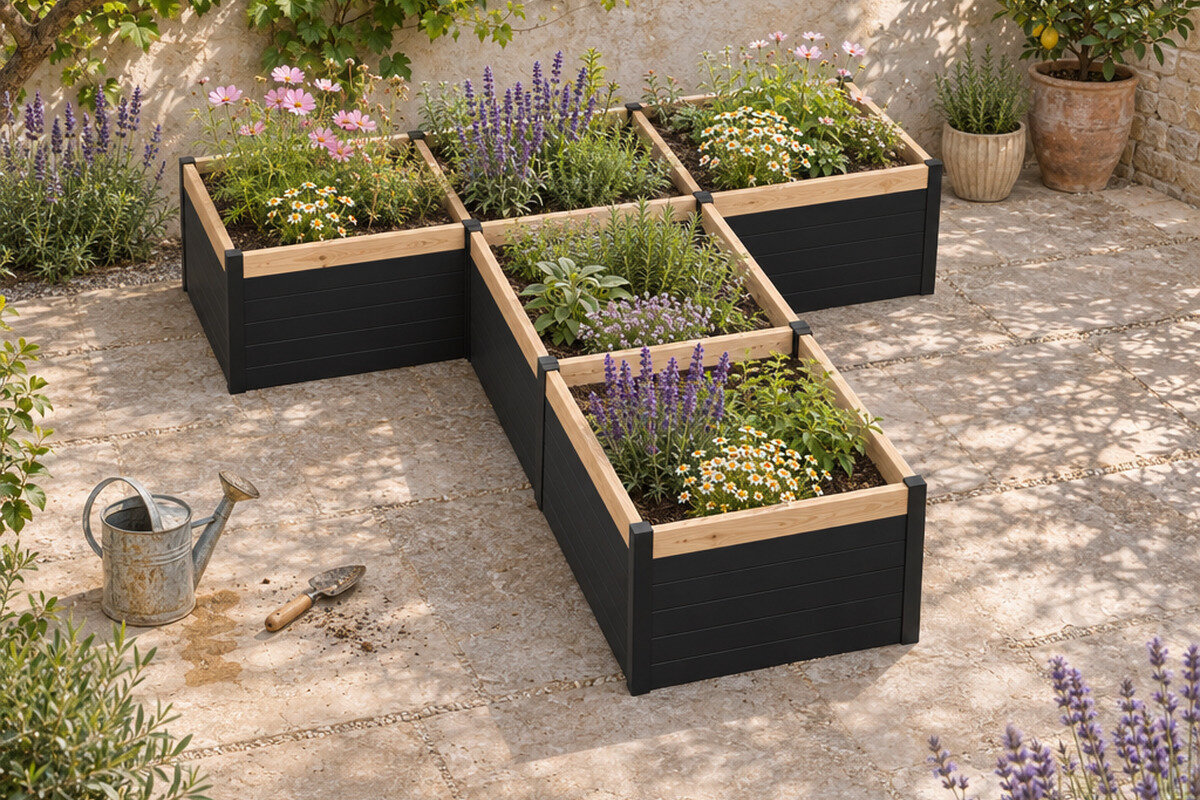
For a larger layout, mark out the route into the bed as well. The U-Shaped Aluminium Raised Bed 300×200×30cm has five planting bays, a stated nominal planting area of 5 m² and a nominal 100 × 100 cm access notch. That notch is not a measured clear opening on your site. Check the usable space after allowing for nearby obstacles, and try the approach with whatever you need to bring in, such as a watering can or a kneeling pad.
When judging aluminium raised garden beds for someone who gardens seated, test reach and working height together. A higher rim does not provide the knee clearance of an elevated planter. Keep paths firm and leave enough room to work without stepping onto the growing medium. Check the route to water, too: a bed you can reach comfortably is still awkward to use if watering it means dragging a hose across the only path.

04
Check what sits beneath the open base
The cited Bloomcabin aluminium raised garden beds are open to prepared ground and have no floor panel. Before choosing a spot on soil, look at the marked footprint after rain. If water collects there or flows into it from an adjoining path, work out whether you can use a better-drained spot or need to address the ground first. An open base describes the frame, not how quickly water will leave that particular site.
If you are considering aluminium raised garden beds for paving, ask whether the exact open-base model is intended for that surface and what base preparation it requires. Check how excess water will leave and how the growing medium will be contained without blocking its route. On a raised terrace or other structure, get the supporting surface assessed rather than using the bed’s empty weight as a guide to the filled load. If the site needs a self-contained planter, do not buy an open frame on the assumption that you can add a floor later.
For an installation on soil, separate wall height from rooting depth. The filled depth depends on the level you fill to, and additional rooting space depends on whether roots can use the ground beneath. Choose a peat-free growing medium suited to the plants and the way the bed will drain. Use seed-packet instructions and local planting guidance to check crop needs and timing, rather than treating the frame material as a guide to either.

05
Confirm the assembly before adding weight
The aluminium raised garden beds shown here are supplied unassembled. Get the instructions for the exact model before preparing the site. Use its parts list to lay out the panels, posts, connectors and any listed hardware. On a multi-bay kit, identify which sections are outer walls and which are dividers before joining them. On a model with different wall heights, match each section to its position in the supplier’s diagram rather than assuming that all sides assemble in the same order.
Prepare the ground as directed and follow the model’s joining sequence, panel orientation and specified fastening method. If a part is missing or a joint will not seat as shown, stop and check the instructions or ask the supplier before proceeding. A similar-looking fastener is not confirmation of a compatible replacement. Do not drill extra holes, add anchors or improvise supports based on what worked for a different bed.
Before filling aluminium raised garden beds, check that the panels and connectors are seated as the instructions show, the frame sits as intended and the access space still works. This is also the time to measure the usable interior and confirm that the base and growing medium meet any stated conditions. Sorting out a joint or moving the frame is simpler before you add the fill.

06
Plan for the finish, the joints and everyday care
Get care instructions for the supplied finish before choosing a cleaner or treatment. Aluminium raised garden beds do not all come with the same surface specification. Ask how to remove soil marks, what products or tools to avoid, and what the supplier recommends if the finish is scratched. If the surface treatment is unknown, do not select a polish, paint or repair coating simply because its label mentions aluminium.
When tending the bed, look for changes you can describe: a joint that has opened, a panel that has moved, or hardware that no longer sits as shown in the instructions. Compare the affected part with the assembly diagram and ask about a compatible replacement or repair before making changes. If you want to attach a trellis or use the rim for support, confirm that use first; the available model specifications do not provide ratings for those loads.
Upkeep also includes the growing medium. Raised soil can dry faster, so check moisture rather than adopting a fixed schedule. When comparing aluminium raised garden beds for a hard-to-reach garden corner, consider how easily you could water the planting and inspect the back joints. A model that fits on paper may still be awkward to maintain if the only accessible side is blocked by pots or stored tools.

07
Work through a narrow-bed choice before buying
Hypothetical example: you want a short strip for herbs and salad leaves along a garden edge, with access from one long side. You are comparing two aluminium raised garden beds: the Narrow Aluminium Raised Bed 100×50×20cm and the Narrow Aluminium Raised Bed 100×50×30cm. Both have one compartment and are open to prepared ground. Assume the spot drains, the underlying soil is suitable for roots, and you can reach the full width from the path. Before buying either, you would still confirm edible use, the wall finish and the installation requirements.
Suppose a rectangular interior measures 96 × 46 cm on site, and you intend to fill it to a depth of 18 cm. Those are hypothetical measurements, not Bloomcabin specifications. The estimate is 0.96 m × 0.46 m × 0.18 m, just under 0.080 m³, or about 79 litres. That is the volume of the assumed rectangle above ground; allow for any internal fittings that occupy space. Use measured dimensions and the intended fill depth when comparing aluminium raised garden beds. For a divided or U-shaped kit, measure the actual planting bays rather than applying this method to the whole outer footprint.
If 18 cm of fill plus the usable soil underneath meets your plants’ needs, the 20 cm model is the one to assess first. If you need more fill above ground or prefer a higher rim, assess the 30 cm version instead. The extra 10 cm of wall does not automatically become 10 cm of extra growing depth: that depends on where you set the fill level. If the soil underneath is unsuitable, revisit the site or bed choice rather than counting on roots reaching through it.

Questions readers ask
Are aluminium raised garden beds suitable for growing vegetables?
They can be if the supplier confirms the exact model is intended for edible planting and the site and growing depth suit your crops. Ask whether that guidance covers the supplied finish and any conditions on direct contact with growing medium. An aluminium parts list alone does not answer those questions.
Do aluminium raised garden beds need a liner?
Check the exact model’s instructions and ask what the liner is meant to do. Lining the side walls and lining the base are different decisions. The Bloomcabin examples here have no floor panel and are open to prepared ground. Do not add a sealed base on the assumption that the existing drainage arrangement will still work.
Should I choose a taller wall for deeper roots?
Only if the extra height gives you growing depth you actually need. Check the planned fill level and the condition of the soil below the open base. Roots may have room beneath the frame on suitable soil, but you should not count that depth if an obstruction or unsuitable ground makes it unavailable.
Make the decision before you order
Shortlist aluminium raised garden beds by layout, then use the material specification and installation instructions to make the final choice. If you cannot confirm a detail your plan depends on, such as edible use or installation on paving, choose a model with guidance that covers it rather than trying to solve the problem after assembly.
Find a raised bed for your plan
Compare layouts and check the dimensions on the product page.
