
Best sleepers for raised beds: what to buy and how to set up the bed

Bloomcabin · Raised-bed guides
Best sleepers for raised beds: what to buy and how to set up the bed
The best sleepers for raised beds are usually new timber you can identify and buy to a measured plan. For a UK vegetable or herb bed, shortlist new treated softwood with written confirmation that it suits soil contact and edible planting, or new untreated oak if you want to avoid added preservative. Leave creosote-treated railway sleepers and reclaimed timber with an unknown treatment history off that shortlist.
Shortlist new sleepers
Start with new untreated oak or new treated softwood documented for the intended use. Skip reclaimed timber with an unknown treatment history.
Measure both sides of the wall
The best sleepers for raised beds leave enough room inside for your crops and enough space outside for you to work.
Get the specification in writing
Ask about soil contact, edible planting, cut ends and compatible fixings before ordering.
Price the finished bed
Compare delivered timber, cutting, fixings, ground preparation and fill, not just the price of one sleeper.
To choose the best sleepers for raised beds, start with the planting space you need, not the lengths on sale. Thick timber takes up part of the footprint, so a bed that fits neatly beside a fence may leave less room for planting than you expect.
Decide what you want to grow, where you will stand to tend it and how the timber and fill will get there. Then compare two quotes for the same usable bed. That gives you a better buying decision than comparing the price of two sleepers sold in different sizes.
01
Shortlist what you can verify
If you are looking for the best sleepers for raised beds on a budget, start by pricing new treated softwood. Ask for the timber specification, the treatment details and written confirmation that the product is intended for soil contact and suitable for the type of bed you are building. Be explicit if you are growing food. A listing that says only ‘treated’ or ‘for outdoor use’ does not answer that question. Ask whether cut ends need a particular treatment before you commit to a cut list.
New untreated oak is the option to price if you want to avoid added wood preservative. Verify that it is supplied untreated and check the actual section size, piece weight and cutting service. Do not buy it on the strength of an assumed lifespan. Compare what you would pay to get the pieces delivered, cut and into position, especially if the only way into the garden is through a passage or the house.
Do not put old railway sleepers treated with creosote, or reclaimed sleepers with an unknown treatment history, on the shortlist for an edible bed. Neither appearance nor a seller’s description of the wood as ‘weathered’ establishes suitability. The best sleepers for raised beds are the ones you can identify before buying. If the seller cannot answer a question about treatment or intended use, leave that listing off your comparison rather than budgeting for a liner to solve it.

02
Compare two quotes for the same bed
To compare the best sleepers for raised beds fairly, give both quotes the same job: one open-bottom rectangle, with the same intended internal length, internal width and fill depth, on the same patch of ground. Ask each supplier for the outside dimensions their timber would produce. If the candidate sleepers differ in thickness, you may need different cut lengths or a wider footprint to keep the planting space constant.
For both softwood and oak, check the cut list, individual piece weights, compatible fixings and any support the design calls for. Run the same access check on both: can you get the pieces to the site, and can you reach the crop row nearest the far side? For upkeep, ask what care is recommended and whether replacing a damaged piece would mean emptying part of the bed. Price both builds with the same allowances for fill, path work, cutting, transport, fixings and any tools or help you need. Choose softwood if its documentation checks out and it delivers the better completed price; choose untreated oak if avoiding added preservative is worth any extra cost and handling.
Even the best sleepers for raised beds may be a poor fit for a tight strip. If wall thickness is the deciding constraint, a useful comparison is Bloomcabin’s Narrow Aluminium Raised Bed 100×50×30cm: it has a nominal footprint of 100 × 50 cm, a 30 cm wall and an open base. It comes unassembled and is not a sleeper bed. Check its actual internal space, assembly and care requirements, path access and filled cost against the same brief.

03
Measure reach before ordering timber
Mark the outside of the proposed bed with string, then mark the inside edges too. Leave room for any posts or other parts shown on the build drawing. If you want to find the best sleepers for raised beds beside a fence, test your reach from the path side only. Put a marker where the most distant crop row would be and see whether you could sow, weed and harvest there without climbing into the bed. Repeat the test at the intended working height; reaching across a marked rectangle at ground level is not the same as leaning over a wall.
Plan paths as part of the build. Make sure the approach is firm enough for the person using it and wide enough for whatever they need to bring through, whether that is a wheelbarrow or a watering can. Check gate swings and the route from the tap. Keeping access separate from the growing area also means you do not have to tread on the soil to tend the middle.
The best sleepers for raised beds need not make the tallest wall. Pick a working height you can use comfortably and a fill depth that suits your plants. Wall height includes any gap you leave below the rim. Total rooting depth may extend beyond the fill where the soil beneath is suitable, but do not count on extra depth over compacted ground, rubble or paving. If you cannot verify what is underneath, plan for what the prepared bed itself can provide.

04
Work out the cuts and litres before you buy
Hypothetical worked example: a gardener wants a single-course bed for salad leaves and herbs, with access from a path along one long side. Their reach test allows a 60 cm planting width. Assume they have verified that the sleepers are 10 cm thick and 20 cm high in the planned orientation. The drawing shows two full-length sides at 200 cm, with the two end pieces fitting between them. For an outside width of 80 cm, the end pieces must each be 60 cm long. Confirm the timber can be supplied or cut to those finished sizes; the dimensions describe the plan, not a product listing.
That layout leaves a theoretical planting rectangle of 180 × 60 cm before any intrusion from fixings or supports. If another quote offers the best sleepers for raised beds on treatment and price but the timber is thicker, ask for a revised drawing rather than ordering the same cuts. The available path determines whether there is scope to widen the whole bed instead of losing planting width.
Assume the ground is level and the gardener leaves 3 cm below the rim. The added fill depth is then 17 cm. Using the planned internal dimensions, 1.8 × 0.6 × 0.17 gives 0.1836 m³, or about 184 litres, before settling. Measure again after assembly and adjust for actual depth or internal obstructions before placing the order. Even the best sleepers for raised beds cannot make the outside footprint a reliable shortcut for calculating fill.

05
Prepare the ground and check the empty frame
Once you have chosen the best sleepers for raised beds at your site, prepare the base before carrying pieces into position. Clear the wall line and check that it is even and firm enough for the chosen design. Look at the centre of the bed too. If water repeatedly stands there, investigate the drainage before assembly rather than hoping a higher wall will fix it. On paving or another hard surface, check where excess water would go and whether the location is appropriate for the filled bed. Do not apply instructions for an open-ground build to a terrace or other structure without checking suitability.
Dry-lay the first course so you can confirm the outside dimensions, internal space and access. On a rectangular layout, compare the two corner-to-corner measurements as a check before fixing the corners. Arrange help or suitable handling equipment if the pieces are awkward to move. Assemble using the instructions and compatible fixings for your chosen design, including any specified support. A taller stack is a different build from a single course; do not assume that repeating the same joint is enough.
Even the best sleepers for raised beds are a poor purchase if there is no suitable assembly plan. Resolve unanswered questions about fastening, support or cut-end treatment while the frame is empty. Before filling, check that the completed frame is level and secure and that the paths you tested are still clear.

06
Fill to the planned depth and plant for the space
Choosing the best sleepers for raised beds settles the wall material, not what goes inside. Look for a growing medium intended for the bed and crops you have planned, and check the label for peat-free status rather than relying on vague environmental wording. Ask the supplier whether its product is meant to fill a raised bed as supplied or to be used as an ingredient. A bag sold for one growing task is not automatically the right bulk fill for another.
Move the growing medium in from the designated path, working along the bed instead of climbing inside it. Spread it to your measured fill line without trampling it. If it settles, check the remaining depth before topping up. Keep that initial depth separate from any additional soil beneath the open base when deciding what to plant.
Even with the best sleepers for raised beds, a narrow strip can become awkward if taller crops shade smaller ones or block access to the back row. For an edible bed, sketch where the plants will stand at mature size and leave frequently picked crops within easy reach. Use seed packets and local UK growing guidance to choose varieties, check spacing and decide when to sow or plant out. In the worked example, the 17 cm of added fill is not a promise that every herb will thrive there; the conditions underneath and the needs of the individual plants still matter.

07
Keep the bed reachable and check the timber
The best sleepers for raised beds are easier to live with when the bed is easy to water. Raised soil can dry faster, so check moisture below the surface where the plants are growing, especially during dry or windy spells. Water according to what you find and what the crops need, rather than working to a fixed timetable. If you repeatedly miss the far end with the watering can, change the way you reach it instead of stepping over the wall into the bed.
When clearing a crop or starting a new season, check the frame as well as the soil. Look for corners opening, boards shifting or timber softening where it meets the ground. Check whether the path has sunk or become awkward to use. If a wall is moving or a joint has failed, get advice on making it secure before adding more fill or leaning against it. Follow the timber supplier’s care instructions rather than applying a coating just because it is sold for garden wood.
Keep the original dimensions, treatment information and fixing details. They make it easier to match a replacement piece or work out whether a change in layout is worthwhile. The best sleepers for raised beds are the ones that still suit the way you garden after the first season: if you avoided planting the back row because you could not reach it, revise the access or planting layout before deciding you need a bigger bed.

Questions readers ask
Are reclaimed railway sleepers ever the best sleepers for raised beds?
Not for the vegetable or herb bed in this guide if they contain creosote or their treatment history is unknown. A weathered surface or lack of smell is not a reliable buying check. Choose new timber with a documented specification rather than trying to make an unidentified sleeper acceptable with a liner.
Does a thicker sleeper give me more growing depth?
Not if it gives you the same wall height. The best sleepers for raised beds balance wall thickness against the space you want inside. At a fixed outside width, thicker walls reduce planting width. To estimate the growing depth you are adding, measure from the prepared ground to the intended fill line, not to the top of the timber.
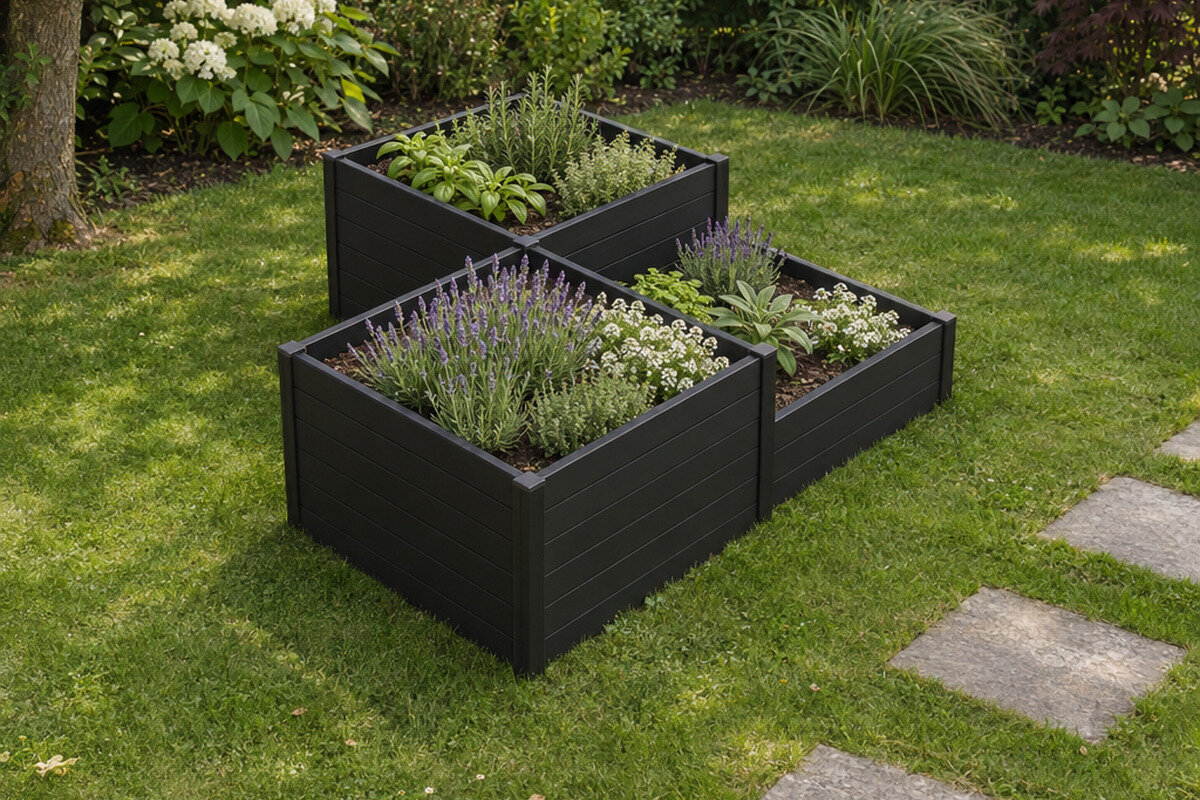
Are the illustrated Bloomcabin frames made from sleepers?
No. The illustrated options use aluminium walls or an aluminium-and-Accoya construction, not solid timber sleepers. If the best sleepers for raised beds still leave too little planting width on your site, compare the actual internal dimensions of a narrower-wall design before deciding.
Buy against your measured plan
Get the timber specification in writing, test your reach and price the cut pieces, fixings and fill together. The best sleepers for raised beds are the ones that meet those checks without making the bed harder to build or tend.
Find a raised bed for your plan
Compare layouts and check the dimensions on the product page.
