
Black raised planter: how to choose the right material and finish

Bloomcabin · Raised-bed guides
Black raised planter: how to choose the right material and finish
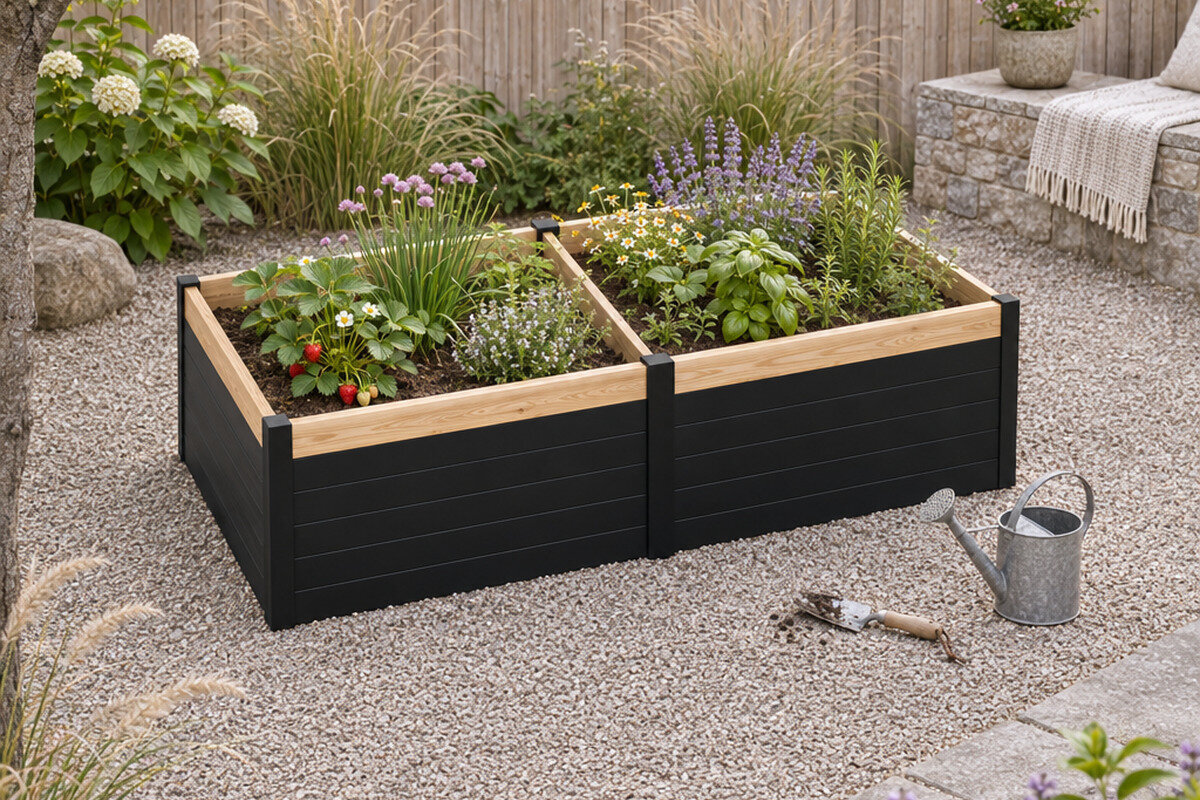
Choose a black raised planter by checking what it’s made from, how the black finish is applied and what the maker says it can be used for. If you plan to grow food, confirm that the soil-facing materials and finishes are intended for that use before you buy or fill it.
Identify the substrate
A black raised planter could be made from several materials. Ask what is beneath the finish.
Confirm the intended use
Check that the maker’s guidance covers the crops you intend to grow and the surfaces that will touch damp growing media.
Judge the actual finish
Compare a sample outdoors if possible. Sheen and texture can matter as much as the shade.
Plan for upkeep
Use the maker’s preparation, cleaning and repair instructions rather than treating all black surfaces alike.
When comparing a black raised planter with another that looks much the same, ask for the specification for the exact model and colour. One may get its colour from the material itself; the other may have an applied coating. That difference affects which cleaning methods and repairs are appropriate.
Work from the inside out: check what will touch the growing media, then assess the visible finish against your garden and decide how you’ll look after it. If you’re recolouring a planter you already own, use the same checks before you buy paint or start preparing the surface.
01
Find out what sits beneath the black finish
Start with the exact model and colour option you intend to order. A black raised planter can have different materials in its panels, supports and fixings. Ask for a component list and the model’s assembly and care instructions. If the listing describes the panels but says nothing about the fasteners, ask what they are made from and which replacements the maker specifies. A thickness figure helps identify what you are buying, but it does not establish how much the assembled structure can hold.
Compare that level of detail with the Narrow Aluminium Raised Bed 200×50×50cm. Its specification identifies aluminium wall panels, corner posts and T connectors. The Ascending Triple Accoya Raised Bed, by contrast, uses aluminium below 20 mm-thick Accoya boards at the top of each compartment. That thickness applies to the timber boards, not the aluminium below them. Neither specification establishes that the model is a black raised planter.
When comparing listings for a black raised planter, keep confirmed details separate from your assumptions. A photograph cannot identify a metal grade, distinguish a coating from a coloured substrate, or tell you what touches the soil on the reverse face.
- For metal, ask for the metal type and grade if specified, the panel thickness and the finish on each face.
- For timber, ask for the species or named material, board thickness, any treatment and the finish on faces and ends.
- For plastic or a composite, ask what the material is, whether the colour runs through it and whether any separate surface layer is used.

02
Check what the finish can come into contact with
If you want a black raised planter for salad leaves or culinary herbs, ask the supplier a direct question: ‘Is this exact model and finish intended for growing edible crops with damp growing media against the inside walls?’ Ask whether the answer covers panels, treatments, internal finishes and any liner the maker specifies. If the intended use depends on fitting that liner, obtain the instructions before buying. Don’t assume a liner you add yourself makes an unidentified finish suitable or preserves the intended drainage.
Read the answer for what it actually confirms. ‘For outdoor use’ describes where a product is meant to go; it doesn’t answer what the inside can contact. ‘Black powder-coated’ names a finishing method, not the suitability of the assembled planter for edible crops. Even a useful coating data sheet may cover only one component. If the outer finish is documented but the soil-facing material isn’t, ask for the missing detail rather than treating the exterior specification as an answer.
The same distinction helps when you already own a black raised planter. Look for a model label or purchase record so you can match the finish to the right instructions. If you cannot establish what a second-hand planter was made from or previously treated with, don’t try to settle the question by painting over it. Unknown composition isn’t proof of harm, but it isn’t a basis for choosing the planter for food growing. Pick a documented alternative if you can’t resolve the uncertainty.

03
Compare sheen, texture and the visible details
Decide what job the colour should do. A black raised planter against a dark fence can read as a quiet edge, while the same shape against pale paving may become a focal point. If you already have black gates or furniture, compare them directly rather than expecting two finishes called ‘black’ to match. Look at the face you’ll see most often, from the place you normally approach or sit.
If the supplier offers a finish sample, hold it vertically beside the intended background in daylight and shade. Compare the sheen and texture as well as the shade. If marks from soil splashes or watering would bother you, look at the sample both wet and dry. This is a way to judge the appearance you’ll live with, not a test of weather resistance. Use gallery images to compare shapes and details, not as proof of the delivered colour or finish.
On a black raised planter made from several components, ask whether posts, connectors and exposed fixings are meant to match the panels or contrast with them. If a continuous black line matters to your design, check corners and top edges as carefully as the broad faces. For a black raised planter you may want to touch up later, ask whether the maker offers a matching repair finish and whether it is intended for small marks or broader areas. A visible patch may matter more on the patio-facing side than at the back.

04
Prepare the surface before you coat or repair it
If you’re buying a factory-finished black raised planter, inspect it before assembly and filling. Look at corners, edges and the areas where panels join. Photograph any damage and ask the supplier what it recommends before sanding, sealing or covering the area. Keep tools and components off visible faces while you work, and follow the actual assembly instructions rather than enlarging holes or substituting fasteners to make parts fit.
If you want to turn an existing bed into a black raised planter, identify both the substrate and what is already on it. A coating intended for bare timber isn’t automatically appropriate over a previous treatment, and a product described as metal paint isn’t necessarily intended for an existing factory finish. Check the planter maker’s advice and the coating instructions together. Confirm that the proposed system is intended for the exact surface and for the part you want to coat. If the old finish is unidentified, don’t sand it back or paint over it as a shortcut.
Once you’ve confirmed a compatible system, follow its sequence: remove dirt and other contaminants by the specified method, let the surface dry as directed, and abrade or prime only where the instructions call for it. Keep decorative coatings off soil-facing areas unless that use is explicitly supported. Check the application conditions and the time needed before reassembly, filling or exposure to weather. A surface that feels dry to the touch isn’t your cue to skip the maker’s return-to-use instructions.

05
Check the base and leave room to care for the finish
Check how the base is designed before settling on a spot. A black raised planter may be an open-bottomed bed or a container with its own base and drainage arrangements. The linked Bloomcabin aluminium model is open to prepared ground and has no floor panel. If your preferred black raised planter is for paving, look for explicit instructions for that surface. Establish how the growing media will be retained and where water will go rather than assuming an open-bottomed design can be converted on site.
Read the dimensions for the decision you are making. An outside footprint tells you where the structure will sit; clear internal measurements tell you what room the plants have. Wall height is not necessarily rooting depth: fill level matters, as does whether roots can extend into suitable ground beneath an open bed. Ask for the actual measurements if a narrow gap or a crop’s space requirement makes small differences important.
Leave room to reach the plants without stepping into the growing area, and check that the path is firm and water is within practical reach. Give yourself access to the face and joints you expect to inspect or clean. Before committing to a black raised planter tight against a wall, consider whether you can see and reach the rear fixings after filling. If those fixings require periodic checks, decide how you’ll reach them before positioning the bed.

06
Inspect first and repair only what needs attention
Plan to inspect a black raised planter when you clear crops or tidy the surrounding area, and after a knock or scrape. Use those occasions to look at corners, joins and the soil line. A surface mark may be cosmetic, but lifting finish, exposed material or movement at a joint warrants a closer look. Take a clear photograph and record where the change is. The maker can give more useful advice if it knows whether you’re dealing with an outside panel, a fixing or a soil-facing edge.
Use the specified cleaner and tools. Don’t assume pressure washing, abrasive pads or strong cleaners are suitable just because the product lives outdoors. If you see a mark on a black raised planter, start with the approved cleaning method so you can distinguish surface residue from damage. If the mark remains, don’t scrub harder or cover it with paint before you know what it is.
Keep the finish name, assembly instructions and any approved repair guidance together. Ask whether a repair can be made with the bed filled, especially if the damaged area is inside or debris could fall into the growing media. For timber with an applied finish, check what signs call for renewal; for coated metal, ask how the maker wants chips handled. Don’t assume either needs an annual repaint, and don’t treat a low-maintenance description as a reason to ignore damage.

07
Worked example: compare two matt black options for salad leaves
Hypothetical example: Priya wants a matt black raised planter for salad leaves along a 2.4 m clear garden edge. She can work from the path along one long side, and the proposed bed position is on prepared ground. She uses the Narrow Aluminium Raised Bed 200×50×50cm as a size comparison. Its nominal footprint is 200 × 50 cm and its wall height is 50 cm. A nominal length of 2 m leaves 0.4 m along that edge, or 20 cm at each end if centred. That is leftover length, not a recommendation for working clearance or proof of the assembled dimensions.
She separately checks whether she can comfortably reach across the proposed strip from the path. Then she compares two hypothetical listings of similar size. One calls its planter ‘matt black, weather resistant’ but doesn’t identify the underlying material or the interior finish. The other identifies the substrate and finish on both faces and provides instructions covering damp growing media and edible crops. Priya still checks the panel thickness, specified fasteners and touch-up advice on the second option rather than assuming the better description answers everything.
The Bloomcabin comparison helps Priya picture the size and an open base, but the supplied specification does not establish that it is a black raised planter. Her buying decision is to proceed only with a model that meets her site requirements and confirms both the finish she wants and the intended growing use. If the first seller can’t answer those questions, matching the colour and footprint isn’t enough.

Questions readers ask
Does a black raised planter have to be painted?
No. The colour could be part of the material or come from an applied finish. Ask how it is achieved, especially if you want to touch up a scratch later. The same-looking surface may call for different care depending on what is underneath.
Is an outdoor finish enough for using a black raised planter for vegetables?
No. An outdoor-use description does not establish suitability for growing edible crops. Ask about the complete product, including surfaces and treatments that may touch damp growing media. If the answer only covers the exterior, the question is still open.
Can I touch up a black raised planter without emptying it?
That depends on the repair location and the maker’s instructions. Ask whether the repair can be confined to the outside, how to protect the plants and growing media, and when the surface can return to use. Don’t assume an interior repair is suitable with the bed still filled.
Make the finish part of the decision
Choose a black raised planter whose finish you like and whose material, intended use and care instructions you can verify. If a key answer is missing, pause before buying, painting or filling it.
Find a raised bed for your plan
Compare layouts and check the dimensions on the product page.
