
Buying a Pergola for a Restaurant or Café Terrace
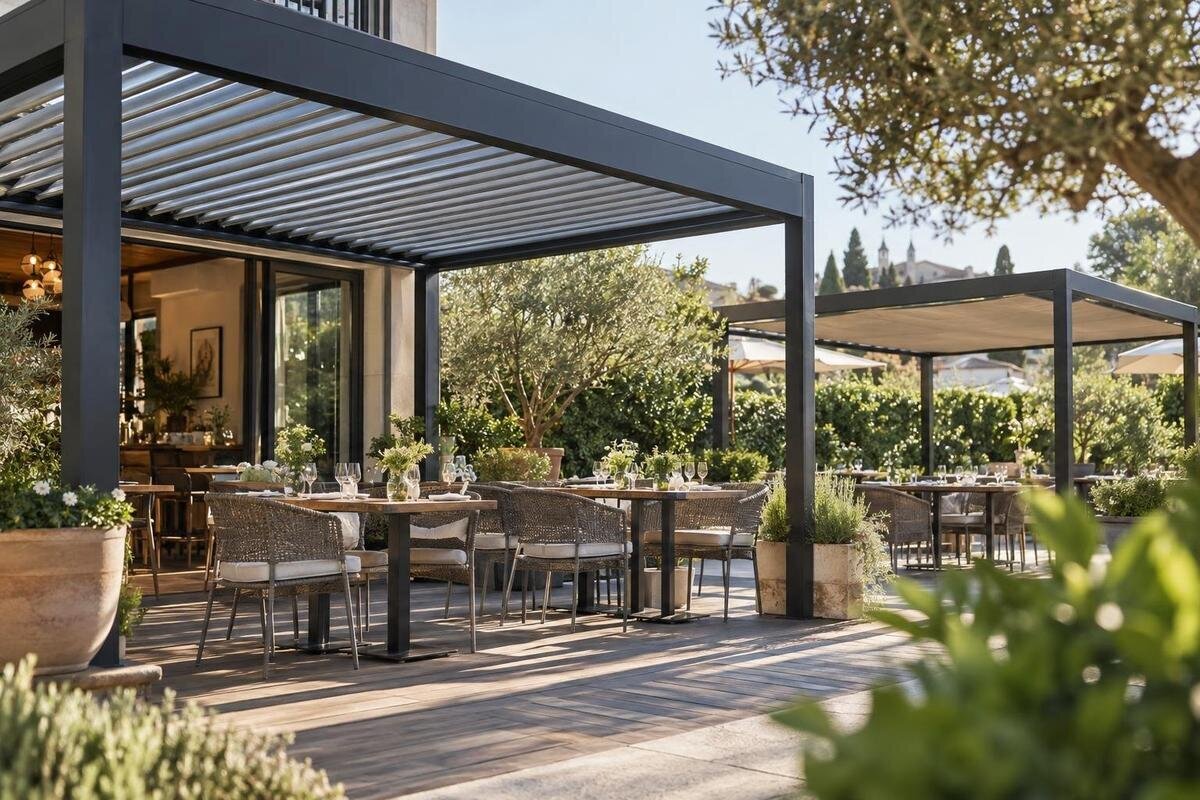
Restaurant and café terrace pergolas
Choosing a pergola for a restaurant or café terrace is a layout and operating decision as much as a style choice. The structure has to fit around tables, staff routes, the building and the way the venue serves. The word pergola does not, by itself, tell you how much shade or rain protection a particular roof provides. Before ordering, compare the actual footprint, roof behaviour, site requirements and full installation scope against a realistic service plan. This guide focuses on those buying questions, rather than assuming one design suits every commercial terrace.
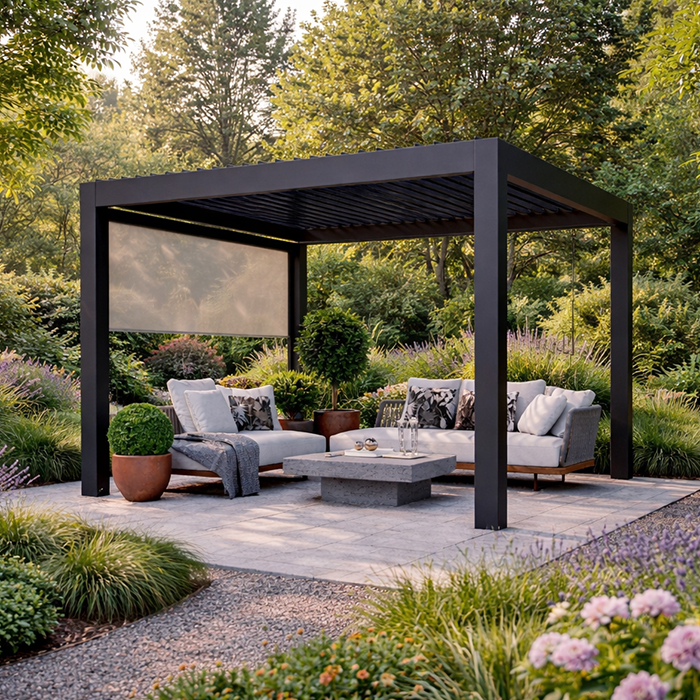
Decide how the terrace will be used
Before comparing pergola designs, decide what role the covered area must play in the venue’s service. A café with a few breakfast tables may use its terrace differently from a restaurant taking evening bookings outdoors. Note the days and hours you expect to serve, how long tables are occupied, whether furniture stays outside between services and where guests wait. This separates the basic aim—defining a dining zone, improving shade or extending use in less settled weather—from a vague hope that one structure will solve everything. Record and rank each aim before looking at product pages.
Ask front-of-house and kitchen staff to walk through an ordinary sitting and a busy one. Where do guests queue, how do servers reach each table, where are cleared plates taken, and which routes must stay clear? If the terrace also serves takeaway customers, private bookings or changing seasonal layouts, note those separately instead of planning for one ideal arrangement. Decide whether the area will be used only in comfortable conditions or whether you expect the pergola to support more frequent service. That answer will shape the roof, lighting and heating questions you ask, but does not guarantee a product can deliver them.
Measure the whole usable footprint
Measure from fixed site boundaries rather than estimating the seating area by eye. Record the width and depth available, changes in level, walls, shopfront, drains and the positions of doors and service points. Compare these measurements with the pergola’s stated overall footprint, including posts and any roof projection, not just the area beneath the roof. The structure can occupy more terrace than the tables underneath suggest. Before treating a candidate such as the Bloomcabin pergola product page as a fit, identify which dimensions are stated and which still need confirmation.
On a plan, include table tops, chairs in their occupied positions, standing guests and the route between the entrance, host point and service area. Show doors opening, steps, fixed furniture and any changes in level. A row of tables that fits on paper can still leave too little room to serve or move through once occupied. Compare the clear usable area beneath the roof as well as the overall dimensions, and ask for a drawing showing post positions before ordering. Check any customer-access route against the requirements applicable to your premises.
Compare attached and freestanding layouts
An attached arrangement and a freestanding one create different constraints. A structure beside the building may align with an existing doorway or façade, while posts in a freestanding layout can take up space in the dining area or sit at its edge. Neither is automatically better for a restaurant: the choice depends on the boundaries, circulation and surface or wall available. If attachment to the building is proposed, ask what fixing method and wall conditions the manufacturer or installer requires. Do not assume that a shopfront, canopy or façade can support a structure.
Mark doors, opening windows, vents, external lights, signs, gutters and cleaning access on the same plan. Check whether the roof edge could cover an entrance, obscure menus, interrupt views from the host point or overlap with neighbouring features. If the terrace is close to a public route or another tenant, discuss boundaries and operating arrangements with the relevant owner or manager. A listing such as the Bloomcabin pergola listing should be assessed from its stated installation details, not just its image or name; ask for site-specific drawings where information is unclear.
Set expectations for shade and rain cover
Write down whether the priority is shade at lunch, shelter from rain, daylight, airflow or a combination. Pergola roofs vary: some leave an open space above, while other designs use adjustable or more complete coverings. The category name and a photograph cannot establish whether a particular roof can be closed, how it performs in rain or how much area it covers. Ask for an exact written description of roof operation, any side components and the conditions or limits attached to advertised coverage. Avoid treating shade and rain protection as interchangeable.
Look at the terrace at the hours you plan to trade rather than judging the shade from a single midday visit. Buildings, neighbouring structures, trees and the changing angle of the sun can alter the light; record which tables need cover and when. Ask where water goes when the roof is closed or wet, whether drainage is included and whether run-off could affect doors, seats or walkways. When comparing this Bloomcabin pergola page, use any stated roof details as the basis for questions and request written clarification for anything not specified.
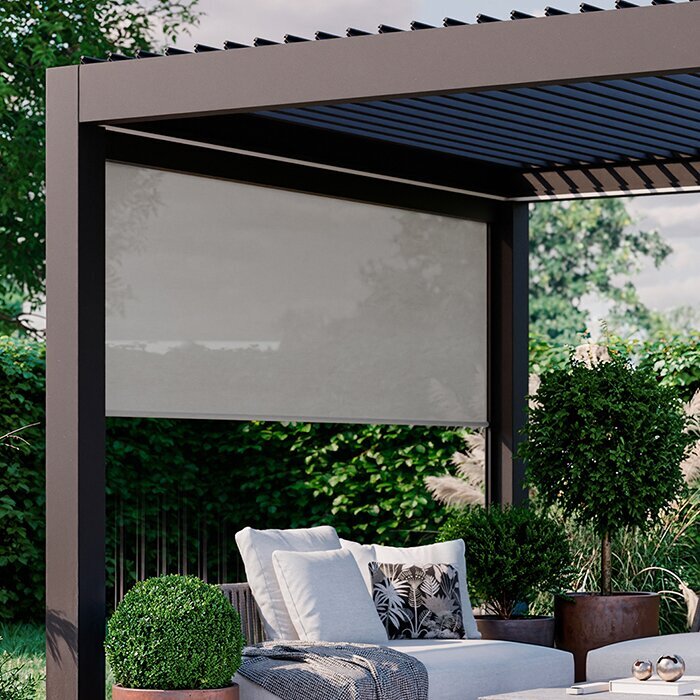
Check mounting, drainage and site access
The terrace surface is part of the purchase decision. Note the paving or decking, changes of level, existing drains, service covers and any areas that cannot be disturbed. Ask the installer to inspect the proposed post positions and confirm what the specific product needs for fixing, support and access before you pay. A photograph or rough footprint is not enough to establish whether a finished terrace is suitable; installation may require site-specific checks. Do not choose fixings or estimate structural capacity yourself: have those matters assessed by a suitably qualified professional.
Include wind exposure, rainwater flow and nearby doors in the site review, even if the terrace seems sheltered at ground level. Ask the supplier or installer to explain the conditions under which the proposed arrangement is suitable, what preparation is included and what happens if a survey finds the surface needs work. A delivery route for components and space for assembly or temporary storage may also matter in a working venue, particularly where access is shared. Before ordering through the pergola product listing, request written installation requirements and a clear statement of any work excluded from the quote.
Compare materials and maintenance requirements
With food and drink served nearby, cleaning and maintenance should be part of the comparison, not an afterthought. Consider likely splashes, dust, pollen and marks from customers, as well as airborne grease where the terrace is near a kitchen. Ask what cleaning methods are permitted for the exact material and finish. Do not infer care needs from a material name, colour or product photograph. Request written instructions covering routine cleaning, suitable products and any maintenance that must be done by a specialist; if the information is missing, ask the seller before ordering.
Think about who will do the work and when. A finish that looks right in a brochure may need more careful cleaning than the venue can routinely provide, while difficult access above tables can make even simple upkeep disruptive. Ask whether components can be serviced or replaced individually, what parts and care guidance are available, and whether products used to clean the terrace could affect the finish. For this Bloomcabin pergola listing, request care information for the exact product and finish being quoted rather than relying on general advice. Include planned maintenance in the budget and operating schedule.
Plan lighting and heating separately
Treat lighting, heating, screens and signage as separate specification questions. A picture showing accessories does not prove they are included, compatible with the model or suitable for the intended commercial setting. List what the service actually needs, such as lighting for evening menus, a way to adjust the light, a heater or a wind screen. Then ask which items are included, optional or supplied by others, and whether fitting them affects installation or ongoing service. This avoids comparing a basic price with a more complete package as if they were equivalent.
If the plan depends on electrical equipment or heat, involve a qualified installer before ordering and confirm compatibility, clearances, power requirements and safe operation for the specific site. Do not improvise wiring or assume a product image shows an approved setup. Consider controls, staff access, cleaning around fittings and what happens if a component fails during service. If the Bloomcabin product listing is on your shortlist, request a written list of included and optional additions for that exact product. Ask the quotation to identify who supplies and installs each item.
Test the layout against staff and customer movement
Try the proposed plan with real furniture dimensions and a realistic number of guests, not simply a count of tables. Mark the post positions on the floor if possible, place chairs where they will be when occupied, and walk the main route as someone carrying plates or drinks would. Check turning space at the entrance, the path to a host point and views between tables and staff. A post can interrupt a serving route or split a table group even when the overall footprint appears to fit. Ask the team to identify places where they would need to step around furniture.
Test the layout at changeover as well as during service: staff may need to clear tables, move chairs, bring out menus or store furniture. Note whether a queue or waiting guests would block the entrance and whether customer routes remain practical for the premises. If children, mobility aids, pushchairs or larger group bookings are common, include them in the trial and check applicable access requirements with a competent adviser. When assessing the Bloomcabin product page, compare its stated footprint with this working plan; do not use nominal roof area as a substitute for movement space.

Compare the full order and installation scope
Ask for a written, itemised quotation based on the exact product and site. It should identify the product reference, dimensions, finish and roof configuration, plus any lighting, heaters, screens or other extras you have agreed to consider. Separate the cost of the structure from delivery, unloading, installation, surface preparation and work by other trades. Check whether a survey, fixings, drainage components, assembly, waste removal and making good are included or excluded. These details make quotations comparable and expose gaps before a deposit is paid. If the terrace plan changes, ask whether the specification and quotation need revising.
Clarify practical order terms as carefully as the product description: delivery access and unloading, who receives the goods, where they can be stored, the expected installation sequence and how site access affects service. Ask for lead-time estimates, payment stages, cancellation or return terms, warranty conditions and an after-sales contact in writing; none should be assumed from a listing. Keep a record of approved drawings and agreed exclusions. A page such as another Bloomcabin pergola page can be compared against the same checklist, but only the final written quotation can show what is actually being supplied to your venue.
Check permissions and site requirements before buying
Physical fit is only part of approval. Before committing, check with the property owner or landlord, the relevant local authority and any other responsible party whether the proposed structure and terrace use need permission at that site. This is especially worth clarifying where seating occupies a pavement or shared area, or where work would alter a building. Requirements can depend on the premises and the proposed arrangement, so do not rely on what another restaurant nearby has installed. Discuss structural fixing, customer access and fire-safety questions with appropriately qualified professionals.
Make the final comparison against a short set of non-negotiables: the pergola fits the measured plan; the roof behaviour matches the service aim; installation and maintenance are documented; additions are clearly priced; and site approval and safety questions have answers. Mark each point as confirmed, still open or unsuitable rather than judging an attractive image against unknowns. Include delivery, preparation, fitting and foreseeable upkeep when considering the total budget. If an important detail is unresolved, pause the order and obtain written clarification; changing the plan after purchase can affect layout, costs and scheduling.
Frequently asked questions
How much space should I allow around a restaurant pergola?
Measure the complete outside footprint and any roof projection, then plot the post positions against tables, pulled-out chairs, doors, fixed furniture and staff and customer routes. Plan for the terrace in use, not just when it is empty. Ask for a dimensioned drawing showing overall and clear dimensions, and check applicable access requirements with a competent adviser.
Will a pergola keep diners dry?
Not necessarily. Pergola roofs differ, and an open roof should not be assumed to keep diners dry. Ask for written details of how the exact roof operates, its stated weather limits and how rainwater is managed. Check that entrances and pedestrian routes will not be affected by run-off before ordering.
Is an attached or freestanding pergola better for a café?
Neither is automatically better. A wall-adjacent design depends on the building, attachment conditions, permission and nearby doors or services. A freestanding layout needs posts placed without obstructing dining and circulation. Compare site drawings and have the surface or façade assessed by a qualified installer before deciding.
What should a pergola quotation include?
Ask for the exact product reference, overall and clear dimensions, finish, roof configuration and included accessories. The quotation should separate the pergola from delivery, unloading, installation and surface preparation, and list exclusions. Confirm the expected lead time, payment and warranty terms, site survey arrangements and who is responsible for each part of the work.
Can I use any garden pergola for a restaurant terrace?
No. The word pergola alone does not establish a product’s suitability for a busy commercial setting. Ask the supplier for written information about intended use, installation, maintenance and any stated limits, and have the proposed site assessed by qualified professionals. Confirm relevant permissions, insurance conditions and safety arrangements for your premises.
A considered order starts with the way the terrace works in service, then matches its measured layout to the pergola’s documented roof, installation and maintenance requirements. Compare the full scope rather than choosing on appearance or headline footprint alone. Where an important point about fit, permissions, safety or compatibility remains uncertain, resolve it with the seller or a qualified professional before committing.
