
Buying a pergola for rain protection: roof and drainage limits
Pergola buying guide
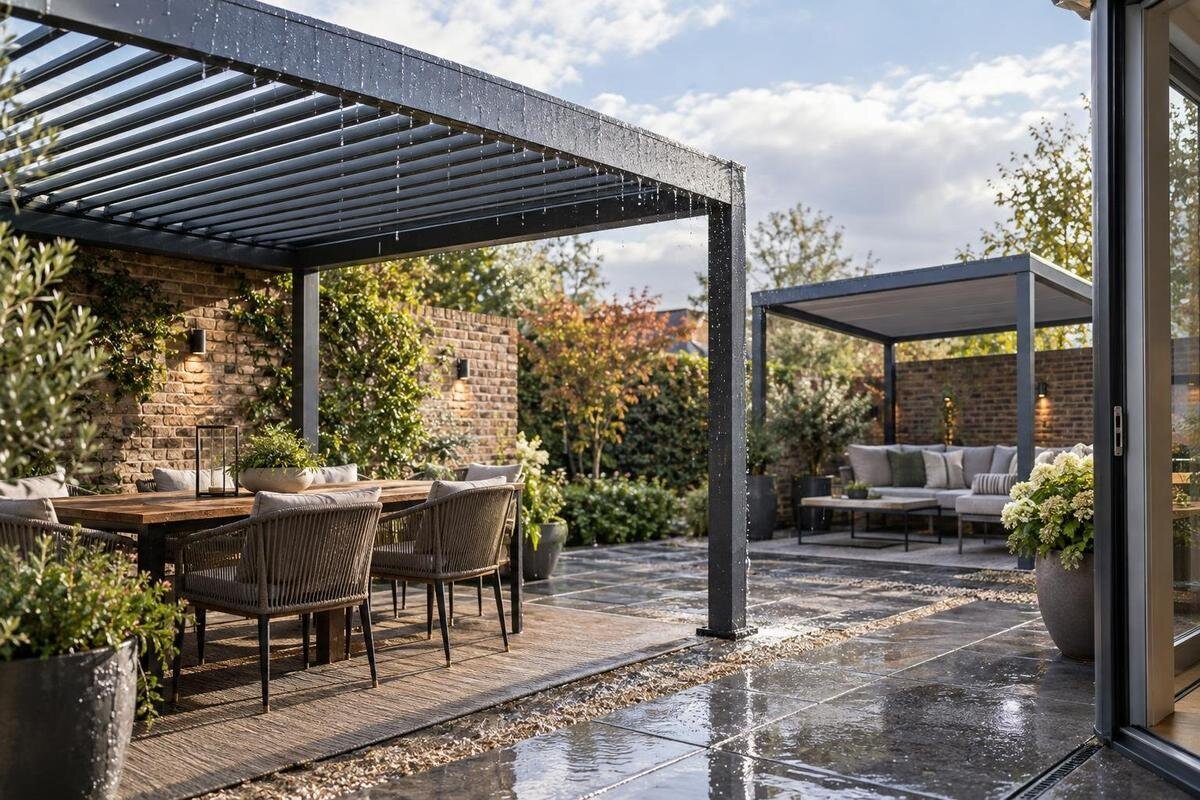
A pergola can redirect rain without creating a fully dry outdoor room. The roof affects how much water passes through or is shed; gutters, outlets and the route to the ground determine where it ends up. Wind-driven rain and a junction beside a house can still expose the area. This guide explains what to establish from product information, how to trace drainage as a complete route and where rain cover has limits.

01
Define what needs to stay dry
First decide what rain protection must mean in your garden. Keeping a table usable during a brief shower is not the same as storing cushions under a roof through prolonged rain. An open-beam or slatted top can provide shade while allowing water through; a roof that closes may reduce direct rainfall, but water can still reach the edges. List what must stay dry, for how long and over what area: a doorway, the whole seating set or only part of the patio. If furniture needs to remain dry when nobody is there, state that explicitly. This gives you a requirement to compare with product information rather than an impression from a photograph.
Consider rain arriving at an angle, too. An open-sided pergola cannot be assumed to keep furniture dry when wind carries water across the space, even if the roof sheds falling rain. Nearby shelter and the position of the covered area affect what feels usable, but neither substitutes for a manufacturer’s stated limits. Ask whether the description refers to the whole roof area or only a more protected zone beneath it; the outer edges may not stay equally dry. Treat the Bloomcabin pergola listing as a product page to assess, not evidence of a particular rain rating or covered footprint. Compare its written description and drawings with the need you have defined. If they do not explain wet-weather use, ask for clarification before deciding.
Compare roof designs and how they close
When comparing roof forms, establish whether the top is open, fixed, retractable or adjustable, then find out how that construction behaves in rain. Open rafters or gaps between slats let water through. A continuous covering may deflect direct rainfall, but its construction, seams, slope and edge treatment affect the result. Adjustable louvres can alter the opening, yet closing them does not automatically make their joints watertight. A retractable fabric roof may have specific wet-weather or operating limits; do not assume it performs like a permanent covering. Check whether instructions say anything about its position during rain. These broad labels help sort designs, but are not a substitute for model-specific information.
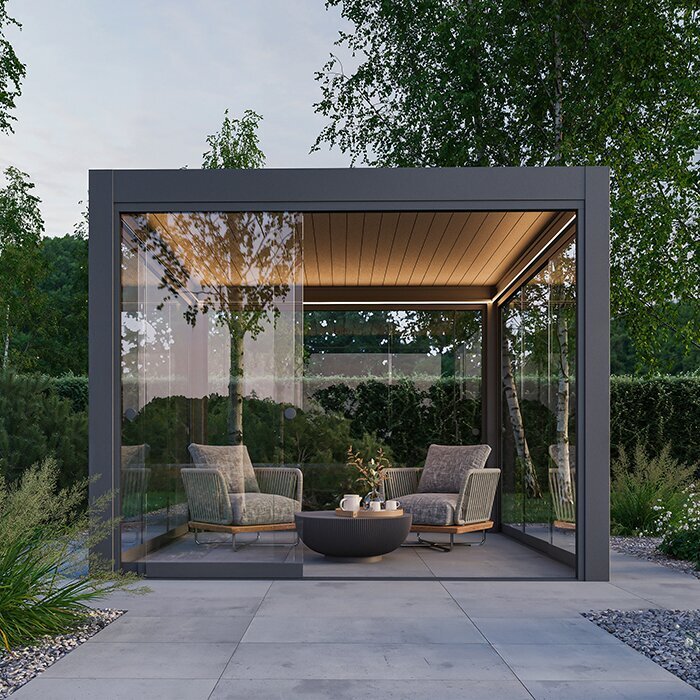
Consider how much control you want alongside the cover. A movable roof requires you to understand its positions, operation and any instructions for wet conditions; a fixed roof cannot be opened when you want more sky above the space. A category name on the Bloomcabin bioclimatic aluminium pergola page is not itself a rain claim and does not settle how a roof closes or drains. Compare the stated construction and water handling rather than relying on the word bioclimatic or the solidity of an image. If several roof arrangements appear in the product gallery, check that the description applies to the exact version you are considering. Ask whether that configuration is intended for the kind of rain cover you expect.
02
Look for model-specific rain claims
Look for wording that states what protection is promised and under which roof position and conditions. Check whether the roof must be fully closed, how moving joints and perimeter edges are handled, and whether the description covers wind-driven rain as well as rain from above. Terms such as water-resistant or weatherproof need a practical explanation for the particular model; a broad label may not answer how dry the space will be. Request the product instructions or technical information, and note any stated limits on operation or weather. If performance changes with roof position, make sure the position you intend to use is covered by the claim. Ask for any relevant conditions to be given in writing.
A picture can show the roof shape, but it cannot establish sealing at joints or how water is collected. The Bloomcabin lean-to pergola listing identifies a product to examine; its name does not prove that the roof keeps out rain. Ask the seller to state plainly whether rain cover is an intended function, how runoff leaves the roof and what areas remain exposed. Keep the answer alongside the exact configuration you are considering. If the response points only to a photograph, a general outdoor-use description or an unqualified assurance, the question remains open. It is reasonable to ask for detail before treating the structure as shelter in wet weather.
Follow water through the roof drainage
Rain cover is incomplete unless the water has a planned route off the roof. Find out whether the design uses an edge gutter, a concealed channel, an outlet through a post or another arrangement; these are possible approaches, not features to assume. Confirm whether gutters, outlets and downpipes are included, sold separately or left to site installation. Follow the route from the roof edge to the outlet on a drawing or in the manual. If water passes through a post or hidden section, ask where it emerges and whether the final discharge point is part of the proposed work. Also ask whether the outlet position depends on the chosen configuration. The word drainage by itself does not explain the route.
Request a diagram for the exact configuration, including optional parts and the position of each outlet. Consider whether an outlet sits above a doorway, seating or a route people use, and how it can be inspected. Leaves and dirt can obstruct channels, so find out what access and cleaning the instructions require. Check the general Bloomcabin pergola product page against those details; the product name alone does not confirm that a gutter or downpipe is included. A roof with a drainage feature is not necessarily a complete site drainage plan, so note any missing connection or work before comparing options.
03
Choose the discharge point before ordering
Follow the water beyond the outlet to the place where it will land. A discharge beside the pergola could leave a wet patch on paving, cross a walking route or collect near a doorway; directing it towards a garden bed is not automatically suitable either. Look at the ground surface, any low spots and the direction water can move, as well as where people sit and walk. Consider whether runoff could pass beyond the intended area or towards a neighbouring surface. Mark the proposed footprint and each outlet on a simple site sketch to expose clashes before ordering. The useful question is not merely where a gutter ends, but where the water goes next.
Trace each outlet to its intended destination rather than stopping at a post or gutter. If the plan is to connect to an existing building drain or alter a hard surface, ask an appropriate installer or drainage professional to check the arrangement for the site and any relevant local requirements. Do not assume that a nearby downpipe is compatible or that water can simply be released at the base. The bioclimatic aluminium pergola listing identifies a product to compare, but only the exact installation information and a site-specific plan can establish where its roof water would go. If the route is still unknown, settle it before placing the order.
Allow for wind-driven rain
Rain falling vertically is only part of the test. With open sides, wind can carry water beneath a roof and onto furniture, cushions or a threshold; the shape of the roof alone cannot prevent this. Think about how exposed the proposed position is, which direction rain reaches it from and whether nearby buildings offer any shelter. Such shelter may improve comfort, but do not count it as product performance unless the information explains the conditions. Set expectations for the area near the roof edges as well as the centre: the space beneath may not stay equally dry across its whole footprint. Consider where you would place furniture if the edges are exposed.
Side panels, screens or curtains can alter how rain enters, but should not be assumed to turn an open structure into a sealed enclosure or to be suitable in every condition. Check what is included, what any side element is designed to do and whether its instructions affect wet-weather use. Assess this Bloomcabin lean-to pergola page for explicit information about the proposed configuration, not for shelter implied by the product name. If side rain is central to your requirement, ask for a clear description of the protected area and its limits. Otherwise, plan seating around the possibility that rain can enter from the sides.
04
Check the junction beside a house
Where a pergola sits against a house, treat the junction with the wall as a separate rain detail. Water may enter at a poorly resolved meeting between structures, and the pergola’s drainage can interact with an existing gutter, window or doorway. Check whether the product is intended for the arrangement you have in mind and what instructions or drawings describe the connection. A wall-adjacent position does not, by itself, seal a gap. Nor should you assume that a pergola can be fixed to any wall or connected to building drainage without specific guidance. Ask how the roof edge and the existing rainwater route relate to one another; the interface needs its own clear answer.
Give the installer information about the wall and nearby openings before ordering, then ask what preparation and fixing method the manufacturer permits. A qualified installer can assess whether the proposed junction and discharge route suit the actual building; a generic catalogue description cannot settle that. If the pergola is freestanding, check the gap between its roof and the house instead: rain may still reach the strip in between, and the position of existing gutters can affect the plan. In either case, agree the interface in a drawing or written scope rather than relying on a product photograph or the word attached. This is particularly important where runoff could reach a doorway.
Measure the covered area and maintenance access
Use dimensions from the product drawing, not perspective in a photograph. Confirm the roof outline, post positions and any projections or gutters, then compare them with the place you want covered. The roof footprint may differ from the clear space between posts, so note exactly which measurement the seller gives. Check clearance for doors, windows, paths and chairs, and consider whether an edge or outlet would put water where you do not want it. Where configurations differ, verify that the dimensions and drainage details refer to the same version; a size by itself cannot establish how much of the space will be kept dry.
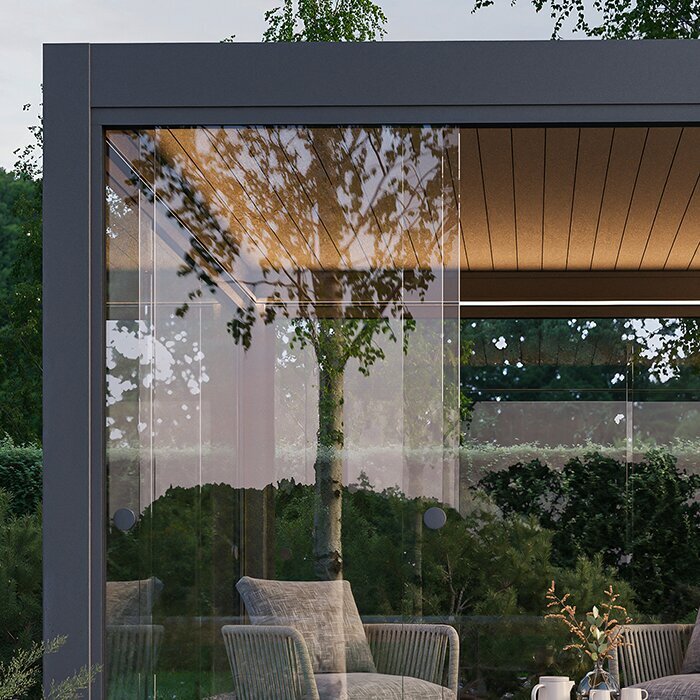
Maintenance access belongs in the layout too. Gutters and outlets may need inspection or clearing, while adjustable or retractable parts have their own operating instructions. Find out how the manufacturer expects you to access and maintain them safely, whether furniture will obstruct that access and whether particular work should be done by a professional. Compare the drawing and care information for the Bloomcabin bioclimatic aluminium listing with the exact version you intend to order; do not infer access or operation from a gallery image. A position that leaves essential parts inaccessible can make drainage harder to manage even if its dimensions fit on paper.
05
Get roof and drainage details in writing
Before committing, ask the supplier precise questions: Is the roof intended to shed rain in the position I will use? What happens at joints and edges? Which gutters, outlets and downpipes are included, and what is the specified discharge route? Are extra parts or site work needed? What wall connection is permitted, if relevant? Request answers and drawings for the chosen configuration rather than relying on broad phrases such as all-weather or integrated drainage. Use this Bloomcabin pergola page as the product reference, then compare its written details with the questions; a listing and its installation instructions may not provide the same information. Keep the relevant documents with the order details.
Make sure the order summary matches the answers: roof arrangement, dimensions, drainage components, selected options, installation responsibility and exclusions. If installation is arranged separately, ask who will assess the ground and water route and which points must be agreed before work starts. Keep supplier and installer responsibilities clear so that a missing outlet or unresolved wall detail is not discovered later. Compare alternatives using the same scope and questions, not just a feature photograph or short product title. When a technical point depends on the building or ground, have the installer confirm it for that site.
Balance rain cover with everyday use
Finally, balance rain cover with the atmosphere you want outdoors. A permanent roof can change the daylight reaching a patio; an open top leaves a more exposed space but offers little rain cover. An adjustable or retractable option may allow a change in roof position, yet that flexibility is useful only within the model’s stated operating guidance. Think about whether you want a covered spot throughout the year, a roof that can open in dry weather or simply respite from showers. Check the instructions for use in wet conditions instead of assuming a movable roof can be operated at any time.
If you expect a reliably dry area even when rain blows in from the sides, ask whether a pergola on its own can meet that expectation. An open-sided roof may protect the ground from direct rainfall and still leave the edges exposed. Side elements can change the look and use of the space, but only their specific description establishes what they do. If the product information cannot support the level of protection you need, do not turn modest rain cover into a promise of an enclosed dry room. Match the purchase to the use the design can substantiate.
Frequently asked questions
Will a pergola keep rain off completely?
A pergola roof may keep direct rainfall off part of the area, but performance depends on the specific roof and its stated limits. Open sides still allow wind-driven rain to enter. Check the manufacturer's information for the exact roof position, edges and area covered; do not treat “covered” as meaning fully enclosed.
Are louvred pergola roofs waterproof when closed?
Not automatically. Closed louvres may reduce gaps, but joints, perimeter channels and the design’s stated wet-weather limits vary. Ask for documentation explaining whether the exact model is intended to keep rain out when closed, and whether there are conditions on operation. A general product label is not enough.
Where should pergola rainwater drain?
Follow the route from the roof edge to a gutter or channel, through each outlet, and to the point where water lands or connects to drainage. Check which parts are included and whether that destination suits the site. Ask a qualified professional to assess any new connection or site-specific drainage work.
Can a pergola be installed against a house?
Possibly, but suitability depends on the product’s instructions and the particular wall, openings and existing gutters. Confirm the permitted attachment and how the roof-to-wall junction is detailed. Have a qualified installer assess the building and planned discharge; a product photograph cannot establish a safe or watertight connection.
What should I confirm before ordering?
Confirm the roof’s rain performance in the position you will use, the treatment of joints and edges, the included gutters and outlets, the discharge route, the chosen dimensions, and any wall-connection or installation requirements. Ask for answers and drawings for the exact configuration, and record anything that remains excluded or unresolved.
A sound rain-protection choice depends on the whole route: a roof with clearly stated wet-weather performance, drainage that is specified for the chosen configuration and a discharge point that suits the site. Confirm how open sides and any wall junction affect the area you expect to keep dry. If the product information leaves those points unanswered, clarify them before ordering rather than relying on a title or photograph.
