
Buying a Pergola for Strong Summer Sun: What to Consider
Pergola buying guide
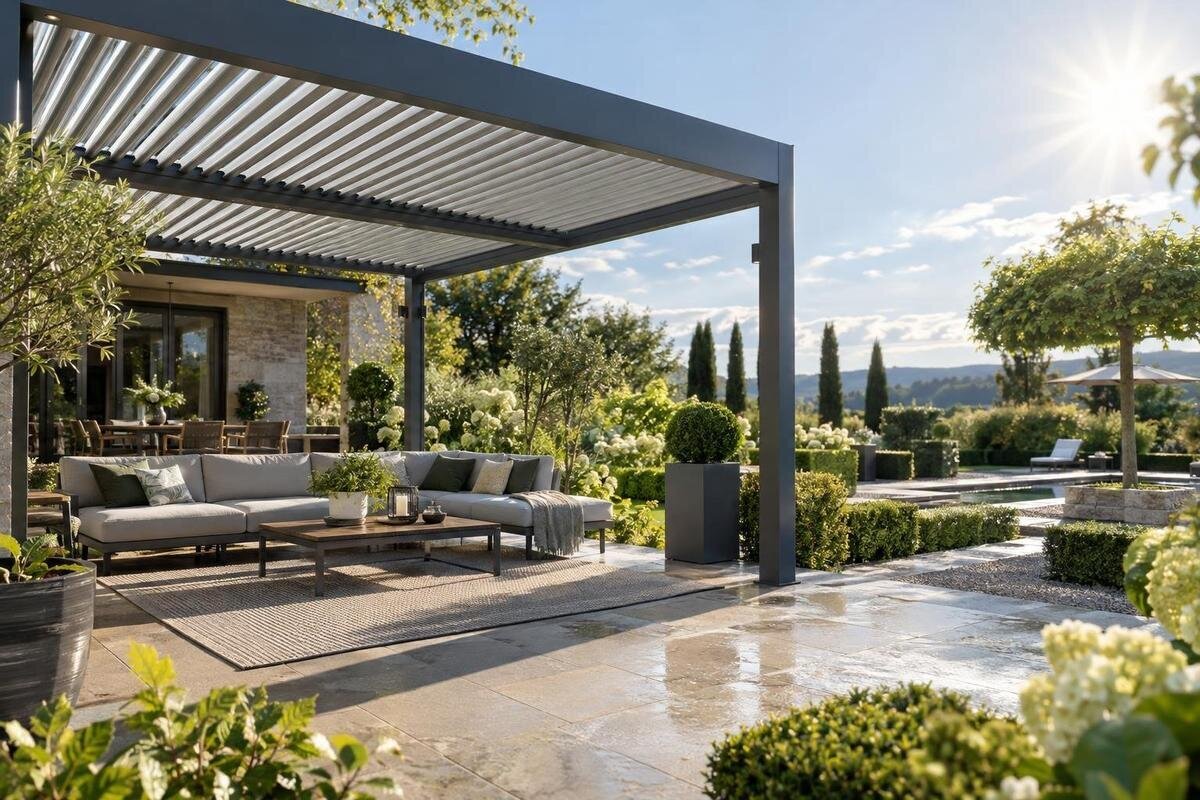
Buying a pergola for strong summer sun is less about choosing the darkest-looking roof than matching shade to the time of day, the place you use and the way your garden works. Compare the sun’s path with the seating or dining area, then weigh roof design, footprint, position and installation requirements. This guide sets out the checks that make product comparisons meaningful, without assuming that every pergola provides the same level of cover.
Before you buy 1
Decide what kind of shade you want
Before comparing pergolas, define what you need the shade to do. A dining table used at lunchtime needs cover over the chairs as well as the tabletop; a reading seat may need protection from low sun at one side. If your aim is a comfortable corner for sitting, you may prioritise broad overhead cover, while a space shared with light-loving planting may call for a more open feel. Strong summer sun is not one fixed condition: overhead light and rays coming from the side create different issues. Note the hours when the area matters and the activity you expect to do there. A clear brief is more useful than choosing by appearance and hoping the shade will suit.
Decide whether you want steady shade or the option to change it. A fixed roof gives a set arrangement, while an open or adjustable design may admit more light or let you alter the cover; the precise effect depends on the construction and position. An open roof can create patches that move across the ground, so do not equate a pergola with an even canopy. Consider who will use the space and how: a meal, reading, entertaining or simply crossing the garden each has a different relationship with glare and sun. Describe your aim in practical terms, such as shade over a seating group at a particular time, rather than asking for more shade everywhere.
Map the sun at your chosen site
Visit the proposed location at the times you expect to use it, ideally on more than one clear day. Note when the sun reaches the table or seating, when nearby buildings or fences cast a shadow, and whether trees change the picture. Morning and late-afternoon rays arrive from lower angles than midday sun, so overhead cover alone may not solve glare from the side. A simple diary with times and a rough sketch is enough; you do not need a precise sun-path calculation to compare practical locations. If weekday and weekend routines differ, include both. This observation gives you a realistic brief for the product search and helps avoid buying a pergola that shades an empty patch while the chairs stay in direct sun.
Mark the sun and shade on a basic plan of the garden. Add the house, boundaries, trees, windows, doors and the area where you intend to place furniture; draw shadows at the useful times rather than relying on one midday snapshot. Remember that the position and height of nearby features affect the pattern, and foliage can change between seasons. Check whether the proposed structure would shade a room or a planting bed that you want to keep bright. The aim is not to predict every ray, but to identify the hours when direct sun is a problem and the direction from which it arrives. That information can guide orientation, placement and roof type.
Before you buy 2
Size the area around furniture and movement
Measure the space as it will be used, not just the empty patch of paving. Include the table, chairs pulled out, loungers and a clear route between the house and garden. Mark the outer edge with string or removable markers and walk around it; this quickly reveals if furniture blocks a door or narrows a route. Also consider how the area will be used when several people are present, rather than measuring only for a tidy furniture arrangement. Then compare that footprint with the structure’s stated overall dimensions and roof coverage, which may not be identical. A page such as the Bloomcabin pergola listing is useful only when its written measurements can be checked against your marked-out space; a photograph is not a scale plan.
Allow for the direction of the sun as well as the pergola’s footprint. The shadow cast by a roof shifts during the day and may extend beyond its edges; low-angle sunlight can still reach furniture underneath from the open sides. A generous structure is not automatically the right answer if it darkens a window, overlaps a boundary or leaves the seating exposed at the time you care about. Compare the roof dimensions, support positions and intended furniture layout before settling on a size. Where product drawings show both overall and usable roof measurements, use the labelled figures and check which one the seller means by coverage. If those details are absent, ask before ordering rather than estimating from a photograph.
Compare roof designs for the shade you need
Roof construction has a direct bearing on the kind of shade you can expect. An open-beam or widely spaced roof lets light through and can give broken, moving shade; it may be a poor match if you want a consistently shaded table during strong overhead sun. A more continuous cover can block more overhead light, but may make the area beneath darker and affect daylight in nearby rooms. Actual results depend on the gaps, material, dimensions, orientation and sun angle, so treat broad labels such as open or covered as a starting point, not a performance guarantee. Compare the roof drawing and written description, and picture the arrangement against the sun observations you made at your own site.
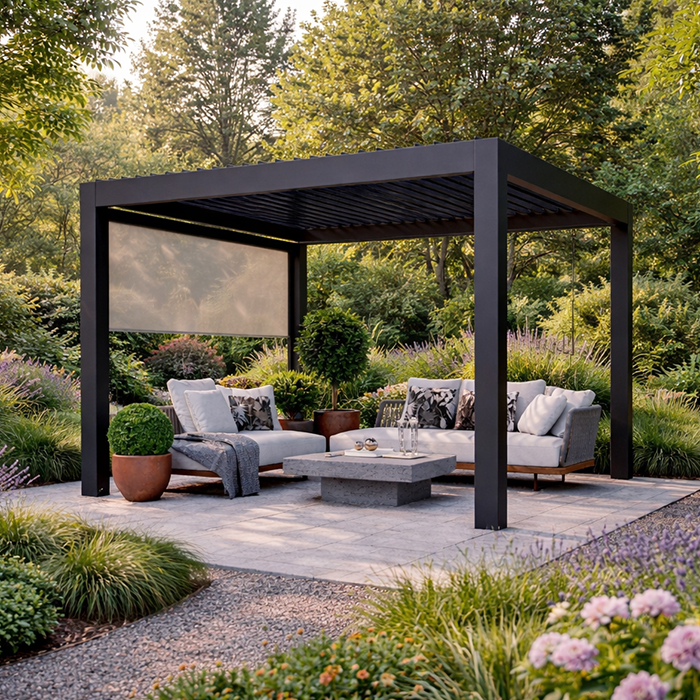
Some designs let you adjust the roof or withdraw a covering, giving you a choice between more sun and more shade. That flexibility is useful only if the adjustment works for your routine: consider how it is operated, whether you would change it during the day, and what care the maker specifies. Fixed arrangements are simpler to assess, but cannot respond when the light shifts. When a listing uses terms such as adjustable or louvred, read what actually moves and how far it can be set; do not infer the mechanism from an image. Check the written details on this pergola product page as you would any candidate, rather than assuming a particular roof feature from the product name.
Before you buy 3
Choose between an attached and a freestanding position
Decide whether the pergola should stand as a separate garden feature or sit beside the house. A position near the home may make a dining area easy to reach and could shade a patio at the hours you want, but its proximity may also affect daylight indoors, views and access through doors. A freestanding layout offers more choice about where the shade falls, although it still has to fit the furniture, paths and boundaries. Compare both positions on your garden plan, using the sun notes rather than treating the house wall as an automatic guide to the best orientation. Also think about where people will enter the shaded area and whether a route remains clear.
Attachment and support are practical purchase questions, not details to settle from appearance. A design intended to connect to a building depends on the specified fixing method and the suitability of the wall; a freestanding structure has its own base and anchoring requirements. Ask a qualified installer to assess the site against the manufacturer’s instructions, especially where the surface or building construction is uncertain. To compare candidates, use this Bloomcabin pergola product page as a prompt to confirm the stated installation arrangement, rather than assuming it is freestanding or attached from a photograph or name. Check what preparation, access and fixing components are required, and who is responsible for supplying them, before committing to an order.
Balance shade with daylight and side exposure
Strong overhead shade can change the light beyond the seating area. If the pergola is near a window, observe daylight inside the room at the hours when you plan to use the garden; a roof that shades the patio may also alter light indoors. Check the effect on nearby planting, too, especially where a bed or container receives direct sun now. This does not mean avoiding shade, but deciding where you are willing to trade light for comfort. An open roof may preserve more brightness while still creating some shade, whereas a closer covering may change the balance. Confirm the roof’s actual coverage and consider the position of the sides as well as the plan view.
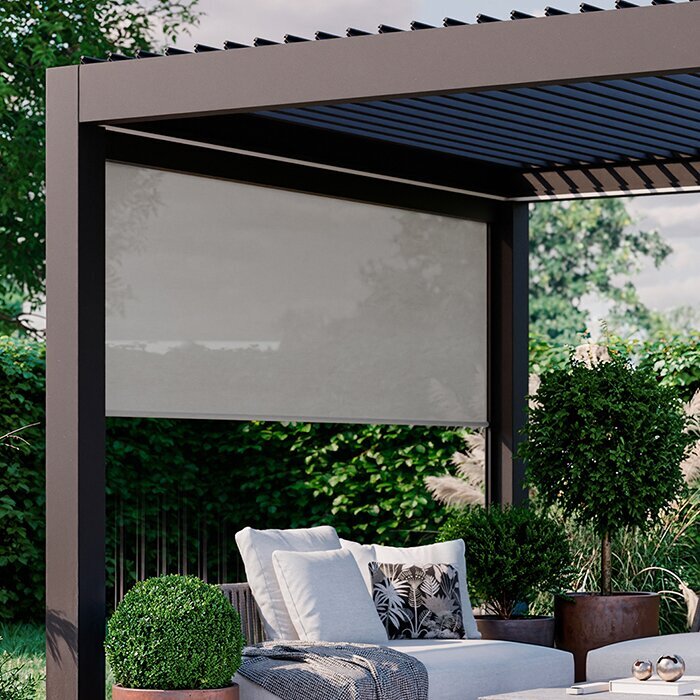
Think about air movement and side exposure at the same time as overhead cover. Open sides can leave the area bright and connected to the garden, but they will not stop sun arriving from a low angle. Screens or curtains, if available for a design, can affect light, airflow and the sense of enclosure; check whether they are included or optional instead of assuming they come with the pergola. A roof that looks dense in a catalogue image may still leave side glare, and a shaded area can remain warm in still weather. When comparing a listing such as the pergola product details, look for explicit information about the roof and any side elements, not a general promise of comfort.
Before you buy 4
Consider how the pergola will look in your garden
Appearance matters because a pergola occupies a noticeable part of the garden, but judge it at the scale of your space. Compare the visual weight of its posts and roof with the house, paving and existing furniture; a large-looking structure can overwhelm a compact seating area even if its measurements fit. Consider whether the roof lines sit comfortably alongside the house’s shape and whether the chosen colour would work with the surfaces around it. Product pictures can help you assess the style, but they do not tell you its real size or finish in your light. Look at the Bloomcabin pergola page for its pictured appearance, then use written specifications to check the details that affect fit.
Think about the view from indoors as well as from the garden. A structure may frame a dining area neatly, or interrupt a sightline you value; its position can be adjusted before purchase, whereas a fixed boundary or window cannot. If you plan to grow climbers or add furniture, allow for that in the overall look and leave room to reach and maintain the area. Do not assume that greenery will provide useful shade straight away, or that it will cover the roof evenly; treat planting as a separate design choice. Compare the pergola with the garden as it is now and as you intend to use it, so the shade solution does not depend on an unfinished planting plan.
Check the site and installation requirements
Inspect the proposed site before choosing a particular model. Note changes in level, paved or decked surfaces, nearby drains, overhanging branches, gates and anything that would obstruct the supports or roof. A surface that feels solid underfoot is not proof that it is suitable for the product’s specified fixing method. Ask the supplier or installer what the instructions require for the base and anchoring, and have a qualified professional assess any uncertain ground or building attachment. This is especially important when deciding between positions with different surface types. The required preparation can affect where the pergola can safely go and the total work involved, so factor it into the decision before placing an order.
Check how the components will reach the chosen position and where assembly can take place. A narrow side passage, steps, a gate or a crowded patio may limit access even when the final footprint fits. Ask what the installation guide says about assembly space, tools, team size and fixings, and whether you need a professional; do not rely on a product photograph to establish what is included. If delivery, assembly or site work is quoted separately, include it in your total budget rather than assuming it comes with the product. The detail on this pergola listing should be read alongside the maker’s instructions, with missing information clarified before purchase. A little planning avoids discovering after delivery that access, ground preparation or assembly is the obstacle.

Before you buy 5
Compare written specifications, not just pictures
Use the written specification to compare shade-relevant facts consistently. Check the overall width, depth and height, the roofed area, the roof material and whether the covering is fixed or adjustable. Distinguish items included in the base product from optional screens, side panels or other accessories, and look for the maker’s care guidance. If a product page lists only a broad category name, ask for drawings or instructions rather than using a photograph to estimate the frame. Keep a note of unanswered questions beside each option; two listings are not comparable if one states its usable coverage and the other only gives an overall dimension. A product such as the Bloomcabin pergola option should be assessed on its published details, not on assumptions attached to its name.
Read any statements about shade, UV performance or light reduction with care. Look for the exact feature or test the claim refers to, its stated scope and whether it applies to the roof material alone or to a complete installed structure. Do not treat a marketing adjective or a dark product image as a measurable guarantee. If you have a specific performance requirement, ask the retailer or manufacturer for the supporting information before ordering. Also check how the roof is cleaned and maintained and whether its position or components need attention after use; these practical tasks affect whether the design suits your household. If answers are missing or vague, compare another option or pause the decision rather than filling the gaps with guesswork.
Plan for changing sun and future use
Consider how the garden and your routine change over the year. Strong sun is the immediate concern, but a roof that works well at a favourite lunchtime may leave a different seating area exposed in the evening or reduce wanted daylight outside summer. Trees can grow, garden furniture can move and household needs can change. Decide which compromise matters least: a little less overhead cover at some times, a darker space at others, or a structure that needs active adjustment. Do not expect one placement to produce the same shadow in every season. The aim is to choose for the hours and activities that matter most while understanding what will be different at other times.
Before ordering, compare your shortlist against one realistic day: when you will sit outside, where the sun falls, which furniture needs shade and whether you want a fixed or adjustable roof. Then match each candidate’s written dimensions, layout and installation information to those needs. You can use the listed pergola product page as one point of comparison, but keep unknowns visible and ask for the relevant documents; never assume that a catalogue image represents the shade at your own home. If two designs both fit, choose the one whose stated features and installation requirements match your priorities with fewer compromises, not simply the one that looks most shaded in a photograph.
Frequently asked questions
Will a pergola block all direct sun?
Not necessarily. The shade depends on the roof design, its gaps and coverage, the pergola’s position, and the direction of the sun. Low-angle light can reach beneath an open-sided structure, so compare the written roof details with the sun pattern at your chosen site.
How do I choose the right size?
Mark out the area needed for furniture, pulled-out chairs and a clear walking route. Compare that footprint with the product’s stated overall dimensions and roof coverage; they may not be the same. Use written measurements rather than judging scale from a photograph.
Is an adjustable roof better for summer shade?
It can be useful if you want to change the amount of light, but it is not automatically the best fit. Check what actually adjusts, how it is operated and what care the maker specifies. A fixed roof may suit you if its set level of shade matches your needs.
Where should I put a pergola in a sunny garden?
Observe the area at the times you expect to use it. Note when the sun reaches the seating, where low-angle glare comes from, and how buildings, fences or trees affect the shade. Also consider windows, planting, doors and garden paths before settling on a position.
Can I attach any pergola to my house?
No. Check that the product instructions allow the intended arrangement and specify the fixing method. Whether a wall is suitable depends on the building and the product requirements, so ask a qualified installer to assess the site if you are unsure.
A suitable pergola is one whose shade pattern matches the hours and activities that matter most in your garden. Use observations from the actual site to compare roof designs and positions, then check dimensions, fixing requirements and written product details before ordering. That way, the decision accounts for both the summer shade you want and the daylight, access and garden use you want to retain.
