
Buying a Replacement Pergola: Can Existing Foundations Be Reused?
Pergola buying guide
When buying a replacement pergola, the old footprint can look like a ready-made advantage: the posts were there before, so perhaps the same foundations can support the new structure. Reuse is possible in some projects, but matching footprints and an apparently solid surface do not prove compatibility. The new pergola’s fixing plan, support requirements and the condition of what lies below ground all matter. This guide explains what to compare, what evidence to gather and when inspection or new foundations belong in your budget before you choose.

Can existing pergola foundations be reused?
Sometimes. Reuse is worth considering only when the existing foundations can be identified, are in suitable condition and match the replacement’s approved support and fixing arrangement. The question is not simply whether concrete remains where the old posts stood. The new pergola has to transfer forces through its specified fixings into support that is suitable for the site; a tidy patio surface or a line of old bolt holes cannot establish that. Even structures with similar overall dimensions may call for different post positions, fixings or support arrangements. A base that carried the previous design is not automatically appropriate for a replacement with a different layout or configuration.
Before comparing replacement products, locate the installation instructions for the proposed structure and any records of the old foundations. If those documents suggest a match, have the installer confirm it for the actual site; a drawing comparison alone is not approval. If records are missing, the base is concealed or the new fixing method is unclear, arrange an assessment before placing an order that depends on reuse. The result might be retaining the base, altering it through a method accepted for the new structure, or installing new foundations. Build the purchase decision around the confirmed option, not an assumed saving. If evidence is incomplete, record what remains unknown.
Identify what the old pergola is fixed to
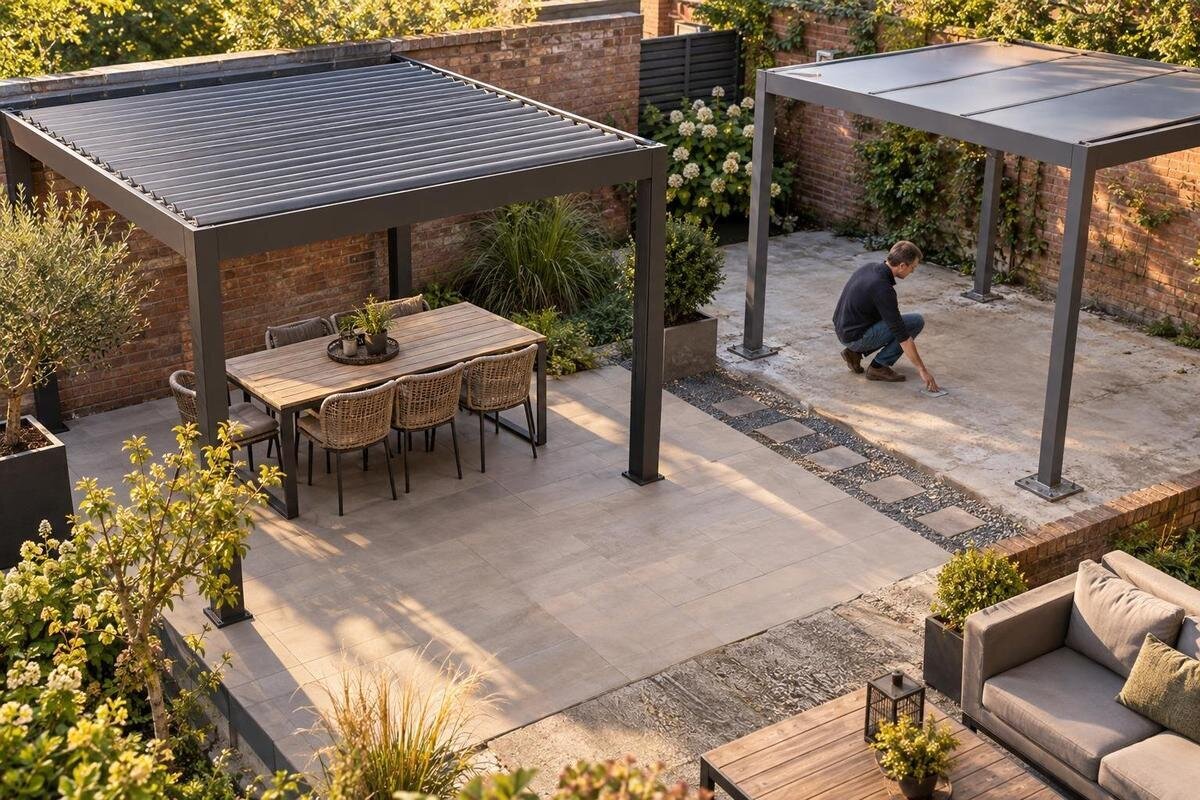
Before the old frame disappears, photograph each support and its surroundings, including the way each post meets the ground. Note which visible elements are paving, tiles or decking and which appear to be concrete or a separate footing; appearance alone may not distinguish them. Look for an original plan, installation manual, invoice or contractor’s note identifying the foundation and fixing method. If the pergola has already been removed, use dated photographs and records rather than relying on memory. Check whether any post was repaired or replaced separately: the supports may not all be identical. The aim is to describe the installation, not declare it sound.
Record each former post’s position against fixed points such as a wall or boundary, and note resurfacing, drainage work or changes to ground level since installation. These changes can hide the original arrangement or affect what an installer can inspect. A labelled sketch and photographs can help explain the site, but they are not a substitute for a measured review. When considering the Bloomcabin pergola product page, treat it as the identity of one candidate, not proof that its fixings suit the old base. Request current installation information for whichever replacement you choose; do not infer requirements from a product name or marketing image.
Compare post positions and fixing patterns
Once you know what the proposed pergola requires, compare its support plan with the existing set-out. Check the number of posts, their centre positions, their distances from walls and edges, and the location and pattern of each base fixing. Matching the overall length and width is not enough: posts may be positioned differently, and two base plates can use different fixing layouts. Use the model-specific drawing or installation manual, not a photograph, promotional sketch or dimensions for the frame alone. Mark the existing and proposed positions on a simple plan, using fixed reference points rather than an uneven patio edge, so an installer can check the comparison.
An old bolt pattern that looks close is not permission to reuse it. The specified fixings may not align with existing anchors, and the installer needs to know whether the new structure permits the proposed method. Do not assume spare holes, a different bolt or an added plate will make a mismatch acceptable; that is a question for the manufacturer and installer. For this Bloomcabin pergola listing, as for any candidate, establish which current instructions apply to the exact model and whether the existing base can be used as proposed. If the manual allows a positioning tolerance, use its stated limits rather than estimating one. Keep the answer with your quote and order records.
Inspect the visible base, but do not rely on appearance alone
Look over the visible supports for cracks, crumbling edges, loose or corroded anchors, movement around a post or signs that a footing has shifted. Water collecting around the bases or repeated patching may also warrant questions, although neither symptom alone diagnoses a problem. A sound-looking top does not reveal the condition or extent of material below ground, and a crack can have different causes. Photograph any concern and note its location and repair history. Treat movement or deterioration as a reason to pause and obtain an on-site opinion, not as a basis for guessing whether the base can support a replacement.
Ask an installer experienced with pergolas to inspect the foundations and fixings in context and say whether a more detailed professional assessment is needed. Share the new installation documents as well as the old records: looking at the base alone cannot establish compatibility. If paving, decking or another finish hides the supports, ask what investigation is appropriate and who would arrange it. Photographs can help with an initial conversation but cannot show every relevant detail. Avoid treating a tidy repair, surface patch or fresh coat as proof of suitability. A useful assessment should explain what is known, what remains uncertain and whether further checks affect the purchase decision.
Check changes to the pergola and its surroundings
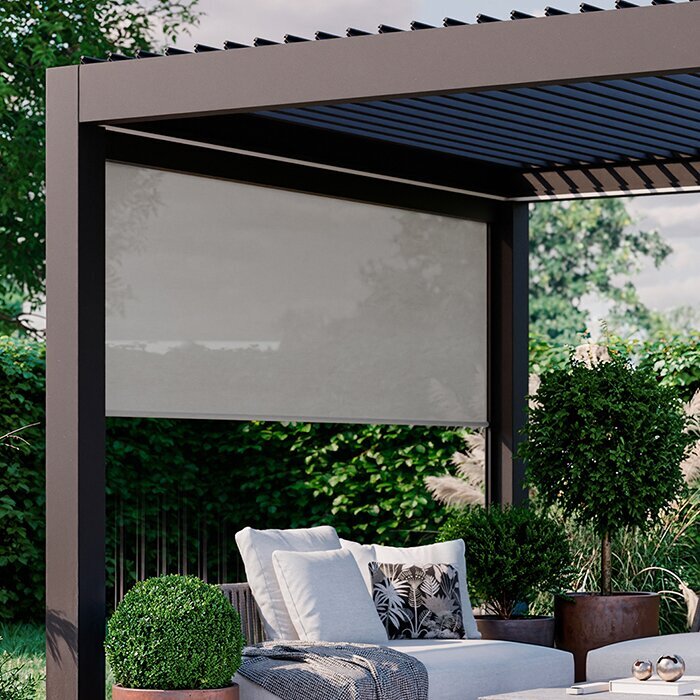
Recheck the replacement’s dimensions and configuration, even if you intend to use the same part of the garden. A change in footprint, post positions, overall height or roof and side arrangement can change how the structure is supported and what demands reach its bases. A pergola with movable roof parts, panels or screens is not interchangeable with another arrangement simply because both are sold under the same category. The assessment should apply to the version you plan to order, including selected options, rather than a similar-looking display model. When foundation reuse matters, compare installation requirements before narrowing the choice by appearance or nominal size.
Consider what has changed around the foundations: the former pergola may have benefited from nearby shelter that is no longer there, or the ground may have been resurfaced or altered. Changes to nearby buildings, fences or screens are worth mentioning to the installer too. These details do not prove the base has failed, but they belong in a site-specific review. If you are comparing several candidates, ask for each model’s requirements before assuming one can inherit the old supports. For a Bloomcabin pergola product entry, as for any replacement, confirm the exact version and fitting information with the seller or installer. The assessment should reflect current conditions, not just the history of the previous structure.
Does the replacement use the same support arrangement?
Check whether the replacement uses the same support arrangement as the old pergola. A freestanding design and one attached to a building do not rely on the same support points. If the new layout moves support from the ground to a wall, the old footings cannot answer whether the wall and its fixings are suitable. Conversely, existing ground bases do not show that a new freestanding arrangement can be fixed correctly. A wall finish, cladding or render may conceal the material behind it, so a visible surface is not evidence of its capacity. Do not treat the word pergola as a single standard attachment method.
Where the proposed structure connects to a house or outbuilding, ask the installer to assess the wall connection and ground supports as one installation. The advice should use the exact product instructions and the actual wall and site, rather than assuming a previous bracket proves compatibility. A category listing cannot settle the layout: for the pergola product page, check the selected model’s own documents and confirm how it is intended to attach before comparing it with the old foundations. Also discuss access to the wall and ground fixing points, as this may affect the work plan. If the support arrangement changes, include that in the installation scope and quote.
Choose between retaining, adapting and replacing the base
Treat reuse, alteration and replacement as separate options in the quote. Retaining a foundation makes sense only if its condition and fixing arrangement are confirmed for the new structure. Alteration may be possible, but only through a method accepted for the model and site; otherwise a new base may be the clearer option. Reuse is simplest on paper, not necessarily cheapest in practice if it calls for extra investigation or remedial work. A small difference in post positions can make old fixing points unusable, while an approved alternative may still be possible. Let the assessment, not the wish to avoid ground work, determine which option proceeds.
Be cautious about improvised solutions such as drilling extra holes, adding an unapproved plate or changing the specified fixings. A proposed adjustment needs agreement from the relevant manufacturer or supplier and the installer responsible for the work; further professional input may be needed. Ask who accepts responsibility for the revised detail and whether it remains within the installation requirements. When considering the listed Bloomcabin pergola, ask for the intended fixing arrangement to be confirmed for the exact model rather than assuming an adaptor or modification is included. If a change departs from the instructions, check its implications for product support and warranty terms before purchasing.
Include foundation work in the purchase budget
Put the foundation question into the total project budget. Costs may include an inspection, removal of the old frame, disposal, opening up or making good the ground, alterations to retained supports, and new foundations if reuse is ruled out. The actual scope depends on the site and installer, so keeping concrete does not necessarily eliminate groundwork. Ask whether an initial assessment is priced separately, and request separate figures for pergola installation and foundation work where possible. Record the assumptions behind each figure, including what is visible now and what could only be confirmed once the old structure or surface is removed.
Compare like with like: a lower structure price is not better value if foundation work is omitted from one estimate or left as an undefined extra. Ask what happens if the existing base proves unsuitable, who agrees any change to the fixing plan, and whether making good is included. Dismantling and waste removal may be separate items, so confirm their scope rather than assuming they are covered. While reviewing this pergola product listing, compare the complete installed plan with alternatives only after recording the foundation allowance and exclusions. If the price depends on a later inspection, ask how that finding changes the quote before you commit.

Questions to settle with the seller and installer
Before ordering, ask the seller or manufacturer for the current installation manual, a drawing showing the required post and fixing positions, and any stated requirements for the support beneath each post. Ask specifically whether the model can use existing foundations and what information they need to assess that; a general yes or no without the site layout is unlikely to settle the question. Send the old plan, dated photographs and a measured post layout where available. Keep the model name or reference with the documents, so advice about one version is not accidentally applied to another. Note who gave each answer and when.
Ask the installer to confirm what has actually been assessed: the foundations’ condition, their location, the compatibility of the fixing method and any work still required. Clarify who removes the old pergola, supplies fixings, carries out groundworks and makes good the area, rather than assuming these tasks sit within a single quote. Also agree what happens if concealed conditions differ from the records and how any change is authorised. If considering a Bloomcabin pergola listing, use it to identify the candidate, then obtain the site-specific answer for that exact model before placing an order that depends on reuse. A clear written scope helps you compare the product, installation proposal and budget on the same basis.
When the old foundations should not decide your purchase
Do not let the old footprint dictate the purchase when its history is unknown, its condition is doubtful or the new post layout does not match. Crumbling or moving supports, damaged anchors, an obscured base with no records, or an installer unable to confirm an acceptable fixing method are reasons to pause. They do not automatically prove that every foundation must be removed, but they do mean you should not rely on it without further assessment. The fact that the old concrete is already paid for does not make reuse good value if it creates uncertainty or extra remedial work.
If the assessment is inconclusive, agree what further inspection or site work is needed before finalising the product and installation package, and understand the cost if reuse fails. You may be able to consider a replacement whose specified layout suits a professionally approved base, but suitability still needs to be established for the whole structure and site. For the Bloomcabin product listing, as for any pergola you shortlist, use the model-specific instructions and a site assessment rather than the former structure’s appearance. Choose a product that can be installed as intended, not simply one that seems to match existing holes.
Frequently asked questions
Can pergola foundations be reused?
Sometimes. Their condition, position and fixing arrangement must suit the exact replacement and its installation instructions. Have an installer assess the existing base before treating reuse as a confirmed option or a saving.
Will a replacement pergola fit if it has the same overall dimensions?
Not necessarily. The post positions and base-fixing pattern may differ even when the overall width and length are similar. Compare the model-specific installation drawing with the measured positions of the existing supports.
Can paving or a patio slab count as a foundation?
Do not assume so from the surface alone. Paving may cover separate supports, and a visible slab does not by itself show how it is constructed or whether it meets the new pergola’s requirements. Ask an installer to assess it.
Should I order a replacement before checking the old foundations?
If reusing the foundations affects your choice or budget, establish whether it is feasible before committing to an installation plan based on that assumption. If an order must come first, understand the possible extra work and costs if reuse is ruled out.
Who can assess existing pergola foundations?
Ask an installer experienced with pergolas to inspect the site and the proposed fixing method. They can advise whether further assessment by a suitably qualified professional is needed. The manufacturer or seller can provide the exact model’s installation requirements.
An existing base is a potential part of the replacement project, not a guarantee of a cheaper or simpler installation. Match the exact new model and its fixings to documented, inspected foundations, then compare reuse, approved alteration and new work in the total quote. If the evidence is weak, let the installation requirements guide the purchase instead of forcing the replacement to fit the old footprint.
