
Buying a Second-Hand Pergola: Parts and Reinstallation Risks
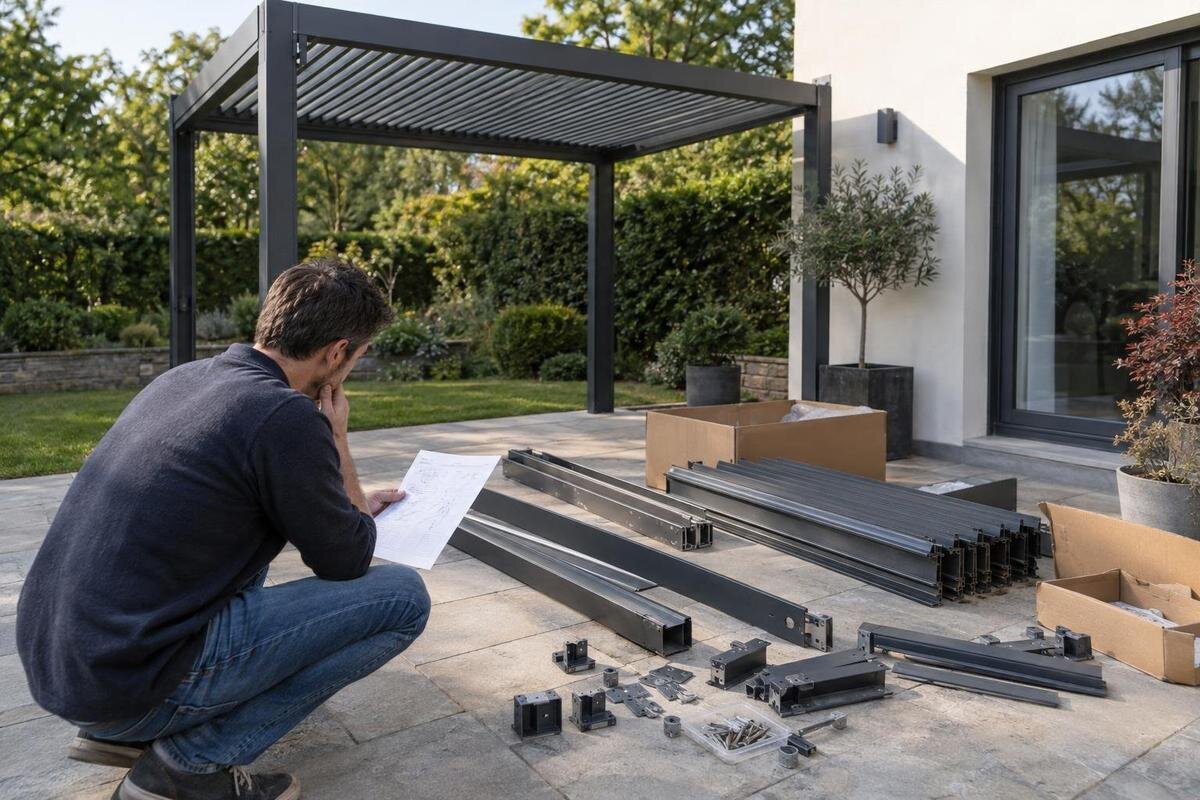
SECOND-HAND PERGOLA GUIDE
A second-hand pergola can look complete in a garden yet be difficult or uneconomical to reinstall elsewhere. Fixings may be missing, documents may belong to a different version, and the original base or wall tells you little about the new site. Use this guide to identify the kit, check its condition and parts, and cost the move before you agree a price or arrange collection.
Before you buy 1
Identify the exact pergola being sold
Ask for the manufacturer, exact model or product name, approximate age, original configuration and whether the structure is freestanding or attached to a wall. “Pergola” is a broad description: frames that look alike can use different rails, brackets, roof components or connection details. Request clear photographs of the whole structure, each major joint, any product label and everything the seller says is included. Record width, projection and height separately, then compare the measurements with a drawing rather than a perspective photograph. Treat compatibility with replacement parts as unproven until the model is identified. If you are also considering a new wall-mounted model, such as the Bloomcabin Lean-To Pergola, keep its details separate from the seller’s description so that specifications from different products do not become mixed.
Ask whether the kit has been moved, shortened, repaired or combined with parts from another model, and whether pictured accessories are included. Similar-looking replacement sections may differ at their joints or fixing points. Request close-up photographs and, where available, invoices or part labels. Record original, replaced and absent components. Ask when it was last assembled and about any previous problems. If the seller cannot identify a collection of mixed parts, do not assume an installer can make them fit.
The documents to request from the seller
Request the original assembly manual, installation drawings, parts list, order confirmation or invoice, plus maintenance and repair records. The most useful documents identify the precise model and configuration, rather than only a range name, and show dimensions or part references you can match against the kit. Compare every document with the structure in the photographs; a manual for a similar-looking version may not describe the same fittings. If you are comparing the used offer with a new Bloomcabin Pergola, request documentation for the proposed configuration as well. A current product page cannot replace the original records for a second-hand kit. Save copies before collection and list documents the seller cannot provide.
Ask who installed and dismantled it, and when. Dated photographs and repair receipts can help explain extra holes or mismatched components, but do not certify its present condition. If a label or manual is absent, request photographs of markings and written details of the model. Ask the manufacturer or supplier whether these identify the correct instructions and replacement parts. Confirm what support is available before paying, particularly for an older or modified kit.
Before you buy 2
Check every part against the original list
Turn the original parts list into a countable inventory. Depending on the model, it may include posts, beams, cross-members, roof pieces, brackets, cover plates, trims, end caps, fixings and control items; not every pergola has all of these, so use the exact list rather than a generic checklist. Mark each item present, missing, damaged or not yet checked, with its reference number and quantity. Keep small fasteners bagged and labelled by location or part reference instead of accepting one mixed box as “all the bolts”. Note loose cables, remotes or covers separately if supplied. If missing components lead you to consider a new Bloomcabin Bioclimatic Aluminum Pergola, ask for an itemised list of what the proposed purchase includes. Compare complete packages, rather than assuming that everything pictured comes with either offer.
Check the inventory with the seller before the parts are separated, photographing labelled bundles. Count left- and right-hand parts separately where the drawing distinguishes them, and record bent, drilled or substituted items. Replacement components need matching dimensions and connection details; apparent similarity is insufficient. Obtain a written list of inclusions and exclusions. Resolve missing parts before payment or explicitly value the kit as incomplete, rather than relying on a promise to “find the rest later”.
Inspect the structure before dismantling
Inspect every structural member before dismantling, in good light and with the owner’s permission. Look for bends, twists, cracks, splits, local crushing, corrosion, flaking finish, soft or rotten timber, enlarged holes and signs of water damage. Pay particular attention to connection areas, post ends and places where water or debris may have sat. Distinguish dirt and surface marks from damage, but do not sand, repaint or seal a suspect area to improve its appearance before it has been assessed. Photograph each defect with a scale or nearby reference and note the affected part; vague notes such as “some rust” are difficult to cost. If covers obscure joints, ask for an agreed inspection by an installer rather than assuming the hidden areas are sound.
Look for evidence of repair or alteration as well as visible damage: extra holes, non-matching bolts, sealant, patches, cut ends or parts that do not appear in the drawings. If the kit has moving roof sections, screens, a motor or electrical accessories, ask to see them operate only by the maker’s stated method and with the seller present. Do not energise unfamiliar wiring or dismantle powered components yourself; have a suitably qualified professional assess them. Stiff movement, uneven gaps or abnormal noise should be investigated, but a brief demonstration cannot establish that the whole structure is safe to reuse. If repairs are needed, compare the written repair estimate and remaining uncertainties with the cost of a new option, such as the Bloomcabin Pergola. Include installation in both totals.

Before you buy 3
Measure the proposed new site
Draw the new location to scale, showing the pergola’s actual outer dimensions and post or wall positions from the seller’s plan. Check headroom, eaves, doors, windows, paths, boundaries and access to gates or storage; allow space to use doors, move furniture and reach areas that need cleaning or maintenance. Use the same measurement points on the drawing and the site, since internal and external dimensions are not interchangeable. If a wall-mounted arrangement is involved, map the proposed fixing positions against openings and visible services, then have the wall assessed separately. Use this measured plan for any alternative enquiry too, including one for the wall-mounted Bloomcabin Lean-To Pergola. Request a drawing for the proposed configuration before judging how either option would fit beside doors or beneath eaves.
Check the route to the site against the longest components, as well as level changes, drainage paths, overhangs, nearby trees and services. Rotating the pergola may change roof direction, wall connections and post positions. Consult the maker’s drawings for any movement clearances required by the roof or screens, and allow maintenance access. Have the proposed installer review your measured plan and photographs before paying for transport. How the pergola fits in the seller’s garden does not establish its suitability for yours.
Assess the wall, base and fixing arrangement
Treat the existing base and fixings as part of the unknown history, not as a transferable foundation. Ask how the original posts were fixed, whether drawings or installation records exist, and whether anchor bolts or base plates are included. Inspect accessible plates and holes for distortion, corrosion, cracking or previous repairs, but do not assume that intact-looking anchors can be reused. Ask what the previous supporting surface was and whether there were any repairs. At the new address, the material, dimensions, condition and layout of the supporting surface need to be checked against the identified pergola and its installation instructions. A patio that looks level may have a different construction or fixing arrangement from the old one.
Wall attachment needs the new wall and proposed connection points assessed; a freestanding structure also needs a suitable fixing arrangement for the actual surface. Have a competent installer or relevant structural professional review the drawings, site and fixing proposal before committing to the move, and arrange an in-person inspection if photographs cannot show the wall or base construction. This is especially important for raised decks, balconies or roof terraces: a pergola sold for a garden is not automatically suitable for a roof-level location, and no assumption about its wind or structural capacity should be made from appearance. If the base work makes you reconsider the used kit, include a site assessment in any enquiry about a new Bloomcabin Pergola model as well. Changing the product does not resolve an unsuitable supporting surface.
Before you buy 4
Dismantling and transport need a plan
Agree who is responsible for dismantling and what the sale includes. Ask that the work follow the correct model instructions, with components labelled as they come off and photographs of connections, sequence and any non-standard changes. Do not accept cut members, forced joints or a mixed pile of unmarked fixings without understanding why. If the roof has powered or moving components, confirm that disconnection and handling will be done by someone qualified for the system; this guide is not a dismantling procedure. Ask whether the seller will allow an installer to inspect or supervise the take-down, and write down what happens if a part is damaged or found missing during the work.
Plan transport before collection. Ask for the dismantled components’ longest lengths, approximate package sizes and any known handling requirements, then check that the vehicle, access route, loading and unloading arrangements can accommodate them. Protect finished surfaces from rubbing, and keep small parts dry, labelled and with their matching sections. Make a collection inventory with photographs before the load leaves; compare it with the agreed sale list rather than trying to remember what was in the garden. Ask the carrier how the load is to be secured and what cover, if any, applies in transit. Arrange secure storage if reinstallation will not be immediate, so parts do not lose labels or acquire further damage.
Calculate the complete cost of reinstallation
Calculate the full project cost, including transport, dismantling, inspection, replacement parts, base or wall work, installation, storage and disposal. Include specialist checks for powered accessories where fitted, and establish whether site permissions or changes to insurance cover are needed. Obtain written prices with exclusions clearly stated; a cheap kit is no bargain if essential parts are unavailable. For a comparison quote for the Bloomcabin Lean-To Pergola option, provide the same site measurements and ask which services and site works are included. Compare installed costs on both sides, not the price of a used frame with a new supply-only package.
For replacement parts, send the supplier the model label, drawing, part reference and photographs. Request confirmation of identification, availability and cost for that exact version. Have alternatives checked for compatibility before buying. Keep unpriced work separate from confirmed costs rather than inserting guesses into the total. Ask about sourcing and installation timescales too: unavailable parts can delay other booked work. Your comparison should distinguish a complete, priced proposal from one dependent on unresolved repairs.

Before you buy 5
Confirm ownership, permissions, insurance and warranty
Confirm that the seller owns the pergola and has authority to sell every component, including any separately stored controls or accessories. Put the model description, included and excluded parts, known damage, agreed dismantling responsibility and collection condition in writing. Photograph the kit and inventory at handover, and keep the receipt and messages. Agree in advance how missing items, damage during dismantling or a mismatch with the description will be handled; do not treat an informal assurance as a substitute for a clear record. If another household member, landlord, business or contractor is involved, clarify their role before money changes hands.
Check requirements for the new property rather than relying on what was allowed at the old one. Depending on the site, seek advice from the local planning authority, landlord, freeholder, management body, insurer or a qualified building professional; verify the position for your circumstances before committing. Do not assume that old consent, insurance cover, installation sign-off or warranty transfers with the structure. Ask the manufacturer, insurer and relevant property decision-maker directly, and keep written replies. If the seller offers a remaining warranty, check the terms and ask whether it can transfer to a new owner and site; assign it no value until confirmed. Requirements and terms can depend on location and ownership.
When is there enough evidence to proceed?
Set a clear buying threshold: the model is identified, documents match the unit, the parts list is reconciled, defects are recorded, and a qualified person has reviewed any structural or site questions that affect reinstallation. Then compare the complete cost and timetable with alternatives. Do not treat an unconfirmed replacement part as a minor expense if its absence prevents assembly. If you are considering a different product type, such as the Bloomcabin bioclimatic pergola, explain what you want from the outdoor space and request details of the proposed configuration. Decide whether each option meets those needs before comparing costs; the seller’s used kit and a new model need not offer the same features or installation scope.
Pause or decline the sale if inspection is refused, the kit cannot be identified, critical parts have no confirmed replacement source, or damage and modifications remain unexplained. Take a professional’s concerns about reuse seriously. Repairs need not rule out purchase when their scope, parts, cost and responsibilities are established in writing. A discount does not resolve safety or compatibility questions. Settle those questions before arranging collection, rather than hoping to find instructions or a suitable base afterwards.
Frequently asked questions
Can I reinstall a pergola at a different address?
Possibly, but first identify the exact model, match its instructions and parts list to the kit, and have a qualified installer assess the new base, wall connections and site. The old foundations and any arrangements for the previous site do not establish that the new location is suitable. Include dismantling, transport and missing parts in your decision, before paying or arranging collection.
Can I reuse the original fixings?
Not by default. Used anchors may be damaged, corroded, positioned for the previous base or unsuitable for the new surface. An intact appearance does not prove that a fixing is right for your site. Ask the manufacturer or installer to confirm the required arrangement for the identified model and the proposed location.
How can I tell whether parts are missing?
Match every component and quantity against the parts list for the exact model and version, then mark each item as present, missing, damaged or uncertain. Check labelled bags, end pieces and accessories as well as the main frame. Record discrepancies in the sale inventory. If you cannot identify the version, a generic count is not enough.
Do old permissions, insurance or a warranty transfer with the pergola?
Do not assume they do. Check with the relevant local authority or property owner, your insurer and the manufacturer, and confirm any warranty terms in writing. Requirements and conditions can depend on the site, ownership and supplier terms. Keep a written record of the answers you receive.
Should I buy if the seller has no manual?
Only if reliable evidence identifies the model and the correct instructions can be obtained before purchase. Match those instructions and the parts list to the actual kit, and have a qualified professional assess its condition and the proposed installation. A generic online diagram is not enough. If essential assembly or fixing information remains unavailable, pause or decline the sale rather than treating the uncertainty as a reason to negotiate a discount.
With a second-hand pergola, the key question is not whether the frame looks intact in its present setting, but whether this exact kit can be identified, moved and safely reinstalled at yours. Matching records, a complete inventory, a documented condition assessment and a professional review of the new site give you a sound basis for deciding. Known repairs and missing parts can be included in the budget once their solutions are confirmed. If essential evidence remains unavailable, decline the sale before transport turns an uncertain purchase into an expensive collection of parts.
