
Cattle Panel Trellis Raised Bed: Choosing Support That Fits

Bloomcabin · Raised-bed guides
Cattle Panel Trellis Raised Bed: Choosing Support That Fits
Choose a cattle panel trellis raised bed when a climbing crop needs a rigid frame and you can secure it without relying on unverified bed-wall fixings. If the problem is birds, frost or wind rather than unsupported growth, choose protection designed for that problem instead.
Name the problem
A cattle panel trellis raised bed supports climbing growth. It is not a substitute for a pest barrier or weather cover.
Inspect the panel
Check the panel’s finish, welds and openings against the crop’s climbing habit and the way you’ll harvest.
Measure the whole assembly
Allow for posts and fixings as well as the panel face. Don’t assume the bed walls can carry the load.
Plan for mature growth
Leave a usable path, check where mature growth will cast shade, and adjust ties before they pinch.
A cattle panel trellis raised bed pairs a raised planting area with rigid livestock mesh used as a climbing frame. The decision is whether the openings suit the crop, the supports fit the site and you can still reach the stems and fruit. A panel can fit beside the bed on paper and still leave no useful room to harvest.
Start with one crop and the position where you want to grow it. Read its seed packet or plant label for mature habit, then compare an actual panel and its fitting instructions with the assembled bed and the surrounding ground. A flat panel along one side is a useful layout to assess first: you can check the fit and reach without assuming the mesh is suitable for bending into an arch.
01
Decide whether the problem is support or exclusion
A cattle panel trellis raised bed makes sense when the problem is a crop that needs a firm climbing surface and you have a place to support the panel independently or mount it by an approved method. The panel can give a row of climbers somewhere to grow without trailing across a path. If the crop is short, self-supporting or needs only a little help near the base, a rigid panel may take up working space without solving much.
Start by naming what is going wrong. If shoots keep straying across the path, check that the variety can be guided up a panel. If birds are eating seedlings, ask where they get in and choose an exclusion method for that route. The openings that let you reach through a cattle panel trellis raised bed may also let animals through. For frost or strong wind, look for a measure designed for that exposure rather than expecting open mesh to provide shelter.
Decide which job takes priority before you buy. If it is support, assess the panel on its own merits. If it is exclusion, assess the barrier, its edges and how you will open it to tend the crop. Don’t assume the supports for a cattle panel trellis raised bed can also take a cover: even a lightweight cover changes how much wind the assembly catches. Confirm that use separately or give the barrier its own suitable frame.

02
Match the welded mesh to the crop and the harvest
For a cattle panel trellis raised bed, look for a rigid welded-wire livestock panel rather than assuming that a roll of flexible fencing will behave the same way. Ask for the actual panel dimensions, wire material, protective finish and intended installation method. If the openings vary across the panel, measure them where the young shoots will first meet the wire and again where you expect to pick. A nominal panel size tells you neither how the crop will climb nor whether your hand and the produce will pass through.
Choose the crop by variety, not just by name. A climbing bean can wind around a suitable upright, whereas a bush bean gives you little reason to install a full panel. A climbing cucumber may need guiding towards the wire at first; check the seed packet for its mature size and training advice. For peas whose tendrils cannot readily reach the next wire, consider a support with closer spacing instead. For a sprawling variety with bulky fruit, don’t assume the panel or a stem tie is suitable for carrying that fruit.
Inspect a second-hand panel before planning a cattle panel trellis raised bed around it. Look along both faces for broken welds, sharp ends, distortion and a damaged finish, especially near proposed fixing points. Don’t place a damaged or unidentified panel beside a busy path on the assumption that it will last another season. If you can’t establish its condition or how it should be fixed, choose one with clear installation guidance.

03
Measure the support footprint, not just the wire face
Make a plan of the cattle panel trellis raised bed showing three separate outlines: the outside of the bed, the clear planting opening and the space taken up by the panel and supports. Record the panel face and the furthest points of the posts, feet or fixings specified for that system. Measure the narrowest part of the path, not just the clear space opposite the middle of the bed. A fixing that projects at one end can spoil an otherwise workable route.
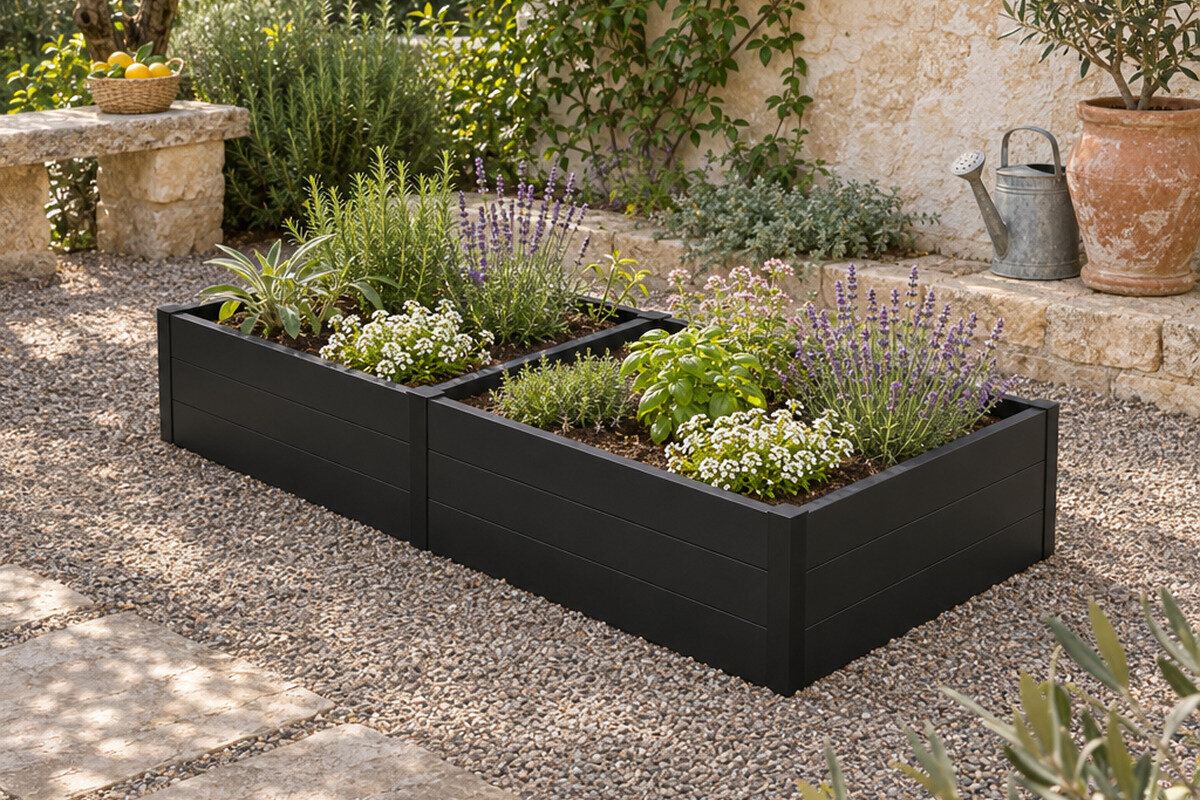
Bloomcabin’s Narrow Aluminium Raised Bed 200×50×60cm has a nominal footprint of 200 × 50 cm and a wall height of 60 cm. It is open to the prepared ground. Those dimensions do not give the actual internal opening, total rooting depth or any allowance for a trellis fixing. Measure the assembled opening and establish where the supports can be installed before using the outside dimensions as a guide to panel placement.
Hypothetical worked example: for a cattle panel trellis raised bed beside a path, suppose the measured outside bed length is 200 cm, the available run beside it is 210 cm and the panel face is 180 cm wide. The documented support layout spans 206 cm end to end, leaving only 4 cm along that run, or 2 cm at each end if centred. At its narrowest the path is 85 cm wide; a support projecting 12 cm into it leaves 73 cm at that point. If the gardener needs 80 cm to manoeuvre their barrow there, the layout fails the access check even though the panel face fits. The remedy is to change the position or support system, not squeeze past the fixing.

04
Give the panel a verified way to stand
Before filling a new cattle panel trellis raised bed or planting an existing one, settle how the panel will be held upright. Check the panel and support instructions for the required layout, fixing points and installation surface. If the proposed arrangement involves ground anchors, establish whether the location is suitable and check for buried services before disturbing the ground. A paved site calls for a system documented for that surface; don’t adapt an earth-anchored design by wedging its posts against the planter.
If you plan to mount the panel on the bed, verify the method for the exact bed model and panel. The long sides of the Bloomcabin narrow bed mentioned above are made from two 100 cm wall sections per side, joined by aluminium T connectors. Those connectors join bed walls; the supplied specification does not identify them as trellis mounts. A cattle panel trellis raised bed should not depend on a clamp, drilled hole or fixing into a corner post unless the applicable instructions or manufacturer confirm that use.
If no wall-mounted method is confirmed, use independently supported hardware with instructions that cover the panel and your site, or choose a different trellis. Before planting a cattle panel trellis raised bed, check that the panel sits at the specified fixing points, the fixings engage as instructed and the assembly does not rest against the bed for stability. A panel that looks steady while bare has not thereby been shown suitable for wind or the weight of mature growth.

05
Walk the route and plan for a leafy screen
Mark the intended panel line and working positions on the ground before installation. On a cattle panel trellis raised bed beside a fence, it may be tempting to put the mesh as far back as possible. Try reaching from the path to the likely planting line, then to the highest point you expect to tie or pick from. If you can only reach by leaning on the mesh or stepping into the bed, change the layout. Keeping foot traffic on the path avoids compacting the growing soil.
Check the route with what you actually use: a watering can, a harvest basket or a barrow. A firm path, comfortable working height and access to water matter as much as bare clearance. Where you will work from one side, check that you can reach a stem to untie it and remove a fruit without dragging either through the wire. Leave room at an end if that is how you will reach behind the panel.
Assess shade from a leafy cattle panel trellis raised bed, not just from bare wire. Look at the site at different times of day and picture the mature crop filling the upper part of the mesh. Note which low crops will sit in its shade and whether a fence or hedge already shades them. If that position would take light from a crop that needs it, put the shorter crop elsewhere or move the trellis before fixing it. Use the variety’s instructions and local growing guidance to settle planting position and timing.

06
Train shoots so you can untie and harvest them later
Plant to the variety’s spacing guidance and leave yourself room to reach the base of each plant. On a cattle panel trellis raised bed, guide young shoots towards the wire while they are still easy to move. Let climbing stems or tendrils take hold where they can. If a shoot needs help, use a soft, adjustable plant tie with enough slack for the stem to thicken. Put the tie where you can see and release it from the path, rather than behind the panel.
Don’t weave thickening stems back and forth through the mesh. That makes them harder to free if they rub against a wire or if you need to replace the panel. Check developing fruit, too: one that starts on the far side of a tight opening may be difficult to pick once it fills out. Guide growth to the side you can harvest from while it is still flexible, without forcing stems or fruit through an opening.
As the cattle panel trellis raised bed fills out, check the crop while you water or pick. Loosen ties that are leaving marks, move shoots that are rubbing and look for stems trapped at the edge of the frame. If growth spills into the path again, guide it back only if the plant can be moved without damage. Don’t bunch multiple shoots under one tight tie to reclaim the space; adjust the training plan to suit the variety and the access you have.

07
Spot movement before the next harvest
Check a cattle panel trellis raised bed as the crop gains weight and after strong winds or an accidental knock. From the path, look for a post that no longer stands as it did, a fixing that has shifted, a broken weld or a panel newly touching the bed wall. A photo taken just after installation can help you spot changes later. Don’t lean or pull on a suspect panel to find out whether it will hold. Keep people clear if it has moved or looks unstable, and follow the supplier’s advice before using it again.
Separate crop maintenance from structural repairs. A pinched stem may just need a tie released; a panel shifting under growth is not a tie problem. Follow the documented maintenance procedure rather than adding a fixing to the nearest bed wall. Look out for fresh damage to the finish or a sharp wire end at harvesting height, and deal with it before reaching through the mesh again.
Once the crop is finished, use the bare cattle panel trellis raised bed to judge whether the layout worked. If picking always meant reaching through the wire, move next season’s planting line to the accessible side where the crop permits. If the path became awkward even with the shoots trained, change the placement before replanting. Reassess the support if you switch to a crop with a different mature habit; success with one row is not a rating for the next.

Questions readers ask
Can a cattle panel trellis raised bed keep birds off my crop?
Not by itself. Select a barrier for the animal and check the openings, edges and access points where it could get through. If you want to add a cover to the panel, confirm that the supports are suitable for the combined arrangement. Otherwise, use a separate cover designed for that job.
Can I shorten a cattle panel that is too wide for my bed?
Check whether the supplier permits cutting and specifies how to finish the cut ends and deal with any exposed metal. Recheck where the shortened panel can be fixed. If there is no documented way to finish or mount it, choose a panel that fits without modification.
Does a cattle panel trellis raised bed have to be arched?
No. A flat panel can support a row without spanning the bed or path. Consider an arch only if the panel maker permits bending and specifies how to restrain it. Check the finished height, access beneath it and the space needed by the crop before committing to that shape.
Keep the panel only if it solves the problem
Choose a cattle panel trellis raised bed only if the crop can use the mesh, the installation method is confirmed and you can still get to the plants at full growth. If one check fails, change the panel, position or support system before planting. If the real problem is pest entry or weather exposure, put your effort into protection made for that job.
Find a raised bed for your plan
Compare layouts and check the dimensions on the product page.
